

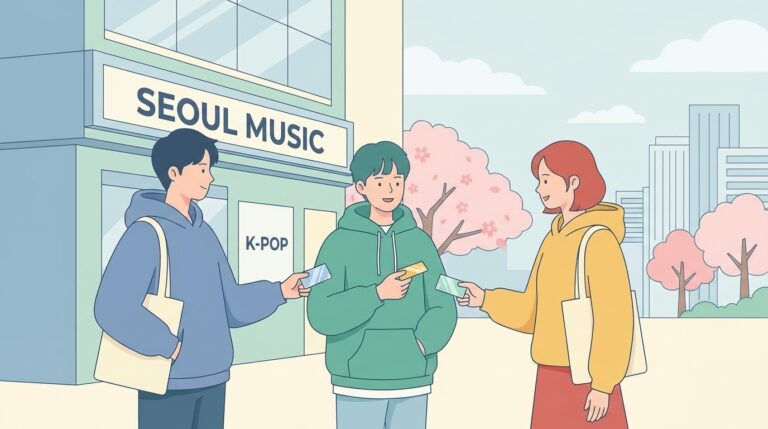
Phase 1: Empathy (Story-Driven Opening)
안녕하세요! (Annyeonghaseyo!) I’m your Daily Hangul editor and your personal K-culture navigator.
Picture this: You are standing right outside the KSPO Dome in Seoul on a breezy concert evening. The energy is electric, lightsticks are glowing in tote bags, and clusters of fans are sitting on picnic mats with colorful binders spread open. You just tore open your new album, heart pounding, hoping for your ultimate favorite idol—your bias—only to pull a different member. Across the plaza, you see someone holding a cardboard sign with your dream photocard taped to it. You want to walk over, make a trade, or buy it, but your mind freezes. What do you say? Is it weird to just tap their shoulder? How do you ask if they already traded it?
If you have ever felt nervous trying to communicate with Korean fans at a concert venue, pop-up store, or online trading platform like X (Twitter) and Bunjang, take a deep breath. Photocard trading (poka gyohwan) has its own heartwarming etiquette and lively vocabulary. With this field-tested guide based on real fan encounters, you will confidently trade photocards, spot collector terms, and bond with fellow fans in authentic Korean!
Phase 2: Deep Dive into 3 Core Expressions
1. 제 최애는 민지예요 (Je choeae-neun Minji-eyo)
- Pronunciation: [Je cho-ae-neun Min-ji-ye-yo] (Sounds like “choh” + “air”, spoken smoothly)
- Meaning: Literal: “My utmost love is Minji.” / Nuance: “Minji is my bias (favorite member).”
- K-Culture Moment: When opening albums in front of a record shop like Soundwave or Aladin, fans frequently introduce their favorite members before discussing trades.
- Editor’s Insight: “최애 (Choeae)” comes from Chinese characters meaning “most loved” (最愛). It has completely replaced older textbook words like “가장 좋아하는 가수 (favorite singer)” in contemporary fan vocabulary.
- Situation Spectrum: Casual ✅ | Semi-formal ✅ | Formal ⚠️
- 🤔 Think About It: In English, we use slang like “bias” or “ult”. How does having a formal Sino-Korean word (최애) integrated into daily slang reflect the structured yet passionate nature of Korean fandom culture?
2. 혹시 민지 포카로 교환 가능하세요? (Hoksi Minji poka-ro gyohwan ganeunghaseyo?)
- Pronunciation: [Hok-shi Min-ji po-ka-ro gyo-hwan ga-neung-ha-se-yo?]
- Meaning: Literal: “By any chance, is an exchange with a Minji photocard possible?” / Nuance: “Could we possibly trade for this Minji photocard?”
- K-Culture Moment: Spoken softly when approaching another fan holding a photocard binder outside a music show or concert.
- Editor’s Insight: Starting with “혹시 (Hoksi – by any chance)” adds instant politeness and reduces the pressure on the other person, showing that you respect their right to say no.
- Situation Spectrum: Casual ✅ | Semi-formal ✅ | Formal ✅
- 🤔 Think About It: Why is buffering a request with “혹시 (by any chance)” so essential in Korean interpersonal etiquette compared to direct English questions like “Can we trade?”?
3. 이거 하자 있나요? (Igeo haja innayo?)
- Pronunciation: [I-geo ha-ja in-na-yo?] (Think “ha-ja” like “haha” with a “j”)
- Meaning: Literal: “Does this have defects?” / Nuance: “Are there any scratches, dents, or print flaws on this card?”
- K-Culture Moment: Said while shining your smartphone flashlight at a 45-degree angle to inspect the glossy surface of a rare card.
- Editor’s Insight: “하자 (Haja)” is the ultimate collector term for factory flaws or surface scratches. Checking for flaws is standard practice and not considered rude if done politely.
- Situation Spectrum: Casual ✅ | Semi-formal ✅ | Formal ⚠️
- 🤔 Think About It: In collector communities worldwide, condition grading varies. In Korea, transparency about microscopic flaws (하자 체크) is considered a core ethical rule between fans.
Phase 3: Textbook Korean vs. Real Korean
Situation 1: Asking who someone’s favorite member is
- 📖 교과서 한국어: 어느 가수를 제일 좋아합니까? (Eoneu gasu-reul jeil joahamnikka?)
- 🗣️ 진짜 한국어: 최애가 누구예요? (Choeae-ga nugu-yeyo?)
- 💡 왜 다를까? Textbook Korean sounds like a formal survey interview. In modern fandoms, everyone uses “최애 (bias)” and “차애 (bias wrecker / second favorite)”.
Situation 2: Asking to exchange collectible cards
- 📖 교과서 한국어: 이 사진 카드를 교환하시겠습니까? (I sajin kadeu-reul gyohwanhasigessseumnikka?)
- 🗣️ 진짜 한국어: 저랑 포카 교환하실래요? (Jeorang poka gyohwanhasillaeyo?)
- 💡 왜 다를까? Nobody calls them “사진 카드 (photo cards)” in full; it is universally abbreviated to “포카 (poka)”. Using the friendly grammar ending “-하실래요?” makes the interaction approachable.
Phase 4: K-Culture Deep Dive & Non-Verbal Manners
4-1. 눈치 (Nunchi) & Photocard Etiquette
When trading photocards in Korea, non-verbal respect speaks louder than words:
1. Two-Hand Presentation: Always hand over and receive the photocard with both hands, holding the card by the edges or inside a protective plastic sleeve (슬리브).
2. Top-loader Protection: Never bring bare cards exposed to the elements. Keep them in hard plastic cases (탑로더) or dedicated pocket binders.
3. Gentle Verification: If you want to check for surface scratches, politely ask “확인해 봐도 될까요? (Hwaginhae bwado doelkkayo? – May I check it?)” before angling it toward the light.
4-2. Cultural Code: The World of ‘Deokjil’ (덕질)
Photocard collecting has grown into an art form in South Korea known as 탑꾸 (Top-kku), short for “Top-loader 꾸미기 (decorating)”. Fans use specialty stickers, lace, and charms to frame their bias’s face. When you make a trade in Korea, it is common to give “덤 (deom)”—small freebies such as idol stickers, snacks, or protective sleeves—as a gesture of fan solidarity.
Phase 5: Real-Life Roleplay Scenario
Setting: Outside the Olympic Gymnastics Arena (KSPO Dome) near the merchandise booth. You meet Sua, an experienced collector holding a binder labeled with your favorite group’s logo.
- You: 저기요, 혹시 교환 찾으세요? (Jeogiyo, hoksi gyohwan chajeuseyo?)
🎭 Holding your album photocard gently with both hands.
(Excuse me, are you by any chance looking to trade?) - Sua: 네! 누구 가지고 계세요? (Ne! Nugu gajigo gyeseyo?)
🎭 Smiling brightly and flipping open her mini photocard binder.
(Yes! Who do you have?) - You: 저는 하니 포카 있어요. (Jeoneun Hanni poka isseoyo.)
🎭 Showing the pristine card in its sleeve.
(I have Hanni’s photocard.) - Sua: 헐, 대박! 저 하니 구하고 있었어요! 제 최애거든요! (Heol, daebak! Jeo Hanni guhago isseosseoyo! Je choeaegodeunyo!)
🎭 Eyes widening in excitement.
(Omg, amazing! I was looking for Hanni! She is my bias!) - You: 혹시 민지 포카 있으신가요? (Hoksi Minji poka isseusingayo?)
🎭 Asking politely with an expectant smile.
(Do you happen to have Minji’s photocard?) - Sua: 네, 여기 있어요! 하자 없는 미개봉급이에요. (Ne, yeogi isseoyo! Haja eomneun migaebong-geubieyo.)
🎭 Pulling out a carefully sleeved card and turning it gently under the daylight.
(Yes, right here! It’s in mint condition with zero scratches.) - You: 우와, 상태 진짜 좋네요. 교환해요! (Uwa, sangtae jinjja jonneyo. Gyohwanhaeyo!)
🎭 Nodding with satisfaction.
(Wow, the condition is really great. Let’s trade!) - Sua: 좋아요! 이거 간식이랑 덤도 같이 드릴게요. (Joayo! Igeo gansig-irang deomdo gachi deurilgeyo.)
🎭 Handing over the card along with cute stickers and candy.
(Awesome! I’ll give you some snacks and freebies with it too.)
🔀 Interactive Decision Point
After making the trade, Sua hands you the card and freebies. How do you respond?
- Option A: “감사합니다! 콘서트 재미있게 보세요! (Gamsahamnida! Konseoteu jaemiitge boseyo!)”
👉 Feedback [Best]: Perfect! Wishing another fan an enjoyable concert creates an instant, warm memory of fandom camaraderie. - Option B: “이거 얼마예요? (Igeo eolmayeyo?)”
👉 Feedback [Bad]: Awkward! You already completed an equal trade (교환). Asking the price now makes it sound like an unexpected commercial transaction. - Option C: “다음에 또 봐요! (Daeume tto bwayo!)”
👉 Feedback [Risk]: A bit too casual for someone you just met at a venue, though understandable. Option A is much more natural and polite.
Phase 6: 10-Second Emotion Shadowing Drill
Practice matching the exact rhythm, pauses (/), and emotions of native collectors!
[😊 Super Excited]
헐, 대박! / 저 이 포카 진짜 찾고 있었어요!
(Heol, daebak! / Jeo i poka jinjja chatgo isseosseoyo!)
(Omg, wow! / I was really looking for this photocard!)-
[🥺 Polite & Hopeful]
혹시 / 민지 포카로 / 교환 가능할까요?
(Hoksi / Minji poka-ro / gyohwan ganeunghalkkayo?)
(By any chance / for a Minji photocard / would a trade be possible?) -
[✨ Grateful & Warm]
교환해 주셔서 감사합니다! / 덤도 잘 받을게요!
(Gyohwanhae jusyeoseo gamsahamnida! / Deomdo jal badeulgeyo!)
(Thank you so much for trading! / I’ll enjoy the freebies too!)
Phase 7: K-Culture Mini Dictionary
- 최애 (Choeae) | Noun | Ultimate bias. Used across all media: “제 최애 멤버예요 (She is my ultimate bias member).”
- 차애 (Cha-ae) | Noun | Bias wrecker / Second favorite member. “최애는 지민, 차애는 정국이에요 (My bias is Jimin, my bias wrecker is Jungkook).”
- 포카 (Poka) | Noun | Abbreviation for ‘Photo Card’. The universal term used by all K-pop fans and entertainment agencies.
- 양도 (Yangdo) | Noun/Verb | Transfer / selling to another fan (usually at face value or standard market price). “포카 양도합니다 (Transferring/selling photocards).”
Phase 8: Traveler’s Survival Kit
TOP 3 Survival Phrases
- 슬리브에 넣어 주실 수 있나요? (Seullibeu-e neoeo jusil su innayo?)
Pro Tip: Use this when buying or trading to ensure the card stays scratch-free during transport. - 미개봉 앨범 있나요? (Migaebong aelbeom innayo?)
Pro Tip: “미개봉 (Migaebong)” means factory-sealed / unopened. Great for album shopping in Myeongdong. - 쿨거래 감사합니다! (Kul-georae gamsahamnida!)
Pro Tip: “쿨거래 (Cool trade/deal)” means a smooth, fast, haggle-free transaction. Common in online DM trading!
Editor’s Travel Note
- Where to find trade spots: Visit the designated trading areas near major pop-up events, offline stores like Withmuu in Hongdae, or music store hubs in Myeongdong.
- Essential Digital Tools: Download Twitter (X) and search keywords like
[Group Name] 포카 교환(e.g.,뉴진스 포카 교환). Use trusted domestic map apps like Naver Map app download for iOS and Android to find local K-pop merchandise stores.
Phase 9: One Step Deeper (Reflective Essay)
In Korean culture, fandom isn’t just about admiring a celebrity from afar; it is built on a strong sense of ‘Jeong’ (정) and shared community belonging (공동체 의식). When fans trade photocards outside concert venues, they aren’t treating it as cold business. They often exchange cute handmade treats, trade at fair non-scalped values, and cheer each other on. Collecting photocards is less about the piece of cardboard itself and more about the joy of connecting with someone who shares your exact passion.
💬 Your Turn: Who is your K-pop ultimate bias (최애), and which dream photocard are you currently hunting for? Let us know in the comments below!
Phase 10: FAQ & Common Mistakes
Q: What is the difference between ‘교환’ (Gyohwan) and ‘양도’ (Yangdo)?
A: ‘교환 (Gyohwan)’ means a direct 1:1 trade of cards without money involved. ‘양도 (Yangdo)’ means transferring/selling a photocard to someone for money, usually at regular market price.
Q: What does ‘반택’ (Bantaek) mean when trading online in Korea?
A: ‘반택’ is short for ‘반값택배 (Half-price convenience store delivery)’. It is a popular, inexpensive shipping method using GS25 or CU convenience stores where buyers pick up packages directly at their local branch.
Q: Is it rude to inspect the photocard for scratches before completing a trade?
A: Not at all! In Korean trading culture, checking for defects (하자 확인) is completely expected. Just ask politely: “하자 확인해 봐도 될까요? (Haja hwaginhae bwado doelkkayo?)”.
🚨 Common Mistakes Warning Board
- ❌ Mistake 1: Touching the glossy center of a photocard with sweaty bare fingers.
Correct Action: Always hold cards by the outer perimeter or keep them inside clear OPP sleeves. - ❌ Mistake 2: Asking “얼마예요? (How much?)” to fans with trade-only signs (교환만 가능).
Correct Action: Look for signs saying ‘양도 (Sale/Transfer)’ before asking about prices. - ❌ Mistake 3: Dropping honorifics when talking to younger fans.
Correct Action: Always use polite form (존댓말) such as “-요” or “-습니다” regardless of the other fan’s perceived age.
Phase 11: Action Mission & Engagement
- 🥉 Bronze Mission (Solo Practice): Say your bias’s name out loud three times using the formula:
제 최애는 [Idol Name]예요! - 🥈 Silver Mission (Social Media): Post a photo of your favorite photocard on social media using the hashtag
#DailyHanguland write “제 최애 포카예요! (This is my favorite photocard!)”. - 🥇 Gold Mission (Real-Life Fan): The next time you visit a K-pop store or concert, say “교환 찾으세요? (Are you looking to trade?)” to a fellow collector!
- 🎮 K-Culture Mission: Watch an unboxing video (앨범 깡) by your favorite Korean YouTuber and see if you can spot the words 포카, 최애, and 중복 (duplicate) in real time.
Phase 12: Interactive Quiz Challenge
1. Situation Judgment: You opened an album and got a duplicate card. You want to ask someone near the store if they want to trade for your bias, Jungkook. What is the most natural sentence?
* (A) 정국 사진 카드 삽니까?
* (B) 혹시 정국이 포카로 교환 가능하세요?
* (C) 정국 카드 내놓으세요.
2. Fill-in-the-Blank: Complete the sentence meaning “My bias wrecker is Felix.”
* 제 [ ]은/는 필릭스예요.
3. True or False: In Korea, asking to check for scratches (하자) on a photocard before trading is considered extremely offensive.
* [ True / False ]
👉 Click here to reveal Answers & Explanations
- Answer: (B)
Explanation: “혹시 정국이 포카로 교환 가능하세요?” is polite, natural, and uses real fandom vocabulary (포카, 교환). (A) is unnaturally formal, and (C) is a rude demand. - Answer: 차애 (Cha-ae)
Explanation: “차애” means second favorite member / bias wrecker. - Answer: False
Explanation: Checking for flaws (하자 확인) is a standard and respected part of Korean photocard collector culture as long as you ask politely beforehand!







