

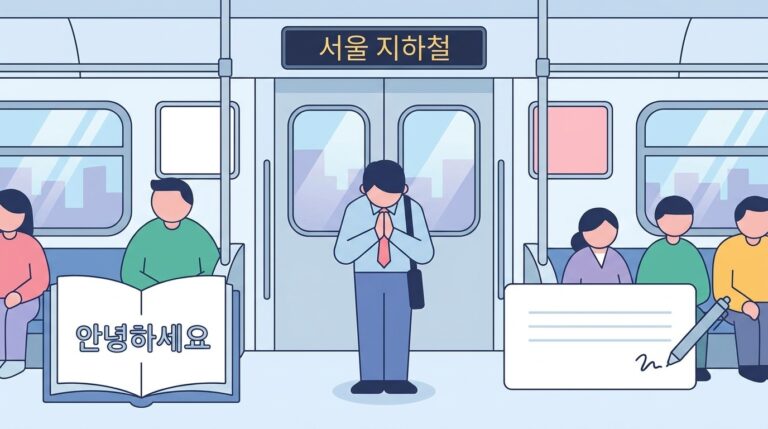
Phase 1: Empathy (Story-Immersive Opening)
안녕하세요! I’m your Daily Hangul editor. Imagine this: you’ve finally landed in Seoul, the neon lights of Hongdae are glowing, and you step onto a packed Line 2 subway train during rush hour—famously known among locals as Hell-cheol (Hell Subway). The train suddenly screeches to a halt, your balance wobbles, and crunch! Your sneaker lands directly on top of the polished leather shoe of an impeccably dressed businessman.
Your heart drops into your stomach. Your mind goes completely blank. You want to apologize instantly, but all your brain offers is a stiff, robotic “Joesonghamnida…” from page 12 of a textbook you read six months ago. Does that sound polite enough? Should you bow? What if they sigh in annoyance?
Accidentally stepping on someone’s foot in crowded spots like subways, K-Pop concerts, or busy street markets is an absolute rite of passage for anyone visiting Korea. But here is the secret: Koreans don’t expect perfection—they look for quick, sincere, and context-appropriate reactions. Mastering these situational apologies will transform an awkward collision into a moment of genuine human connection. Based on real classroom dilemmas and feedback from hundreds of intermediate learners, this guide will equip you to handle these everyday mishaps smoothly, naturally, and with total confidence.
Phase 2: Top 3 Core Expressions Deep Dive
1. 죄송합니다! 괜찮으세요? (한글)
- Pronunciation: [Joe-song-ham-ni-da! Gwaen-chan-eu-se-yo?] (Sounds like: Jweh-song-hahm-nee-dah! Gwen-chahn-ew-say-yoh?)
- Meaning: Literal: “I feel apologetic! Are you okay?” / Real Nuance: “I am so sorry! Are you alright?”
- K-Culture Moment: The classic K-drama scenario where the clumsy protagonist bumps into the handsome CEO in an elevator, immediately checking if he’s hurt.
- Editor’s Insight: Combining the apology (죄송합니다) with a sincere check on their well-being (괜찮으세요?) demonstrates empathy rather than just self-defense. It softens the mood instantly.
- Situation Spectrum: Casual ⚠️ | Semi-formal ✅ | Formal ✅
- 🤔 Think About It: In English, we often just say “Oops, sorry!” Why do you think Korean naturally links the apology directly to asking about the other person’s condition?
2. 앗, 발을 밟아서 정말 죄송해요. (한글)
- Pronunciation: [At, bal-eul balb-a-seo jeong-mal joe-song-hae-yo.] (Sounds like: Aht, bah-reul bah-bah-soh jung-mahl jweh-song-heh-yoh.)
- Meaning: Literal: “Ah, because I stepped on your foot, I am really sorry.” / Real Nuance: “Oh no, I’m so sorry for stepping on your foot!”
- K-Culture Moment: Standing in the pit area of a high-energy K-Pop concert when everyone jumps during the chorus, causing an accidental foot-stomp.
- Editor’s Insight: The exclamation 앗 (At) functions exactly like “Oops!” or “Oh!” in English. It instantly signals that your action was 100% unintentional.
- Situation Spectrum: Casual ⚠️ | Semi-formal ✅ | Formal ⚠️
- 🤔 Think About It: Does adding the precise reason (발을 밟아서) make an apology feel more accountable in your native culture?
3. 아이고, 죄송합니다! 다치지 않으셨어요? (한글)
- Pronunciation: [A-i-go, joe-song-ham-ni-da! Da-chi-ji anh-eu-syeoss-eo-yo?] (Sounds like: Ah-ee-go, jweh-song-hahm-nee-dah! Dah-chee-jee ahn-ew-shyut-soh-yoh?)
- Meaning: Literal: “Aigo, I am sorry! Were you not hurt?” / Real Nuance: “Oh dear, I’m terribly sorry! You’re not hurt, are you?”
- K-Culture Moment: You bump into a friendly grandmother (Halmeoni) at a bustling traditional market like Gwangjang Market.
- Editor’s Insight: Using honorific verb forms (-시-, as in 다치지 않으셨어요?) shows elevated respect when interacting with seniors or in formal public spaces.
- Situation Spectrum: Casual 🚫 | Semi-formal ✅ | Formal ✅
- 🤔 Think About It: How does the universal Korean emotional sigh Aigo change the perceived warmth of an apology?
Phase 3: Textbook Korean vs. Real Korean
Situation 1: Stepping on a stranger’s foot on the subway
- 📖 Textbook Korean: 실례지만, 제가 당신의 발을 밟았습니다. 용서해 주십시오. (Sil-lye-ji-man, je-ga dang-sin-ui bal-eul balb-at-seum-ni-da. Yong-seo-hae ju-sip-si-o. – Excuse me, I stepped on your foot. Please forgive me.)
- 🗣️ Real Korean: 앗, 죄송합니다! 괜찮으세요? (At, joe-song-ham-ni-da! Gwaen-chan-eu-se-yo? – Ah, I’m so sorry! Are you okay?)
- 💡 Why is it different? Real-life situations happen in fractions of a second. Using the pronoun 당신 (dang-sin) sounds confrontational or like an old movie script, while 용서해 주십시오 is far too dramatic for a simple bump.
Situation 2: Lightly grazing someone while passing through a crowd
- 📖 Textbook Korean: 저에게 지나갈 길을 양보해 주시겠습니까? (Jeo-e-ge ji-na-gal gil-eul yang-bo-hae ju-si-get-seum-ni-da-kka? – Would you concede the path to me?)
- 🗣️ Real Korean: 잠시만요! / 죄송합니다, 지나갈게요! (Jam-si-man-yo! / Joe-song-ham-ni-da, ji-na-gal-ge-yo! – Just a moment! / Excuse me, coming through!)
- 💡 Why is it different? Koreans value efficient, clear public interactions (Ppal-li Ppal-li culture). A crisp, polite interjection gets immediate results without causing awkward delays.
Phase 4: K-Culture Deep Dive & Non-Verbal Manners
4-1. Nunchi (눈치) & Body Language
When you step on someone’s foot in Korea, your non-verbal cues carry 70% of your apology’s weight. Here is how to nail the etiquette:
* The Quick Bow (Mok-rye, 목례): Never stand completely stiff. Give a quick 15-to-30-degree nod or bow from the waist while speaking.
* The Hand Gesture: Place one hand gently across your chest or stomach, or extend both hands palms slightly up in a gesture of humility.
* Eye Contact: Make brief, apologetic eye contact, then lower your gaze slightly while bowing. Staring intensely after saying sorry can be misinterpreted as defensive or aggressive.
4-2. Cultural Code: Subway Commuting Etiquette
In dense metropolitan areas like Seoul, physical proximity is unavoidable. Koreans practice collective spatial awareness. When an accidental step occurs, a prompt, reflexive apology de-escalates tension instantly. If the person gives a light nod and says “괜찮아요” (It’s okay), standard etiquette is to nod back and gently adjust your stance so it doesn’t happen again.
Phase 5: Real-Life Roleplay Scenario
Setting: A bustling, evening rush-hour train on Seoul Metro Line 2 heading toward Gangnam. The train sways abruptly before entering the station.
Characters:
* You: A thoughtful traveler holding onto the overhead strap.
* Min-jun (민준): A sharp-dressed office worker carrying a briefcase.
- You: 🎭 (Train jerks violently; your foot lands on Min-jun’s shoe) 앗! 죄송합니다! (At! Joe-song-ham-ni-da! – Ah! I am so sorry!)
- Min-jun: 🎭 (Winces slightly, looking down at his shoe) 아, 깜짝이야. (A, kkam-jjak-i-ya. – Oh, that startled me.)
- You: 🎭 (Lowering head with a 20-degree bow) 발을 밟아서 정말 죄송해요. 다치지 않으셨어요? (Bal-eul balb-a-seo jeong-mal joe-song-hae-yo. Da-chi-ji anh-eu-syeoss-eo-yo? – I’m so sorry for stepping on your foot. You’re not hurt, are you?)
- Min-jun: 🎭 (Sees your sincere expression and relaxes his shoulders) 네, 괜찮습니다. 전철이 많이 흔들리네요. (Ne, gwaen-chan-seum-ni-da. Jeon-cheol-i man-i heun-deul-li-ne-yo. – Yes, I’m fine. The train is swaying a lot.)
- You: 🎭 (Hands held politely in front) 네, 구두는 괜찮으세요? 혹시 닦아드릴까요? (Ne, gu-du-neun gwaen-chan-eu-se-yo? Hok-si dakk-a-deu-ril-kka-yo? – Yes, are your shoes alright? Should I wipe them for you?)
- Min-jun: 🎭 (Smiles warmly and waves his hand) 아닙니다, 정말 괜찮아요. 신경 쓰지 마세요. (A-nip-ni-da, jeong-mal gwaen-chan-a-yo. Sin-gyeong sseu-ji ma-se-yo. – No, it’s really okay. Please don’t worry about it.)
- You: 🎭 (Nodding respectfully) 네, 정말 조심하겠습니다. 좋은 저녁 보내세요. (Ne, jeong-mal jo-sim-ha-get-seum-ni-da. Jo-eun jeo-nyeok bo-nae-se-yo. – Yes, I will be much more careful. Have a good evening.)
- Min-jun: 🎭 (Nods back pleasantly) 네, 여행 잘 하세요. (Ne, yeo-haeng jal ha-se-yo. – Yes, enjoy your trip.)
🔀 Interactive Choice Point
Right after you step on his foot at Turn 1, how do you react?
- Choice A: Say nothing, pretend you didn’t notice, and stare at your smartphone screen.
- Feedback (Bad ❌): This is considered very rude (Bi-mae-neo). The other person will feel disrespected, creating uncomfortable train tension.
- Choice B: Shout “Mianhae!” while giving him a high five.
- Feedback (Risk ⚠️): 미안해 is informal Banmal (casual speech). Using it with a stranger is inappropriate and overly familiar.
- Choice C: Make brief eye contact, bow your head slightly, and say “앗, 죄송합니다! 괜찮으세요?”
- Feedback (Best ✅): Perfect! Polite, natural, and instantly diffuses any potential frustration.
Phase 6: 10-Second Emotional Shadowing Drill
Sentence 1:
[⚡ Surprised and urgently apologetic]
앗! / 발을 밟아서 / 정말 죄송합니다!
(At! / bal-eul balb-a-seo / jeong-mal joe-song-ham-ni-da!)
Sentence 2:
[🥺 Sincerely concerned and caring]
많이 / 아프시죠? / 다치지 않으셨어요?
(Man-i / a-peu-si-jyo? / da-chi-ji anh-eu-syeoss-eo-yo?)
Sentence 3:
[🤝 Relieved and polite]
괜찮다고 해 주셔서 / 감사합니다. / 조심할게요!
(Gwaen-chan-da-go hae ju-syeo-seo / gam-sa-ham-ni-da. / jo-sim-hal-ge-yo!)
Phase 7: K-Culture Mini Dictionary
- 지옥철 (Ji-ok-cheol) | Hell Subway | A compound of ‘지옥’ (Hell) and ‘지하철’ (Subway). Refers to the extreme congestion during Seoul commute hours (lines 9 and 2 in particular).
- 눈치 (Nun-chi) | Social Intuition / Tact | The ability to read room dynamics, body language, and unspoken cues to maintain harmony.
- 목례 (Mok-rye) | Nodding Bow | A brief, respectful head nod used in tight quarters where a full bow is physically impossible.
- 매너 (Mae-neo) | Etiquette / Manners | Commonly used in compound terms like ‘지하철 매너’ (subway manners) or ‘비매너’ (bad manners).
Phase 8: Traveler’s Survival Kit
Top 3 Survival Expressions
- 죄송합니다! (Joe-song-ham-ni-da!) – Pro Tip: Your all-purpose golden key when bumping into anyone anywhere in Korea.
- 잠시만 지나갈게요! (Jam-si-man ji-na-gal-ge-yo!) – Pro Tip: Use this to politely slice through a crowded train door instead of pushing silently.
- 괜찮으세요? (Gwaen-chan-eu-se-yo?) – Pro Tip: Always ask this right after apologizing if you accidentally dropped something or stepped on someone’s foot.
Editor’s Travel Note
Navigating Seoul’s transit is smooth once you master the right tools. We recommend utilizing the KakaoMetro subway navigation service for real-time train transfer information and carriage congestion levels. When boarding during peak hours (8:00–9:00 AM and 6:30–7:30 PM), always keep your backpack in front of your chest to avoid accidentally bumping others!
Phase 9: A Step Deeper (Reflection Question)
In Korean society, an apology is rarely just a logical admission of fault; it is an act of restoring interpersonal emotional balance (Jeong and harmony). When stepping on someone’s foot, immediate acknowledgment matters far more than debating whose fault it was. By acknowledging the minor discomfort you caused with a gentle bow, you signal that you respect the shared communal space.
💬 Your Turn: In your home country, how do strangers typically react when someone accidentally steps on their foot? Do people usually apologize verbally, or is eye contact enough? Share your experiences in the comments below!
Phase 10: FAQ & Common Mistakes
Q: Can I just say “미안해요 (Mianhaeyo)” when I step on someone’s foot?
A: While 미안해요 is polite, 죄송합니다 (Joesonghamnida) is much more appropriate for strangers and elders in public. 미안해요 can sometimes sound slightly casual when used with people you don’t know.
Q: What should I say if someone steps on MY foot and apologizes?
A: Simply give a small nod, smile gently, and say: “괜찮습니다” (Gwaen-chan-seum-ni-da) or “괜찮아요” (Gwaen-chan-a-yo). It immediately puts them at ease.
Q: What if I scuffed their brand-new white shoes?
A: Say: “어떡해요, 정말 죄송합니다! 휴지 있으세요?” (What should I do, I’m so sorry! Do you need a tissue?). Offering to help clean a visible mark shows exceptional courtesy.
🚨 Common Mistakes Board
- ❌ Mistake 1: Saying “실례합니다 (Sil-lye-ham-ni-da)” AFTER stepping on someone.
👉 Correction: 실례합니다 means “Excuse me (for what I am about to do).” Use 죄송합니다 for actions you have already committed. - ❌ Mistake 2: Freezing in total silence due to panic.
👉 Correction: Even if the words escape you, immediately offer a 20-degree head bow and say “죄송합니다!” - ❌ Mistake 3: Using casual “미안! (Mian!)” with adults or strangers.
👉 Correction: Reserve 미안 exclusively for close friends of the same age or younger.
Phase 11: Action Missions
- 🥉 Bronze Mission (Solo): Stand in front of a mirror. Practice bowing 20 degrees while saying “앗, 죄송합니다! 괜찮으세요?” 5 times smoothly.
- 🥈 Silver Mission (Social): Leave a comment below introducing yourself and writing your own Korean apology scenario using today’s expressions.
- 🥇 Gold Mission (Real Life): Next time you pass through a crowded hallway, metro station, or market, use “잠시만 지나갈게요!” clearly with confidence.
🎮 K-Culture Mission: Watch an episode of any slice-of-life K-Drama (like Hospital Playlist or Business Proposal). Spot at least one moment where a character says “죄송합니다” or “괜찮으세요?” and observe their body language.
Phase 12: Interactive Quiz Challenge
Question 1 (Situational): You are on a crowded bus in Busan. You accidentally step on a grandfather’s shoe. What is the most respectful response?
(A) 미안해!
(B) 아이고, 죄송합니다! 다치지 않으셨어요?
(C) 실례합니다!
Question 2 (Fill-in-the-blank): Complete the natural apology:
“앗, 발을 ________ 정말 죄송해요!” (밟아서 / 밟으면 / 밟고)
Question 3 (True or False): In Korea, bowing slightly while saying an apology to a stranger is considered unnecessary if you speak clearly.
(True / False)
👉 Click to Reveal Answers & Explanations
-
Answer: (B)
Explanation: Using the respectful exclamatory opener 아이고 and honorific question form 다치지 않으셨어요? shows the highest level of warmth and politeness to elders. -
Answer: 밟아서 (balb-a-seo)
Explanation: The grammar pattern -아서/어서 indicates the cause/reason (“Because I stepped on your foot, I’m sorry”). -
Answer: False
Explanation: Non-verbal manners like a slight bow (목례) are an essential part of polite Korean communication, especially during apologies.







