

Conquer the Karaoke Remote: How to Search Songs in a Korean Noraebang Like a Pro
Phase 1: Empathy & Storytelling
안녕하세요! Welcome back to Daily Hangul! I’m your Korean culture buddy and editor.
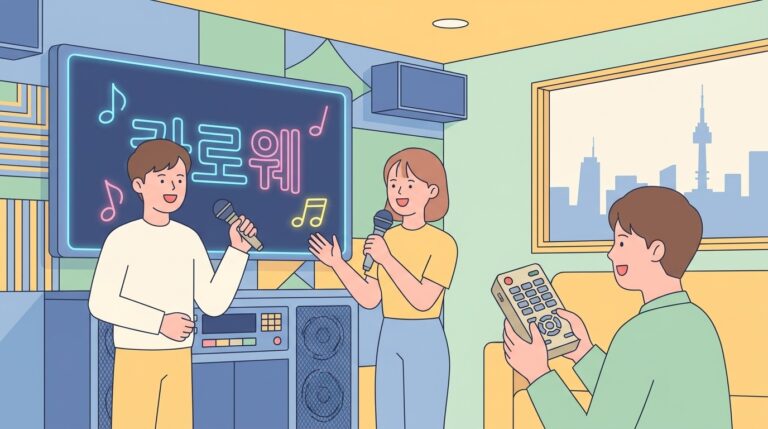
Picture this: You step into a vibrant, neon-lit Korean noraebang (노래방 – karaoke room) in Hongdae with your Korean friends. Tambourines are shaking, disco lights are spinning, and the countdown timer is ticking away on the giant screen. Someone hands you the massive, heavy remote control—which looks more like a spacecraft dashboard than a TV remote—and says, “Sing whatever you want!”
Panic sets in. The buttons are covered in Hangul, your mind goes completely blank, and you have no idea how to search for that BTS or NewJeans song you’ve practiced in the shower for weeks. You don’t want to monopolize the machine for ten minutes flipping through a thick songbook while everyone waits awkwardly.
Don’t worry! Searching for songs in a Korean noraebang is actually super simple once you master three essential phrases and understand how Korean karaoke remotes work. Based on real feedback from dozens of our A2 learners who once froze in karaoke rooms, this friendly survival guide will turn you from a nervous spectator into the MVP who queues the next big hit effortlessly.
Phase 2: Top 3 Core Expressions Deep Dive
1. 노래 검색해 주세요 (Norae geomsaek-hae juseyo)
- Pronunciation: Noh-rae geom-sek-heh joo-seh-yo (Sounds like “GOM-sack”)
- Meaning: Literal: “Please search the song.” | Real Nuance: “Could you look up a song for me?”
- K-Culture Moment: Seen in countless K-dramas where a shy character hands the remote to a karaoke master friend before singing a dramatic ballad.
- Editor’s Insight: If the huge remote is sitting on the other side of the couch, use this friendly phrase to ask whoever is holding it to find your track.
- Situation Spectrum: Casual: ✅ | Semi-formal: ✅ | Formal: ⚠️
- 🤔 Think About It: In English, we often ask “Can you find this song?” In Korean, using ~해 주세요 (-hae juseyo) shows respect while requesting an action smoothly without sounding bossy.
2. 이 노래 예약해 줘 (I norae yeyak-hae jwo)
- Pronunciation: Ee noh-rae yeh-yahk-heh jwo (Rhymes with “say-yahk”)
- Meaning: Literal: “Reserve this song.” | Real Nuance: “Queue this song next! / Add this to the playlist.”
- K-Culture Moment: In reality shows like Running Man, cast members battle to hit the 예약 (Reservation) button before anyone else can snatch the mic.
- Editor’s Insight: In Korean karaoke, you don’t just start a song immediately unless the room is silent; you usually queue it up using the word 예약 (reservation/queue).
- Situation Spectrum: Casual (with close friends): ✅ | Semi-formal: 🚫 | Formal: 🚫
- 🤔 Think About It: Notice the word 예약 (reservation)? Koreans use the same word for booking a restaurant table and queuing a karaoke song. Why do you think that is?
3. 제목으로 찾을게요 (Jemok-euro chajeulgeyo)
- Pronunciation: Jeh-mohk-oo-ro cha-jeul-geh-yo (Like “jay-moke”)
- Meaning: Literal: “I will find by title.” | Real Nuance: “I’ll search by the song title.”
- K-Culture Moment: When friends argue over whether to search by singer name (가수) or song title (제목) on the remote navigation bar.
- Editor’s Insight: Korean remotes have separate modes: 제목 (Title), 가수 (Singer), and 국가 (Country/Pop). Stating your search method keeps the group synchronized!
- Situation Spectrum: Casual: ✅ | Semi-formal: ✅ | Formal: ⚠️
- 🤔 Think About It: English uses prepositions like “by” or “with”, while Korean attaches particles like ~으로 (-euro). How does setting the method first change the focus of your sentence?
Phase 3: Textbook Korean vs. Real Korean
Situation 1: Asking how to type an English song title
- 📖 Textbook Korean: 영문 노래는 어떻게 검색합니까? (Yeongmun noraeneun eotteoke geomsaekhamnikka? – How do you search for English songs?)
- 🗣️ Real Korean: 팝송은 어떻게 찾아요? (Papsong-eun eotteoke chajayo? – How do I look up pop songs?)
- 💡 Why is it different? Real Koreans rarely say “English song” (영문 노래); they casually refer to non-Korean pop tracks as 팝송 (pop song), using the conversational verb 찾다 (to look for) rather than formal 검색하다.
Situation 2: Asking someone to push the START button
- 📖 Textbook Korean: 시작 버튼을 눌러 주십시오. (Sijak beoteun-eul nulleo jusipsio. – Please press the start button.)
- 🗣️ Real Korean: 시작 눌러 줘! (Sijak nulleo jwo! – Hit start!)
- 💡 Why is it different? Noraebang is a high-energy, casual space. Long honorifics kill the hype! Drop the object particle and shorten the verb when cheering with friends.
Phase 4: K-Culture Deep Dive & Non-Verbal Manners
4-1. Noraebang Nunchi & Gestures
- The Remote Holder Courtesy: If you are holding the remote, you are the room’s DJ. Constantly check the room: make eye contact and tilt the remote slightly toward friends to ask non-verbally, “Do you want to pick one?”
- Two-Handed Mic Pass: When passing the microphone to someone else, use both hands or support your right elbow with your left hand—even in a karaoke room, this shows warm consideration.
- Screen Etiquette: Never stand directly in front of the TV while searching on the screen menu; squat down or sit to keep the lyrics visible for whoever is currently singing.
4-2. Cultural Code: The TJ vs. KY Battle & The “Cancel” Button
In South Korea, two major brands dominate all karaoke systems: TJ Media (태진) and Geumyoung (KY – 금영). You will see buttons like 취소 (Cancel) and 간주점프 (Interlude Jump).
* Pro-Manner Tip: Never press 취소 (Cancel) on someone else’s song unless they explicitly yell “끄자!” (Let’s turn it off!). However, pressing 간주점프 (Skip long instrumental intros) is considered a heroic deed that saves precious minutes!
Phase 5: Real-Life Roleplay Scenario
- Setting: A bustling coin noraebang (코인노래방) in Sinchon on a Friday night.
- Characters: You (excited traveler/student) and Minji (민지 – your energetic Korean university friend).
- 민지: 뭐 부를 거야? 내가 찾아줄게!
(Mwo bureul geoya? Naega chajajulge!)
🎭 Bouncing on the sofa while gripping the remote.
“What are you gonna sing? I’ll find it for you!” -
You: 아이유 노래 부르고 싶어요.
(Aiyu norae bureugo sipeoyo.)
🎭 Pointing at the screen with a wide smile.
“I want to sing an IU song.” -
민지: 오, 아이유 좋지! 제목 알아?
(O, Aiyu jotji! Jemok ara?)
🎭 Rapidly tapping the keypad.
“Oh, IU is awesome! Do you know the title?” -
You: 제목으로 찾을게요. ‘좋은 날’ 있어요?
(Jemok-euro chajeulgeyo. ‘Joeun nal’ isseoyo?)
🎭 Leaning forward to look at the remote.
“I’ll search by title. Is ‘Good Day’ there?” -
민지: 당연하지! 바로 예약할까, 아니면 지금 부를래?
(Dang-yeonhaji! Baro yeyak-halkka, animyeon jigeum bureullae?)
🎭 Hovering her thumb over the reservation button.
“Of course! Shall I queue it, or do you want to sing right now?” -
You: 다음 차례로 예약해 줘.
(Daeum charye-ro yeyak-hae jwo.)
🎭 Handing a tambourine to Minji.
“Queue it for the next turn.” -
민지: 오케이, 예약 완료! 마이크 준비해!
(Okei, yeyak wanryo! Maikeu junbihae!)
🎭 Handing you the wireless microphone with two hands.
“Okay, reserved! Get your mic ready!” -
You: 고마워! 열심히 불러볼게!
(Gomawo! Yeolsimhi bulleobolge!)
🎭 Laughing and testing the mic.
“Thanks! I’ll do my best!”
🔀 Interactive Choice Point
Minji is currently singing a very long emotional ballad, and there is a 45-second instrumental bridge (간주). What do you do?
- Option A: Press the red 취소 (Cancel) button immediately.
Feedback (Bad): 😱 Major party foul! This cuts her song off and gives her a score of zero. - Option B: Press 간주점프 (Interlude Jump) without asking.
Feedback (Risk): ⚠️ Helpful in fast songs, but in dramatic ballads, she might want to build the emotion! Ask first: “간주 넘길까?” (Shall we skip the bridge?). - Option C: Shake the tambourine gently to the beat and wait for her high note.
Feedback (Best): 🌟 Perfect noraebang etiquette! You are the ultimate hype friend!
Phase 6: 10-Second Emotion Shadowing Drill
Practice reading these out loud with natural rhythm and pauses (/ indicates a breath pause):
[😊 Exciting & High Energy]
이 노래 / 아는 사람? / 같이 부르자!
(I norae / aneun saram? / Gachi bureuja!)
“Who knows this song? / Let’s sing together!”-
[🤔 Curious & Focused]
가수 이름으로 / 검색해 볼까요?
(Gasu ireum-euro / geomsaek-hae bolkkayo?)
“Shall we search / by the singer’s name?” -
[🥺 Polite & Urgent]
제 노래도 / 예약 하나만 / 해 주세요!
(Je noraedo / yeyak hanaman / hae juseyo!)
“Could you please / queue just one song / for me too?”
Phase 7: K-Culture Mini Dictionary
- 신곡 (Sin-gok / New Releases): The dedicated button on the remote that lists the newest weekly chart-toppers. Great when you don’t know what to sing.
- 애창곡 (Aechang-gok / Favorite Go-To Song): Your signature karaoke anthem that you always nail whenever you get the mic.
- 간주점프 (Ganju-jeompeu / Skip Interlude): The magical button that fast-forwards through long musical breaks between verse and chorus to save room time.
- 보너스 (Boneoseu / Bonus Time): When the screen clock hits 0:00 and suddenly jumps back up to 20:00 because the kind owner gave you free extra time!
Phase 8: Traveler’s Survival Kit
Survival Phrases TOP 3
- 한국 노래 추천해 주세요. (Hanguk norae chucheon-hae juseyo.) – Please recommend a Korean song.
- 마이크 볼륨 좀 올려도 돼요? (Maikeu bollyum jom ollyeodo dwaeyo?) – Can I turn up the mic volume?
- 서비스 시간 더 주실 수 있나요? (Seobiseu sigan deo jusil su innayo?) – Could you give us a little bonus service time?
Editor’s Travel Note: TJ & KY Remote Apps
Did you know you don’t even need the physical remote? You can search songs on your smartphone! Check out the TJ Noraebang Songbook App on Google Play or search for TJ노래방 on your app store. You can look up song codes on your subway ride and type the 5-digit number straight into the machine when you arrive!
Phase 9: A Step Deeper (Reflection)
In many Western cultures, karaoke is often a solo performance where an individual stands on a stage while the audience watches. In South Korea, however, Noraebang is fundamentally a communal bonding ritual (공동체 문화). It is not about singing like a trained vocal idol; it’s about matching each other’s energy, hyping up quiet friends, and sharing the rhythm.
Searching for and queuing songs for one another is an active expression of care and attentiveness (정 – Jeong).
💬 Your Turn: What is your ultimate Korean “go-to” song (애창곡) that you want to search and sing on your next trip to Seoul? Tell us in the comments below!
Phase 10: FAQ & Avoiding Misunderstandings
Q: Can I search for English or Spanish songs on a Korean karaoke machine?
A: Yes! Press the 국가별 (Country/Global) or 팝송 (Pop Song) button on the remote. You can type in English alphabet letters using the keypad.
Q: What is the difference between ‘시작’ (Start) and ‘예약’ (Reserve)?
A: Pressing 시작 (Start) cuts off whatever is happening and starts the song instantly. Pressing 예약 (Reserve) queues it behind the current playlist so everyone gets a fair turn.
Q: How do Coin Noraebangs (코인노래방) differ from regular Noraebangs?
A: In Coin Noraebangs (often called Koin-no-rae-bang or Kono), you pay per song (e.g., 1,000 KRW for 3 songs) or for 30-minute blocks, making them perfect for 1-2 people without time pressure!
🚨 Common Mistakes Warning Board
- Mistake: Pressing “시작” (Start) while someone else is singing.
Correct Action: Always press 예약 (Reserve/Queue) unless the screen is blank. - Mistake: Typing Korean names in English letters on the standard search screen.
Correct Action: Toggle the input language or switch to the 가수별 (Singer) tab. - Mistake: Monopolizing 5 songs in a row.
Correct Action: Queue 1 song at a time and pass the remote to your neighbor.
Phase 11: Action Missions
- 🥉 Bronze Mission (Solo Practice): Say “노래 검색해 주세요!” out loud three times while looking at a picture of a remote.
- 🥈 Silver Mission (Social Share): Share your favorite K-pop track title written in Hangul in our comments section.
- 🥇 Gold Mission (Real Life Action): Visit a local Korean karaoke room (or Coin Noraebang) and successfully find and reserve a song using only the remote control buttons!
- 🎮 K-Culture Mission: Watch an episode of a Korean variety show (like Knowing Bros or I Live Alone) and spot the moment a celebrity presses the 간주점프 button!
Phase 12: Interactive Quiz Challenge
1. Situation Quiz: You want to queue BTS’s “Dynamite” to play after your friend finishes singing. Which button on the remote should you press?
* A) 취소 (Cancel)
* B) 시작 (Start)
* C) 예약 (Reserve)
👉 Click here for the Answer & Explanation
Correct Answer: C) 예약 (Reserve)
Explanation: Pressing 예약 queues the track smoothly without interrupting your friend’s performance!
2. Fill-in-the-Blank: Complete the sentence to say: “I will search by title.”
“________(으)로 찾을게요.”
👉 Click here for the Answer & Explanation
Correct Answer: 제목 (Jemok – Title)
Explanation: 제목 means song title. Pair it with (으)로 to express the method of search.
3. True or False: In Korea, it is considered polite to press 취소 (Cancel) if you don’t like the song your friend is singing.
* True
* False
👉 Click here for the Answer & Explanation
Correct Answer: False
Explanation: Cutting off someone’s song with the cancel button is a major party foul in Korean karaoke culture!







