

The Ultimate Survival Guide to Food Waste in Korea
Phase 1: Welcome to the K-Kitchen Reality Check!
안녕하세요! 매일한글 에디터입니다. (Hello! I am your Daily Hangul Editor.)
Picture this: You just had the most glorious night eating K-delivery fried chicken and spicy tteokbokki at your cozy Seoul Airbnb. You are feeling full, happy, and living your best K-drama life. Then morning arrives. You look at the leftovers—chicken bones, watermelon rinds, leftover sauce, and eggshells. You walk down to the recycling area outside, and suddenly your brain freezes.
There are colored bins everywhere, tiny special bags, and an intense resident glaring at your regular plastic bag! If you’ve ever stood in front of a Korean trash station feeling completely lost, you are not alone. In Korea, food waste isn’t just thrown away; it’s recycled into livestock feed and compost! Mixing the wrong item can lead to big fines and awkward neighbor confrontations.
Don’t panic! With just a few simple phrases and basic rules, you will navigate Korean food waste like a seasoned local. Let’s master this together!
Phase 2: Top 3 Essential Expressions
1. 이거 음식물 쓰레기예요? (Igeo eumsingmul sseuregi-yeyo?)
- Pronunciation: Ee-guh eum-sing-mool sseu-reh-gee-yeh-yo? (Think “sing-mool” like a singing pool!)
- Meaning: “Is this food waste?” (Real nuance: “Should I put this in the food waste bag or regular trash?”)
- K-Culture Moment: You see your favorite K-variety show stars arguing on a camping trip over whether onion skins go into the yellow bag or blue bag.
- Editor’s Insight: The golden rule in Korea: “Can an animal eat this?” If yes (like soft leftovers), it’s food waste. If no (bones, shells, hard pits), it’s regular trash!
- Situation Spectrum: Casual: ✅ | Semi-formal: ✅ | Formal: ✅
- 🤔 Think About It: In many Western countries, everything scrap goes down the sink disposal or into general waste. How does separating food scraps change the way we view our meals?
2. 음식물 쓰레기봉투 어디 있어요? (Eumsingmul sseuregibongtu eodi isseoyo?)
- Pronunciation: Eum-sing-mool sseu-reh-gee-bong-too uh-dee ees-suh-yo?
- Meaning: “Where is the food waste bag?” / “Where can I buy the designated food waste bags?”
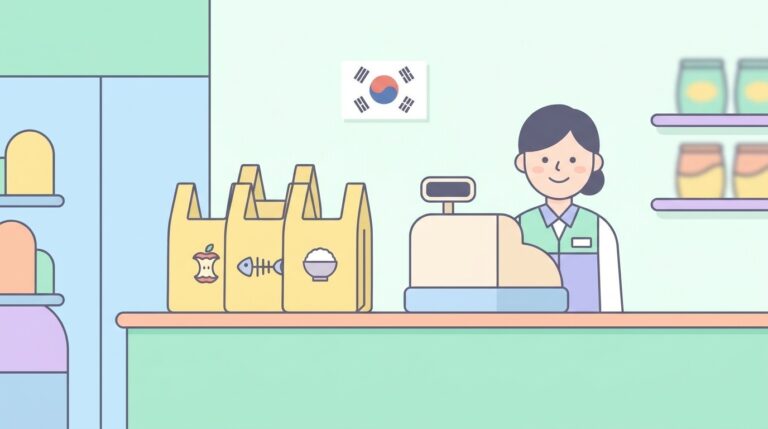
- K-Culture Moment: Walking into a neighborhood convenience store (CU, GS25, or 7-Eleven) at midnight to buy the official government garbage bag for your district.
- Editor’s Insight: You cannot use regular grocery bags! Each district (gu) in Seoul has its own designated colored bag (often yellow). Asking this at a convenience store counter saves your day.
- Situation Spectrum: Casual: ⚠️ | Semi-formal: ✅ | Formal: ✅
- 🤔 Think About It: Why does Korea enforce district-specific trash bags instead of national standard ones?
3. 국물은 버렸어요. (Gungmureun beoryeosseoyo.)
- Pronunciation: Goong-moo-reun buh-ryuh-ssuh-yo. (Sounds like “Gung-mool” with a gentle rolling ‘r’)
- Meaning: “I drained the broth / soup.”
- K-Culture Moment: Cleaning up leftover Ramyun broth in a dormitory kitchen or Han River picnic area.
- Editor’s Insight: Squeezing out moisture and draining soup is mandatory before disposing of food waste. It prevents terrible smells and keeps the collection bins clean!
- Situation Spectrum: Casual: ✅ | Semi-formal: ✅ | Formal: ✅
- 🤔 Think About It: How does taking extra steps to drain liquids show respect for community sanitation workers?
Phase 3: Textbook Korean vs. Real Korean
Situation 1: Asking where to throw food leftovers
- 📖 교과서 한국어 (Textbook): 음식물 쓰레기를 어디에 폐기합니까? (Eumsingmul sseuregireul eodie pyegihamnikka? – “Where do I dispose of the food waste?”)
- 🗣️ 진짜 한국어 (Real-Life): 이거 어디에 버려요? (Igeo eodie beoryeoyo? – “Where do I throw this?”)
- 💡 Why the difference? Textbook phrasing uses heavy administrative terms like “폐기” (dispose/discard). Real Koreans keep it simple with “버려요” (beoryeoyo – throw away).
Situation 2: Confirming if chicken bones are regular trash
- 📖 교과서 한국어 (Textbook): 뼈는 일반 쓰레기로 분류됩니다. (Ppyeoneun ilban sseuregiro bullyudoemnida. – “Bones are categorized as general waste.”)
- 🗣️ 진짜 한국어 (Real-Life): 뼈는 그냥 일반 쓰레기예요! (Ppyeoneun geunyang ilban sseuregiyeyo! – “Bones are just regular trash!”)
- 💡 Why the difference? In daily conversations, Koreans add “그냥” (geunyang – just/simply) to make directions sound breezy and casual.
Phase 4: K-Culture Deep Dive & Non-Verbal Manners
4-1. 눈치 (Nunchi) & Trash Station Etiquette
- The Double-Bag Squeeze: When tying your food waste bag, press the air out carefully so it doesn’t puff up like a balloon in the outdoor bin.
- The Gentle Nod: If a building manager (Gwanri-ajeossi) watches you at the recycling area, give a polite 15-degree bow before asking for guidance. It instantly builds warmth and unlocks their helpful side!
4-2. The “Livestock Feed” Rule
In Korea, food waste is legally called 음식물 쓰레기 (Eumsingmul sseuregi). But here is the secret hack: ask yourself, “Can a pig eat this?”
* ❌ NOT Food Waste (Throw in General Trash / 일반 쓰레기): Chicken & beef bones, eggshells, onion/garlic paper skins, hard fruit pits (avocado, peach), clamshells, teabags.
* ✅ YES Food Waste: Leftover cooked rice, soft vegetables, fruit peelings (banana, apple), leftover meat without bones.
Phase 5: Real-Life Roleplay Scenario
Setting: Convenience store counter near Hongdae Station. Min-woo (a friendly part-timer) is organizing shelves when you approach holding leftover takeaway containers.
- You: 저기요, 실례합니다. (Jeogiyo, sillyehamnida. / Excuse me.)
🎭 [Nervously holding hands together] - Min-woo: 네! 무엇을 도와드릴까요? (Ne! Mueoseul dowadeurilkkayo? / Yes! How can I help you?)
🎭 [Smiles pleasantly] - You: 음식물 쓰레기봉투 있어요? (Eumsingmul sseuregibongtu isseoyo? / Do you have food waste bags?)
🎭 [Points subtly toward the counter] - Min-woo: 네, 몇 리터 드릴까요? 2리터요? (Ne, myeot riteo deurilkkayo? I-riteoyo? / Yes, what size? 2 liters?)
🎭 [Reaches under the register] - You: 네, 2리터 주세요! (Ne, i-riteo juseyo! / Yes, 2 liters please!)
🎭 [Nods gratefully] - Min-woo: 여기 있습니다. 500원이에요. (Yeogi itsseumnida. O-baeg-won-ieyo. / Here you go. That’s 500 won.)
🎭 [Hands over the small yellow bag] - You: 치킨 뼈도 여기에 넣어요? (Chikin ppyeodo yeogie neoeoyo? / Do chicken bones go in here too?)
🎭 [Tilts head inquisitively] - Min-woo: 아, 아니요! 뼈는 일반 쓰레기에 버리셔야 해요. (A, aniyo! Ppyeoneun ilban sseuregie beorisyeoya haeyo. / Ah, no! Bones must be thrown in regular trash.)
🎭 [Gently crosses hands to signal 'No']
🔀 Interactive Choice Point: How do you respond to Min-woo?
- Option A: “아, 몰라요! 그냥 다 넣을래요.” (I don’t care, I’ll just throw everything in.)
- 🚫 Risk: Major cultural taboo! Doing this will get your Airbnb host fined up to 300,000 KRW.
- Option B: “아, 몰랐어요. 감사합니다!” (Ah, I didn’t know that. Thank you!)
- 🏆 Best Choice: Polite, natural, and acknowledges the new tip with good manners.
- Option C: “치킨 맛없어요.” (The chicken was not tasty.)
- ⚠️ Bad Choice: Totally random and leaves Min-woo utterly confused!
Phase 6: 10-Second Emotion Shadowing Drill
Read these out loud with rhythm and passion!
[🤔 호기심 가득하게 / Puzzled & Curious]- 이거… / 음식물 쓰레기예요? / 일반 쓰레기예요?
- (Igeo… / eumsingmul sseuregiyeyo? / ilban sseuregiyeyo?)
[💡 깨달음을 얻고 당당하게 / Confident & Enlightened]- 아하! / 닭뼈는 / 일반 쓰레기구나!
- (Aha! / dak-ppyeoneun / ilban sseuregikuna!)
[😊 정중하고 상냥하게 / Polite & Warm]- 봉투 / 제일 작은 거 / 하나 주세요.
- (Bongtu / jeil jageun geo / hana juseyo.)
Phase 7: K-Culture Mini Dictionary
- 음식물 쓰레기 (Eumsingmul Sseuregi) | Food Waste | Decomposable food leftovers that can be processed into animal feed or fertilizer.
- 종량제 봉투 (Jongnyangje Bongtu) | Volume-Rate Standard Trash Bag | Government-regulated trash bags required by law for domestic waste disposal.
- 일반 쓰레기 (Ilban Sseuregi) | General Waste | Non-recyclable, non-food garbage that goes into regular incineration or landfill.
- 국물 (Gungmul) | Broth / Soup / Liquid base | Must be poured down the drain before throwing soup-based leftovers into food waste bags.
Phase 8: Survival Kit for Travelers
⚡ TOP 3 Survival Phrases
- 이거 어디에 버려요? (Igeo eodie beoryeoyo?)
- Pro Tip: Use this at any food stall, cafe, or train station when you are unsure where to dispose of cups or snack sticks.
- 종량제 봉투 주세요. (Jongnyangje bongtu juseyo.)
- Pro Tip: Say this at convenience stores when you need standard trash bags for your Airbnb.
- 분리수거 어디서 해요? (Bullisugeo eodiseo haeyo?)
- Pro Tip: Means “Where is the recycling area?” Perfect for asking your apartment security guard.
🗺️ Editor’s Travel Note
Before stepping out, make sure you download the Naver Map application on your smartphone. It accurately shows neighborhood trash disposal guidelines and nearby local community service centers (Jumin Center) where you can ask for regional recycling pamphlets!
Phase 9: A Step Deeper (한 발 더 깊이)
In Korea, waste separation is not just a city policy—it is a deeply rooted reflection of Jeong (정) and communal consideration. Because South Korea has a high population density and limited land, how one individual packs their garbage directly impacts the health and aroma of the entire neighborhood. When you carefully separate your watermelon rinds from your chicken bones, you are actively participating in Korean community care.
💬 Your Turn: How does your home country handle food waste? Share your funny or surprising trash culture shock stories in the comments below!
Phase 10: FAQ & Common Mistakes
Q: Can I put banana peels and apple skins into food waste?
A: Yes! Fruit peels that are soft and easily decomposable (like bananas, apples, oranges, and melons) are 100% classified as food waste.
Q: Where do eggshells and walnut shells go?
A: They go into 일반 쓰레기 (General Waste). Hard shells cannot be digested by livestock and will break recycling machinery.
Q: Can I buy trash bags in Gangnam and use them in Mapo (Hongdae)?
A: No! Trash bags are valid only within their specific designated district (Gu). If you stay in Mapo-gu, buy Mapo-gu bags at a local store in that area.
🚨 Common Mistakes Alert
- Throwing plastic delivery sauce packets together with food waste: Always rinse and squeeze out sauces into the sink, recycle clean plastic, or trash dirty containers in general waste.
- Putting chicken or pork bones into food bags: Keep bones separate in the white general trash bag.
- Using normal plastic grocery bags for food disposal: This is illegal in Korea and subject to spot-fines.
Phase 11: Action Missions
- 🥉 Bronze Mission (Solo Practice): Stand in your kitchen, hold an apple core, and say aloud: “이거 음식물 쓰레기예요!” (Igeo eumsingmul sseuregiyeyo!)
- 🥈 Silver Mission (Social Share): Snap a photo of a Korean yellow food waste bag and share it on Instagram with the caption: #음식물쓰레기 마스터 완료!
- 🥇 Gold Mission (Real Life): Walk into a convenience store in Korea and buy one 2L food waste bag using solely Korean: “음식물 쓰레기봉투 2리터 하나 주세요!”
🎮 K-Culture Mission: Watch an episode of the reality show Three Meals a Day (삼시세끼) or I Live Alone (나 혼자 산다) and spot how celebrities clean up after cooking!
Phase 12: Interactive Quiz Challenge
Q1. Which of the following CAN be thrown into the Food Waste bag (음식물 쓰레기)?
* A) Fried chicken drumstick bones
* B) Clam and oyster shells
* C) Soft leftover cooked white rice
* D) Hard peach seed pit
Q2. Fill in the blank: “국물을 다 ______.” (I drained all the broth.)
* A) 마셨어요 (drank)
* B) 버렸어요 (poured out/discarded)
* C) 샀어요 (bought)
Q3. [True or False] You can throw onion peels and garlic skins into food waste because they are vegetables.
🔍 Click here to reveal Answers & Explanations!
- Q1 Answer: C) Soft leftover cooked white rice (Bones, shellfish, and hard pits belong to general trash).
- Q2 Answer: B) 버렸어요 (Gungmureul da beoryeosseoyo – I discarded/drained the broth).
- Q3 Answer: False! Fibrous, dry skins of onions and garlic cannot be consumed by animals and must be placed in general waste!







