

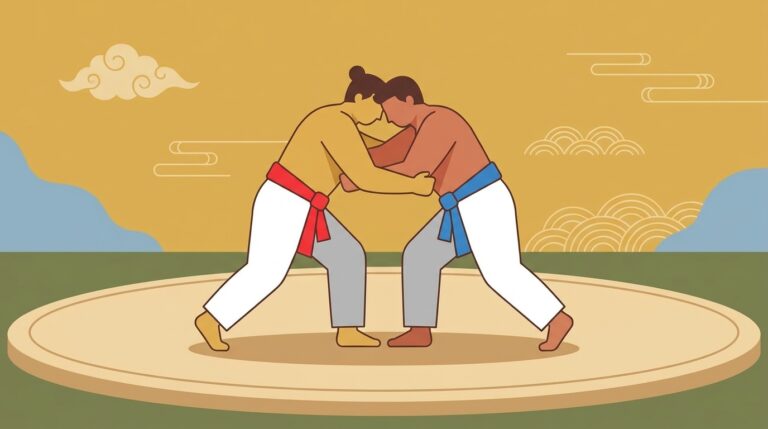
Mastering Ssireum: Unlocking Advanced Korean Through Traditional Wrestling Idioms and Spirit
Phase 1: Empathy & Immersion
안녕하세요! It is your Daily Hangul editor here. Have you ever tuned into a classic K-variety show like Knowing Bros (아는 형님) or watched vintage sports broadcasts and wondered why the cast treats legendary host Kang Ho-dong with such genuine athletic reverence? Or perhaps while watching historical dramas like Like Flowers in Sand (모래에도 꽃이 핀다), you noticed characters passionately debating dynamic wrestling moves and throwing around idioms like “뒤집기 한판” during corporate boardrooms or political debates.
Ssireum (씨름), Korea’s UNESCO-inscribed traditional wrestling, is far more than sand rings and heavyweight clashes. It is an intricate web of tactical leverage, psychological grit, and deep cultural metaphor. For advanced (C1) Korean learners, Ssireum idioms are indispensable. Native speakers routinely weave these athletic terms into high-stakes business negotiations, political commentary, and everyday banter to describe dramatic reversals, ultimate champions, and strategic maneuvers. If you have ever felt confused when a colleague declared an upcoming project review “배지기 한 판으로 끝내자,” this masterclass will transform your understanding from textbook bystander to cultural insider.
Phase 2: Deep Dive into 3 Core Expressions
1. 천하장사 (Cheon-ha-jang-sa)
- Pronunciation: [Cheon-ha-jang-sa] (sounds like: chuhn-ha-jahng-sah, rolling smoothly like “champion of the whole realm”)
- Meaning: Literal: “Strongest warrior under the heavens” | Real Nuance: An undisputed champion, an icon of peerless physical strength, resilience, and undisputed dominance in any field.
- K-Culture Moment: Seen whenever veteran MC Kang Ho-dong playfully shows his raw grip strength on variety shows, or when describing dominant K-pop groups sweeping year-end awards.
- Editor’s Insight: In historical Ssireum tournaments, the top open-weight winner earned the title Cheonhajangsa along with a prized ox and a massive trophy. Today, using it metaphorically highlights undisputed excellence combined with humble traditional dignity.
- Situation Spectrum: Casual ✅ | Semi-formal ✅ | Formal ✅
- 🤔 Think About It: Does your native culture elevate traditional champions into living legends whose titles become universal terms for peak capability?
2. 뒤집기 한판 (Dwi-jip-gi Han-pan)
- Pronunciation: [Dwi-jip-gi han-pan] (sounds like: dwee-jeep-gee han-pahn, sharp and decisive)
- Meaning: Literal: “A flipping/inversion technique round” | Real Nuance: A dramatic, sudden turnaround or come-from-behind victory achieved against all odds.
- K-Culture Moment: Widely used in K-dramas during climactic courtroom reveals, election night news broadcasts, or dramatic startup turnaround scenes.
- Editor’s Insight: A Dwijipgi is a breathtaking Ssireum technique where a wrestler on the verge of being thrown leverages their opponent’s momentum to flip them onto the sand at the very last second. In business or life, it conveys turning a crisis into a decisive triumph.
- Situation Spectrum: Casual ✅ | Semi-formal ✅ | Formal ⚠️
- 🤔 Think About It: How does phrasing strategic reversals as physical combat techniques change the energy of your conversation?
3. 샅바 싸움 (Sat-ba Ssa-um)
- Pronunciation: [Sat-ba ssa-um] (sounds like: saht-bah sah-oom, with tight glottal emphasis on ‘ss’)
- Meaning: Literal: “Fight over the thigh-strap (satba)” | Real Nuance: Fierce psychological warfare, tug-of-war, or preliminary jockeying for leverage before a major contest or negotiation.
- K-Culture Moment: Used by political analysts describing parliamentary budget standoffs or entertainment agency contract negotiations.
- Editor’s Insight: Before a bout starts, wrestlers grip each other’s waist and thigh belt (satba). The struggle to gain even a half-inch of better grip (satba ssaum) often decides the entire match before either foot moves.
- Situation Spectrum: Casual ✅ | Semi-formal ✅ | Formal ✅
- 🤔 Think About It: What idiomatic metaphors does your culture use to describe the tense pre-negotiation positioning phase?
Phase 3: Textbook Korean vs. Real Korean
Scenario A: Describing a Dramatic Turnaround
- 📖 Textbook Korean: 상황이 극적으로 역전되었습니다. (The situation has dramatically reversed.)
- 🗣️ Real Korean: 마지막에 완전 뒤집기 한판으로 끝냈잖아요! (We completely turned the tables with a decisive reversal in the final stretch!)
- 💡 Why is it different? While “역전” is technically correct, native speakers favor the dynamic, tactile visual of “뒤집기 한판” to evoke excitement and visceral underdog victory.
Scenario B: Describing Tense Contract Jousting
- 📖 Textbook Korean: 양측이 치열한 신경전을 벌이고 있습니다. (Both sides are engaged in an intense battle of nerves.)
- 🗣️ Real Korean: 연봉 협상에서 지금 샅바 싸움이 아주 치열해요. (The preliminary tug-of-war in the salary negotiations is fierce right now.)
- 💡 Why is it different? “샅바 싸움” encapsulates both mental pressure and tactical leverage, transforming abstract tension into a clear physical contest.
Phase 4: K-Culture Deep Dive & Non-Verbal Etiquette
4-1. Nunchi & Sand-Ring Etiquette (예의와 기싸움)
Ssireum is founded upon deep mutual respect (ye-ui). Notice how wrestlers bow (in-sa) deeply before entering the ring, dust off their defeated opponents with sincere humility, and never display overt arrogance. In high-level Korean professional conversations, when you reference wrestling metaphors, balance competitive determination with graceful modesty. Avoid aggressive posturing; let your strategic poise (gissae) speak for itself.
4-2. Cultural Code Analysis: The Legend of Kang Ho-dong and Folk Heritage
In the 1980s and 90s, Ssireum matches emptied Korean city streets. Kang Ho-dong’s rise as the youngest Cheonhajangsa revolutionized Korean pop culture, leading to his iconic broadcasting career. Understanding Ssireum uncovers the bedrock of Korean entertainment archetypes: the powerhouse who respects traditional hierarchy while possessing cunning tactical wit.
Phase 5: Real-World Roleplay Scenario
Setting: A vibrant open-air restaurant in Jangchung-dong, Seoul, after a high-stakes startup pitch competition.
Characters:
– Min-jun (민준): Senior Strategy Lead, Ssireum enthusiast.
– Learner (You): International Business Partner aiming for flawless natural Korean.
- Turn 1 (Min-jun): 이번 투자 유치 프레젠테이션, 초반에 기세가 밀려서 정말 아슬아슬했어요. (🎭 Leaning forward, wiping sweat from his forehead with a nervous sigh)
- Turn 2 (Learner): 맞아요, 상대 측 질문 공세 때문에 초반 샅바 싸움부터 만만치 않았죠. (🎭 Nodding sympathetically with focused eye contact)
- Turn 3 (Min-jun): 특히 데이터 분석 파트에서 공격받을 땐 등골이 서늘하더라고요.
- Turn 4 (Learner): 그래도 팀장님이 반박 데이터로 기술 들어가신 덕분에 완벽한 뒤집기 한판이었어요! (🎭 Smiling broadly, gesturing an upward lifting motion with two fists)
- Turn 5 (Min-jun): 하하! 역시 위기일 때 배지기 한 방 제대로 꽂아 넣는 쾌감이 있죠.
- Turn 6 (Learner): 심사위원들 표정 보셨어요? 완전히 승기를 잡으셨던데요. (🎭 Chuckling warmly while raising a water glass for a toast)
- Turn 7 (Min-jun): 오늘 활약상만 보면 우리 파트너님이 진정한 천하장사십니다. 건배합시다!
- Turn 8 (Learner): 팀워크 덕분이죠! 앞으로 남은 계약까지 깔끔하게 밀어붙여 보시죠! (🎭 Clinking glasses enthusiastically with respectful two-handed grip)
🔀 Interactive Decision Point
How would you respond if Min-jun asks you how to handle tomorrow’s tough supplier negotiations?
- Option A: “상대방이 샅바를 강하게 쥐기 전에, 우리가 먼저 주도권을 잡고 유연하게 대처하죠.” (Feedback: Best! Perfect C1 metaphorical precision balancing assertion with strategy.)
- Option B: “우리가 무조건 힘으로 밀어붙여서 쓰러뜨리면 됩니다!” (Feedback: Bad. Too confrontational and misses the tactical nuance of Ssireum.)
- Option C: “그냥 상황 보고 적당히 합의합시다.” (Feedback: Risk. Sounding overly passive and disengaged in a professional team setting.)
Phase 6: 10-Second Emotion Shadowing Drill
- Drill 1:
[🔥 자신감 넘치고 역동적으로]초반엔 밀렸지만 / 막판에 완벽한 / 뒤집기 한판으로 / 끝냈습니다! - Drill 2:
[🤫 신중하고 전략적으로]지금은 섣불리 움직이지 말고 / 상대방의 샅바 싸움을 / 지켜봐야 합니다. - Drill 3:
[👏 진심 어린 존경을 담아]이번 프로젝트를 성공시킨 / 진정한 천하장사는 / 바로 여러분입니다!
Phase 7: K-Culture Mini Dictionary
- 배지기 (Bae-ji-gi): “Stomach-lift technique.” A core offensive move lifting the opponent with the abdomen before twisting them down. In business, it refers to executing a signature, decisive power move.
- 안다리걸기 (An-da-ri-geol-gi): “Inner leg trip.” Tripping the inner thigh of an opponent. Metaphorically, a swift, sharp inside tactic that catches competitors off-guard.
- 모래판 (Mo-rae-pan): “The sand ring.” The battleground arena of Ssireum. Frequently used as a metaphor for any competitive market, industry arena, or election ground.
- 꽃가마 (Kkot-ga-ma): “Flower-adorned palanquin.” The ceremonial carriage carrying the victorious Cheonhajangsa. Idiomatically used as riding the triumphant victory carriage (꽃가마를 타다).
Phase 8: Traveler’s Cultural Survival Kit
Top 3 Live-Event Expressions:
- 기술 들어간다! (Gi-sul deul-eo-gan-da!): [A technique is being initiated!] Pro Tip: Shout this during sports games when an athlete launches a critical offensive attack.
- 버텨라! (Beo-tyeo-ra!): [Hold your ground!] Pro Tip: Perfect cheer when supporting someone under intense physical or mental pressure.
- 한판승이다! (Han-pan-seung-i-da!): [It is a clean, decisive round victory!] Pro Tip: Use when celebrating a clean, undeniable success.
Editor’s Travel Note
Heading to Seoul during national holidays like Chuseok or Seollal? Experience live tournaments at the Jangchung Arena or regional traditional festivals. For seamless route planning, make sure to check the Naver Map Navigation App Guide to find local stadium transit links and live arena schedules without getting lost.
Phase 9: Deep Reflection (인문학 에세이)
Unlike combat sports focused on inflicting strikes, Ssireum is fundamentally an art of leverage and harmony. It begins with mutual physical connection—the interlocking of satba belts before the referee blows the whistle. You cannot overcome an opponent in Ssireum without feeling their center of gravity and absorbing their force. This embodies Korea’s traditional philosophical worldview: acknowledging the interdependence of rivals and transforming collective energy into decisive momentum.
💬 Your Turn: What traditional sport or cultural practice from your home country provides rich metaphors for modern business and life? Share your thoughts below!
Phase 10: Structured FAQ & Common Mistakes
Q: Can ‘천하장사’ be used to describe non-physical achievements?
A: Absolutely! In advanced Korean, it frequently describes powerhouse performers in business, academia, or the arts who exhibit overwhelming competence.
Q: What is the grammatical difference between ‘뒤집기’ and ‘역전’?
A: ‘역전’ is a Sino-Korean noun suitable for formal statistics, while ‘뒤집기’ carries vivid native Korean physical imagery, evoking an active, kinetic turnaround.
Q: Is ‘샅바 싸움’ considered impolite in business contexts?
A: Not at all! It is a standard, highly respected analytical idiom often heard on business podcasts, economic news reports, and strategic briefings.
🚨 Common Mistakes Warning Board
- Mistake: Using “샅바 싸움” to mean physical fist-fighting. -> Correct Action: Use it strictly for preliminary psychological maneuvering and positioning.
- Mistake: Confusing “배지기” with a rude belly joke. -> Correct Action: Recognize it proudly as the premier classic wrestling throw.
- Mistake: Saying “천하장사를 했다” instead of “천하장사에 등극했다/올랐다”. -> Correct Action: Pair with elevated honorific verbs like 등극하다 (ascend to the throne).
Phase 11: Action Missions
- 🥉 Bronze Mission: Record yourself practicing the Phase 6 Shadowing Drill 1 with full athletic gusto.
- 🥈 Silver Mission: Write a 2-sentence comment on social media describing your favorite sports team’s comeback using “뒤집기 한판”.
- 🥇 Gold Mission: Incorporate “샅바 싸움” into your next Korean conversation when discussing negotiation strategies.
- 🎮 K-Culture Mission: Watch an episode of Knowing Bros or Like Flowers in Sand and spot at least two Ssireum-derived idioms in action!
Phase 12: Interactive Quiz Challenge
Question 1: Situational Judgment
Which expression best describes two companies prolonging preliminary contract clauses to gain strategic leverage?
👉 Click to reveal Answer & Explanation
Answer: 샅바 싸움 (Sat-ba Ssa-um)
Explanation: It accurately captures the tense pre-bout maneuvering for an optimal grip and strategic advantage.
Question 2: Fill in the Blank
절체절명의 위기에서 팀원들의 기지로 멋진 (__________)을/를 이루어냈다.
👉 Click to reveal Answer & Explanation
Answer: 뒤집기 한판 (Dwi-jip-gi han-pan)
Explanation: Describes an extraordinary, dramatic comeback victory from the brink of defeat.
Question 3: Cultural True/False
True or False: In Ssireum, a wrestler wins when they force any part of the opponent’s body above the knee to touch the sand floor.
👉 Click to reveal Answer & Explanation
Answer: True (참)
Explanation: Unlike Western wrestling where pins are required, in Ssireum, touching the sand with any body part above the knee constitutes an instant loss, emphasizing balance and precision.






