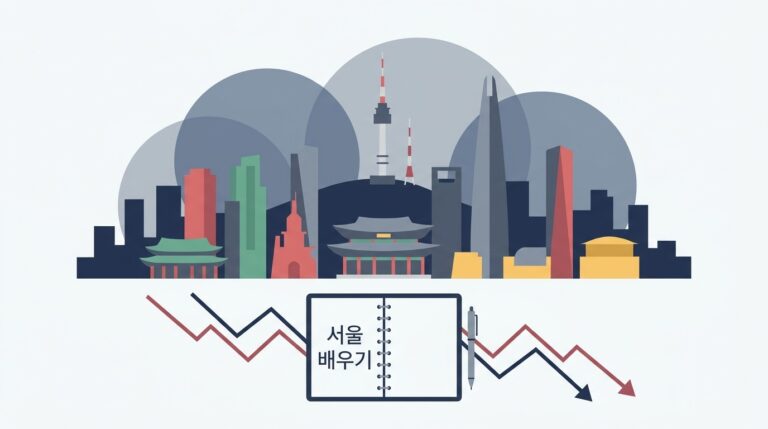
Deconstructing the Seoul Sky-High Illusion: Advanced Discourse on Korea’s Real Estate Bubble
Phase 1: Empathy (Story-Immersive Opening)
안녕하세요! 매일한글 (Daily Hangul) Editor here! Have you ever watched a high-stakes K-Drama like The Penthouse or tuned into a Korean financial news broadcast and wondered why an entire nation seems holding its collective breath over apartment prices in Gangnam? You hear analysts tossing around heavy financial jargon like gap investment, jeonse crisis, and interest rate shockwaves, but when you try to articulate your own critical assessment in high-level Korean, textbook phrases just fall short.
Critiquing macroeconomic vulnerabilities requires more than standard fluency; it demands rhetorical nuance, sociocultural awareness, and lexical precision. In this masterclass guide curated for C2-level proficiency, we bridge the gap between academic economics and natural, sophisticated boardroom debates. By mastering these analytical structures, you will confidently dissect fiscal policies, evaluate speculative risks, and critique market corrections like a seasoned Seoul macroeconomic strategist.
Phase 2: 3 Core Expressions Deep-Dive
1. 거품 붕괴의 전조 증상 (Geopum bunggoe-ui jeonjo jeungsang)
- Pronunciation: [Geopum bunggoe-ui jeonjo jeungsang] (Sounds like “Guh-poom boong-gweh-wee jun-joh jeung-sang”)
- Meaning: Precursor symptoms of an asset bubble bursting.
- K-Culture Moment: Seen frequently on investigative journalism programs like SBS Unanswered Questions (그것이 알고 싶다) when examining sudden liquidity contractions in metropolitan redevelopment zones.
- Editor’s Insight: While 거품 (bubble) is common, pairing it with 전조 증상 elevates your discourse from everyday chit-chat to formal macroeconomic critique.
- Situation Spectrum: Casual 🚫 | Semi-formal ⚠️ | Formal ✅
- 🤔 Think About It: In your native language, do economic risk terms evoke biological pathology (증상 = symptom) as naturally as they do in Korean?
2. 영끌족의 부실 대출 리스크 (Yeongkkeuljok-ui busil daechul riseukeu)
- Pronunciation: [Yeongkkeuljok-ui busil daechul riseukeu] (Sounds like “Young-kkeul-jok-wee boo-sheel deh-chool lee-seu-keu”)
- Meaning: Default risks faced by overleveraged retail buyers (“soul-pulling” debtors).
- K-Culture Moment: Prominently discussed across YouTube economic channels like SamproTV when debating household debt thresholds among millennials and Gen Z.
- Editor’s Insight: 영끌 (pulling one’s soul) is a cultural neologism, but appending 부실 대출 리스크 converts it into a legitimate, institutional-grade analytical phrase.
- Situation Spectrum: Casual ⚠️ | Semi-formal ✅ | Formal ✅
- 🤔 Think About It: How does your culture linguistically categorize hyper-leveraged panic buying among younger generations?
3. 연착륙을 유도하기 위한 정책적 완충 장치 (Yeonchangnyuk-eul yudohagi wihan jeongchaekjeok wanchung jangchi)
- Pronunciation: [Yeonchangnyuk-eul yudohagi wihan jeongchaekjeok wanchung jangchi] (Sounds like “Yun-chang-nyook-eul yoo-doh-hah-ghee wee-hahn jung-chek-jeok wahn-choong jahng-chee”)
- Meaning: Policy buffers engineered to induce an economic soft landing.
- K-Culture Moment: The core rhetoric utilized by Bank of Korea (한국은행) officials during monetary policy press briefings.
- Editor’s Insight: Combining aeronautical metaphors (연착륙 – soft landing) with engineering terms (완충 장치 – buffer/shock absorber) demonstrates the highest tier of Korean rhetorical precision.
- Situation Spectrum: Casual 🚫 | Semi-formal ⚠️ | Formal ✅
- 🤔 Think About It: What transport or physical metaphors dominate fiscal policy explanations in your home country?
Phase 3: Textbook Korean vs. Real Korean
Situation 1: Highlighting real estate market stagnation
- 📖 Textbook Korean: 부동산 시장 가격이 앞으로 많이 내려갈 것 같습니다. (Boudongsan sijang gagyeogi apeuro mani naeryeogal geot gatseumnida. / I think real estate prices will drop a lot in the future.)
- 🗣️ Real Korean: 거래 절벽이 장기화되면서 하방 압력이 가중되고 있습니다. (Georae jeolbyeogi janggihwadoemyeonseo habang amnyeogi gajungdoego itseumnida. / As the transaction cliff prolongs, downward pressure continues to mount.)
- 💡 Why the Difference: Native experts prefer structural terms like 거래 절벽 (transaction cliff) and 하방 압력 (downward pressure) rather than simple descriptive adjectives like ‘많이 내려가다’.
Situation 2: Describing excessive mortgage burdens
- 📖 Textbook Korean: 이자가 너무 비싸서 사람들이 집을 팔고 있습니다. (Ijaga neomu bissaseo saramdeuri jibeul palgo itseumnida. / People are selling homes because interest is too high.)
- 🗣️ Real Korean: 고금리 기조 속에서 투매 현상과 차익 실현 물량이 혼재하고 있습니다. (Gogeumri gijo sogeseo tumae hyeonsanggwa chaik silhyeon mulryangi honjaehago itseumnida. / Amid high interest rate conditions, panic selling and profit-taking volumes are coexisting.)
- 💡 Why the Difference: C2 proficiency distinguishes between involuntary panic sales (투매) and strategic capital liquidation (차익 실현).
Phase 4: K-Culture Deep Dive & Non-Verbal Manners
4-1. Nunchi (눈치) & Gestures in Macroeconomic Debates
When critiquing asset valuation bubbles in Korean business environments, direct aggressive assertions can cause public loss of face. Korean economists maintain neutral posture, keeping palms visible and angled inward while adopting tentative epistemic hedges such as ~로 사료됩니다 (It is considered that…) or ~의 가능성을 배제할 수 없습니다 (The possibility of… cannot be ruled out). Eye contact should be sustained but softened when pointing out policy failures.
4-2. Cultural Code: The Jeonse (전세) System & ‘Apartment Republic’
Korea is globally unique in its Jeonse (lump-sum deposit lease) system. When interest rates drop, speculative investors leverage gap investments (갭투자) using tenant deposits as non-interest loans to purchase multiple apartments. This created the cultural landscape known as the ‘Apartment Republic’ (아파트 공화국). To critique the Korean bubble accurately, one must assess how fluctuations in deposit return insurance (보증보험) destabilize broader household liquidity.
Phase 5: Real-World Roleplay Scenario
Setting: Yeouido Financial District, Seoul. Inside a macro strategy boardroom between Senior Portfolio Manager Kim Min-woo and you (Foreign Macro Analyst).
- 민우 (Min-woo): 최근 수도권 외곽 지역의 낙폭이 심상치 않은데, 시장 거품 붕괴의 신호탄으로 보십니까? (Choegeun sudogwon oegwak jiyeogui nakpogi simsangchi aneunde, sijang geopum bunggoe-ui sinhotaneuro bosimnikka? / With the recent steep price drops in outer metropolitan areas, do you view this as the catalyst for a bubble collapse?)
- 🎭 Action:
[Adjusts rimless glasses while tapping the analytical dashboard] - You: 단순한 단기 조정을 넘어, 차주들의 상환 능력 한계에 기인한 구조적 하락 국면으로 판단됩니다. (Dansunhan dangi jojeongeul neomeo, chajudeurui sanghwan neungnyeok hangyee giinhan gujojeok harak gungmyeoneuro pandandoemnida. / Beyond a mere short-term correction, I evaluate this as a structural downturn stemming from borrower solvency limits.)
- 🎭 Action:
[Nods subtly and gestures toward the projected interest rate curves] - 민우 (Min-woo): 그렇다면 정부의 부동산 규제 완화 카드가 시장의 연착륙을 유도할 수 있을까요? (Geureotamyeon jeongbu-ui budongsan gyuje wanwha kadeuga sijangui yeonchangnyugeul yudohal su isseulkkayo? / In that case, do you think the government’s deregulation measures can induce a soft landing?)
- You: 공급 과잉 리스크와 금리 역전 현상이 맞물려 있어, 정책적 유동성 공급만으로는 한계가 명확합니다. (Gonggeup gwaing riseukeuwa geumri yeokjeon hyeonsangi matmullyeo isseo, jeongchaekjeok yudongseong gonggeummaneuroneun hangyega myeonghwakamnida. / With oversupply risks intertwined with interest rate inversions, policy liquidity injections alone have clear limitations.)
🔀 Interactive Branch Point
- Option A (Aggressive): “부동산 불패 신화는 끝났으니 전면적인 투매를 권고해야 합니다.” (The real estate myth is over; we must recommend total dumping.)
- Feedback (Risk): Too abrupt. Overly dramatic language breaks professional decorum in executive meetings.
- Option B (Analytical Masterclass): “자산 가치 재평가 국면에 따른 질적 차별화 장세가 전개될 가능성을 열어두어야 합니다.” (We must remain open to a bifurcated market driven by fundamental asset revaluation.)
- Feedback (Best): Demonstrates exceptional C2 precision and professional neutrality.
- Option C (Passive): “앞으로 집값이 어떻게 될지는 아무도 모릅니다.” (Nobody knows how housing prices will turn out.)
- Feedback (Bad): Fails to deliver actionable market intelligence.
Phase 6: 10-Second Emotion Shadowing Drill
[🧐 냉철하고 분석적인 어조 / Cool & Analytical]
“부동산 거품 논란은 / 단순한 가격 변동이 아니라 / 시스템 리스크의 전이 여부로 / 평가해야 합니다.”
(Budongsan geopum nonraneun / dansunhan gagyeok byeondongi anira / siseutem riseukeu-ui jeoni yeoburo / pyeonggahayeoya hamnida.)-
[⚖️ 균형 잡힌 정책 제언 어조 / Balanced Policy Stance]
“무분별한 규제 완화보다는 / 취약 차주를 보호하는 / 맞춤형 연착륙 로드맵이 / 선행되어야 합니다.”
(Mubunbyeolhan gyuje wanhwabodaneun / chwiyak chajureul bohohaneun / matchumhyeong yeonchangnyuk rodeumaebi / seonhaengdoeeoya hamnida.)
Phase 7: K-Culture Mini Dictionary
- 영끌 (Yeongkkeul): Pulling every ounce of soul (and debt) to invest. Used in modern economy reports to illustrate hyper-leveraged housing speculation.
- 갭투자 (Gaep-tuja): Gap investment. Purchasing properties by using tenant Jeonse deposits to cover the difference between sale and rental prices.
- 깡통전세 (Kkangtong-jeonse): Tin-can Jeonse (Negative equity rental). Situations where total debt and deposit exceed the apartment’s actual market value upon liquidation.
- 똘똘한 한 채 (Ttolttolhan han chae): One smart property. The socio-economic trend of liquidating regional assets to concentrate capital into a single premier Gangnam apartment.
Phase 8: Survival Kit for Field Observers
- 부동산 실거래가지수 (Budongsan silgeoraegajisu): Actual transaction price index.
- Pro Tip: Reference this official metric over asking prices when discussing market inflation.
- 담보인정비율 (LTV) / 총부채원리금상환비율 (DSR): Loan-to-Value / Debt Service Ratio.
- Pro Tip: Core acronyms essential for understanding Korean mortgage caps.
- 역전세난 (Yeok-jeonse-nan): Reverse Jeonse crisis (landlords unable to return deposits due to falling market rent).
- Pro Tip: Use this term to explain financial stress in suburban apartment complexes.
📱 Editor’s Real Estate Tool Guide: To evaluate accurate localized price adjustments on the ground, consult the 국토교통부 실거래가 공개시스템 모바일 앱 다운로드 alongside leading private tracking engines like KB부동산 데이터허브 플랫폼 바로가기.
Phase 9: Think Deeper (한 발 더 깊이)
In South Korea, real estate transcends economic utility—it functions as a societal scoreboard and an intergenerational wealth vehicle. The cultural fixation on concrete assets (아파트) stems from rapid post-war industrialization, where real estate consistently outpaced wage inflation. When analyzing Korean market corrections, one must balance raw macroeconomic indicators against the deeply ingrained public belief in ‘Real Estate Invincibility’ (부동산 불패).
💬 Your Turn: How does your home country’s cultural perception of homeownership affect the willingness of policymakers to let housing bubbles deflate? Share your thoughts below!
Phase 10: FAQ & Common Mistakes
Q: Is Jeonse really the main driver of real estate bubbles in Korea?
A: Yes, because it acts as quasi-banking leverage without formal institutional oversight, enabling speculative gap investments during low-interest regimes.
Q: How does high DSR regulation affect bubble deflation?
A: Stricter DSR caps curtail additional borrowing capacity, precipitating liquidity contractions and forcing overleveraged buyers into distressed selling.
Q: What is the linguistic difference between ‘하락’ (Harak) and ‘조정’ (Jojeong)?
A: ‘하락’ denotes general price drops, while ‘조정’ implies a healthy or anticipated market correction after speculative overheating.
🚨 Common Mistakes Warning Board
- Calling all apartments ‘집’ in formal papers: Use 주택 (housing) or 공동주택 (multi-unit residential properties) in macroeconomic analysis.
- Confusing ‘전세가율’ with ‘매매가율’: 전세가율 (Jeonse-to-sale ratio) is the crucial indicator for evaluating bubble vulnerability.
- Overusing ‘위험해요’ (It’s dangerous): Replace with sophisticated financial phrases like
채무 불이행 위험이 상존합니다(Default risks remain prevalent).
Phase 11: Action Mission
- 🥉 Bronze: Shadow Phase 6 sentences 5 times with focused cadence and analytical gravity.
- 🥈 Silver: Write a 3-sentence critique of current interest trends using terms like 하방 압력 and 연착륙 and share it on your study feeds.
- 🥇 Gold: Read a recent Bank of Korea monetary summary article and summarize its assessment of 부실 대출 리스크 in professional Korean.
- 🎮 K-Culture Mission: Watch an episode of a Korean business documentary and list every instance of the words 영끌 and 거래 절벽.
Phase 12: Interactive Quiz Challenge
- Context Choice: Which phrase best fits an official macroeconomic critique of overleveraged buyers?
- (A) 집을 너무 많이 사서 큰일 났습니다.
- (B) 무리한 레버리지에 기인한 한계 차주의 부실화 우려가 심화되고 있습니다.
- (C) 돈이 부족해서 집을 못 사고 있습니다.
- Fill in the Blank: “시장의 급격한 충격을 완화하고 (_______)을 유도하기 위한 정책 공조가 시급합니다.”
- Clue: Aeronautical term for gentle landing.
- True or False: Gap investment (갭투자) decreases financial leverage during speculative periods.
👉 Click to View Answers & Explanations
- Answer: (B) – Employs professional macroeconomic lexicon (
레버리지,한계 차주,부실화 우려). - Answer: 연착륙 (Soft landing) – Inducing gradual stabilization without systemic crisis.
- Answer: False – Gap investment drastically multiplies financial leverage by using tenant deposits as unhedged capital.