

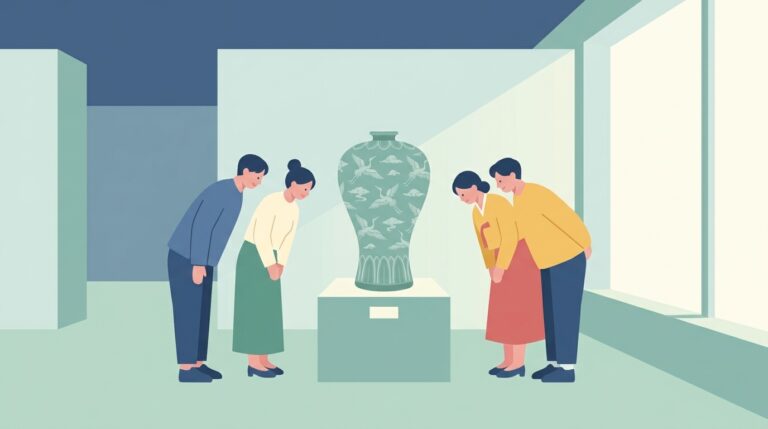
How to Enjoy Korean Museums and Art Galleries Quietly Like a Local
Phase 1: 공감 (Empathy & Immersive Story Opening)
안녕하세요! 매일한글 에디터입니다. (Hello! I’m your Daily Hangul editor.)
Have you ever walked into a serene, dimly lit room at the National Museum of Korea—perhaps the famous ‘Room of Quiet Contemplation’ (사유의 방)—and felt your phone suddenly vibrate like a jackhammer, or accidentally gasped out loud when you saw the breathtaking Pensive Bodhisattva? You quickly look around, noticing everyone gliding soundlessly across the polished wood floors, speaking in soft, gentle whispers. Suddenly, a cold sweat breaks out: “Am I being too loud? What if I accidentally touch something or break a museum rule without knowing?”
If you have ever felt that sudden panic in a K-Drama-worthy art exhibition or gallery in Seoul, you are definitely not alone! Many of our beginner learners tell us that visiting Korean cultural spots feels slightly intimidating because Korean public etiquette places huge value on collective quietness. But don’t worry—with just a few simple, polite A2-level Korean phrases and quick cultural insights, you will navigate any gallery from MMCA (National Museum of Modern and Contemporary Art) to Leeum Museum with confidence, charm, and total peace of mind.
Phase 2: 핵심 표현 3선 심층 분석 (Top 3 Key Expressions Deep Dive)
1. 조용히 해 주세요 (Joyonghi hae juseyo)
- Pronunciation: [Jo-yong-hee hae joo-seh-yo] (Sounds like “Joe-young-he” + “hay” + “joo-say-yo”)
- Meaning: “Please be quiet” (Literal: Quietly please do) | Nuance: A polite and gentle request to lower one’s voice or keep noise down.
- K-Culture Moment: Seen in romantic gallery dates in K-Dramas like Her Private Life when a curator politely reminds lively visitors before stepping into an exclusive exhibition hall.
- Editor’s Insight: While
조용히 해(Joyonghi hae) is a blunt command used with close friends, adding주세요(juseyo) softens it into a respectful polite form suitable for public spaces.- Situation Spectrum: Casual 🚫 | Semi-formal ✅ | Formal ✅
- 🤔 Think About It: In English, we often say “Could you keep it down?” Notice how Korean explicitly embeds the action “to do quietness” (
조용히 하다) as a considerate favor to others.2. 사진 찍어도 돼요? (Sajin jjigeodo dwaeyo?)
- Pronunciation: [Sah-jin jjee-gaw-doh dway-yo?] (Think “Sah-jean” + sharp “jji” like ‘cheese’ + “go-doh dway-yo”)
- Meaning: “May I take photos?” (Literal: Even if I take a picture, is it okay?)
- K-Culture Moment: When BTS’s RM shares his serene museum visits on Instagram, he always ensures whether photography (without flash!) is permitted beforehand.
- Editor’s Insight: The
-아/어도 돼요?(-a/eodo dwaeyo) grammar pattern is the ultimate polite permission formula in Korean for A2 learners.- Situation Spectrum: Casual ⚠️ | Semi-formal ✅ | Formal ✅
- 🤔 Think About It: Why does Korean ask for permission using “is it okay if I do…?” rather than a direct “Can I…?” It highlights relational harmony!
3. 만지지 마세요 (Manjiji maseyo)
- Pronunciation: [Mahn-jee-jee mah-seh-yo] (Sounds like “Mahn-jee-jee” + “mah-say-yo”)
- Meaning: “Please do not touch” | Nuance: A standard polite prohibition sign or staff reminder near delicate artifacts.
- K-Culture Moment: Often spotted next to ancient celadon pottery or fragile contemporary installations in Insadong art galleries.
- Editor’s Insight: You will see this on signs everywhere. If a staff member says this, simply nod, step back one pace, and say
죄송합니다(Joesonghamnida – I am sorry).- Situation Spectrum: Casual 🚫 | Semi-formal ✅ | Formal ✅
- 🤔 Think About It: The
-지 마세요ending is a respectful way of preventing actions without sounding hostile or overly aggressive.
Phase 3: 교과서 한국어 vs 진짜 한국어 (Textbook vs. Real Korean)
Situation 1: Asking someone to lower their voice
- 📖 교과서 한국어 (Textbook Korean): 정숙해 주십시오. (Jeongsuk-hae jusipsio. / Please maintain silence.)
- 🗣️ 진짜 한국어 (Real Korean): 조금만 조용히 해 주세요. (Jogeumman joyonghi hae juseyo. / Please keep it down just a little.)
- 💡 Why is it different? While
정숙(solemn silence) is written on historical signage, native speakers softening a request in person almost always add조금만(just a little) to sound warm and friendly.
Situation 2: Asking if flash photography is allowed
- 📖 교과서 한국어 (Textbook Korean): 플래시 사용이 금지되어 있습니까? (Peullaesi sayongi geumjidoeeo itseumnikka? / Is flash usage prohibited?)
- 🗣️ 진짜 한국어 (Real Korean): 플래시 터뜨려도 돼요? (Peullaesi teotteuryeodo dwaeyo? / Can I use flash?)
- 💡 Why is it different? Real museum-goers use the dynamic spoken verb
터뜨리다(to pop/burst flash) instead of stiff formal Sino-Korean nouns like사용(usage) or금지(prohibition).
Phase 4: K-Culture 딥다이브 & 비언어적 매너 (Nunchi & Non-Verbal Manners)
4-1. 눈치 (Nunchi) & Polite Gestures in Quiet Spaces
- The Footstep Mute: In Korean galleries, dragging your heels or clicking loud shoes breaks the collective flow. Locals consciously tread lightly.
- The Two-Handed Screen Check: When checking your phone, keep it on vibrate (
진동, jindong) or silent (무음, mueum). If you must show your e-ticket to an attendant, present your screen holding the phone with both hands or supporting your right wrist with your left hand. This demonstrates deep politeness. - Distance Rule: Keep at least two footsteps back from the velvet rope or floor guide lines. Leaning over the boundary immediately triggers anxious Nunchi from security guards!
4-2. Cultural Code: The Art of “Room of Quiet Contemplation” (사유의 방)
In Korea, visiting exhibitions has evolved from just educational viewing to a form of mindful healing (힐링, Healing). K-Pop stars and young locals visit galleries on rainy afternoons for quiet reflection. Silence in Korean museums is not seen as restrictive; rather, it is created together as a shared oasis of peace.
Phase 5: 실전 롤플레이 시나리오 (Interactive Roleplay Scenario)
Setting: National Museum of Korea (국립중앙박물관), in front of a delicate Joseon Dynasty painting.
Characters: You (learning Korean) and Min-ji (민지, gentle museum docent).
- Min-ji: 안녕하세요! 천천히 둘러보세요.
(Annyeonghaseyo! Cheoncheonhi dulleoboseyo.)
“Hello! Please take your time looking around.”
🎭 (Hands you a gallery brochure with a gentle smile) - You: 저기요, 사진 찍어도 돼요?
(Jeogiyo, sajin jjigeodo dwaeyo?)
“Excuse me, may I take photos?”
🎭 (Pointing politely toward the artwork) - Min-ji: 네, 사진은 괜찮지만 플래시는 꺼 주세요.
(Ne, sajineun gwaenchanchiman peullaesineun kkeo juseyo.)
“Yes, photos are fine, but please turn off the flash.”
🎭 (Taps camera icon on the info board) - You: 아, 알겠습니다. 플래시 껐어요.
(A, algetseumnida. Peullaesi kkeosseoyo.)
“Ah, I understand. I turned off the flash.”
🎭 (Shows phone screen to confirm the flash is off) - Min-ji: 감사합니다! 다른 관람객을 위해 조금만 조용히 관람해 주세요.
(Gamsahamnida! Dareun gwallamgaegeul wihae jogeumman joyonghi gwallamhae juseyo.)
“Thank you! Please view quietly for the other visitors.”
🎭 (Whispers warmly with a soft bow) - You: 네, 조용히 볼게요.
(Ne, joyonghi bolgeyo.)
“Yes, I will view quietly.”
🎭 (Nods respectfully in a lowered tone) - Min-ji: 즐거운 관람 되세요.
(Jeulgeoun gwallam doeseyo.)
“Have an enjoyable visit.”
🎭 (Steps back gracefully) - You: 네, 감사합니다!
(Ne, gamsahamnida!)
“Yes, thank you!”
🎭 (Smiles softly and begins admiring the painting)
🔀 Interactive Choice Point
A group next to you starts speaking loudly on speakerphone. What do you do?
* Choice A: Shout: 야! 조용히 해! (Hey! Be quiet!)
* Feedback [Bad]: Too aggressive and disrespectful in a public gallery space.
* Choice B: Politely whisper to the docent: 저기요, 조금 시끄러워요. (Excuse me, it is a bit noisy.)
* Feedback [Best]: Perfect! Letting the museum staff handle crowd control is the safest and most natural Korean Nunchi move.
* Choice C: Tap them on the shoulder and say: 만지지 마세요! (Do not touch!)
* Feedback [Risk]: Incorrect context! That means “Don’t touch,” which will only cause confusion.
Phase 6: 10초 감정 섀도잉 드릴 (10-Second Emotion Shadowing Drill)
Practice these lines out loud with the emotional markers and rhythm breaks (/):
[🤫 속삭이듯 조심스럽게 / Softly whispering]
저기요… / 사진 찍어도 돼요?
(Jeogiyo… / sajin jjigeodo dwaeyo?)-
[💡 깨달으며 차분하게 / Calm realization]
아, 알겠습니다! / 플래시 끌게요.
(A, algetseumnida! / peullaesi kkeulgeyo.) -
[😊 정중하고 다정하게 / Respectful and sweet]
네, / 조용히 관람할게요. / 감사합니다.
(Ne, / joyonghi gwallamhalgeyo. / gamsahamnida.)
Phase 7: K-Culture 미니 사전 (Mini Culture Dictionary)
- 도슨트 (Doseunteu) | Docent / Museum Guide
Used regularly in Korean galleries. Many major museums offer free timed docent tours in Korean and English. - 무음 모드 (Mueum modeu) | Silent Mode
Essential setting for your smartphone before stepping inside any exhibition room or memorial. - 관람 예절 (Gwallam yejeol) | Viewing Etiquette
The comprehensive set of manners expected in theaters, galleries, and museums across Korea. - 사유 (Sayu) | Deep Contemplation / Meditation
A traditional philosophical term trending among young Koreans seeking mindfulness through art appreciation.
Phase 8: 여행자를 위한 생존 키트 (Traveler’s Survival Kit)
Survival TOP 3 Phrases
- 플래시 꺼 주세요 (Peullaesi kkeo juseyo) — Please turn off flash. (Pro Tip: Essential if someone accidentally flashes their camera near you).
- 음식물 반입 금지예요 (Eumsikmul ban-ip geumjiyeyo) — No food or drinks allowed. (Pro Tip: Finish your iced Americano before entering the ticket gate).
- 오디오 가이드 있어요? (Odio gaideu isseoyo?) — Do you have an audio guide? (Pro Tip: Most Seoul museums provide English audio handsets for under 3,000 KRW).
Editor’s Travel Note
- Download the 네이버 지도 앱 (Naver Map App) to check real-time museum operating hours and exhibition closing dates, as Google Maps often lacks real-time holiday closure data in South Korea.
Phase 9: “한 발 더 깊이” (Cultural Essay: Thought Question)
In many Western galleries, lively discussions and spirited critiques in front of art pieces are welcomed. However, in Korea, silence in cultural spaces is seen as an act of communal respect—granting fellow visitors their own private headspace to experience emotion unhindered. This reflects the broader Korean societal principle of 배려 (Baeryeo, thoughtful consideration for others in shared public spheres).
💬 Your Turn: How does museum etiquette in your country compare with Korea’s quiet contemplation culture? Share your thoughts below!
Phase 10: FAQ & 오해 방지 (FAQ & Common Mistakes)
Q: Can I take photos of every exhibition in Korea?
A: Not always. Contemporary art exhibitions frequently allow non-flash photography for social media, but ancient artifact galleries or special loan exhibitions from abroad often strictly prohibit all photography.
Q: Are drinks like bottled water permitted inside exhibition rooms?
A: Usually, all open beverages (especially coffee cups) are strictly barred. Bottled water with a screw cap is sometimes allowed in your bag, but drinking inside the main exhibition hall is discouraged.
Q: What should I do if my phone rings unexpectedly?
A: Quickly silence it without answering, step out to the hallway or lobby immediately, and return any urgent calls outside the exhibition hall.
🚨 Common Mistakes Warning Board
- Mistake: Saying
조용하세요!(Joyonghaseyo!) to strangers.
Correction: It sounds like an imperative “Quiet down!” Say조금만 조용히 해 주세요(Please keep it down just a bit). - Mistake: Forgetting that Korean phone camera shutters make a loud shutter click sound by default law.
Correction: Place your finger gently over the speaker grill when taking permitted photos to muffle the shutter click in quiet rooms. - Mistake: Touching glass display cases with both hands while peering closely.
Correction: Keep hands behind your back or at your sides to avoid leaving handprints on the glass.
Phase 11: 액션 미션 & 참여 유도 (Action Missions)
- 🥉 Bronze Mission (Solo Practice): Practice whispering
플래시 껐어요(I turned off the flash) 5 times in front of the mirror. - 🥈 Silver Mission (Social Sharing): Screenshot your favorite Korean museum or artwork online and post it on your Instagram story with the caption
#사유의방 #DailyHangul! - 🥇 Gold Mission (Real-Life Application): Next time you visit a museum or gallery, ask the staff at the entrance:
사진 찍어도 돼요?(Sajin jjigeodo dwaeyo?).
🎮 K-Culture Mission: Watch an episode of a modern K-Drama (like Her Private Life or Business Proposal) and spot a museum/gallery scene. Listen closely to how characters lower their voices in formal spaces!
Phase 12: 인터랙티브 퀴즈 챌린지 (Interactive Quiz Challenge)
1. Situation Quiz
You want to ask the gallery attendant if you can take pictures of a sculpture. What is the most natural Korean expression?
* A) 이거 만져도 돼요?
* B) 사진 찍어도 돼요?
* C) 조용히 해 주세요.
2. Fill-in-the-Blank
Please do not touch the artwork: “작품을 ______ 마세요.”
* A) 보지
* B) 듣지
* C) 만지지
3. True / False Cultural Quiz
- Statement: In Korea, it is completely acceptable to take loud phone calls on speaker in art museums as long as you speak quickly.
👉 Click here to reveal Quiz Answers & Explanations!
- Answer: B (사진 찍어도 돼요?)
Explanation: A means “May I touch this?” and C means “Please be quiet.” B is the proper phrase for asking permission to take photos. - Answer: C (만지지)
Explanation:만지다means to touch. Combined with-지 마세요,만지지 마세요means “Please do not touch.” - Answer: False
Explanation: Taking phone calls inside exhibition rooms is considered impolite. Always take phone calls in the lobby or outside.






