

Master Korean Food Delivery Apps Like a Local
Phase 1: Empathy (Your Midnight K-Delivery Dream)
안녕하세요! 매일한글 에디터입니다. Have you ever watched a late-night K-Drama where the main characters order piping hot, crispy fried chicken (치킨) or savory black bean noodles (짜장면) straight to their door, complete with a plastic tablecloth and pickled radish? You open your delivery app in Korea—maybe Baemin (배달의민족) or Yogiyo (요기요)—hoping for the same blissful experience, but suddenly you are staring at mysterious drop-down options like “문 앞에 두고 벨 눌러주세요” and “리뷰 이벤트 참여.” Your heart races, your stomach rumbles, and you end up closing the app to eat plain convenience store ramen instead.
Don’t worry! Ordering food delivery in Korea isn’t just about tapping buttons; it’s a vibrant cultural ritual designed for maximum convenience and speed. Based on feedback from hundreds of our intermediate learners, this guide will unlock the exact phrases, request notes, and app etiquette you need to order effortlessly and feast like a true Seoulite.
Phase 2: Core 3 Expressions In-Depth Breakdown
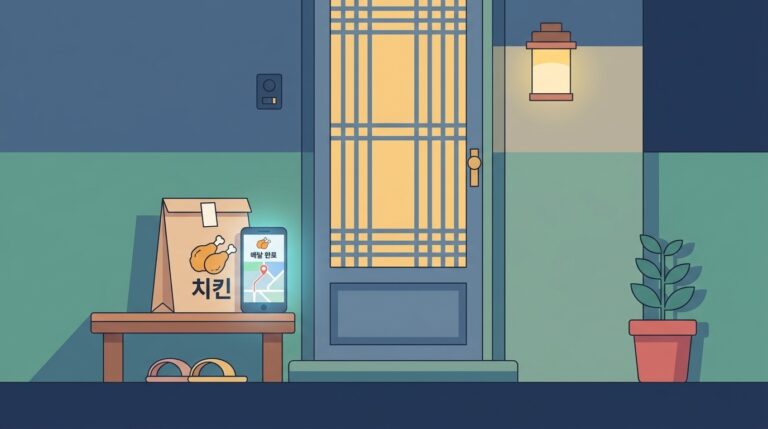
1. 문 앞에 두고 벨 눌러주세요 (Mun ape dugo bel nulleojuseyo)
- Pronunciation: [Mun ah-peh doo-goh bel nool-luh-joo-seh-yo] (Sounds like: Moon-apple doo-go bell null-uh-joo-seh-yo)
- Meaning: “Please leave it at the door and ring the bell.” (Literal vs. Nuance: The go-to phrase for contactless delivery in modern Korea).
- K-Culture Moment: In modern web dramas, characters working from home or avoiding awkward greetings always select this default rider note.
- Editor’s Insight: With high-density apartment living in Korea, delivery riders appreciate clear, concise instructions so they can drop off quickly and move to the next order.
- Situation Spectrum: Casual ⚠️ / Semi-formal ✅ / Formal ✅
- 🤔 Think About It: Why do you think contactless delivery took off so seamlessly in South Korea compared to other countries?
2. 리뷰 이벤트 참여할게요 (Ribyu ibenteu cham-yeohalgeyo)
- Pronunciation: [Ree-view ee-ben-teu chahm-yuh-hahl-geh-yo] (Sounds like: Review event-to charm-yuh-hal-geh-yo)
- Meaning: “I will participate in the review event!” (Nuance: A polite pledge written in the memo to get free service items like cheese balls or drinks).
- K-Culture Moment: Mukbang creators showing off their “Service” side dishes received by typing this magical phrase in the owner request box.
- Editor’s Insight: Korean restaurant owners value 5-star photo reviews immensely. Pledging a review upfront builds instant goodwill!
- Situation Spectrum: Casual ⚠️ / Semi-formal ✅ / Formal ✅
- 🤔 Think About It: How does the culture of jeong (affectionate community exchange) show up in digital food delivery reviews?
3. 덜 맵게 해주실 수 있나요? (Deol maepge haejusil su innayo?)
- Pronunciation: [Deol maep-geh hae-joo-shil soo eek-nah-yo?] (Sounds like: Dull map-geh hae-joo-sheel soo in-nah-yo)
- Meaning: “Could you please make it less spicy?”
- K-Culture Moment: When foreigners or spice-sensitive Koreans order Tteokbokki (떡볶이) or spicy chicken feet (닭발) and need to adjust the heat level.
- Editor’s Insight: If a menu item has spicy levels, using this polite question in the request box helps you avoid tears during dinner.
- Situation Spectrum: Casual ⚠️ / Semi-formal ✅ / Formal ✅
- 🤔 Think About It: In English, we often ask “Is it spicy?”, but Korean app culture encourages proactive customization requests like “덜 맵게” (less spicy) or “순한맛” (mild flavor).
Phase 3: Textbook Korean vs Real Korean
Situation 1: Giving instructions to the rider
- 📖 교과서 한국어: 배달원님, 음식을 우리 집 문 앞에 놓아주십시오. (Baedalwonnim, eumsigeul uri jip mun ape no-ajusipsio. – Delivery person, please place the food in front of our house door.)
- 🗣️ 진짜 한국어: 문 앞에 놔주세요. (Mun ape nwajuseyo. – Leave it by the door, please.)
- 💡 왜 다를까? Koreans prefer compact, fast, and polite phrasing in delivery apps instead of rigid honorific grammar.
Situation 2: Asking to exclude disposable cutlery
- 📖 교과서 한국어: 일회용 수저와 젓가락을 제공하지 않으셔도 괜찮습니다. (Ilhoeyong sujeowa jeotgarageul jegonghaji aneusyeodo gwaenchansumnida.)
- 🗣️ 진짜 한국어: 수저 안 주셔도 돼요! (Sujeo an jusyeodo dwaeyo! – No cutlery needed!)
- 💡 왜 다를까? App checklists usually handle this, but when writing custom notes, short phrases with “~도 돼요” sound friendly and natural.
Phase 4: K-Culture Deep Dive & Non-Verbal Manners
4-1. 눈치(Nunchi) & Rider Etiquette
If you meet the delivery rider in person at your door, use Nunchi (situational awareness). They are usually in a hurry. A quick two-handed grab of the bag accompanied by a 15-degree bow and a warm “감사합니다! 수고하세요!” (Thank you! Keep up the good work!) is the gold standard of Korean delivery politeness.
4-2. The Magic of Service (서비스)
In Korean food culture, Service (서비스) means free treats provided by the restaurant. When ordering through delivery apps, participating in the “리뷰 이벤트” (Review Event) often unlocks free fried dumplings, cheese sticks, or a beverage. It is an unspoken digital bond of trust between hungry customers and hard-working restaurant owners.
Phase 5: Real-world Roleplay Scenario
Setting: You are chilling in an Airbnb in Hongdae on Friday night. You open a delivery app to order Korean Fried Chicken and want to customize your order without any phone calls.
- You (Minho): 🍗 [앱 주문 메모를 작성하며] 사장님, 치킨 바삭하게 튀겨주세요! (Sajangnim, chikin basakhage twigyeojuseyo!)
- 🎭 행동 지문: (Typing into the restaurant request box with eager anticipation)
- “Boss, please fry the chicken extra crispy!”
- App Notification (NPC): 📱 주문이 정상적으로 접수되었습니다. (Jumuni jeongsangjeogeuro jeopsudoeeotseumnida.)
- 🎭 행동 지문: (Push notification pops up on the smartphone screen)
- “Your order has been successfully received.”
- You (Minho): 💬 라이더 요청사항에는 뭐라고 쓸까? (Raideo yocheongsangeneun mworago sseulkka?)
- 🎭 행동 지문: (Muttering to yourself while tapping the rider note field)
- “What should I write in the rider request section?”
- You (Minho): ✍️ ‘문 앞에 두고 벨 눌러주세요’로 선택 완료! (‘Mun ape dugo bel nulleojuseyo’ro seontaek wanryo!)
- 🎭 행동 지문: (Checking the contactless drop-off option with a satisfied nod)
- “Selected ‘Please leave at the door and ring the bell’!”
- Rider (NPC): 🛵 [30분 후 초인종 소리] 띵동! 배달 왔습니다! (Ttingdong! Baedal watseumnida!)
- 🎭 행동 지문: (Rings the bell, places the bag quietly on the clean doorstep, and steps away)
- “Ding-dong! Delivery is here!”
- You (Minho): 🚪 [문을 살짝 열며] 와, 감사합니다! (Wa, gamsahamnida!)
- 🎭 행동 지문: (Opening the door slightly and picking up the warm chicken box)
- “Wow, thank you!”
- Rider (NPC): 🏍️ 맛있게 드세요! (Masitge deuseyo!)
- 🎭 행동 지문: (Waving briefly while heading towards the elevator)
- “Enjoy your meal!”
- You (Minho): 😋 잘 먹겠습니다! (Jal meokgetseumnida!)
- 🎭 행동 지문: (Smiling widely while bringing the feast to the dining table)
- “I will enjoy this meal!”
🔀 Interactive Choice Point
What do you do right after eating your delicious meal?
– Option A: Write a 5-star review with a quick photo saying “너무 맛있어요! 또 주문할게요!”
– Option B: Leave the empty boxes outside in the hallway without separating recyclables.
– Option C: Call the restaurant owner at 1:00 AM to verbally say thank you.
- Feedback on A (Best): 🌟 Perfect! Fulfilling your review promise makes the shop owner happy and helps other foodies.
- Feedback on B (Bad): ❌ Hallways are shared spaces. Leaving food boxes outside attracts pests and violates residential rules.
- Feedback on C (Risk): ⚠️ Calling late at night disrupts business operations. Keep reviews and compliments inside the app!
Phase 6: 10-Second Emotion Shadowing Drill
Practice reading these lines with authentic rhythm and feelings! (/ indicates a natural breath/pause point)
[😊 설레고 기대하며 - Excited & Anticipating]- 문 앞에 / 두고 / 벨 눌러주세요! (Mun ape / dugo / bel nulleojuseyo!)
[🙏 간절하고 애교 섞어서 - Sweetly Asking a Favor]- 리뷰 이벤트 / 참여할 테니 / 치즈볼 부탁드려요! (Ribyu ibenteu / cham-yeohal teni / chijeubol butakdeuryeoyo!)
[🔥 진지하게 신중하게 - Serious & Careful]- 조금 덜 맵게 / 조리해 주실 수 있나요? (Jogeum deol maepge / jorihae jusil su innayo?)
Phase 7: K-Culture Mini Dictionary
- 배달비 (Baedal-bi): Delivery fee. Varies depending on distance, bad weather, or late-night surge hours.
- 치맥 (Chimaek): The iconic portmanteau of 치킨 (Chicken) and 맥주 (Beer), the undisputed king of Korean delivery culture.
- 야식 (Yasik): Late-night snack/meal culture in Korea, typically enjoyed between 10 PM and 2 AM.
- 안심번호 (Ansim-beonho): Virtual safety phone number generated automatically by delivery apps to protect your personal contact information.
Phase 8: Survival Kit for Travelers
Survival Expressions TOP 3
- 도착하면 전화 주세요. (Dochakhamyeon jeonhwa juseyo.)
- Pro Tip: Use this if your building entrance requires a keycard or passcode that the rider cannot bypass.
- 공동현관 비밀번호는 ****이에요. (Gongdong-hyeongwan bimilbeonhoneun ****ieyo.)
- Pro Tip: Put your lobby entrance passcode in the rider notes so they can access your apartment floor directly.
- 단무지 많이 주세요. (Danmuji mani juseyo.)
- Pro Tip: Useful when ordering Chinese food (Jajangmyeon) or snacks if you love yellow pickled radish!
Editor’s Travel Note
Before ordering, install the 배달의민족 앱 다운로드 (Baemin) or 요기요 앱 다운로드 (Yogiyo). If you don’t have a local Korean credit card or ARC, look for apps that support foreign payment cards like Shuttle Delivery or select “현장 결제” (pay on-site with physical cash/card) if available.
Phase 9: One Step Deeper
In Korean society, food delivery is far more than a business—it reflects Bbali-Bbali (빨리빨리, hurry-hurry) efficiency balanced with deep hospitality. Even a simple delivery note is structured around mutual consideration for workers rushing through urban traffic. When you master these small digital phrases, you are participating in a living, breathing social system built on speed, precision, and shared comfort.
💬 Your Turn: What is the first Korean food you want to order via a delivery app at midnight? Drop your dream menu in the comments below!
Phase 10: FAQ & Common Mistakes
Q: Can foreigners without a Korean phone number use Korean delivery apps?
A: Major apps like Baemin usually require Korean phone verification. Travelers can use English-friendly alternatives like Shuttle Delivery or ask hotel/guesthouse concierges for assistance using local payment methods.
Q: What does ‘수저포크 O / X’ mean on the checkout page?
A: It asks whether you need single-use cutlery. Selecting ‘X’ means you have your own chopsticks and helps reduce plastic waste.
Q: What should I do if my food is delivered to the wrong apartment door?
A: Take a quick photo of the incorrect spot and contact customer support via the in-app chat (고객센터) with your order number.
🚨 Common Mistakes Warning Board
- Mistake: Forgetting to write the building lobby passcode (공동현관 비번) in rider notes.
- Correct Action: Always format it clearly:
공동현관: #1234.
- Correct Action: Always format it clearly:
- Mistake: Confusing the restaurant request box (사장님 요청사항) with the delivery rider box (라이더 요청사항).
- Correct Action: Food customization goes to the 사장님; door drop-off instructions go to the 라이더.
- Mistake: Writing long, complicated English sentences in request boxes.
- Correct Action: Use simple, standard Korean phrases provided in Phase 2 for instant understanding.
Phase 11: Action Missions
- 🥉 Bronze Mission (Solo Practice): Read the Phase 6 Shadowing Drills aloud 3 times focusing on natural pauses.
- 🥈 Silver Mission (Social Share): Share your favorite Korean late-night food photo on Instagram or X with the hashtag
#DailyHangulDelivery. - 🥇 Gold Mission (Real-world Challenge): Next time you are in Korea (or simulating in an app), write “문 앞에 두고 벨 눌러주세요” in the rider memo box!
- 🎮 K-Culture Mission: Watch an episode of a K-Drama and spot what food delivery boxes (chicken, pizza, Chinese food) appear on the table.
Phase 12: Interactive Quiz Challenge
1. Situation Check
You want your delivery rider to leave the food at your doorstep without face-to-face interaction. Which phrase is best?
* A) 수저포크 안 주셔도 돼요.
* B) 문 앞에 두고 벨 눌러주세요.
* C) 리뷰 이벤트 참여할게요.
👉 Click to reveal Answer & Explanation
Answer: B
Explanation: “문 앞에 두고 벨 눌러주세요” asks the rider to leave the order at the door and ring the bell. Option A is about cutlery, and Option C is about review promotions.
2. Fill in the Blank
Complete the phrase to ask for mild spiciness: “조금 덜 ____ 해주실 수 있나요?”
* A) 맵게 (maepge)
* B) 달게 (dalge)
* C) 짜게 (jpage)
👉 Click to reveal Answer & Explanation
Answer: A (맵게)
Explanation: “덜 맵게” means “less spicy”. “달게” means sweet, and “짜게” means salty.
3. True / False Cultural Quiz
Statement: In Korean delivery apps, “서비스” refers to an extra customer service fee charged to your bill.
* True
* False
👉 Click to reveal Answer & Explanation
Answer: False
Explanation: In Korean dining/delivery context, “서비스” (Service) means complimentary free food or drinks provided as a gift from the restaurant!







