

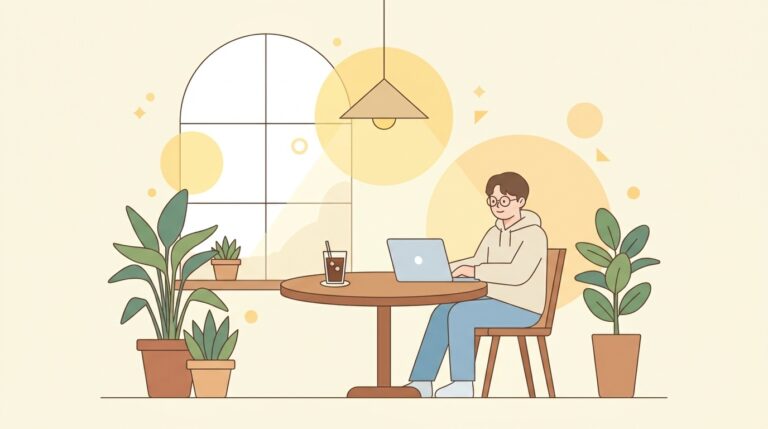
Mastering Kagong: Your Ultimate Guide to Working and Studying in Korean Cafes
Phase 1: Empathy & Immersion
안녕하세요! (Hello!) I’m your editor from Daily Hangul.
Picture this: You step into a gorgeous, sunlit cafe in the bustling alleys of Sinchon or Hongdae. Your backpack is heavy with your laptop, tablet, and chargers. You can smell the freshly ground espresso beans, hear the gentle lo-fi beats playing overhead, and notice dozens of local university students effortlessly typing away. You want nothing more than to claim a cozy corner desk, plug in, and get some productive work done just like a character in a slice-of-life K-Drama.
Suddenly, anxiety creeps in. Where are the power outlets? How do I ask for the Wi-Fi password without sounding like a robotic textbook? Is it rude to stay here for three hours with just one iced Americano?
If you’ve ever stood frozen by the counter clutching your laptop sleeve, you are definitely not alone. Over 80% of intermediate Korean learners tell us that navigating Korea’s unique “Kagong” (cafe studying) etiquette is one of their biggest real-world hurdles. Today, we’re unlocking the exact phrases, cultural nunchi (눈치), and barista-approved manners you need to walk into any Korean cafe and study like a seasoned local!
Phase 2: 3 Key Expressions Deep Dive
1. 콘센트 있는 자리 있어요? (Consent-eu inneun jari isseoyo?)
- Pronunciation: cone-sen-teu een-neun ja-ri ee-sseo-yo? (Think of “concentric” trimmed to “con-sent” + “e-so-yo”).
- Meaning: Literal: “Is there a seat with a concentric plug?” | Actual Nuance: “Do you have a seat near a power outlet?”
- K-Culture Moment: Seen in college-campus dramas like Cheese in the Trap or Weightlifting Fairy Kim Bok-joo, where students hunt for charging spots before finals.
- Editor’s Insight: In Korea, electrical outlets are universally called 콘센트 (concentric plug), not ‘아웃렛 (outlet)’. If you ask for an ‘outlet’, staff might think you are looking for a shopping mall!
- Situation Spectrum:
- Casual (to a friend): 콘센트 자리 있어? (✅)
- Semi-formal (to a barista): 콘센트 있는 자리 있어요? (✅)
- Formal (business setting): 콘센트 좌석이 마련되어 있습니까? (⚠️ Too stiff for a cafe)
- 🤔 Think About It: In English, we simply say “plug” or “outlet.” Why do you think Korean adopted the specific technical term concentric from vintage engineering into everyday slang?
2. 와이파이 비밀번호가 뭐예요? (Wa-i-pa-i bimilbeonhoga mwoyeyo?)
- Pronunciation: why-pie bee-meel-beon-ho-ga mwo-ye-yo? (Rhymes with “bee meal bun hoe ga”).
- Meaning: Literal: “What is the Wi-Fi secret number?” | Actual Nuance: “What’s the Wi-Fi password?”
- K-Culture Moment: That awkward moment when a traveler searches the cafe walls for a password sticker, while the barista calmly points to the bottom of the printed receipt.
- Editor’s Insight: While 비밀번호 is the full term, locals frequently abbreviate it to 비번 (bi-beon) in casual conversation: 와이파이 비번 뭐예요?
- Situation Spectrum:
- Casual: 와이파이 비번 뭐야? (✅)
- Semi-formal: 와이파이 비밀번호(비번)가 뭐예요? (✅)
- Formal: 무선 인터넷 암호를 알려주시겠습니까? (🚫 Sounds like a spy movie)
- 🤔 Think About It: Notice how Korean creates smooth compound words by blending Sino-Korean terms (비밀 = secret + 번호 = number). How does your native language shorten technical terms?
3. 카공하기 좋은 카페 (Kagong-hagi joeun kape)
- Pronunciation: kah-gong-ha-gee jo-eun kah-peh (“Kagong” sounds like “car” + “gong” as in gong chime).
- Meaning: Literal: “A cafe good for doing cafe-study” | Actual Nuance: “A laptop/study-friendly cafe.”
- K-Culture Moment: Searching Naver Blog or Instagram hashtags (
#카공카페,#카공족) before heading out on a weekend. - Editor’s Insight: 카공 (Kagong) is a portmanteau of 카페 (Cafe) + 공부 (Study). A person who does this is called a 카공족 (Kagong-jok).
- Situation Spectrum:
- Casual: 여기 완전 카공하기 좋다! (✅)
- Semi-formal: 근처에 카공하기 좋은 카페 있어요? (✅)
- Formal: 학업에 적합한 카페 (⚠️ Grammatically okay, culturally unnatural)
- 🤔 Think About It: The existence of a dedicated word like “Kagong” shows how deeply cafe studying is woven into youth lifestyle in South Korea.
Phase 3: Textbook Korean vs. Real Korean
Situation 1: Asking if it is okay to use your laptop for a while
- 📖 Textbook Korean: 여기서 오랫동안 노트북 컴퓨터를 사용해도 됩니까? (Yeogiseo oraetdong-an noteubuk keompyuteoreul sayonghaedo doemnikka?)
- 🗣️ Real Korean: 혹시 노트북 좀 써도 괜찮을까요? (Hoksi noteubuk jom sseodo gwaenchaneulkkayo?)
- 💡 Why the Difference?: Native speakers soften requests with 혹시 (by any chance) and 좀 (a little/politely) instead of rigid declarative question endings like
-합니까?.
Situation 2: Asking where the Wi-Fi info is written
- 📖 Textbook Korean: 와이파이 접속 정보가 어디에 기재되어 있습니까? (Wa-i-pa-i jeopsok jeongboga eodie gijaedoeeo isseumnikka?)
- 🗣️ Real Korean: 와이파이 비번 영수증에 있나요? (Wa-i-pa-i bibeon yeongsujeung-e innayo?)
- 💡 Why the Difference?: Korean cafe receipts almost always display the Wi-Fi SSID, password, and restroom door codes. Asking directly about the receipt (영수증) is faster and more natural.
Phase 4: K-Culture Deep Dive & Non-Verbal Manners
4-1. 눈치 (Nunchi) & Table Manners for Kagong-jok
- The 1-Drink, 1-Person Rule (1인 1음료): Even if you sit together at a table, every single person must order at least one beverage. Ordering one tea and two cups is a major social faux pas.
- The 3-Hour Golden Rule: If you stay longer than 3 to 4 hours, it is customary courtesy (and good nunchi) to order an additional dessert or a second beverage.
- Desk Territory: Avoid taking a 4-person dining table if you are working alone. Look for long communal study tables with built-in plugs (커뮤니티 테이블) or single-seater window counters.
4-2. Cultural Code: Franchise vs. Aesthetic Indie Cafes
- Franchises (A Twosome Place, Hollys, Starbucks): These chains actively welcome Kagong-jok, often dedicating entire 2nd or 3rd floors with individual desk lamps and partitioned study booths.
- Indie “No-Study Zones” (노스터디존): Some boutique, Instagram-famous dessert cafes have short time limits (e.g., 1.5 hours) or restrict laptop use to maintain a vibrant social ambiance. Look out for subtle signage near the register!
Phase 5: Real-World Roleplay Scenario
Setting: A modern 2-story cafe near Ewha Womans University on a rainy Tuesday afternoon.
Characters: You (Alex) and Min-woo (Friendly Barista).
- Min-woo: 어서 오세요! 주문 도와드릴까요? (Eoseo oseyo! Jumun dowadeurilkkayo? – Welcome! Can I help you order?)
🎭 Smiling behind the counter, touching the POS screen. - Alex: 네, 아이스 아메리카노 한 잔 주세요. (Ne, a-i-seu a-me-ri-ka-no han jan juseyo. – Yes, one iced Americano, please.)
🎭 Pointing gently at the menu board. - Min-woo: 매장에서 드시고 가시나요? (Maejang-eseo deusigo gasinayo? – Will you be having this in-store?)
🎭 Holding a reusable glass mug. - Alex: 네, 마시고 갈게요. 혹시 2층에 콘센트 있는 자리 있나요? (Ne, masigo galgeyo. Hoksi icheung-e consent-eu inneun jari innayo? – Yes, for here. By any chance, are there seats with outlets on the 2nd floor?)
🎭 Tapping laptop backpack strap lightly. - Min-woo: 네, 2층 창가 쪽이랑 중앙 테이블에 콘센트 많이 있어요. (Ne, icheung changga jjok-irang jung-ang teibeure consent-eu mani isseoyo. – Yes, there are plenty of outlets by the 2nd-floor window and center table.)
🎭 Nodding toward the stairs. - Alex: 다행이네요! 그리고 와이파이 비번은 어디에 있어요? (Dahaeng-ineyo! Geurigo wa-i-pa-i bibeoneun eodie isseoyo? – What a relief! And where is the Wi-Fi password?)
🎭 Preparing payment card. - Min-woo: 출력해 드린 영수증 하단에 적혀 있습니다! 진동벨 울리면 픽업대로 와주세요. (Chullyeokhae deurin yeongsujeung hadane jeokhyeo itseumnida! Jindongbel ullimyeon pikeopdaero wajuseyo. – It’s printed at the bottom of your receipt! When the buzzer vibrates, please come to the pickup counter.)
🎭 Handing over receipt and buzzer. - Alex: 감사합니다. 맛있게 만들어 주세요! (Gamsahamnida. Mas-itge mandeureo juseyo! – Thank you. Please make it delicious!)
🎭 Bowing head slightly with two hands receiving the receipt.
🔀 Interactive Choice Point
You have studied for 3.5 hours on the 2nd floor and your laptop battery is full, but you want to stay for one more hour. What do you do?
- Option A: Pack your bags slightly, leave your laptop on the desk, go down and order a warm Earl Grey tea or a slice of cake.
👉 Feedback (Best! ⭐): Exemplary K-Cafe manners. Baristas love this, and your table spot remains secure. - Option B: Ask for free hot water refill 3 times while continuing to study without ordering anything new.
👉 Feedback (Bad ❌): Causes barista fatigue and breaks unspoken Kagong etiquette. - Option C: Pack everything and rush out immediately, assuming you will get kicked out at the 4-hour mark.
👉 Feedback (Risk ⚠️): Unnecessary panic! Most cafes won’t confront you unless it is peak rush hour with people waiting in line.
Phase 6: 10-Second Emotion Shadowing Drill
Read aloud along with the pause markers (/) and feeling annotations!
[😊 Polite & Inquiring]저 혹시 / 콘센트 있는 자리 / 있어요?
(Jeo hoksi / consent-eu inneun jari / isseoyo?)[💡 Realizing & Friendly]아, 와이파이 비번이 / 영수증에 / 있었네요!
(A, wa-i-pa-i bibeoni / yeongsujeung-e / isseonneyo!)[☕ Relaxed & Content]여기 분위기 / 완전 카공하기 / 딱 좋다.
(Yeogi bunwigi / wanjeon kagong-hagi / ttak jota.)
Phase 7: K-Culture Mini Dictionary
- 카공족 (Kagong-jok / [kah-gong-jok]): Cafe studiers. Combines ‘카공’ (cafe studying) + ‘족’ (tribe/group). Refers to students/remote workers who frequent cafes.
- 콘센트 (Consent-eu / [cone-sen-teu]): Wall electrical socket/outlet. A Konglish term derived from 19th-century British ‘concentric plug’.
- 비번 (Bibeon / [bee-beon]): Short abbreviation of 비밀번호 (password/PIN). Essential for cafe Wi-Fi and restroom door locks.
- 1인 1음료 (Il-in Il-eumryo / [eel-een eel-eum-ryo]): “One drink per person.” The universal baseline policy of Korean cafes.
Phase 8: Survival Kit for Travelers
Top 3 Survival Phrases
- 자리 먼저 잡아도 돼요? (Jari meonjeo jabado dwaeyo? – Can I save a seat first?)
Pro Tip: Use this when a cafe is crowded to reserve your spot with a coat or notebook before ordering at the counter. - 화장실 비밀번호 몇 번이에요? (Hwajangsil bimilbeonho myeot beonieyo? – What is the restroom door code?)
Pro Tip: Restrooms in Korean commercial buildings are usually locked with digital keypads. - 영수증 버려주세요. (Yeongsujeung beoryeojuseyo. – Please throw away the receipt.)
Pro Tip: Only say this if you already memorized the Wi-Fi and bathroom codes!
Editor’s Travel Note
Before heading out, open the 네이버 지도 앱 다운로드 (Naver Map App) and search for “카공 카페” or “대형 카페” (large cafe) in your district. Franchise hubs like Hollys Coffee and A Twosome Place generally feature the most spacious study zones with dual outlets at almost every table.
Phase 9: Going Deeper (Cultural Perspective)
In modern Korea, living spaces—especially studio apartments (원룸) for single students and young professionals—are often compact. Cafes function as an indispensable “Third Place” (제3의 공간): an extended living room, study lounge, and creative office. The acceptance of Kagong culture reflects Korean society’s collective understanding of academic diligence combined with a love for high-speed connectivity and aesthetic comfort.
💬 Your Turn: Does your home country embrace people studying or working in cafes for hours, or is it expected that cafes are strictly for quick conversations and dining? Share your thoughts below!
Phase 10: FAQ & Common Mistakes
Q: Can I leave my laptop and backpack on the table while going to the restroom?
A: Yes! Korea is famous for its incredible public safety. Leaving your laptop, notebook, or phone on the table while using the restroom or ordering at the counter is completely standard and safe in 99% of cafes.
Q: What does ‘진동벨’ mean when ordering?
A: 진동벨 (Jindongbel) is the handheld pager/buzzer. When your coffee and food are ready, it vibrates and blinks red, signaling you to bring it to the pickup desk (픽업대).
Q: Is there a time limit for studying at Korean cafes?
A: Most large chain cafes don’t enforce strict timers. However, independent cafes might display a polite notice such as “이용 시간 2시간 제한” (2-hour limit during weekends).
🚨 Common Mistakes Warning Board
- Mistake 1: Searching for wall plugs across customer tables.
Correct Action: Look beneath the table edge or on the wooden bench baseboards; Korean cafes install built-in track sockets right beneath seat cushions! - Mistake 2: Leaving your trash on the table when you leave.
Correct Action: Bring all trays, mugs, and trash back to the 리턴 존 (Return Zone / 반납대) near the counter. - Mistake 3: Talking loudly on speakerphone or watching lectures without earphones.
Correct Action: Always keep headphones plugged in; Kagong zones maintain a respectful library-like hush.
Phase 11: Action Missions
- 🥉 Bronze Mission (Solo Practice): Stand in front of your mirror and practice asking: “콘센트 있는 자리 있어요?” with a natural smile 5 times.
- 🥈 Silver Mission (Social Share): Next time you grab a coffee, snap a photo of your study setup and post it on social media with the hashtag
#카공중(Currently cafe-studying)! - 🥇 Gold Mission (Real-Life Quest): Visit a Korean cafe, check the bottom of your receipt to find the Wi-Fi password on your own, and successfully log in!
- 🎮 K-Culture Mission: Watch an episode of a college K-Drama (like Twenty-Five Twenty-One or Weightlifting Fairy) and spot how often characters study at cafes with study materials spread out.
Phase 12: Interactive Quiz Challenge
Question 1: Situation Judgment
You enter a quiet independent cafe in Yeonnam-dong and see a small sign that says ‘노스터디존’ (No Study Zone). What should you do?
* A) Take out your mechanical keyboard and start typing noisily.
* B) Enjoy a coffee and chat quietly with a friend without using laptops or bulky textbooks.
* C) Demand the barista provide an extension cord.
👉 Click to reveal Answer & Explanation
Answer: B
‘노스터디존’ indicates the cafe owner wants to keep the space dedicated to conversation, relaxation, and aesthetics rather than long-term laptop work. Respecting the store policy is great Korean cultural manners!
Question 2: Fill-in-the-Blank
Complete the sentence to ask for the Wi-Fi password:
“와이파이 ____________가 뭐예요?”
👉 Click to reveal Answer & Explanation
Answer: 비밀번호 (or 비번)
비밀번호 (Bimilbeonho = password) or its common spoken contraction 비번 (Bibeon) correctly fits the blank!
Question 3: True or False (Culture Check)
In South Korea, asking a barista “영수증 버려주세요” (Please throw away my receipt) is the best way to get the Wi-Fi and restroom door codes.
👉 Click to reveal Answer & Explanation
Answer: False (X)
In Korea, Wi-Fi passwords and bathroom digital padlock codes are almost universally printed at the bottom of the receipt (영수증). Always keep the receipt until you’ve connected and checked the codes!







