

Phase 1: Empathy & Story Opening
안녕하세요! 매일한글 (Daily Hangul) 에디터입니다!
Picture this: You are walking through the buzzing streets of Hongdae after a long flight and an exciting day of sightseeing. Suddenly, a pounding headache strikes right behind your eyes. You spot a green cross sign glowing in the distance—a Korean pharmacy (yakguk). You step inside, feeling relieved, but then freeze. How do you explain your headache without sounding robotic like a grammar textbook, or accidentally saying your hair hurts?
If you’ve ever watched a K-Drama, you know the classic scene: the stressed office worker grabs the sides of their temples with a dramatic sigh. Headaches happen to all of us, especially when traveling or adjusting to a new environment. Knowing how to clearly and naturally express that your head hurts in Korean is an essential survival skill. Based on real questions from hundreds of our A2 beginner learners, this guide will turn that stressful pharmacy encounter into a smooth, confident conversation. Let’s make sure you get the right medicine and feel better in no time!
Phase 2: Top 3 Core Expressions In-Depth
1. 머리가 아파요 (Meoriga apayo)
- Pronunciation: Meo-ri-ga a-pa-yo (Sounds like: “Muhl-ee-gah ah-pah-yo” – think of “mermaid” without the ‘d’, and “papa” without the second ‘p’)
- Meaning: Literal: “Head is sick/hurting” | Real Nuance: “I have a headache” or “My head hurts.”
- K-Culture Moment: Heard constantly in family K-Dramas when parents get stressed over their children’s test scores or dating lives!
- Editor’s Insight: 머리 (meori) means both “head” and “hair”, but when paired with 아프다 (apeuda), Koreans automatically understand it as a headache, not painful hair!
- Situation Spectrum:
- Casual (with close friends): 머리 아파 (Meori apa) ✅
- Semi-formal (Pharmacy, polite daily life): 머리가 아파요 (Meoriga apayo) ✅
- Formal (Work presentation / Doctor’s report): 두통이 있습니다 (Dutongi itseumnida) ✅
- 🤔 Think About It: In English, we say “I have a headache” (possession), but Korean focuses on the body part acting as the subject: “The head hurts“. How does this change the way we view physical discomfort?
2. 두통약 있어요? (Dutongyak isseoyo?)
- Pronunciation: Du-tong-nyak is-seo-yo (Notice how dutong + yak flows smoothly as “Doo-tong-nyahk ees-suh-yo”)
- Meaning: Literal: “Is there headache medicine?” | Real Nuance: “Do you have headache pain relievers?”
- K-Culture Moment: In convenience store scenes where characters run in late at night after a tough breakup or overtime shift.
- Editor’s Insight: 두통 (dutong) comes from Sino-Korean roots (頭 head + 痛 pain), and 약 (yak) means medicine. Combining them gives you the exact medical term for headache medicine.
- Situation Spectrum:
- Casual: 두통약 있어? (Dutongyak isseo?) ✅
- Semi-formal: 두통약 있어요? (Dutongyak isseoyo?) ✅
- Formal: 두통약 있습니까? (Dutongyak itsseumnikka?) ⚠️ (A bit too stiff for a simple pharmacy visit)
- 🤔 Think About It: Why do you think compounding root words like Head (두) + Pain (통) + Medicine (약) makes Korean medical vocabulary surprisingly systematic to learn?
3. 머리가 지끈지끈해요 (Meoriga jikkeun-jikkeun-haeyo)
- Pronunciation: Meo-ri-ga jik-keun-jik-keun-hae-yo (Crisp double ‘kk’ sound, like “jee-kkun jee-kkun”)
- Meaning: Literal: “My head is throbbing/pulsing” | Real Nuance: “I have a throbbing, pounding headache.”
- K-Culture Moment: When characters in comedy or slice-of-life dramas rub their temples after looking at complex documents.
- Editor’s Insight: Korean has rich onomatopoeia and mimetic words (uiseong-eo / uitae-eo). 지끈지끈 (jikkeun-jikkeun) mimics the pulsing, rhythmic throbbing sensation inside the head.
- Situation Spectrum:
- Casual: 머리 지끈지끈해 (Meori jikkeun-jikkeun-hae) ✅
- Semi-formal: 머리가 지끈지끈해요 (Meoriga jikkeun-jikkeun-haeyo) ✅
- Formal: 극심한 편두통이 있습니다 (Geuksimhan pyeondutongi itseumnida) 🚫 (Too technical for casual description)
- 🤔 Think About It: Does your native language use rhythmic sounds to describe different types of bodily pain?
Phase 3: Textbook Korean vs Real Korean
Situation 1: Explaining your headache to a pharmacist
- 📖 교과서 한국어 (Textbook): 저는 심각한 두통을 앓고 있습니다. (Jeoneun simgakhan dutongeul alko itseumnida. – “I am suffering from a severe headache.”)
- 🗣️ 진짜 한국어 (Real-Life): 머리가 너무 욱신거리고 아파요. (Meoriga neomu uksingeorigo apayo. – “My head is throbbing and hurts so much.”)
- 💡 왜 다를까? (Why the difference?): Textbook phrasing uses heavy written-style grammar like ~을 앓다 (to suffer an illness). Native speakers simply state the sensation clearly using adverbs like 너무 (neomu – very/too) and sensory words like 욱신거리다 (uksingeorida – to throb).
Situation 2: Asking for pain relief medicine
- 📖 교과서 한국어 (Textbook): 진통제를 저에게 판매해 주십시오. (Jintongjereul jeoege panmaehae jusipsio. – “Please sell analgesic medicine to me.”)
- 🗣️ 진짜 한국어 (Real-Life): 두통약 하나만 주세요. (Dutongyak hanaman juseyo. – “Just one pack of headache pills, please.”)
- 💡 왜 다를까? (Why the difference?): Using 판매하다 (to sell) sounds like a commercial business contract. In daily life, [Item] + 하나 주세요 (Please give me one [Item]) is the most polite and natural standard.
Phase 4: K-Culture Deep Dive & Non-Verbal Manners
4-1. 눈치 (Nunchi) & Gestures
When visiting a Korean pharmacy (약국 – yakguk):
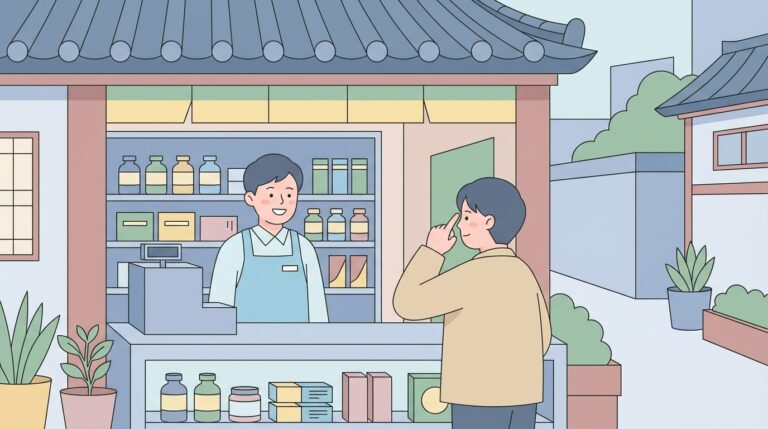
* Temple Touch: Gently placing your fingers against your temple or forehead while saying 머리가 아파요 instantly signals your condition even before the pharmacist fully processes your pronunciation.
* Two-Handed Courtesy: When receiving medicine or handing over your credit card, hold it lightly with both hands or support your right wrist with your left hand. This non-verbal respect (gongsonham) makes a warm impression.
4-2. Cultural Code: The Korean “Yakguk” vs 24-Hour Convenience Store
In Korea, community pharmacies are everywhere, usually within a 2-minute walk from subway exits. Pharmacists often double as quick healthcare advisors. If pharmacies are closed late at night, look for the green “Safe Over-the-Counter Medicine” (안전상비의약품) sign at convenience stores (CU, GS25, 7-Eleven), where basic pain relievers like Tylenol (타이레놀) and Pancol (판콜) are readily stocked behind the counter.
Phase 5: Real-Life Roleplay Scenario
Setting: A cozy neighborhood pharmacy near Mapo Station in Seoul. Warm herbal tea aroma fills the air. Pharmacist Kim (약사님) looks up kindly over rimless glasses.
- Pharmacist Kim: 어서 오세요! 어디가 불편하세요? (Eoseo oseyo! Eodiga bulpyeonhaseyo?) 🎭 [Smiles warmly, folding hands on the counter] — “Welcome! Where does it feel uncomfortable?”
- You: 안녕하세요. 머리가 너무 아파요. (Annyeonghaseyo. Meoriga neomu apayo.) 🎭 [Lightly touches forehead with a tired expression] — “Hello. I have a really bad headache.”
- Pharmacist Kim: 아이고, 언제부터 아프셨어요? (Aigo, eonjebuteo apeusyeosseoyo?) 🎭 [Tilts head with empathy] — “Oh dear, since when has it hurt?”
- You: 오늘 아침부터 지끈지끈해요. (Oneul achimbuteo jikkeun-jikkeun-haeyo.) 🎭 [Frowns slightly, gesturing a throbbing motion] — “It has been throbbing since this morning.”
- Pharmacist Kim: 열도 나시나요? 밥은 드셨어요? (Yeoldo nasinayo? Babeun deusyeosseoyo?) 🎭 [Reaches for a box of pain relievers on the shelf] — “Do you have a fever too? Have you eaten?”
- You: 열은 없는데, 밥은 아직 안 먹었어요. (Yeoreun eomneunde, babeun ajik an meogeosseoyo.) 🎭 [Shakes head gently] — “No fever, but I haven’t eaten yet.”
- Pharmacist Kim: 그럼 이 약은 식사 후에 두 알 드세요. 위 보호제도 같이 드릴게요. (Geureom i yageun siksa hue du al deuseyo. Wi bohojedo gachi deurilgeyo.) 🎭 [Writes ‘2알 식후’ clearly on the box] — “Then take two pills of this medicine after eating. I will also include a stomach protector.”
- You: 네, 감사합니다! 얼마예요? (Ne, gamsahamnida! Eolmayeyo?) 🎭 [Takes out payment card with both hands] — “Yes, thank you! How much is it?”
🔀 Interactive Choice Point
The pharmacist asks if you’ve eaten before taking the pills. What do you reply?
- Option A: “머리 아파. 약 줘.” (Meori apa. Yak jwo.)
- Option B: “식후에 먹을게요. 물도 주세요.” (Sik-hu-e meogeulgeyo. Muldo juseyo.)
- Option C: “밥을 절대로 먹지 않을 것입니다.” (Babeul jeoldaero meokji aneul geosimnida.)
Feedback Breakdown:
* Option A [Bad / Rude]: Drops all politeness (banmal) and sounds demanding. The pharmacist will be taken aback.
* Option B [Best Choice!]: Polite, natural, and accurately communicates: “I will take it after eating. Please give me some water too.”
* Option C [Risk / Awkward]: Grammatically extreme dramatic textbook tone (“I shall never eat rice under any circumstances”).
Phase 6: 10-Second Emotion Shadowing Drill
Practice these with natural speech pauses (/) and dynamic emotion markers:
[😫 Painful & Exhausted]
머리가 / 지끈지끈 / 너무 아파요.
(Meoriga / jikkeun-jikkeun / neomu apayo.)
“My head / is throbbing / it hurts so much.”-
[🙏 Polite & Seeking Help]
식후에 먹는 / 두통약 / 있어요?
(Sik-hu-e meongneun / dutongyak / isseoyo?)
“Do you have / headache medicine / to take after meals?” -
[😊 Relieved & Grateful]
설명해 주셔서 / 정말 감사합니다!
(Seolmyeonghae jusyeoseo / jeongmal gamsahamnida!)
“Thank you / so much / for explaining!”
Phase 7: K-Culture Mini Dictionary
- 두통 (Dutong – Headache): Sino-Korean noun. Used on medical forms and medicine boxes.
- 진통제 (Jintongje – Painkiller / Analgesic): General umbrella term covering headaches, menstrual cramps (saengritong), and muscle aches.
- 약국 (Yakguk – Pharmacy): Look for the bold red/green syllable 약 on street storefronts across Korea.
- 처방전 (Cheobangjeon – Prescription): Necessary for strong antibiotics or prescription medication from Korean clinics (uiwon/byeong-won).
Phase 8: Traveler’s Survival Kit
Top 3 Survival Phrases
- 한글: 타이레놀 있어요? | Romanization: Tairenol isseoyo? | Pro Tip: Tylenol is universally recognized in both pharmacies and 24-hour convenience stores.
- 한글: 하루에 몇 번 먹어요? | Romanization: Harue myeot beon meogeoyo? | Pro Tip: Ask this to clarify daily dosage (Once = 한 번, Twice = 두 번, 3 times = 세 번).
- 한글: 따뜻한 물 한 잔만 주실 수 있나요? | Romanization: Ttatteutan mul han janman jusil su innayo? | Pro Tip: Useful when taking medicine immediately on the spot inside the pharmacy.
Editor’s Travel Note
Always have the Naver Map app download ready on your phone. Simply search 약국 (pharmacy) or 24시 편의점 (24-hour convenience store) to find nearby spots that are open right now. Most Korean transit and taxi payments accept foreign credit cards or T-Money cards with no hassle!
Phase 9: One Step Deeper (Reflection Essay)
In Korean culture, asking about someone’s health isn’t merely an exchange of medical status—it is a core expression of Jeong (warm communal affection). When someone says 머리 아파요, friends will immediately ask “밥은 먹었어?” (Did you eat?) or say “아프지 마~” (Don’t be sick!). Caring for the physical wellbeing of others is woven directly into everyday etiquette.
💬 Your Turn: How do people around you typically react when you tell them you have a headache? Do you power through it or head straight for medicine? Share your stories in the comments below!
Phase 10: FAQ & Common Mistakes
Q: Can I buy Ibuprofen or Tylenol at Korean convenience stores at 2 AM?
A: Yes! Korean convenience stores stock designated OTC medicines (안전상비의약품) including Tylenol, basic cold syrups, and muscle relief patches (pas).
Q: What is the difference between 두통 (Dutong) and 머리가 아프다 (Meoriga apeuda)?
A: 두통 is a noun meaning “headache” (often used with verbs like 두통이 있다/두통약을 먹다). 머리가 아프다 is a natural verbal descriptive phrase meaning “my head hurts”.
Q: Do I need insurance or an ID card to buy headache medicine at a pharmacy?
A: No. Over-the-counter painkillers do not require an ID or Korean National Health Insurance. You only need an ID if you visit a medical clinic for a formal prescription.
🚨 Common Mistakes Alert
- Mistake: Saying “제 머리가 죽을 것 같아요” (Literal translation of ‘My head feels like dying’).
- Correct Action: Say “머리가 깨질 것 같아요” (My head feels like it’s splitting), which is the genuine native idiom.
- Mistake: Pronouncing 두통약 as Du-tong-yak with a hard stop.
- Correct Action: Blend it naturally as [두통냑 / Du-tong-nyak].
- Mistake: Dropping the polite ending -요 (-yo) when speaking to the pharmacist.
- Correct Action: Always end with ~아파요 or ~주세요 to maintain polite respect.
Phase 11: Action Mission
- 🥉 Bronze Mission: Stand in front of the mirror, hold your temple, and say “머리가 지끈지끈해요” with full dramatic emotion 3 times.
- 🥈 Silver Mission: Write down your favorite headache remedy in Korean in our comments section using “[Remedy] + 좋아요!”
- 🥇 Gold Mission: Next time you visit Korea or a Korean store, politely ask for an item using “[Item] + 하나 주세요!”
- 🎮 K-Culture Mission: Watch an episode of a workplace K-Drama (like Misaeng or King the Land) and count how many times characters sigh and hold their heads!
Phase 12: Interactive Quiz Challenge
1. Situational Judgment: You enter a pharmacy with a throbbing headache. Which sentence is the most polite and natural?
* A) 머리 아파. 약 줘.
* B) 머리가 너무 아파서 두통약 하나 주세요.
* C) 저는 머리 질병이 발생했습니다.
2. Fill-in-the-Blank:
“오늘 아침부터 머리가 ________해요.” (Hint: The sound of throbbing headache)
3. True or False: In Korea, you can never buy basic painkillers late at night because pharmacies close early.
👉 Click here to reveal the answers and explanations!
- Answer: B (머리가 너무 아파서 두통약 하나 주세요 is polite, natural, and directly states the need).
- Answer: 지끈지끈 (jikkeun-jikkeun)
- Answer: False (Convenience stores stock basic safety OTC medicines 24/7!).







