

What Color Are You Wearing? Spot Your Korean Friends in a Crowd!
Phase 1: Empathy & Storytelling
안녕하세요! 매일한글 에디터입니다. (Hello! I’m your Daily Hangul editor.)
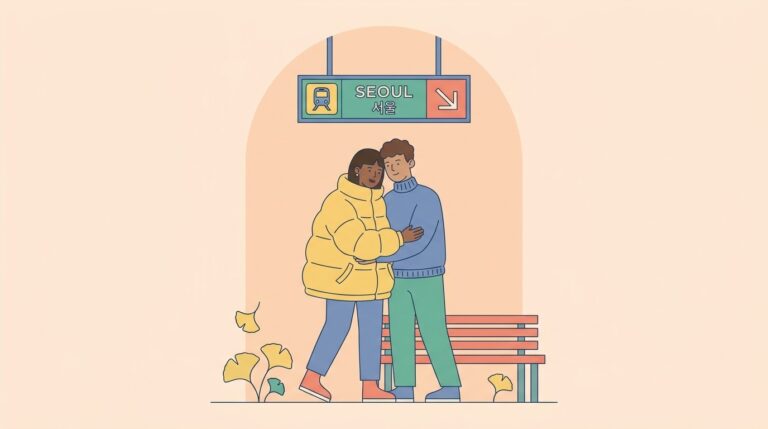
Picture this: You just stepped out of Hongik University Station Exit 9 on a buzzing Friday evening. The neon signs are flashing, street buskers are tuning their guitars, and a sea of stylish people is moving past you. Your Korean friend texts: “Where are you? I’m right in front of the exit!” You look around frantically, your phone buzzing in your palm, but everyone seems to be wearing oversized black puffer jackets. You type back in panic: “What color clothes are you wearing?”
Did you freeze trying to remember how to say basic colors in Korean, or did you mix up color nouns with adjectives? You are not alone! Over 80% of beginner Korean learners struggle when switching between color words like geom-eun-saek (black color) and geom-jeong or describing daily outfits smoothly.
This guide is crafted straight from real classroom pain points to give you the exact phrases, pronunciation hacks, and cultural context you need. By the end of this lesson, you will spot your friends in crowded K-pop concerts, navigate Hongdae fashion boutiques, and describe your outfit like a true Seoulite!
Phase 2: 3 Core Expressions In-Depth
1. 무슨 색 옷 입었어요? (Museun saek ot ib-eosseoyo?)
- Pronunciation: Moo-seun sek ot ee-beoss-eo-yo? (Think “moose” + “sun”, then “sec” as in second, and “eat” with a soft ‘b’ sound blending into ‘eo’).
- Meaning: Literal: “What color clothes did you wear?” | Real Nuance: “What color are you wearing right now?”
- K-Culture Moment: Used constantly when meeting friends at packed spots like Gangnam Station Exit 10 or Han River parks during picnic season.
- Editor’s Insight: In Korean, describing what you are currently wearing uses the past tense verb 입었어요 (ib-eosseoyo) because the action of putting the clothes on happened before this moment.
- Situation Spectrum: Casual: ⚠️ (Use ‘무슨 색 옷 입었어?’) | Semi-formal: ✅ | Formal: ✅ (‘어떤 색상의 옷을 착용하셨습니까?’)
- 🤔 Think About It: In English, we use present continuous (“What are you wearing?”), but Korean views clothing as an existing state resulting from a past action. How does this shift your perception of time in language?
2. 저 파란색 니트 입었어요. (Jeo paran-saek niteu ib-eosseoyo.)
- Pronunciation: Jeo pah-rahn-sek nee-teu ee-beoss-eo-yo.
- Meaning: Literal: “I blue knit wore.” | Real Nuance: “I’m wearing a blue knit sweater.”
- K-Culture Moment: In K-Dramas, whenever a blind date (소개팅, sogaeting) happens at a cafe, the classic cue over the phone is naming your top’s color.
- Editor’s Insight: Simply attaching -색 (saek) to color roots turns them into clear descriptive markers: Ppal-gan-saek (Red), No-ran-saek (Yellow), Pa-ran-saek (Blue), Heen-saek (White), Geom-eun-saek (Black).
- Situation Spectrum: Casual: ⚠️ (Use ‘나 파란색 니트 입었어’) | Semi-formal: ✅ | Formal: ✅
- 🤔 Think About It: Notice how Korean borrows fashion loanwords like niteu (knit) and maentumaen (sweatshirt). How do loanwords make beginner communication feel more approachable?
3. 저기 흰색 모자 쓴 사람이에요. (Jeogi heun-saek moja sseun saram-ieyo.)
- Pronunciation: Jeo-gee heen-sek mo-jah sseun sah-rahm-ee-eh-yo.
- Meaning: Literal: “I am the person over there who wore a white hat.” | Real Nuance: “I’m the one over there wearing the white cap!”
- K-Culture Moment: Airport arrival gates when meeting a tour guide, language exchange buddy, or picking up a friend from Seoul Station.
- Editor’s Insight: Korean uses specific verbs for different accessories! You wear clothes (입다, ipda), wear hats/glasses (쓰다, sseuda), and wear shoes (신다, sinda).
- Situation Spectrum: Casual: ⚠️ (Use ‘저기 흰색 모자 쓴 사람이야’) | Semi-formal: ✅ | Formal: ✅
- 🤔 Think About It: Why does Korean have distinct verbs for wearing different items on different parts of the body, whereas English often uses “wear” for everything?
Phase 3: Textbook Korean vs. Real Korean
Situation 1: Asking what color top a friend is wearing
- 📖 Textbook Korean: 당신은 어떤 색깔의 상의를 입고 있습니까? (Dangsin-eun eotteon saekkkal-ui sang-ui-reul ipgo itsseumnikka?)
- 🗣️ Real Korean: 오늘 무슨 색 입었어? (Oneul museun saek ib-eosseo?)
- 💡 Why is it different? Native speakers rarely say “상-의 (upper garment)” or use “당신 (you)” in daily chat. Dropping the subject and simplifying to “What color did you wear today?” sounds 100 times more natural.
Situation 2: Pointing out your black coat in the crowd
- 📖 Textbook Korean: 저는 검은색의 외투를 착용하고 있습니다. (Jeoneun geom-eun-saek-ui oetu-reul chagyonghago itsseumnida.)
- 🗣️ Real Korean: 나 까만 롱패딩 입었어! (Na kkaman long-paeding ib-eosseo!)
- 💡 Why is it different? Koreans frequently use the descriptive word 까만 (kkaman) for black and refer directly to the iconic Korean fashion staple: 롱패딩 (long-paeding – long down jacket)!
Phase 4: K-Culture Deep Dive & Non-Verbal Manners
4-1. 눈치 (Nunchi) & Body Gestures
When spotting someone in Korea, never point directly with an aggressive single index finger—it can feel confrontational. Instead, do the friendly “Seoul Wave”: raise your hand slightly above shoulder height and gently flutter your hand, or point toward your own clothing with an open palm while maintaining eye contact with a bright smile. If you’re on a voice call outside, hold the phone with one hand and lift your other hand high so they can locate your silhouette.
4-2. Culture Code: The “Personal Color” Craze in Korea
If you watch K-Beauty vlogs or variety shows, you will hear everyone asking: “What is your Personal Color (퍼스널 컬러)?” Koreans divide color tones into Warm Tone (웜톤) and Cool Tone (쿨톤), matching seasonal palettes to clothes and makeup. Understanding color vocabulary isn’t just about finding friends in a crowd; it’s your gateway to shopping in Myeongdong and having lively conversation starters over Korean BBQ!
Phase 5: Real-Life Roleplay Scenario
Setting: Outside Hongik University Station Exit 9 on a chilly Saturday afternoon. Minho (민호) is waiting by the bakery holding iced Americanos, looking for his friend Sarah (사라).
- Minho: 사라 씨, 저 지금 9번 출구 앞이에요! (Sarah-ssi, jeo jigeum gubeon chulgu ap-ieyo!)
🎭 Looking around the crowded street with a phone to his ear.
“Sarah, I’m in front of Exit 9 right now!” -
Sarah: 저도 거의 다 왔어요! 지금 사람 너무 많네요. (Jeodo geoui da wasseoyo! Jigeum saram neomu mannTranslate: eyo.)
🎭 Walking quickly up the subway stairs.
“I’m almost there too! There are so many people right now.” -
Minho: 오늘 무슨 색 옷 입었어요? (Oneul museun saek ot ib-eosseoyo?)
🎭 Scanning the crowd to spot her.
“What color clothes are you wearing today?” -
Sarah: 저 노란색 패딩 입었어요! (Jeo noran-saek paeding ib-eosseoyo!)
🎭 Waving her bright yellow sleeve.
“I’m wearing a yellow puffer jacket!” -
Minho: 노란색 패딩이요? 혹시 모자도 썼어요? (Noran-saek paeding-iyo? Hoksi moja-do sseosseoyo?)
🎭 Squinting near the crosswalk.
“A yellow puffer? Are you wearing a hat too by any chance?” -
Sarah: 네, 베이지색 캡모자 썼어요! (Ne, beiji-saek kaep-moja sseosseoyo!)
🎭 Tapping her beige baseball cap.
“Yes, I’m wearing a beige ball cap!” -
Minho: 아, 찾았다! 저기 올리브영 앞에 있죠? 손 흔들어주세요! (Ah, chajatda! Jeogi Ollibeuyeong ap-e itjyo? Son heundeureo-juseyo!)
🎭 Raising his hand high and smiling.
“Ah, found you! You’re in front of Olive Young over there, right? Wave your hand!” -
Sarah: 네, 민호 씨 보여요! 지금 갈게요! (Ne, Minho-ssi boyeoyo! Jigeum galgeyo!)
🎭 Happily jogging across the sidewalk.
“Yes, I see you Minho! Coming right now!”
🔀 Interactive Choice Point
You are meeting a friend at a concert hall. They text: “무슨 색 옷 입었어요?” How do you reply?
- Option A:
검은색 티셔츠랑 청바지 입었어요!(Geom-eun-saek tisyeocheu-rang cheongbaji ib-eosseoyo! – I’m wearing a black T-shirt and blue jeans!)- Feedback (Best! ⭐⭐⭐): Natural, perfectly structured A1 response that includes both top and bottom!
- Option B:
빨간색 모자 입었어요.(Ppal-gan-saek moja ib-eosseoyo.)- Feedback (Bad! ❌): For hats, use 썼어요 (sseosseoyo), not 입었어요 (ib-eosseoyo)!
- Option C:
저 옷 색깔 있어요.(Jeo ot saekkkal itsseoyo.)- Feedback (Risk! ⚠️): This means “I have clothing color,” which sounds confusing and doesn’t tell your friend what you are actually wearing.
Phase 6: 10-Second Emotion Shadowing Drill
Repeat these lines out loud with the emotional tone markers and pauses (/):
[🤔 궁금하고 다급하게 / Curious & slightly hurried]
지금 / 어디예요? / 무슨 색 / 입었어요?
(Jigeum / eodi-yeyo? / Museun saek / ib-eosseoyo?)-
[✨ 반갑고 또렷하게 / Bright & cheerful]
저 / 노란색 코트 / 입었어요!
(Jeo / noran-saek koteu / ib-eosseoyo!) -
[🎉 드디어 발견해서 신나게 / Excited upon spotting]
아! / 저기 / 빨간 모자 / 보여요!
(Ah! / Jeogi / ppal-gan moja / boyeoyo!)
Phase 7: K-Culture Mini Dictionary
- 시밀러룩 (Similar-look / Si-mil-leo-ruk): Coordinated couple or group fashion where people wear matching color tones rather than identical outfits.
- 롱패딩 (Long-paeding / Rong-pae-ding): An ankle-length down winter coat, colloquially known as Korea’s “winter uniform.”
- 꾸안꾸 (Kku-an-kku / Kku-ahn-kku): Short for 꾸민 듯 안 꾸민 듯 (looking effortlessly stylish without trying too hard).
- 소개팅 룩 (Sogaeting-look / So-gae-ting-ruk): Neat, classic date attire typically composed of clean neutrals (navy, beige, black, cream).
Phase 8: Traveler’s Survival Kit
Survival Phrases TOP 3
- 이거 다른 색 있어요? (Igeo dareun saek itsseoyo?)
Pro Tip: Use this in Dongdaemun or underground shopping malls when asking for other color options. - 검은색으로 주세요. (Geom-eun-saek-euro juseyo.)
Pro Tip: Means “Please give me the black one.” Replace geom-eun-saek with any color name. - 저기 분홍색 간판 보여요. (Jeogi bunhong-saek ganpan boyeoyo.)
Pro Tip: “I see the pink signboard over there.” Helpful when describing meetup landmarks!
Editor’s Travel Note
When navigating Seoul’s busy meetup hubs like Myeongdong, Gangnam, or Hongdae, download the 네이버 지도 (Naver Map app) instead of Google Maps for pinpoint accuracy on subway exits and landmark store fronts. Remember: Korean subway exit numbers are your ultimate meeting coordinates!
Phase 9: One Step Deeper (Cultural Reflection)
In Korean culture, describing what someone is wearing is not just practical; it reflects a high-context society that values mutual consideration. Koreans constantly pay attention to surroundings and visual cues to ensure smooth encounters without inconveniencing others. When you tell your friend your jacket color before they even ask, you are demonstrating thoughtful Baeryeo (배려 – consideration).
💬 Your Turn: What color outfit are you wearing right now while reading this? Try writing “저 [Color]색 입었어요” in the comments below!
Phase 10: FAQ & Common Mistakes
Q: What is the difference between ‘파란색’ (paran-saek) and ‘파랑’ (parang)?
A: 파란색 (paran-saek) is the standard noun used in daily conversation when describing objects and clothing. 파랑 (parang) is the pure abstract noun for the color blue (often used in art, design, or poetic contexts). For daily speaking, sticking to [Color]-색 is always safe!
Q: Why do Koreans ask “무슨 색 입었어요?” in past tense instead of present tense?
A: Because the act of putting on clothes (입다) already occurred when you got dressed at home. In Korean grammatical logic, you are currently in the state resulting from that past action.
Q: Can I use ‘입다’ (ipda) for shoes and hats?
A: No! Korean uses distinct verbs: clothes are 입다 (ipda), hats/glasses/masks are 쓰다 (sseuda), and shoes/socks are 신다 (sinda).
🚨 Common Mistakes Board
- ❌ 빨간색 신발 입었어요. ➔ ✅ 빨간색 신발 신었어요. (Always use sinda for shoes!)
- ❌ 무슨 색깔을 있어요? ➔ ✅ 무슨 색 있어요? / 무슨 색 입었어요? (Don’t confuse existence verbs with clothing verbs).
- ❌ 블랙 색 입었어요. ➔ ✅ 검은색 입었어요. (While English loanwords exist, stick to native color roots for natural Korean).
Phase 11: Action Missions
- 🥉 Bronze Mission (Solo Practice): Stand in front of your mirror and say out loud what you are wearing: “저 오늘 [Color]색 옷 입었어요!”
- 🥈 Silver Mission (Social Share): Snap a quick photo of your shoes or coffee mug and post a story with the Korean caption: “[Color]색 좋아해요!” (I like [Color]!)
- 🥇 Gold Mission (Real Life Action): The next time you message a language partner or meet someone in Korea, text them your top’s color in Korean first!
- 🎮 K-Culture Mission: Watch any K-drama episode and spot a scene where characters meet up in a public place. Listen closely for color words like Heen-saek (white) or Kkaman-saek (black)!
Phase 12: Interactive Quiz Challenge
Q1. Fill in the blank:
“저 오늘 노란색 모자 _____.” (I wore a yellow hat today.)
1) 입었어요
2) 썼어요
3) 신었어요
Q2. True or False:
In Korean, asking “무슨 색 옷 입었어요?” uses the past tense verb because putting on clothes is an action completed prior to meeting. ( T / F )
Q3. Situation Check:
You want to tell your friend you are wearing white sneakers. Which sentence is correct?
A) 흰색 신발 신었어요.
B) 흰색 신발 입었어요.
C) 흰색 신발 썼어요.
👉 Click here to reveal Answers & Explanations!
- Q1 Answer: 2) 썼어요 (Hats and caps always take the verb 쓰다/썼어요).
- Q2 Answer: True (T) (Korean frames clothing state with past completed action).
- Q3 Answer: A) 흰색 신발 신었어요. (Shoes and footwear strictly take 신다/신었어요).







