

Phase 1: 공감 (Story-driven Opening)
안녕하세요! 매일한글 에디터입니다.
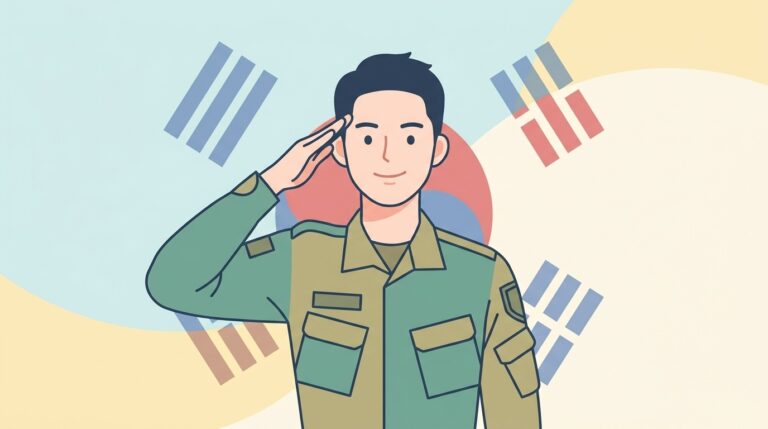
Have you ever watched your favorite K-Drama actor or beloved K-Pop idol stand in front of flashing cameras with short hair, raising their right hand sharply to their brow and shouting, “충성! (Chungseong!)”? Or maybe you’ve watched hit dramas like Crash Landing on You or Descendants of the Sun and wondered why military greetings feel so dramatic, emotional, and deeply respected in Korea.
When foreign learners first encounter Korean military greetings, it often feels like an intimidating, rigid world. You might wonder: “When is it actually okay to say ‘Chungseong’? Can I say it playfully to my Korean friends, or will it be offensive? What does it really mean?”
Don’t worry! Military culture in Korea isn’t just about the armed forces; it is deeply embedded in everyday idioms, workplace hierarchy, entertainment shows, and heartfelt farewells. In this guide, based on real feedback from beginner learners, we will break down the iconic military salute greetings into easy, fun, and culturally respectful steps so you can sound natural, whether you’re supporting your bias or chatting with Korean friends.
Phase 2: 핵심 표현 3선 심층 분석 (Top 3 Essential Expressions)
1. 충성! (Chungseong!)
- Pronunciation: [Chung-seong] (Sounds like choong-sung, rhymes with the English word song with an airy ung sound)
- Meaning: Literal: “Loyalty!” | Real Nuance: The classic Korean Army salute used to demonstrate absolute respect, discipline, and unity.
- K-Culture Moment: Captain Yoo Si-jin raising a crisp salute in Descendants of the Sun, or K-Pop idols greeting the press on their military enlistment day.
- Editor’s Insight: While “Chungseong” is the standard salute for the Republic of Korea Army, it is also playfully used among close friends or junior colleagues as a humorous way to say, “Yes, Boss! I’ll do it right away!”
- Situation Spectrum:
- Casual (with close friends as a joke): ✅
- Semi-formal (in a casual workplace): ⚠️
- Formal (business meeting/elderly): 🚫 (Use standard honorifics instead)
- 🤔 Think About It: Why do you think Korean military greetings use moral virtues (like ‘loyalty’) as standard hello/goodbye greetings?
2. 필승! (Pilseung!)
- Pronunciation: [Pil-seung] (Sounds like peel-sung, start with a quick peel and end with seung)
- Meaning: Literal: “Certain Victory!” | Real Nuance: The official salute motto for the ROK Navy, Air Force, and Marines.
- K-Culture Moment: Marine characters or Navy officers in action films shouting before embarking on a mission.
- Editor’s Insight: Different branches of the military have distinct salutes! If your favorite star enters the Marines or Navy, they will shout Pilseung! instead of Chungseong!
- Situation Spectrum:
- Casual: ✅
- Semi-formal: ⚠️
- Formal: 🚫
- 🤔 Think About It: In your native country, do different military units or emergency services use specific battle cries when greeting each other?
3. 몸 건강히 잘 다녀오겠습니다! (Mom geonganghi jal danyeo-ogess-seumnida!)
- Pronunciation: [Mom geon-gang-hi jal da-nyeo-o-get-seum-ni-da] (Mom like mother, gun-gang-hee, jal, dah-nyuh-oh-get-seum-nee-dah)
- Meaning: Literal: “I will go and return in good health!” | Real Nuance: The standard, heartfelt farewell expression someone says right before leaving for military service or a long, demanding journey.
- K-Culture Moment: The classic tearful press conference where a K-Pop idol promises fans they will serve faithfully and return safely.
- Editor’s Insight: This sentence pairs perfect grammar with emotional sincerity. As a supporter, you can reply: “몸 건강히 잘 다녀오세요!” (Please stay healthy and come back safely!).
- Situation Spectrum:
- Casual: ✅
- Semi-formal: ✅
- Formal: ✅
- 🤔 Think About It: Notice how Korean culture prioritizes health and safe return over personal glory when saying goodbye.
Phase 3: 교과서 한국어 vs 진짜 한국어 (Textbook vs. Real Korean)
Situation 1: Cheering for someone leaving for military service
- 📖 교과서 한국어 (Textbook): 군 복무를 성실히 수행하십시오. (Gun bongmureul seongsilhi suhaenghasipsio. / “Perform your military duty faithfully.”)
- 🗣️ 진짜 한국어 (Real-life): 다치지 말고 건강하게 전역하자! (Dachiji malgo geonganghage jeon-yeokhaja! / “Don’t get hurt, and let’s get discharged in good health!”)
- 💡 왜 다를까?: Official textbooks teach rigid public duty phrases, but real Koreans care most about safety, not getting injured, and the countdown to discharge (전역, jeon-yeok).
Situation 2: Playfully acknowledging a request from a friend
- 📖 교과서 한국어 (Textbook): 당신의 지시를 따르겠습니다. (Dangsin-ui jisireul ttareugessseumnida. / “I will obey your command.”)
- 🗣️ 진짜 한국어 (Real-life): 충성! 바로 하겠습니다! (Chungseong! Baro hagess-seumnida! / “Loyalty! I’ll do it right away, cap!”)
- 💡 왜 다를까?: Friends often mimic military discipline with a sharp “Chungseong!” to inject humor into mundane favors.
Phase 4: K-Culture 딥다이브 & 비언어적 매너 (Deep Dive & Manners)
4-1. 눈치 (Nunchi) & Non-Verbal Gestures
- Salute Angle: The edge of your index finger should touch the outer tip of your right eyebrow. Your palm must not show forward; keep your hand completely straight in line with your forearm.
- Eye Contact: When shouting Chungseong!, look directly into the senior’s eyes with confidence, not looking down at your feet.
- Tone Pitch: Military tone is sharp and punchy (다나까 / Da-Na-Kka tone). Say Chung! and snap on Seong! firmly.
4-2. 문화 코드 (Cultural Code)
In Korea, mandatory military service (병역 의무) is a rite of passage shared by almost every young man. It creates a universal shared experience across generations. When K-Pop idols enlist, it is a significant cultural event where fans display loyalty, send letters (인터넷 편지), and celebrate their eventual discharge. Understanding these greetings helps you connect with Korean friends on a deeply empathetic level.
Phase 5: 실전 롤플레이 시나리오 (Interactive Roleplay Scenario)
Setting: You are meeting your Korean friend, Minho (민호), at a cafe. Tomorrow is his official enlistment day (입대일).
- 민호 (Minho): 오늘 나와줘서 고마워. 내일 드디어 입대야. (Oneul nawajwoseo gomawo. Naeil deudieo ipdaeya.)
- 🎭 Minho smiles nervously, rubbing his freshly buzzed hair.
- You: 머리 자르니까 진짜 군인 같다! (Meori jareunikka jinjja gun-in gatda!)
- 🎭 You offer a warm, encouraging smile.
- 민호 (Minho): 어색하지? 내일 훈련소 들어가면 실감 날 것 같아. (Eosaekhaji? Naeil hullyeonso deureogamyeon silgam nal geot gata.)
- 🎭 Minho looks slightly anxious but determined.
- You: 잘할 수 있을 거야. 몸 건강히 잘 다녀와! (Jalhal su isseul geoya. Mom geon-gang-hi jal danyeowa!)
- 🎭 You gently pat his shoulder.
- 민호 (Minho): 응! 멋진 군인이 돼서 돌아올게. (Eung! Meotjin gun-ini dwaeseo doraolge.)
- 🎭 Minho jokingly stands up straight.
- 민호 (Minho): 충성! 신고합니다! (Chungseong! Sin-gohamnida!)
- 🎭 Minho makes a crisp salute pose towards you.
- You: [Choose your response below]
🔀 인터랙티브 분기점 (Interactive Branching):
- Option A: “충성! 다치지 말고 밥 잘 챙겨 먹어!” (Chungseong! Dachiji malgo bap jal chaenggyeo meogeo!)
- 👉 Feedback (Best!): Perfect balance! You match his playful salute while offering genuine, warm care about his well-being.
- Option B: “당신은 국가를 위해 희생해야 합니다.” (Dangsineun gukgareul wihae huisaenghaeya hamnida.)
- 👉 Feedback (Bad): Far too rigid and impersonal. Sounds like an old propaganda broadcast!
- Option C: “충성! 매일 군대 놀이하자!” (Chungseong! Maeil gundae norihaja!)
- 👉 Feedback (Risk): Military service is demanding and serious; treating it purely as a game might feel dismissive of his real anxiety.
Phase 6: 10초 감정 섀도잉 드릴 (10-Second Emotion Shadowing Drill)
Practice reading these out loud with rhythm (/ marks a brief micro-pause):
- [💪 당당하고 씩씩하게 / Confident & Sharp]
- 충성! / 몸 건강히 / 잘 다녀오겠습니다!
- (Chungseong! / Mom geon-gang-hi / jal danyeo-ogess-seumnida!)
- [🥺 다정하고 진심을 담아 / Warm & Sincere]
- 다치지 말고 / 건강하게만 / 돌아와!
- (Dachiji malgo / geon-gang-hageman / dorawa!)
- [😆 장난스럽고 유쾌하게 / Playful & Cheerful]
- 충성! / 커피 사 오겠습니다 / 선배님!
- (Chungseong! / Keopi sa ogess-seumnida / Seonbaenim!)
Phase 7: K-Culture 미니 사전 (Mini Dictionary)
- 입대 (Ip-dae): Enlistment / Entering the military training camp.
- Usage: When someone enters active duty: “다음 주에 입대해요” (I enlist next week).
- 전역 (Jeon-yeok): Military Discharge / Completing service.
- Usage: Highly celebrated milestone: “전역을 축하합니다!” (Congratulations on your discharge!).
- 곰신 (Gomsin): Short for ‘Gomusin’ (Rubber shoes); refers to someone waiting for their partner in the military.
- Usage: Common romantic slang: “저는 1년째 곰신이에요” (I have been a military girlfriend for 1 year).
- 군대리아 (Gundaeria): A nickname for military-style DIY burgers served in the armed forces.
- Usage: Frequently featured on Korean food variety shows and convenience store collabs.
Phase 8: 여행자를 위한 생존 키트 (Traveler’s Survival Kit)
🧰 Top 3 Survival Phrases
- 충성! (Chungseong!) — Use when taking fun souvenir photos at DMZ tours or photo booths with friends.
- 군인 할인 되나요? (Gun-in hal-in doenayo?) — “Is there a military discount?” (Great to know when traveling with soldier friends in Korea).
- 수고 많으셨습니다! (Sugo maneusyeosseumnida!) — “Thank you for your hard work!” (The respectful greeting to active-duty personnel or veterans).
✈️ Editor’s Travel Note
If you are visiting tourist spots like the Korean War Memorial in Yongsan or booking a DMZ Peace Tour, check train schedules easily through the official 네이버 지도 앱 다운로드 (Naver Map application). Active soldiers often get preferential boarding and discounts across Korail trains!
Phase 9: 한 발 더 깊이 (Deeper Cultural Insight)
In many Western cultures, military service is viewed as a specialized career choice. In South Korea, however, it is a shared collective memory bridging generations of sons, brothers, fathers, and friends. The salutes you hear in daily life are not just about martial power; they represent a communal language of endurance, camaraderie, and mutual respect. When you understand the heart behind “Chungseong”, you understand the Korean spirit of sticking together through adversity.
💬 Your Turn: What is the most memorable military scene or enlistment goodbye you’ve seen in a K-Drama or K-Pop clip? Share your favorite moment in the comments below!
Phase 10: FAQ & 오해 방지 (FAQ & Common Mistakes)
Q: Can I use “Chungseong” to greet store clerks or elders in Korea?
A: No! Outside of roleplay or joking with close friends, greeting normal civilians with a military salute is considered awkward and inappropriate. Always stick to standard bows and “안녕하세요 (Annyeonghaseyo)”.
Q: Do all Korean soldiers say “Chungseong”?
A: Not all! While the Army primarily uses Chungseong, the Navy, Air Force, and Marines use Pilseung (필승). Certain special divisions even use unique unit mottos like Dan-gyeol (단결 – Unity)!
Q: Why do Korean idols cut their hair so short before enlisting?
A: Strict military hygiene and uniformity standards require a crew cut (삭발/스포츠 머리). It has become a symbolic rite of transition marking the start of their active service.
🚨 Common Mistakes TOP 3
- Saluting with the Left Hand: ❌ Saluting with the left hand is considered a major blunder in military etiquette. Always use the right hand!
- Showing the Palm: ❌ Tilting your wrist so your palm faces forward looks like a mock salute. Keep your hand flat and angled downward.
- Overusing Military Speech in Business: ❌ Ending every business sentence in “~이지 말입니다” (military slang made famous in dramas) sounds unnatural in modern civilian offices.
Phase 11: 액션 미션 & 참여 유도 (Action Missions)
- 🥉 Bronze Mission: Stand before a mirror, make a sharp right-hand salute at eyebrow level, and record yourself saying “충성!” with clear pronunciation.
- 🥈 Silver Mission: Write a short supportive message in Korean under a video or post of a celebrity currently serving in the military using “몸 건강히 다녀오세요!”.
- 🥇 Gold Mission: Use “충성! 바로 하겠습니다!” jokingly with a Korean study partner when they ask you for a quick favor.
- 🎮 K-Culture Mission: Watch an episode of Real Men (진짜 사나이) or D.P. and spot at least two different unit salutes!
Phase 12: 인터랙티브 퀴즈 챌린지 (Interactive Quiz)
1. Situation Quiz: Your close Korean friend is leaving for the Army tomorrow. What is the most natural, supportive phrase to tell him?
* A) 충성! 절대 돌아오지 마세요.
* B) 몸 건강히 잘 다녀와!
* C) 군 복무 지침을 숙지하십시오.
2. Fill-in-the-Blank: When saluting in the Korean Army, soldiers raise their right hand and shout “___!” (Chung-seong).
3. True or False: The Navy and Marine Corps use the exact same salute motto as the Army.
* [ True / False ]
🔍 Click here to reveal Answers & Explanations!
- Answer: B) 몸 건강히 잘 다녀와!
- Explanation: Expressing warm wishes for health and safety is the most natural, caring way to send off a friend.
- Answer: 충성 (Chungseong)
- Explanation: Chungseong translates to “Loyalty” and is the universal army greeting.
- Answer: False
- Explanation: The Navy and Marine Corps shout 필승 (Pilseung – Certain Victory) rather than Chungseong!
- Explanation: The Navy and Marine Corps shout 필승 (Pilseung – Certain Victory) rather than Chungseong!







