

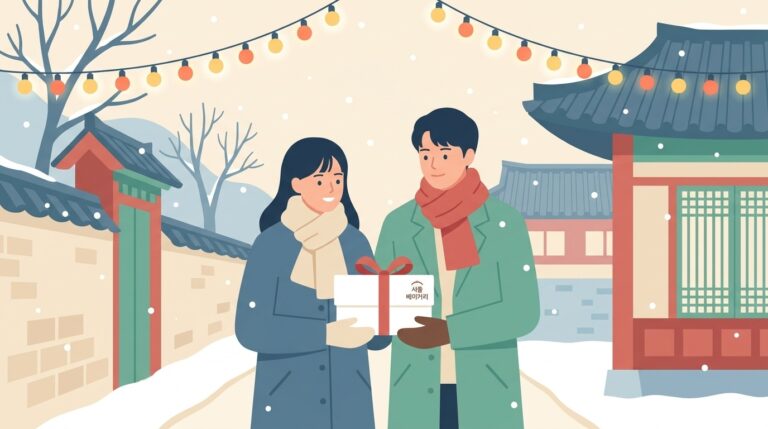
Christmas in Korea: How to Celebrate Like a True Local
Phase 1: Empathy & Story-Driven Opening
안녕하세요! 매일한글 에디터입니다. (Hello! I am your Daily Hangul editor.)
Picture this: It’s December 24th in Myeongdong, Seoul. Soft holiday carols are echoing through the crisp winter air, glowing neon lights shimmer on snow-dusted pavements, and the aroma of roasted chestnuts fills the streets. You turn to greet a Korean friend, excited to share the festive cheer, but you suddenly freeze—Wait, do people in Korea say Merry Christmas the same way? Is Christmas a family holiday here, or do people hang out with friends and dates?
If you’ve ever felt unsure about how to wish someone a happy holiday in Korean or wondered why Korean bakeries are suddenly overflowing with towering strawberry sponge cakes every December, you’re not alone! Many of our beginner learners tell us they feel nervous about using holiday greetings because they worry about sound changes or sounding too formal.
Don’t worry at all! Based on real classroom feedback and local cultural insights, this step-by-step guide is designed specifically for A1 beginners. By the end of this post, you’ll know exactly what to say, how to say it with natural confidence, and how to enjoy Christmas in Korea just like a true local.
Phase 2: Top 3 Essential Expressions
1. 메리 크리스마스! (Meri Keuriseumaseu!)
- Pronunciation: [Me-ri Keu-ri-seu-ma-seu] (Think of saying ‘Merry Christmas’ broken into smooth, even syllables without rolling your ‘R’)
- Meaning: “Merry Christmas!” (Direct & Natural nuance)
- K-Culture Moment: Heard everywhere in Seoul cafes, K-pop Christmas special stages, and cheerful holiday variety shows.
- Editor’s Insight: English loanwords are widely loved in Korea! You can say this comfortably to friends, store clerks, or colleagues without worrying about complex honorific endings.
- Situation Spectrum: Casual: ✅ | Semi-formal: ✅ | Formal: ⚠️
- 🤔 Think About It: Notice how English sounds adapt to Korean phonetics. How does your native language adapt global loanwords?
2. 크리스마스 잘 보내세요! (Keuriseumaseu jal bonaeseyo!)
- Pronunciation: [Keu-ri-seu-ma-seu jal bo-nae-se-yo] (Pronounce ‘jal’ like ‘tjal’ and ‘bonaeseyo’ smoothly like ‘bo-neh-seh-yo’)
- Meaning: Lit. “Spend Christmas well!” → Real Nuance: “Have a wonderful Christmas!”
- K-Culture Moment: What polite drama characters say when waving goodbye to coworkers before leaving the office on Christmas Eve.
- Editor’s Insight: This is the most polite and natural way to wish someone a good holiday in semi-formal situations.
- Situation Spectrum: Casual: ⚠️ (Use ‘잘 보내!’ instead) | Semi-formal: ✅ | Formal: ✅
- 🤔 Think About It: Koreans often use the verb “to spend (time)” (보내다 – bonaeda) rather than just wishing an abstract “happy” state. Why do you think spending time is emphasized?
3. 케이크 예약했어요? (Keikeu yeyakhaesseoyo?)
- Pronunciation: [Ke-i-keu ye-yak-haet-seo-yo] (Sounds like ‘cake-uh’ + ‘yeah-yakh-et-so-yo’)
- Meaning: Lit. “Did you reserve the cake?” → Real Nuance: “Did you order your Christmas cake in advance?”
- K-Culture Moment: Every Korean December vlog where people scramble to pick up their custom decorated strawberry cakes from trendy bakeries.
- Editor’s Insight: In Korea, buying a special Christmas cake is an absolute must-do tradition on December 24th and 25th!
- Situation Spectrum: Casual: ✅ | Semi-formal: ✅ | Formal: ✅
- 🤔 Think About It: Why has food (especially cake) become the universal symbol of modern celebrations across cultures?
Phase 3: Textbook Korean vs. Real Korean
Situation 1: Wishing a close friend a Happy Christmas
- 📖 Textbook Korean: 즐거운 성탄절 되십시오. (Jeulgeoun seongtanjeol doesipsio. – “Have a joyful holy birth day.”)
- 🗣️ Real Korean: 메리 크리스마스! 잘 보내! (Meri keuriseumaseu! Jal bonae! – “Merry Christmas! Have fun!”)
- 💡 Why is it different? While “성탄절” (Seongtanjeol) is the official Sino-Korean word for Christmas used in news broadcasts and church services, everyday people of all ages almost exclusively say “메리 크리스마스” in casual life.
Situation 2: Asking someone what their holiday plans are
- 📖 Textbook Korean: 크리스마스에 무슨 계획이 있습니까? (Keuriseumaseue museun gyehoegei itsseumnikka?)
- 🗣️ Real Korean: 크리스마스에 뭐 해요? (Keuriseumaseue mwo haeyo? – “What are you doing on Christmas?”)
- 💡 Why is it different? Real Korean conversations favor simple question words like “뭐 해요?” (What do you do?) over formal business nouns like “계획” (plans).
Phase 4: K-Culture Deep Dive & Non-Verbal Manners
4-1. Nunchi & Gestures: The Holiday Vibe
- The Two-Handed Handover: When gifting a holiday present or handing someone a Christmas card, always hold the item with both hands (or touch your left hand to your right forearm). It shows genuine respect and warmth.
- Couples Atmosphere: Unlike Western traditions where Christmas is primarily celebrated at home with extended family, in Korea it is largely celebrated as a romantic holiday for couples (much like Valentine’s Day). If you ask someone about their plans, keep your tone light and non-intrusive—some singles joke about “hibernating” on Christmas!
4-2. Cultural Code: The Famous Strawberry Cake & Light Festivals
During December in Korea, bakeries like Paris Baguette, Tous Les Jours, and boutique hotel patisseries showcase breathtaking Christmas cakes. It is customary to light candles, blow them out together, and share a sweet slice. Major landmarks like Shinsegae Department Store in Myeongdong and Lotte World in Jamsil transform into magical LED spectacles, drawing thousands of visitors bundled in stylish padded coats (long padding).
Phase 5: Real-Life Roleplay Scenario
Setting: December 24th evening at a cozy Hongdae cafe. You meet your Korean friend, Minho (민호), who is holding a cute red bakery box.
- 민호 (Minho): 앤디 씨, 메리 크리스마스! (Aendi ssi, meri keuriseumaseu! – “Andy, Merry Christmas!”)
🎭 Smiles brightly and hands you a hot cup of hot chocolate. - You: 메리 크리스마스, 민호 씨! (Meri keuriseumaseu, Minho ssi! – “Merry Christmas, Minho!”)
🎭 Takes the cup with both hands and bows slightly. - 민호 (Minho): 오늘 진짜 춥죠? (Oneul jinjja chupjyo? – “It is really cold today, right?”)
🎭 Pulls his warm scarf tighter around his neck. - You: 네, 정말 추워요! 손이 꽁꽁 얼었어요. (Ne, jeongmal chuwoyo! Soni kkongkkong eoreosseoyo. – “Yes, really cold! My hands are freezing.”)
🎭 Laughs and rubs hands together for warmth. - 민호 (Minho): 이거 제가 산 크리스마스 케이크예요! (Igeo jega san keuriseumaseu keikeuyeyo! – “This is the Christmas cake I bought!”)
🎭 Proudly lifts up the decorative bakery box with ribbon. - You: 와, 너무 예뻐요! 케이크 예약했어요? (Wa, neomu yeppeoyo! Keikeu yeyakhaesseoyo? – “Wow, so pretty! Did you reserve the cake?”)
🎭 Gasps happily and leans in to look at the box. - 민호 (Minho): 네! 일주일 전에 예약했어요. 같이 먹어요! (Ne! Iljuil jeone yeyakhaesseoyo. Gachi meogeoyo! – “Yes! I reserved it a week ago. Let’s eat together!”)
🎭 Unties the ribbon with excitement. - You: 고마워요! 크리스마스 잘 보내요! (Gomawoyo! Keuriseumaseu jal bonaeyo! – “Thank you! Have a great Christmas!”)
🎭 Claps hands gently in anticipation.
🔀 Interactive Branching Point
Minho offers you the first slice of cake. How do you respond?
* Choice A: “감사합니다! 잘 먹겠습니다!” (Gamsahamnida! Jal meokgetseumnida! – “Thank you! I will eat well!”)
* Feedback (Best): 🌟 Perfect! Polite, cheerful, and culturally natural before enjoying food.
* Choice B: “안 먹어요. 배불러요.” (An meogeoyo. Baebulleoyo. – “I won’t eat. I’m full.”)
* Feedback (Bad): 🚫 A bit too blunt! Even if full, it’s kinder to say “조금만 맛볼게요!” (I’ll just try a little bit!).
* Choice C: “Merry Christmas!” (in English with no Korean honorifics)
* Feedback (Risk): ⚠️ Minho will understand, but you miss a great chance to practice polite Korean dining etiquette.
Phase 6: 10-Second Emotional Shadowing Drill
[😊 Cheerful & Bright]- Sentence: 메리 크리스마스! / 오늘 / 즐겁게 보내세요!
- Romanization: Meri keuriseumaseu! / Oneul / jeulgeopge bonaeseyo!
- Meaning: “Merry Christmas! Have a joyful time today!”
[🍰 Excited & Sweet]- Sentence: 딸기 케이크 / 진짜 / 맛있겠다!
- Romanization: Ttalgi keikeu / jinjja / masitgetda!
- Meaning: “This strawberry cake looks so delicious!”
[🥺 Warm & Affectionate]- Sentence: 추우니까 / 감기 / 조심해요!
- Romanization: Chuunikka / gamgi / josimhaeyo!
- Meaning: “Because it’s cold, please be careful not to catch a cold!”
Phase 7: K-Culture Mini Dictionary
- 성탄절 (Seongtanjeol)
- Meaning: The formal/official term for Christmas (Holy Birth Day).
- Usage: Used on public holiday calendars, formal news reports, and church banners.
- 크리스마스 이브 (Keuriseumaseu Ibeu)
- Meaning: Christmas Eve (December 24th).
- Usage: Highly celebrated in Korea; often busier and livelier for dates and parties than the 25th itself.
- 솔로 크리스마스 (Sollo Keuriseumaseu)
- Meaning: “Solo Christmas” (Spending Christmas as a single person).
- Usage: Frequently joked about among single friends eating fried chicken at home while watching holiday movies.
- 눈 (Nun) / 화이트 크리스마스 (Hwaiteu Keuriseumaseu)
- Meaning: Snow / White Christmas.
- Usage: Koreans eagerly check weather forecasts to see if it will snow on Christmas morning.
Phase 8: Survival Kit for Travelers
Top 3 Survival Phrases
- 크리스마스 카드 있어요? (Keuriseumaseu kadeu itsseoyo? – “Do you have Christmas cards?”)
- Pro Tip: Stationery shops like Artbox or Kyobo Hottracks have gorgeous pop-up cards!
- 따뜻한 아메리카노 한 잔 주세요. (Ttatteutan amerikano han jan juseyo. – “One hot Americano, please.”)
- Pro Tip: Keep warm while walking through holiday light festivals.
- 사진 찍어 주실 수 있나요? (Sajin jjigeo jusil su innayo? – “Could you take a photo for me?”)
- Pro Tip: Hand over your phone politely at scenic illuminations like Myeongdong Cathedral.
Editor’s Travel Note
- During the Christmas rush, Seoul subways and streets get very crowded. For real-time transit directions and walking paths, make sure to check the Naver Map App Download Page rather than standard global GPS apps, which have limited transit data in Korea.
- Most cafes and department store pop-ups accept foreign credit cards easily (Visa/Mastercard), but keeping a T-Money transit card topped up with cash will ensure seamless travel on snowy nights.
Phase 9: A Step Deeper: Thought-Provoking Cultural Essay
In many Western cultures, Christmas is fundamentally rooted in home, family dinners, and religious traditions, while New Year’s Eve is reserved for friends and romance. In South Korea, however, this dynamic is uniquely inverted. Christmas is primarily a sparkling date night for young couples and lively friends, whereas the major family-centered holiday arrives a bit later with Seollal (Lunar New Year), where generations gather at home to pay respects and share traditional soups.
💬 Your Turn: How does your hometown celebrate Christmas compared to Korea? Are you spending it with family, close friends, or someone special this year? Let us know in the comments below!
Phase 10: FAQ & Avoiding Misunderstandings
Q: Is Christmas an official public holiday in South Korea?
A: Yes! Unlike in neighboring countries like Japan, Christmas Day (December 25th) is an official national red-day holiday (공휴일) in South Korea, meaning schools, banks, and public offices are closed, while shopping malls and restaurants stay open with buzzing crowds.
Q: Do Koreans exchange big Christmas presents?
A: Generally, major gift exchanges happen between romantic couples (like perfume, jewelry, or warm winter accessories) or for young children from their parents. Friends usually exchange small gifts, coffee coupons via KakaoTalk, or pretty holiday cards rather than piles of presents under a home tree.
Q: Can I use “메리 크리스마스” with my Korean boss or elders?
A: Yes, “메리 크리스마스!” is completely friendly and polite. However, to make it extra respectful for superiors, add: “크리스마스 연휴 잘 보내세요!” (Keuriseumaseu yeonhyu jal bonaeseyo! – “Have a wonderful Christmas holiday!”).
🚨 Common Mistakes Alert (TOP 3)
- Mistake: Pronouncing Christmas with a hard English R and swallowed syllables.
- Correct Action: Say it clearly with Korean vowel blocks: Me-ri Keu-ri-seu-ma-seu!
- Mistake: Assuming all stores close early on Christmas Eve.
- Correct Action: Seoul never sleeps! Most cafes, bakeries, and restaurants in busy districts remain open late.
- Mistake: Forgetting to book popular restaurants and cakes in advance.
- Correct Action: In Korea, holiday reservations fill up weeks ahead. Plan your special meals early!
Phase 11: Action Mission & Engagement
- 🥉 Bronze Level (Solo Practice): Stand in front of a mirror and say “메리 크리스마스! 크리스마스 잘 보내세요!” 3 times with a warm smile.
- 🥈 Silver Level (Social Practice): Send a KakaoTalk or Instagram DM greeting to a Korean friend using: “메리 크리스마스! 따뜻한 연말 보내요!”
- 🥇 Gold Level (Real Life): Order a holiday beverage or cake at a Korean bakery or cafe and wish the barista “크리스마스 잘 보내세요!” before leaving.
🎮 K-Culture Mission: Search for your favorite K-pop group’s holiday greeting video on YouTube or Instagram. Listen closely—can you hear them say “메리 크리스마스” or “케이크”?
Phase 12: Interactive Quiz Challenge
1. Situational Check
You want to politely wish your Korean language teacher a good Christmas on your last class before the holiday. What is the best phrase to say?
* A) 안녕! 크리스마스 케이크 사줘! (Hi! Buy me cake!)
* B) 선생님, 크리스마스 잘 보내세요! (Teacher, have a great Christmas!)
* C) 즐거운 성탄절 되십시오! (Ancient formal textbook style)
👉 Click to reveal Answer & Explanation
Correct Answer: B
Explanation: Option B is natural, warm, and appropriately polite with the honorific ending “-세요”. Option A is too casual and impolite for a teacher, and Option C is overly stiff for a friendly teacher-student relationship.
2. Fill-in-the-Blank
Fill in the missing word for “Did you reserve the Christmas cake?”:
크리스마스 _______ 예약했어요? (Keuriseumaseu _______ yeyakhaesseoyo?)
👉 Click to reveal Answer & Explanation
Correct Answer: 케이크 (Keikeu – Cake)
Explanation: Buying and reserving holiday cakes is a signature Korean Christmas tradition!
3. True or False Cultural Quiz
Statement: In South Korea, Christmas is exclusively celebrated as a traditional quiet family gathering at home with turkey.
👉 Click to reveal Answer & Explanation
Correct Answer: False (F)
Explanation: In Korea, Christmas is celebrated as a vibrant romantic holiday and fun social day out with couples and friends enjoying street lights, festive dinners, and cakes!







