

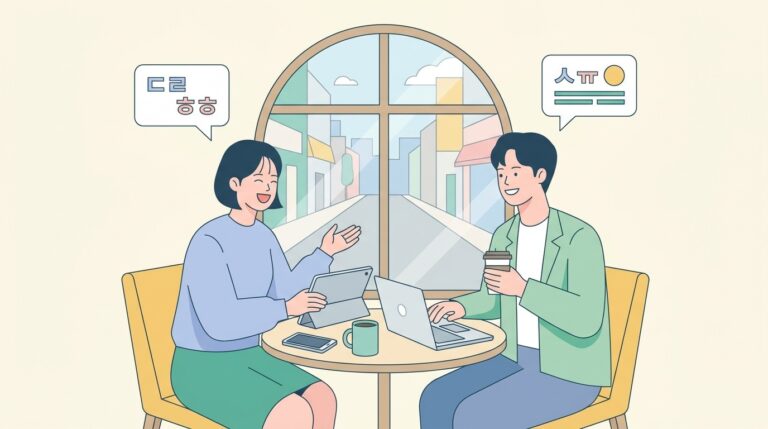
The Art of Korean Playground Banter: Decoding ‘Eojjeol-TV’ and Gen-Z Deflection Slang
Phase 1: Empathy & Immersion
안녕하세요! 매일한글 (Daily Hangul) editor here! Have you ever watched a modern K-variety clip or scrolled through Korean TikTok comments, only to be completely floored by words like 어쩔티비 (Eojjeol-TV), 안물안궁 (An-mul-an-gung), or an endless cascade of household appliances being shouted back and forth? You might have wondered, “Why are they suddenly talking about TVs and refrigerators in the middle of an argument?”
Even for learners at an advanced C2 level who have mastered complex grammatical connectors like -ㄹ진대 or sociolinguistic honorifics, Korean juvenile internet slang—often called Choding (elementary schooler) banter—remains one of the steepest pragmatic hurdles. It defies traditional semantic logic because its entire communicative purpose is conversational disruption and benign exasperation. Mastering these high-speed deflection memes will help you decode raw internet culture, banter fluently with native peers without crossing boundaries, and understand the playful linguistic subversion that defines contemporary Korean youth culture.
Phase 2: Core 3 Expressions Deep Dive
1. 어쩔티비 (Eojjeol-TV)
- Pronunciation: [Eo-jjeol-ti-bi] (Sounds like “Uh-jull” followed by “TV”)
- Meaning: Literal: “So what? Go watch TV!” | Pragmatic Nuance: “So what? What are you gonna do about it? Cry about it to your screen!”
- K-Culture Moment: Popularized massively via SNL Korea’s “Insa Challenge” sketches and streaming platforms, where characters counter any valid critique by rapid-firing brand names and screen gadgets.
- Editor’s Insight: Derived from 어쩌라고 (Eojjeorago – So what?) contracted with TV. It is an intentionally childish rhetorical dead-end. If someone tries to escalate, the speaker counters with higher-end electronics like “저쩔냉장고” (Jeojjeol-naengjanggo – So what, go stare at a fridge!) or “어쩔다이슨청소기” (Eojjeol-Dyson-cheongssogi – So what, Dyson vacuum!).
- Situation Spectrum: Casual: ✅ | Semi-formal: ⚠️ | Formal: 🚫
- 🤔 Think About It: How does your native language create nonsensical “brush-off” phrases (like “Talk to the hand” or “L + Ratio”), and why do cultures gravitate toward absurdist humor to neutralize conflict?
2. 안물안궁 (An-mul-an-gung)
- Pronunciation: [An-mul-an-gung] (Rhythmically bounces like “Ahn-mool-ahn-goong”)
- Meaning: Literal: “Didn’t ask, not curious.” | Pragmatic Nuance: “Nobody asked for your opinion, and frankly, nobody cares.”
- K-Culture Moment: Frequently spotted in community bulletin boards (DC Inside, theqoo, Instagram comments) when someone posts unprompted TMI (Too Much Information) or preachy moralizing advice.
- Editor’s Insight: Portmanteau of 안 물어봤고 (didn’t ask) + 안 궁금해 (not curious). While it sounds blunt, among close friends it is delivered with a deadpan or cheeky facial expression to playfully dismiss long-winded bragging.
- Situation Spectrum: Casual: ✅ | Semi-formal: 🚫 | Formal: 🚫
- 🤔 Think About It: Contrast the directness of 안물안궁 with the traditionally indirect, face-saving norms of Korean high-context communication. What does this contrast say about modern internet anonymity?
3. 킹받네 (King-bat-ne)
- Pronunciation: [King-ban-ne] (The ‘d’ assimilates into an ‘n’ sound before ‘ne’: King + Bat + Ne -> King-ban-ne)
- Meaning: Literal: “King-annoyed!” | Pragmatic Nuance: “This is so irritatingly hilarious / I am begrudgingly ticked off.”
- K-Culture Moment: Originating from Twitch streamer CalmDownMan (Lee Mal-nyeon), this term evolved into an indispensable reaction phrase across all Korean social media platforms.
- Editor’s Insight: Formed by prefixing the English word “King” (used as an intensifier) to 열받네 (Yeol-bat-ne – I’m getting heated). It conveys that specific feeling when someone hits you with an undeniably annoying comeback like 어쩔티비 and you can’t help but laugh while fuming.
- Situation Spectrum: Casual: ✅ | Semi-formal: ⚠️ | Formal: 🚫
- 🤔 Think About It: How does blending English loan-words as superlative prefixes (“King-“, “God-“) reshape the pragmatic tone of native Korean emotional expressions?
Phase 3: Textbook Korean vs. Real Korean
Scenario A: Dismissing Unsolicited Advice from a Close Friend
- 📖 Textbook Korean: “그 의견은 제가 물어보지 않았고 별로 궁금하지도 않습니다.” (Geu uigyeoneun jega mureoboji anatgo byeollo gunggeumhajido anseumnida. – I did not ask for that opinion, nor am I particularly curious.)
- 🗣️ Real Korean: “응~ 안물티비~ 안궁세탁기~” (Eung~ an-mul-ti-bi~ an-gung-se-tak-gi~ – Yeah whatever, didn’t-ask TV, not-curious washing machine~)
- 💡 Why the difference? Textbook phrasing sounds excessively passive-aggressive and robotic. In casual youth banter, rhyming gadgets creates an absurdist, self-aware barrier that diffuses tension with humor.
Scenario B: Reacting to Playful Teasing
- 📖 Textbook Korean: “당신의 농담 때문에 제가 정말 화가 나려고 합니다.” (Dangsin-ui nongdam ttaemune jega jeongmal hwaga naryeogo hamnida. – Your joke is really starting to make me angry.)
- 🗣️ Real Korean: “와, 진짜 킹받네? 뇌절하지 마라.” (Wa, jinjja king-ban-ne? Noejeol-haji mara. – Wow, that is supremely annoying? Don’t push it too far / know when to stop.)
- 💡 Why the difference? Real spoken Korean among peers favors punchy, meme-ified psychological descriptors (킹받다, 뇌절) over literal emotional declarations.
Phase 4: K-Culture Deep Dive & Non-Verbal Manners
4-1. 눈치 (Nunchi) & Gestures
When using elementary banter like 어쩔티비, the physical execution dictates whether you are being playful or legitimately obnoxious:
* The Head Tilt & Sarcastic Smile: Native speakers often deliver these phrases with an exaggerated head tilt, slightly puffed cheeks, or rhythmic shoulder shrugging. This makes the parody obvious.
* The Tempo Rule: The delivery must be rapid-fire without pauses. Hesitation ruins the comedic rhythm.
* Reading the Room (Nunchi): Never use these terms in vertical hierarchy situations (with bosses, professors, or in-laws), unless it is an explicitly agreed-upon comedy bit.
4-2. The Cultural Phenomenon of “Jammin-i” (잼민이) Discourse
The explosion of 어쩔티비 reflects the emergence of Jammin-i culture—a slang term originally describing younger elementary school netizens that broadened into a cultural archetype. Korean variety television shows (like Earth Arcade and Amazing Saturday) regularly pit veteran entertainers against Gen-Z idols in rapid slang battles, transforming playground bickering into mainstream pop entertainment.
Phase 5: Real-Life Roleplay Scenario
Setting: A casual café in Hongdae. Minho (26) and Sora (25), two close university friends, are bantering over who should pay for dessert after losing an arcade bet.
- Minho: 야, 솔직히 아까 철권 게임 내가 봐준 거 알지? 네가 와플 사야 됨. (Ya, soljikhi akka cheol-gwon geim naega bwajun geo alji? Nega wapeul saya doem.)
🎭 [Smirking while leaning back in his chair](“Hey, you know I went easy on you in Tekken earlier, right? You should buy the waffles.”) - Sora: 어쩔티비? 내가 이겼쥬? 약 오르쥬? (Eo-jjeol-ti-bi? Naega igyeot-jyu? Yak o-reu-jyu?)
🎭 [Wiggling her index fingers playfully](“So what? I won, didn’t I? Upset, aren’t you?”) - Minho: 저쩔냉장고! 팩트는 내가 콤보 기술 안 썼다는 거임. (Jeo-jjeol-naeng-jang-go! Paek-teu-neun naega kombo gisul an sseot-da-neun geo-im.)
🎭 [Narrowing his eyes with exaggerated frustration](“So what, refrigerator! The factual truth is I held back my combo attacks.”) - Sora: 안물안궁~ 어쩔스타일러~ (An-mul-an-gung~ eo-jjeol-seu-ta-il-leo~)
🎭 [Looking away while pretending to check her nails](“Didn’t ask, don’t care~ So what, LG Styler clothing care system~”) - Minho: 크큭, 진짜 킹받게 하네… 어디까지 가나 보자. 어쩔비스포크? (Keukeuk, jinjja king-bat-ge ha-ne… eodi-kkaji gana boja. Eo-jjeol-bi-seu-po-keu?)
🎭 [Laughing reluctantly while rubbing his forehead](“Pfft, you are truly king-annoying… let’s see how far you take this. Eojjeol-Bespoke fridge?”) - Sora: 저쩔초고속진공블렌더! 꼬우면 와플 사든가! (Jeo-jjeol-cho-go-sok-jin-gong-beul-len-deo! Kkow-u-myeon wapeul sadeun-ga!)
🎭 [Clapping hands together in mock triumph](“Jeojjeol ultra-high-speed vacuum blender! If you’re salty, go buy the waffles!”) - Minho: 알았다, 졌어. 뇌절하기 전에 내가 산다. (Aratda, jyeosseo. Noejeol-hagi jeone naega sanda.)
🎭 [Reaching for his card with a grin](“Alright, I give up. Before our brains short-circuit, I’ll pay.”) - Sora: 나이스! 잘 먹겠습니다~ (Na-i-seu! Jal meok-get-seum-ni-da~)
🎭 [Bowing happily with mock gratitude](“Nice! Thanks for the meal~”)
🔀 Interactive Choice Point
How would you intervene if you were sitting with Minho and Sora?
* Option A: “저기요, 두 분 다 진정하시고 문법적으로 올바른 한국어를 구사해 주세요.” (Pardon me, please calm down and use grammatically standard Korean.)
* Option B: “어쩔최신형식기세척기! 와플에 아이스크림 추가는 필수지!” (Eojjeol latest-model dishwasher! Adding ice cream to the waffle is mandatory!)
* Option C: “네가 틀렸어. 민호 말이 맞으니까 와플 네가 사.” (You are wrong. Minho is right, so you buy the waffle.)
Feedback:
* Option A (Bad): Ruins the social atmosphere. Playground banter relies on intentional grammatical breakdown for humor.
* Option B (Best): Matches the escalating electronic appliance meme, joining the playful dynamic seamlessly.
* Option C (Risk): Takes a joke contest literally, killing the comedic banter.
Phase 6: 10-Second Emotion Shadowing Drill
Practice reading these rhythmically with the indicated emotion markings and breath pauses (/):
[😏 약 올리듯이 / Smug & Taunting]- Sentence: “어쩔티비? / 저쩔냉장고? / 아무것도 못 하쥬?”
- Romanization: “Eo-jjeol-ti-bi? / Jeo-jjeol-naeng-jang-go? / A-mu-geot-do mot ha-jyu?”
- (So what, TV? / So what, fridge? / You can’t do anything about it, can ya?)
[😤 어이없고 헛웃음 나오게 / Half-amused Exasperation]- Sentence: “와, / 진짜 킹받네… / 어디서 그런 말을 배워왔냐?”
- Romanization: “Wa, / jinjja king-ban-ne… / eodiseo geureon mareul bae-wo-wat-nya?”
- (Wow, / that is so king-annoying… / where on earth did you learn that?)
[✋ 장난을 끝내며 쿨하게 / Calling a Ceasefire]- Sentence: “거기까지만 해라, / 뇌절치지 말고 / 밥이나 먹으러 가자.”
- Romanization: “Geogi-kkaji-man hae-ra, / noejeol-chiji malgo / bab-ina meog-eureo ga-ja.”
- (Keep it right there, / don’t overdo the joke / let’s just grab food.)
Phase 7: K-Culture Mini Dictionary
- 잼민이 (Jam-min-i)
- Meaning: Elementary schooler netizen; used colloquially to describe anyone behaving childishly or trolling online.
- Real-world Use: “쟤 하는 짓 보면 완전 잼민이야.” (Look at how he acts, he’s such a kid.)
- 뇌절 (Noe-jeol)
- Meaning: Overdoing a joke until it becomes cringe or unfunny (Short-circuiting one’s brain).
- Real-world Use: “그 밈은 1절만 해야지, 뇌절하면 노잼이야.” (You should only do one verse of that meme; if you overdo it, it’s not funny.)
- 팩폭 (Paek-pok)
- Meaning: “Fact Violence” (팩트 폭행) — Delivering a brutally undeniable truth.
- Real-world Use: “와, 너 말 너무 심하다. 완전 팩폭이네.” (Whoa, that was harsh. Pure fact-violence.)
- 쿠쿠루삥뽕 (Kukuru-bbing-bbong)
- Meaning: An onomatopoeic taunt popularized by donation TTS (text-to-speech) bots on Korean live streams.
- Real-world Use: Shouted playfully when someone makes a silly blunder in a video game.
Phase 8: Traveler’s Survival Kit
Top 3 Street/Online Slang Survival Tips
- Use self-deprecatingly first: If you make a mistake in a game with Korean friends, drop a quick “아, 킹받네!” (Ah, king-annoying!) to show you are self-aware.
- Avoid using against service staff: Never utter 어쩔티비 or 안물안궁 to cab drivers, waiters, or clerks, even in jest.
- Notice the tone shift: If someone answers your slang with formal ending -시지요 or silence, immediately pivot back to standard polite speech (존댓말).
Editor’s Travel Note
When navigating Korea’s hyper-connected digital landscape, checking real-time community reviews will expose you to tons of modern slang. To find trendy hangout spots where local university students banter like this, check the search results on the Naver Map Application.
Phase 9: A Step Deeper (한 발 더 깊이)
Why does a society characterized by strict linguistic hierarchy produce expressions like 어쩔티비? In linguistic pragmatics, Korean places heavy structural demands on speakers to encode respect, social distance, and modesty in every predicate. 어쩔티비 functions as a deliberate, harmless pressure release valve. By substituting logical rebuttal with absurd electronics, speakers subvert conversational tension without engaging in genuine profanity. It is linguistic play at its purest—a momentary escape from social hierarchies.
💬 Your Turn: Have you ever encountered a slang phrase in Korean that completely baffled you until you learned the cultural backstory? Share your favorite meme phrases in the comments below!
Phase 10: FAQ & Common Mistakes
Q: Is 어쩔티비 considered swear words or profanity (욕설)?
A: No, it contains zero profanity. However, because its pragmatic intent is to taunt or deflect, using it with someone older or in a formal setting is considered extremely rude.
Q: Why do people add random appliance names like 다이슨 (Dyson) or 스타일러 (Styler)?
A: It started as an escalation game among kids: the more expensive and specific the household appliance, the more absurd and unbeatable the comeback felt.
Q: How do you gracefully end a banter war when someone keeps repeating 어쩔티비?
A: You can say, “이제 1절만 하자” (Let’s stop at verse 1) or “그만 뇌절해라~” (Stop overplaying the meme) with a lighthearted smile.
🚨 Common Mistakes Board
- Mistake 1: Using 어쩔티비 in text messages with professors or coworkers.
- Correct Action: Reserve strictly for peer-level group chats (동갑/친구).
- Mistake 2: Mispronouncing 킹받네 as [King-bad-ne] instead of nasal assimilation [King-ban-ne].
- Correct Action: Smoothly assimilate the ‘d’ into ‘n’ -> [King-ban-ne].
- Mistake 3: Taking 안물안궁 as a personal attack during lighthearted games.
- Correct Action: Recognize it as standard meme banter and counter with humor instead of offense.
Phase 11: Action Mission
- 🥉 Bronze Mission (Solo Practice): Say “어쩔티비 저쩔냉장고 안물안궁 킹받네” in under 3 seconds without stumbling over the rhythm.
- 🥈 Silver Mission (Social Recognition): Spot one instance of 킹받다 or 어쩔티비 in a Korean YouTube comment section or webtoon and identify what provoked it.
- 🥇 Gold Mission (Real Application): Drop a lighthearted “완전 킹받네!” when your Korean study buddy playfully beats you at a vocabulary game.
- 🎮 K-Culture Mission: Watch a clip of SNL Korea’s Insa Challenge or a variety show like Running Man to observe the facial expressions paired with these memes.
Phase 12: Interactive Quiz Challenge
1. Situational Judgment
Which response is most culturally natural when your close peer says, “야, 너 오늘 옷 스타일 좀 특이하다?” (Hey, your outfit style is a bit strange today?)
a) “선생님, 실례지만 조용히 해주십시오.”
b) “어쩔티비? 내 스타일인데?”
c) “저의 의복 양식에 대해 비판하지 마세요.”
👉 Click to reveal answer
Correct Answer: b) “어쩔티비? 내 스타일인데?”
Explanation: Among close friends, brushing off light aesthetic teasing with 어쩔티비 is natural, funny, and defuses potential insecurity with playfulness.
2. Fill in the Blank
Complete the dialogue:
A: “너 게임 진짜 못한다!”
B: “와, 진짜 (_______)! 한 판 더 해!”
(Hint: A slang word meaning ‘supremely annoyed / tilted’ in a funny way)
👉 Click to reveal answer
Correct Answer: 킹받네 (King-ban-ne)
Explanation: Expresses the playful frustration of losing a game without turning toxic.
3. True / False Cultural Check
Statement: “안물안궁 can be politely used in a business meeting if you wish to indicate that an agenda item is not relevant to your department.”
👉 Click to reveal answer
Correct Answer: False (F)
Explanation: 안물안궁 is strictly informal youth slang. In a corporate meeting, you should say: “해당 안건은 저희 부서 소관이 아니어서 논의 대상에서 제외하고자 합니다.”







