

Never Fear Asking for Refills: How to Ask for More Banchan Like a Pro
Phase 1: Empathy (Story-Immersive Opening)
안녕하세요! I’m your editor at Daily Hangul.
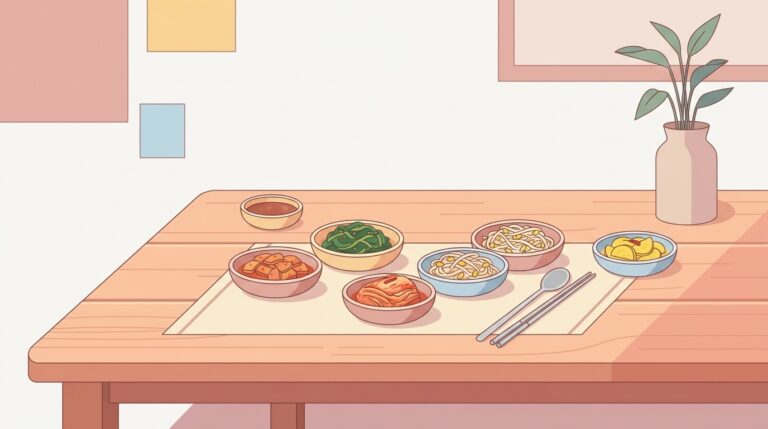
Picture this: You are sitting at a bustling Korean barbecue joint in the heart of Hongdae, Seoul. The aroma of sizzling pork belly fills the air, and around your table sits an array of tiny, colorful ceramic bowls filled with mouthwatering pickled radishes, seasoned spinach, spicy kimchi, and sweet glazed potatoes. You take a bite of the rolled egg omelet—it is heavenly. Within two minutes, the bowl is completely empty.
Your stomach screams for another serving, but a sudden wave of panic freezes you. Is it rude to ask for more? Do they charge extra? How on earth do I catch the busy server’s attention without shouting awkwardly?
If you have ever stared longingly at an empty banchan (side dish) bowl while feeling completely tongue-tied, you are not alone! Over 80% of our beginner students tell us that asking for side dish refills was their biggest hurdle during their first week traveling in Korea. Today, we are going to give you the golden key to unlock Korea’s world-famous free refill culture. By the end of this guide, you will order extra side dishes with zero hesitation and total confidence!
Phase 2: Top 3 Core Expressions In-Depth Breakdown
1. 반찬 더 주세요 (Banchan deo juseyo)
- Pronunciation: [bahn-chan duh joo-seh-yo] (Think: “Bahn” as in Vietnamese banh mi + “duh” like a friendly nod + “juseyo” like juice-say-yo)
- Meaning: Literal: “Side dish more please.” / Real Nuance: “Could we please have some more side dishes?”
- K-Culture Moment: You will see this everywhere in K-dramas like Weightlifting Fairy Kim Bok-joo, where athletes joyfully ask for mountain-high bowls of side dishes to fuel their hearty appetites.
- Editor’s Insight: “더 (deo)” is a magic word in Korean meaning “more.” Paired with “주세요 (juseyo)” (please give me), it works in countless dining situations.
- Situation Spectrum: Casual: ⚠️ (Use 반찬 더 줘 with close friends) | Semi-formal: ✅ (Standard polite for restaurants) | Formal: ✅
- 🤔 Think About It: In many Western cultures, asking for extra side items usually incurs an extra fee on the receipt. How does knowing banchan refills are traditionally free in Korea change your feeling about asking?
2. 김치 좀 더 주세요 (Gimchi jom deo juseyo)
- Pronunciation: [gim-chee johm duh joo-seh-yo] (Think: “Gimchi” + “jom” sounding like “chum” with a gentle j sound)
- Meaning: Literal: “Kimchi a little more please.” / Real Nuance: “Could I get a bit more kimchi, please?”
- K-Culture Moment: Seen in nearly every family-meal scene in Reply 1988, where a warm neighborhood restaurant owner heaps extra kimchi onto dinner plates without a second thought.
- Editor’s Insight: Adding “좀 (jom – a little)” softens the request, making your sentence sound incredibly polite, warm, and natural rather than demanding.
- Situation Spectrum: Casual: ⚠️ | Semi-formal: ✅ (Best for everyday restaurants) | Formal: ✅
- 🤔 Think About It: Why do you think Korean uses softening words like “a little (좀)” even when you actually want a generous portion?
3. 저기요, 이거 리필 돼요? (Jeogiyo, igeo ripil dwaeyo?)
- Pronunciation: [juh-gee-yo, ee-guh ree-peel dway-yo?] (Think: “Jeo-gi-yo” + “ee-guh” + English “refill” pronounced with a Korean accent “ree-peel”)
- Meaning: Literal: “Excuse me, is this refillable?” / Real Nuance: “Excuse me, can I get a refill of this specific dish?”
- K-Culture Moment: Popular in modern food vlogs and variety shows like Street Food Fighter, whenever hosts discover a gourmet, high-end banchan (like seasoned crab or raw fish).
- Editor’s Insight: While 95% of everyday banchan are unlimited, expensive side dishes (like soy-marinated crab or bossam radish) might have an extra charge. Asking this prevents surprises.
- Situation Spectrum: Casual: ⚠️ | Semi-formal: ✅ | Formal: ✅
- 🤔 Think About It: Notice how Korean borrows the English word “refill” (리필) and adapts it with Korean verb conjugation. Isn’t language adaptation fascinating?
Phase 3: Textbook Korean vs. Real-world Korean
Situation 1: Pointing to an empty dish and asking for a refill
* 📖 Textbook Korean: 반찬을 추가로 주문하고 싶습니다. (Banchan-eul chuga-ro jumunhago sipseumnida. – I would like to order additional side dishes.)
* 🗣️ Real Korean: 저기요, 이거 더 주세요! (Jeogiyo, igeo deo juseyo! – Excuse me, more of this please!)
* 💡 Why is it different? The textbook phrase sounds like you are reading a legal contract or ordering at a 5-star hotel banquet. Everyday Korean diners simply point and say “이거 더 주세요 (More of this please).”
Situation 2: Getting the server’s attention politely
* 📖 Textbook Korean: 웨이터님, 여기로 와 주시겠습니까? (Weiteo-nim, yeogiro wa jusigesseumnikka? – Mr. Waiter, would you please come here?)
* 🗣️ Real Korean: 사장님, 여기 반찬 좀 더 주세요! (Sajangnim, yeogi banchan jom deo juseyo! – Boss/Owner, more side dishes here please!)
* 💡 Why is it different? Koreans rarely use the word “waiter.” Instead, calling the staff “사장님 (sajangnim – boss/manager)” flatters them and creates an instant friendly connection.
Phase 4: K-Culture Deep Dive & Non-Verbal Manners
4-1. 눈치 (Nunchi) & Dining Gestures
- The Soft Hand Raise: Raise your hand just up to shoulder height, make gentle eye contact, and say “저기요 (Jeogiyo).” Never snap your fingers or whistle—it is considered very rude.
- The Two-Handed Handover: When the server brings your refreshed banchan dish, receive it with both hands or touch your right wrist with your left hand. It shows respect and genuine gratitude.
- Spotting the Self-Bar (셀프 코너): Look around the restaurant walls. If you see signs saying “추가 반찬은 셀프입니다” (Additional side dishes are self-service), grab your empty small plate and refill it yourself at the banchan station!
4-2. Cultural Insight: Jeong (정) and the Banchan Tradition
In Korean dining culture, banchan is not just an appetizer; it is a manifestation of Jeong (정)—a deep emotional bond and generous hospitality. Historically, offering numerous vibrant side dishes was a host’s way of treating guests like royalty. Asking for more banchan is actually seen as a compliment to the chef’s culinary skill!
Phase 5: Live Roleplay Scenario
- Setting: A warm, traditional sundubu-jjigae (soft tofu stew) diner in Insadong.
- Character: Auntie Min (이모님), a cheerful and energetic restaurant owner wearing a floral apron.
-
Turn 1 (Learner): 🎭 Politely raising hand to shoulder height
저기요! (Jeogiyo!)
“Excuse me!” - Turn 2 (Auntie Min): 🎭 Walking over with a warm smile
네~ 손님, 필요한 거 있으세요? (Ne~ sonnim, piryohan geo isseuseyo?)
“Yes dear customer, do you need anything?” - Turn 3 (Learner): 🎭 Holding up the empty fish cake bowl
이 어묵 반찬 더 주세요. (I eomuk banchan deo juseyo.)
“Please give me more of this fish cake side dish.” - Turn 4 (Auntie Min): 🎭 Nodding enthusiastically
어머, 어묵 맛있죠? 금방 가져다줄게요! (Eomeo, eomuk masitjyo? Geumbang gajyeodajulgeyo!)
“Oh, delicious fish cake, right? I will bring it right away!” - Turn 5 (Learner): 🎭 Bowing head slightly
감사합니다! 혹시 김치도 리필 돼요? (Gamsahamnida! Hoksi gimchido ripil dwaeyo?)
“Thank you! By any chance, can kimchi be refilled too?” - Turn 6 (Auntie Min): 🎭 Laughing warmly
당연하죠! 김치는 저기 셀프바에서 마음껏 드세요~ (Dangyeonhajyo! Gimchineun jeogi selpeuba-eseo maeumkkeot deuseyo~)
“Of course! Feel free to take as much kimchi as you like at the self-bar over there~” - Turn 7 (Learner): 🎭 Standing up happily
아, 네! 감사합니다, 사장님! (A, ne! Gamsahamnida, sajangnim!)
“Ah, yes! Thank you, boss!” - Turn 8 (Auntie Min): 🎭 Pats table warmly
맛있게 많이 먹어요! (Masitge mani meogeoyo!)
“Eat lots and enjoy your meal!”
🔀 Interactive Choice Point
You just finished your favorite banchan, but the restaurant is very busy. What do you do?
* Option A: You shout across the room: “야! 반찬 가져와!” (Ya! Banchan gajyeowa! – Hey! Bring side dishes!)
* Feedback: 🚫 Bad / Disaster! “야” is extremely rude slang used only with peers, and this command sounds like an aggressive demand. Avoid at all costs.
* Option B: You wait until the staff walks nearby, raise your hand, and say: “사장님, 이거 조금만 더 주실 수 있나요?” (Sajangnim, igeo jogeumman deo jusil su innayo? – Boss, could I get a little more of this?)
* Feedback: 🏆 Best Choice! Highly polite, flattering, and natural. The staff will happily double your portion!
* Option C: You stay silent and leave hungry because you are afraid to bother anyone.
* Feedback: ⚠️ Risk / Sad outcome! Korean restaurant staff love serving proactive eaters. Don’t be shy; simply use “저기요”!
Phase 6: 10-Second Emotion Shadowing Drill
Practice reading these out loud with rhythm pauses (/) and authentic emotion:
[😊 Politeness & Warmth]
저기요! / 반찬 좀 / 더 주세요!
(Jeogiyo! / banchan jom / deo juseyo!)-
[🤤 Excited & Hungry]
이거 / 너무 맛있어요! / 더 주실 수 있어요?
(Igeo / neomu masisseoyo! / deo jusil su isseoyo?) -
[🙏 Grateful & Sweet]
감사합니다, / 사장님! / 잘 먹겠습니다!
(Gamsahamnida, / sajangnim! / jal meokgetseumnida!)
Phase 7: K-Culture Mini Dictionary
- 반찬 (Banchan) | Side dishes | Refers to small communal dishes served alongside steamed rice and soup in Korean cuisine.
- 리필 (Ripil) | Refill | A Koreanized English word used in restaurants and cafes for food/drink refills.
- 셀프 (Selpeu) | Self-service | Short for “self-service,” commonly seen on restaurant signage for water and side dishes.
- 이모님 (Imonim) | Auntie / Female restaurant staff | A loving, respectful title literally meaning “maternal aunt,” used to address friendly middle-aged female staff.
Phase 8: Traveler’s Survival Kit
Top 3 Survival Phrases
- 이거 더 주세요 (Igeo deo juseyo) – [ee-guh duh joo-seh-yo]
- Pro Tip: Simply point your finger at the empty bowl while saying this.
- 물은 셀프인가요? (Mureun selpeuingayo?) – [moo-reun sel-peu-in-gah-yo?]
- Pro Tip: In Korea, cold water is almost always self-service from the water purifier.
- 계산해 주세요 (Gyesanhae juseyo) – [gye-sahn-hae joo-seh-yo]
- Pro Tip: Say this at the counter or to your server when you are ready to pay the bill.
Editor’s Travel Note
Before exploring local eateries in Seoul or Busan, ensure you have set up the Naver Map Korean Navigation App. Unlike generic global maps, Naver Map specifies if restaurants offer self-bars and shows real customer photos of the banchan spread!
Phase 9: A Step Deeper (Reflection)
In many global dining cultures, sharing food from the same central bowl is uncommon. However, Korean table culture is founded on 공동체 문화 (Gongdongche Munhwa – Community Culture). When you share banchan from common plates and freely request more together, food transforms into a tool for social bonding and warmth.
💬 Your Turn: What is your favorite Korean side dish (kimchi, pickled radish, fish cake, or potato salad), and how does the concept of free refills compare to dining in your hometown? Leave a comment below!
Phase 10: FAQ & Avoiding Common Mistakes
Q: Are all side dish refills 100% free in Korea?
A: Everyday banchan like kimchi, beansprouts, pickled veggies, and tofu are almost always completely free and unlimited. However, expensive specialty side dishes (such as whole fried fish, seasoned raw crab, or meat platters) may cost a modest extra fee.
Q: What should I do if nobody comes when I say “저기요 (Jeogiyo)”?
A: Check the edges of your table! Modern Korean restaurants have a small wireless call button called the 벨 (bell) on the table or attached to the chopstick box. Just press it once, and staff will come right over.
Q: Is it okay to leave side dishes unfinished if I asked for a refill?
A: While there is no fine in most places, asking for refills and leaving large amounts of food behind causes food waste. It is polite to ask for only as much as you can eat (you can say “조금만 더 주세요 – Just a little more please”).
🚨 Common Mistakes Alert (TOP 3)
- Mistake: Shouting “여기 봐요! (Look here!)” to the server.
- Correct Action: Say “저기요 (Jeogiyo)” or press the call button.
- Mistake: Handing back dirty dishes with both hands full of trash.
- Correct Action: Leave the empty bowl on the table corner so the server can easily swap it.
- Mistake: Forgetting to check if it is a Self-Bar before calling the server.
- Correct Action: Look around for the “셀프 코너 (Self-Service Corner)” sign first.
Phase 11: Action Mission & Challenge
- 🥉 Bronze Level: Say “반찬 더 주세요 (Banchan deo juseyo)” out loud 5 times in front of your mirror with a bright smile.
- 🥈 Silver Level: Post an Instagram Story of your next Korean meal with the caption: “김치 좀 더 주세요! 🥢 Learning Korean with Daily Hangul.”
- 🥇 Gold Level: Visit a local Korean restaurant or K-Town diner this week and successfully request a refill in Korean without using English!
🎮 K-Culture Mission: Watch an episode of your favorite Korean food drama or variety show (like Let’s Eat or Jinny’s Kitchen) and listen for the moment customers ask for “더 주세요 (deo juseyo)”!
Phase 12: Interactive Quiz Challenge
1. Situation Question: You are eating delicious Korean BBQ, and you want more garlic and pickled onions. You see a buffet table with a sign saying “셀프 코너”. What is the best action?
* A) Shout “저기요!” and demand the server bring them.
* B) Take your empty side plate to the self-service station and take what you need.
* C) Leave the restaurant.
2. Fill-in-the-Blank:
* “김치 ___ 더 주세요!” (Please give me a little more kimchi!)
* Options: [좀 / 많이 / 안]
3. True or False: In Korea, asking for an extra plate of kimchi will usually result in an extra charge on your bill.
* [ True / False ]
🔍 Click here to view Answers & Explanations
- Answer: B | The sign “셀프 코너” means Self-Service Corner. You are encouraged to refill your own side dishes.
- Answer: 좀 (Jom) | “김치 좀 더 주세요” is the natural, polite way to ask for a refill.
- Answer: False | Standard banchan refills in Korea are culturally complimentary!







