Surviving Sickness Alone in Korea: The Emotional and Practical Guide
Phase 1: Empathy & Story-driven Opening
안녕하세요! It’s your friendly Daily Hangul editor and cultural navigator.
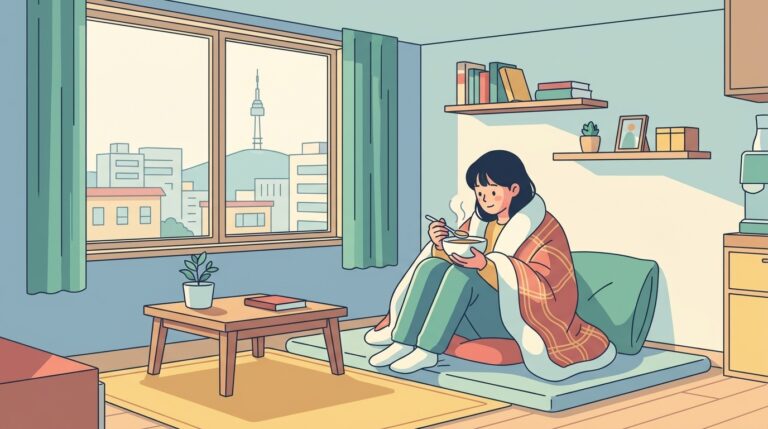
Picture this: You wake up in your small, quiet studio apartment (원룸 – wonrum) in Seoul. Your throat feels like sandpaper, your forehead is burning with fever, and outside the window, a cold rain is falling. You reach for a glass of water, only to realize the pitcher is empty. There is no family member walking in with warm soup, no roommate asking how you are doing—just the faint hum of your refrigerator. In Korean culture, there is a very specific, deeply shared emotional concept for this exact situation: “혼자 살 때 아프면 제일 서럽다” (Honja sal ttae apeumyeon jeil seoreopda — “Getting sick when living alone is the most sorrowful, heart-aching thing”).
Over the past ten years of coaching foreign residents and international students in Korea, I have seen even the toughest, most independent souls tear up during their first bad cold while living solo. It is not just about physical pain; it is the unique ache of loneliness and helplessness in a foreign country. In this guide, tailored specifically for intermediate (B1) learners, we are going to dive into the emotional vocabulary, hospital manners, and real-life phrases you need so you can navigate being sick in Korea with confidence, self-care, and cultural ease.
Phase 2: Top 3 Core Expressions
1. 서럽다 (Seoreopda)
- Pronunciation: Seo-reop-da (Sounds like suh-ruhp-da, rhymes with a soft sigh of frustration)
- Meaning: Literal: “To feel sorrowful/grieved” | Real Nuance: A bitter, tearful sadness triggered by feeling helpless, lonely, or neglected in a tough moment.
- K-Culture Moment: Seen frequently in K-dramas like Reply 1988 or Fight for My Way when a broke young adult gets a fever and cries eating instant porridge alone.
- Editor’s Insight: English words like “sad” (슬프다 – seulpeuda) or “depressed” (우울하다 – uulhada) don’t fully capture 서럽다. 서럽다 is sadness combined with a feeling of deep self-pity and missing warmth from others.
- Situation Spectrum: Casual: ✅ | Semi-formal: ✅ (서러워요 – seoreowoyo) | Formal: ⚠️ (서럽습니다 – used in reflective essays/interviews)
- 🤔 Think About It: Does your native culture have a specific word for sorrow that stems purely from having to suffer alone without someone to pamper you?
2. 입맛이 없다 (Immasi eopda)
- Pronunciation: Im-ma-si eop-da (Sounds like eem-mah-shee up-da)
- Meaning: Literal: “There is no mouth-taste” | Real Nuance: “I have completely lost my appetite due to illness or stress.”
- K-Culture Moment: When a friend or co-worker notices you leaving food untouched and asks with concern: “입맛이 없어요?” (Do you have no appetite?)
- Editor’s Insight: Koreans place massive cultural importance on eating well to recover (밥심 – bap-sim, the strength from rice). Saying 입맛이 없어요 signals to others that you are genuinely unwell.
- Situation Spectrum: Casual: ✅ (입맛 없어) | Semi-formal: ✅ (입맛이 없어요) | Formal: ✅ (입맛이 없습니다)
- 🤔 Think About It: In your culture, do people focus first on medicine or on force-feeding comforting food when someone falls sick?
3. 몸살 기운이 있다 (Momsal giuni itda)
- Pronunciation: Mom-sal gi-u-ni it-da (Sounds like mohm-sahl gee-oon-ee eet-da)
- Meaning: Literal: “Energy/signs of body ache exist” | Real Nuance: “I feel a systemic fatigue and flu-like body ache coming on.”
- K-Culture Moment: Texting your boss or manager early in the morning before work: “몸살 기운이 있어서 병원에 들렀다 가겠습니다.” (I have severe body aches, so I will visit a clinic before coming in.)
- Editor’s Insight: 몸살 (momsal) is a unique Korean somatic concept referring to full-body exhaustion and chills caused by overwork, stress, or a virus.
- Situation Spectrum: Casual: ✅ | Semi-formal: ✅ | Formal: ✅
- 🤔 Think About It: How does naming a pre-illness state (기운 – giun) help people communicate boundaries before completely collapsing?
Phase 3: Textbook Korean vs. Real Korean
Situation 1: Explaining your symptoms at the pharmacy
- 📖 교과서 한국어 (Textbook): “저는 감기에 걸렸으니 약을 주십시오.” (Jeoneun gamgie geollyeosseuni yageul jusipsio. — I caught a cold, so please give me medicine.)
- 🗣️ 진짜 한국어 (Real-life Native): “목이 따끔거리고 으슬으슬한데 감기약 좀 주세요.” (Mogi ttagkeumgeorigo euseul-euseulhande gamgiyak jom juseyo. — My throat is stinging and I have chills, could I get some cold medicine please?)
- 💡 왜 다를까? (Why the difference?): Real Korean speech relies heavily on mimetic/sensory words (의태어/의성어) like 따끔따끔 (prickling/stinging) and 으슬으슬 (shivering/chilly) to describe physical sensations precisely to pharmacists.
Situation 2: Replying to a friend asking about your condition
- 📖 교과서 한국어 (Textbook): “저는 지금 아파서 슬픕니다.” (Jeoneun jigeum apaseo seulpeumnida. — I am sick now, so I am sad.)
- 🗣️ 진짜 한국어 (Real-life Native): “혼자 앓아누우니까 괜히 맘이 서럽네.” (Honja aranuunikka gwaenhi mami seoreomne. — Being bedridden all alone just makes me feel so sorrowful and teary.)
- 💡 왜 다를까? (Why the difference?): Intermediate native speakers use natural idiomatic compounds like 앓아눕다 (to be bedridden with illness) and 괜히 (for no clear reason / spontaneously emotional).
Phase 4: K-Culture Deep Dive & Non-Verbal Manners
4-1. Nunchi (눈치) & Waiting Room Manners
When visiting a local clinic (내과 – naegwa, Internal Medicine) or ENT (이비인후과 – ib-i-in-hu-gwa) in Korea, notice the distinct non-verbal atmosphere:
* Mask Etiquette & Voice Level: Even post-pandemic, wearing a mask in medical facilities is considered basic nunchi. Speak in hushed, soft tones at the reception desk.
* Concise Symptom Summary: Korean doctors are exceptionally efficient. Before your turn, list three things in your head: when it started (언제부터), where it hurts (어디가), and your main symptom (가장 힘든 증상).
4-2. Cultural Code: The Healing Power of Juk (죽) and Delivery Apps
In Korea, you rarely eat heavy soup or bread when sick. The quintessential recovery food is 죽 (rice porridge). Brands like Bonjuk (본죽) are found in every neighborhood. When Koreans see a solitary friend fall ill, their ultimate act of caring (정 – jeong) is sending a KakaoTalk gift coupon for 전복죽 (Abalone Porridge) or 소고기야채죽 (Beef & Vegetable Porridge).
Phase 5: Real-Life Roleplay Scenario
Setting: Min-woo (Korean neighbor/friend) checks on Alex, an expat living alone in a Mapo-gu studio, who hasn’t answered messages all morning.
- Min-woo: 띵동! 알렉스, 안에 있어? 문 좀 열어봐. (Tting-dong! Alex, ane isseo? Mun jom yeoreobwa. — Ding dong! Alex, are you inside? Open up! 🎭 Knocking gently with a grocery bag in hand)
- Alex: 어, 민우야… 목소리가 안 나와서 미안. (Eo, Min-u-ya… moksoriga an nawaseo mian. — Ah, Min-woo… sorry, my voice is barely coming out. 🎭 Opening the door wrapped in a thick blanket)
- Min-woo: 아이고, 얼굴이 왜 이렇게 하얘? 열 재봤어? (Aigo, eolguri wae ireoke hayae? Yeol jaebwasseo? — Oh my goodness, why are you so pale? Did you take your temperature? 🎭 Touching Alex’s forehead with the back of his hand)
- Alex: 체온계가 없어서… 그냥 온몸이 쑤시고 으슬으슬해. (Che-on-gyega eopseoseo… geunyang onmomi ssusigo euseul-euseulhae. — I don’t have a thermometer… my whole body just aches and I have chills.)
- Min-woo: 혼자 있는데 아프면 진짜 서러운데… 약은 먹었어? (Honja inneunde apeumyeon jinjja seoreounde… yageun meogeosseo? — Being sick while living alone is truly miserable… Did you take any medicine? 🎭 Setting a thermos and pharmacy bag on the table)
- Alex: 빈속이라 아직 못 먹었어. 입맛이 통 없네. (Binsogira ajik mot meogeosseo. Immasi tong eomne. — My stomach is empty so I couldn’t. I have zero appetite at all.)
- Min-woo: 내가 오는 길에 전복죽 사 왔어. 세 숟가락이라도 먹고 약 먹자. (Naega oneun gire jeonbokjuk sa wasseo. Se sutgarag-irado meokgo yak meokja. — I bought abalone porridge on my way. Eat even just three spoonfuls and let’s take the meds. 🎭 Opening the porridge lid, steam rising)
- Alex: 진짜 고마워… 혼자 끙끙 앓다가 너 보니까 살 것 같다. (Jinjja gomawo… honja kkeung-kkeung altaga neo bonikka sal geot gatda. — Thank you so much… I was groaning in pain alone, but seeing you makes me feel like I can survive.)
🔀 Interactive Choice Point
If you were Alex, how would you respond if Min-woo asks if he should stay until you fall asleep?
* Option A: “아니야, 너한테 감기 옮기면 안 되니까 얼른 가! 그래도 죽 고마워.” (Best! Shows sincere gratitude while being considerate of the friend’s health.)
* Option B: “왜 이제 왔어? 진작 오지 그랬어.” (Bad! Blames the friend playfully but sounds genuinely ungrateful and entitled.)
* Option C: “그냥 가세요. 혼자 있는 게 편해요.” (Risk! Too stiff/formal, sounds cold and dismissive of their warm gesture.)
Phase 6: 10-Second Emotion Shadowing Drill
Practice these lines focusing on natural pause points (/) and distinct emotion markers:
[🥺 서럽고 힘없이]혼자 사는데 / 열까지 나니까 / 괜히 서럽네… (Honja saneunde / yeolkkaji nanikka / gwaenhi seoreomne… — Living alone / and now running a fever / I just feel so sorrowful…)[🤒 지치고 간절하게]목이 너무 따끔거려서 / 침 삼키기도 힘들어요. (Mogi neomu ttagkeumgeoryeoseo / chim samkigido himdeureoyo. — My throat stings so bad / that even swallowing saliva is painful.)[🙏 깊은 안도와 감사]죽 챙겨줘서 고마워, / 덕분에 살 것 같아. (Juk chaeng-gyeojwoseo gomawo, / deokbune sal geot gatda. — Thanks for bringing porridge, / thanks to you I feel like I’ll live.)
Phase 7: K-Culture Mini Dictionary
- 서러움 (Seoreoum) — The profound emotion of sorrow mixed with feeling forsaken or lonely during difficult circumstances.
- 링거 (Ring-geo / Ringer IV) — An IV drip/saline infusion. Many Korean office workers visit clinics during lunch break to get a “Ringer shot” (링거 맞다) for rapid fatigue and cold recovery.
- 상비약 (Sangbiyak) — Essential household emergency medications (e.g., Tylenol, digestive aids, band-aids) kept in the house at all times.
- 간병 (Ganbyeong) — Caring for and nursing a sick person, traditionally seen in Korea as an obligation of intimate loved ones.
Phase 8: Traveler & Expat Survival Kit
Top 3 Sickness Survival Expressions
- “종합 감기약 하나 주세요.” (Jonghap gamgiyak hana juseyo.) — Pro Tip: Say this at any pharmacy (약국) for broad-spectrum cold/flu capsules.
- “실비 보험 청구 서류 떼어 주세요.” (Silbi boheom cheong-gu seoryu tteeo juseyo.) — Pro Tip: Say this after a clinic visit to get medical receipts for your insurance claim.
- “속이 메스껍고 토할 것 같아요.” (Sogi meseukkeopgo tohal geot gatayo.) — Pro Tip: Use this to clearly describe acute nausea/food poisoning symptoms.
Editor’s Travel Note
- Install the Baedal Minjok delivery app or Yogiyo beforehand so you can order warm porridge without leaving your bed.
- Use KakaoMap app for navigation and search “야간 약국” (night pharmacy) or “달빛어린이병원/야간진료” (after-hours medical clinic) if you fall ill past 7 PM.
Phase 9: A Step Deeper (Reflection)
In traditional Korean culture, illness was never an individual problem—it was an event shared by the family (가족) and community (공동체). When you fall sick in Korea, people naturally expect someone to cook for you, wipe your forehead, and check your breathing. The surge of single-person households (1인 가구) in modern Korea has created an emotional gap where people experience physical vulnerability without the traditional community safety net. This is why 서럽다 resonates so deeply with modern young Koreans living alone in busy metropolitan areas.
💬 Your Turn: Have you ever experienced being sick alone away from home? How did you comfort yourself?
Phase 10: FAQ & Common Mistakes
Q: Can I buy effective painkillers or cold medicine at 24-hour convenience stores?
A: Yes! Convenience stores in Korea carry basic emergency items (안전상비의약품) like Tylenol, Brufen syrup, basic digestive medicine (훼스탈), and pain relief patches (파스). However, dedicated pharmacies offer much more targeted, stronger combination meds.
Q: How do I find an English-speaking doctor in Seoul?
A: You can call the 1339 Korea Disease Control helpline for medical translation or search for local international clinics in districts like Itaewon, Gangnam, or university hospitals (Sinchon Severance, Asan Medical Center).
Q: Is it okay to go straight to a university hospital when I have a common cold?
A: No, in Korea you should start with a local primary neighborhood clinic (1차 의원). Going directly to a tertiary general hospital without a doctor’s referral letter (진료의뢰서) will result in massive out-of-pocket fees and long wait times.
🚨 Common Mistakes Warning Board
- ❌ Mistake 1: Saying “약국 어디 있어요?” without checking opening hours. (Many close by 7-8 PM on weekdays!)
- ❌ Mistake 2: Using 슬퍼요 (I am sad) when talking about feeling lonely and sick. (Use 서러워요 for authentic nuance!)
- ❌ Mistake 3: Forgetting to mention preexisting allergies at Korean clinics. (Always state: “~ 알레르기 있어요” — I have an allergy to ~).
Phase 11: Action Missions
- 🥉 Bronze Level: Write down the 3 core symptoms you usually get (e.g., fever, runny nose, cough) in Korean in your notes app.
- 🥈 Silver Level: Share a story on Instagram/Threads about your comfort food when sick using the hashtag
#매일한글 #아플때서럽다. - 🥇 Gold Level: Visit a local Korean pharmacy or store and confidently ask for a specific item like 목감기약 (throat cold medicine) or 소화제 (digestive aid).
- 🎮 K-Culture Mission: Watch an episode of a slice-of-life K-drama (like Hospital Playlist or Because This Is My First Life) and spot how characters react when someone falls sick at home!
Phase 12: Interactive Quiz Challenge
1. [Situation Decision] You have a fever, chills, and an empty fridge. What is the most natural Korean sentence to text a close Korean friend for help?
* A) 저 오늘 죽을 것 같이 슬픕니다.
* B) 몸살 기운이 너무 심해서 꼼짝을 못 하겠어. 혹시 약 좀 사다 줄 수 있어?
* C) 저의 병원에 같이 동행해 주십시오.
👉 Click to reveal Answer & Explanation
Correct Answer: B
Explanation: 몸살 기운 (body ache/chills) and 꼼짝을 못 하다 (cannot move a muscle) sound natural and convey the situation accurately to a close friend without sounding overly stiff or dramatic.
2. [Fill in the Blank]
혼자 사는데 심하게 아프니까 괜히 맘이 ( ________ ). (I live alone, so getting heavily sick makes my heart feel so sorrowful/lonely.)
👉 Click to reveal Answer & Explanation
Correct Answer: 서러워요 (or 서럽다 / 서럽네)
Explanation: 서럽다 is the exact emotion word that captures feeling pity, sorrow, and loneliness when struggling by yourself.
3. [True / False Cultural Check]
In Korea, you need an official doctor’s prescription for every single painkiller and cold tablet.
👉 Click to reveal Answer & Explanation
Correct Answer: False
Explanation: Over-the-counter medications (일반의약품) like standard cold pills, Tylenol, and cough syrups can be bought directly at any pharmacy without a prescription.