

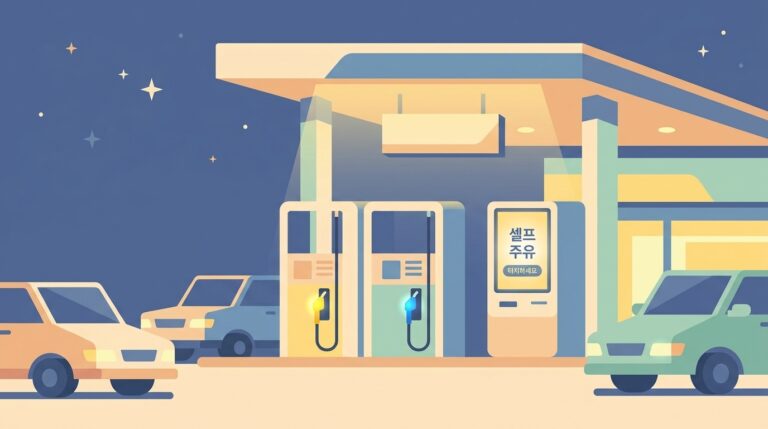
Mastering the Korean Self-Service Gas Station: From Fuel Selection to Full Tank Confidence
Phase 1: Empathy (Story-Driven Opening)
안녕하세요! 매일한글 에디터입니다. (Hello! It’s your Daily Hangul editor.)
Picture this: You’ve rented a sleek car for an unforgettable road trip along the scenic coastal cliffs of Jeju Island or the winding mountain roads of Gangwon-do. You feel just like a lead actor in a cozy healing K-drama, windows down, breeze in your hair. Then suddenly, your dashboard lights up with a relentless blinking fuel icon. You pull into the nearest brightly lit station, only to see the massive glowing sign: 셀프 (Self).
Panic kicks in as a digital voice starts barking instructions at rapid-fire speed: “정전기 방지 패드를 터치해 주세요” (Please touch the anti-static pad), while flashing buttons demand choices between 휘발유 (Gasoline) and 경유 (Diesel), along with preset won amounts. Making a mistake could ruin your rental engine—or at least leave you flustered with a line of impatient cars honking behind you.
Don’t sweat it! Having guided hundreds of intermediate learners through real-life Korean road trips, I’ve broken down the exact vocabulary, cultural quirks, and machine prompts you need. After reading this guide, you’ll handle any self-service fuel pump in Korea like a seasoned local driver.
Phase 2: Deep Dive into 3 Core Expressions
1. 가득 넣어 주세요 (Gadeuk neoeo juseyo)
- Pronunciation: [Ga-deuk neo-eo ju-se-yo] (Sounds like “GAH-deuk nuh-uh joo-seh-yo”—imagine packing a suitcase to the brim, saying ‘Gadeuk!’)
- Meaning: Literal: “Please put in fully.” / Real Nuance: “Fill it up to the top, please!”
- K-Culture Moment: Seen frequently in travel variety shows like 2 Days & 1 Night when cast members pull into highway rest stops before a long cross-country race.
- Editor’s Insight: On self-service touchscreens, you will see a big button labeled 가득 (Full) or 가득(100,000원). When interacting with an attendant at a full-service station, this is the #1 phrase you need.
- Situation Spectrum: Casual ⚠️ (Say 가득 채워줘 with close friends) / Semi-formal ✅ (가득 넣어 주세요) / Formal ✅ (가득 주유해 주십시오)
- 🤔 Think About It: In English, we say “Fill it up,” putting the focus on the container. In Korean, the adverb 가득 (overflowing fullness) comes first. How does this reflect Korea’s emphasis on visual completeness and generosity?
2. 휘발유로 5만 원어치 넣어 주세요 (Hwiballyuro o-man woneochi neoeo juseyo)
- Pronunciation: [Hwi-bal-lyu-ro o-man won-eo-chi neo-eo ju-se-yo] (Think: “Hwee-bahl-lyoo-roh oh-mahn won-uh-chee…”)
- Meaning: Literal: “Please put in 50,000 KRW worth of gasoline.”
- K-Culture Moment: The standard phrase used by pragmatic Korean drivers who prefer fueling in set monetary increments rather than full tanks during daily commutes.
- Editor’s Insight: Notice the suffix -어치 (-eochi), which indicates “worth of an amount.” Whether buying street food or pumping fuel, pairing an amount with ~치 makes your Korean sound instantly natural.
- Situation Spectrum: Casual ⚠️ / Semi-formal ✅ / Formal ✅
- 🤔 Think About It: Why do Koreans often buy fuel by monetary value (e.g., 30,000 KRW or 50,000 KRW) rather than liters? Reflect on how digital cash and credit card culture streamlined payment habits in Korea.
3. 정전기 패드에 손을 대고 주유해 주세요 (Jeongjeongi paedeue soneul daego juyuhyeo juseyo)
- Pronunciation: [Jeong-jeon-gi pae-deu-e son-eul dae-go ju-yu-hae ju-se-yo] (Rhythm: Jung-jun-gee / pad-eh / so-neul / dae-go…)
- Meaning: Literal: “Please touch the static electricity pad with your hand before fueling.” / Real Nuance: Safety automated voice prompt.
- K-Culture Moment: The repetitive voice prompt echoing through every modern Korean self-service gas station night and day.
- Editor’s Insight: 정전기 means static electricity. Korean gas pump nozzles won’t start dispensing if safety sensors detect static hazards, especially during dry winter months.
- Situation Spectrum: Automated System Instruction ✅ / Formal Announcement ✅
- 🤔 Think About It: Safety warnings in public Korean facilities use polite honorific commands (-해 주세요). How does this maintain civic harmony without sounding aggressive?
Phase 3: Textbook Korean vs. Real Korean
Situation 1: Asking for a full tank
- 📖 Textbook Korean: 연료를 탱크에 가득 채워 주십시오. (Yeonlyoreul taengkkeue gadeuk chaeweo jusipsio. – “Please fill the fuel into the tank completely.”)
- 🗣️ Real Korean: 가득이요! (Gadeugiyo!) or casually with older drivers 만땅이요! (Manttang-iyo!)
- 💡 Why is it different? Nobody speaks in textbook paragraphs at a windy, loud gas station. 만땅 (Manttang) is widespread everyday slang (originating from Japanese ‘man’ [full] + English ‘tank’), though pure Korean 가득 (Gadeuk) is always preferred and polite.
Situation 2: Understanding refunding overpayments on credit card
- 📖 Textbook Korean: 초과 결제된 금액에 대한 승인이 취소되었습니다. (Chogwa gyeoljjedoen geumaek-e daehan seung-ini chwisodoeeossseumnida.)
- 🗣️ Real Korean: 차액은 자동 환불돼요. (Cha-aegeun jadong hwanbul-dwaeyo. – “The price difference will be refunded automatically.”)
- 💡 Why is it different? Self-service pumps pre-authorize a set limit (like 100,000 KRW) and immediately void the difference when your tank gets full earlier. Attendants explain this briskly using concise nouns like 차액 (balance difference).
Phase 4: K-Culture Deep Dive & Non-Verbal Manners
4-1. Nunchi & Physical Etiquette at Korean Pumps
- Color Coding Matters: In Korea, nozzle handles follow strict color schemes: Yellow (노란색) = Gasoline / Unleaded (휘발유), and Blue or Green (파란색/초록색) = Diesel (경유). Premium Gasoline (고급 휘발유) is often Red (빨간색). Always double check your car’s fuel door decal before inserting the nozzle!
- The Quick Bow & Card Hand-off: If an attendant steps out to guide your parking, roll down your window slightly, offer a quick 15-degree nod, and hand your payment card with both hands.
4-2. The Romanticized “Rest Stop” Culture (휴게소 문화)
Driving in Korea isn’t just transportation; it’s a culinary adventure. Gas stations connected to highway rest stops (고속도로 휴게소) are iconic cultural hubs popularized by celebrities like Lee Young-ja. After fueling, drivers habitually grab Sotteok Sotteok (sausage and rice cake skewers) or walnut cakes (Hodu-gwaja).
Phase 5: Real-Life Roleplay Scenario
- Location: A neon-lit self-gas station near Gangneung coastal highway.
- Characters:
- You (민우 / Min-woo): Rental car driver trying to refuel before returning the vehicle.
- Station Attendant (아저씨 / Ajeossi): Friendly local attendant sipping instant coffee.
- You: 저기요, 사장님! 셀프 주유 처음인데 도와주실 수 있나요?
(Jeogiyo, sajangnim! Selpeu juyu cheo-eum-inde dowajusil su innayo?)
🎭 [Waving politely while pointing at the screen with an apologetic smile]
“Excuse me, boss! This is my first time at a self-pump. Could you help me out?” -
Attendant: 네, 연료 종류가 뭐예요? 휘발유예요, 경유예요?
(Ne, yeonlyo jongnyuga mwoyeyo? Hwiballyuyeyo, gyeongyuyeyo?)
🎭 [Walking over briskly and tapping the screen]
“Sure, what fuel type is it? Gasoline or diesel?” -
You: 렌터카인데 휘발유 차량이에요.
(Renteokea-inde hwiballyu charyang-ieyo.)
🎭 [Showing the key tag label confirming gasoline]
“It’s a rental car, and it’s a gasoline vehicle.” -
Attendant: 좋아요. 먼저 화면에서 ‘휘발유’ 누르고, ‘가득’ 누르세요.
(Joh-ayo. Meonjeo hwamyeon-eseo ‘hwiballyu’ nureugo, ‘gadeuk’ nureuseyo.)
🎭 [Pointing his finger toward the bright yellow touchscreen icon]
“Great. First touch ‘Gasoline’ on screen, then press ‘Full Tank.'” -
You: 네, 눌렀어요. 이제 카드 꽂으면 되나요?
(Ne, nulleosseoyo. Ije kadeu kkojeumyeon doenayo?)
🎭 [Holding up your credit card towards the IC chip slot]
“Got it, pressed it. Should I insert my card now?” -
Attendant: 네, 카드 넣고 정전기 패드에 손 터치한 다음 노란색 노즐 꽂으세요.
(Ne, kadeu neoko jeongjeongi paedeue son teochihan daeum noransaek nojeul kkojeuseyo.)
🎭 [Demonstrating touching the round anti-static pad]
“Yes, insert your card, tap the static pad, then insert the yellow nozzle.” -
You: 찰칵 소리 날 때까지 쏘면 되죠?
(Chalkak sori nal ttaekkaji ssomyeon doejo?)
🎭 [Gripping the pump trigger carefully]
“I squeeze until I hear the ‘click’ sound, right?” -
Attendant: 맞아요. 멈추면 영수증 챙기시고요! 안전운전하세요.
(Majayo. Meomchumyeon yeongsujeung chaeng-gisigoyo! Anjeon-unjeonhaseyo.)
🎭 [Giving a thumbs-up and stepping back]
“That’s right. When it stops, take your receipt! Drive safely.”
🔀 Interactive Decision Branch
What should you do if the tank clicks full at 42,000 KRW, but the machine pre-charged 100,000 KRW on your credit card?
- Option A: Panic, leave the nozzle in, and run inside the office shouting for help.
👉 Feedback (Bad): High safety risk! Leaving the nozzle unattended can trigger hazard sensors. - Option B: Pull the nozzle out, place it back on the holster, wait 5 seconds for the receipt showing the pre-auth cancellation and actual 42,000 KRW charge.
👉 Feedback (Best!): Exactly how Korean smart-pumps work. The system automatically cancels the pre-auth amount and bills the precise pumped amount. - Option C: Press “Cancel” on the screen immediately while the fuel is still pumping.
👉 Feedback (Risk): The pump will abruptly halt, potentially causing an incomplete transaction error.
Phase 6: 10-Second Emotional Shadowing Drill
Practice reading these out loud with the marked pauses (/) and emotional cues:
[🚗 차분하고 정중하게 / Calm & Polite]
휘발유로 / 5만 원어치 / 넣어 주세요.
(Hwiballyuro / o-man woneochi / neoeo juseyo.)-
[🤔 기계 앞에서 당황하지만 침착하게 / Slightly puzzled but composed]
정전기 패드를 / 먼저 터치해야 / 작동하는군요.
(Jeongjeongi paedeureul / meonjeo teochihayea / jakdonghaneungunyo.) -
[😊 주유를 마치고 상쾌하게 / Refreshed & Satisfied]
영수증 나왔으니까 / 이제 출발해 볼까요?
(Yeongsujeung nawasseunikka / ije chulbalhae bolkkayo?)
Phase 7: K-Culture Mini Dictionary
- 휘발유 (Hwiballyu) | Gasoline / Unleaded | The standard yellow fuel choice for passenger sedans and compact rental cars in Korea.
- 경유 (Gyeong-yu) | Diesel | Blue/Green fuel nozzle choice, commonly used for large SUVs, commercial vans, and trucks.
- 주유구 (Juyu-gu) | Fuel tank flap / Fuel door | Used when asking which side the tank is on: “주유구가 왼쪽에 있어요” (The fuel cap is on the left side).
- 세차 (Secha) | Car Wash | Automated tunnel car washes located beside gas stations; discounts (할인권) are often printed at the bottom of your fuel receipt!
Phase 8: Traveler’s Survival Kit
Top 3 Survival Phrases
- 주유구 열어 주세요. (Juyu-gu yeoreo juseyo.) – Please pop the fuel tank door.
Pro Tip: In rental cars, look for the lever near the bottom left of the driver’s seat or floor. - 영수증 출력해 주세요. (Yeongsujeung chullyeokhae juseyo.) – Please print a receipt.
Pro Tip: Essential for reimbursement or rental return proof. - 보너스 카드 없어요. (Boneoseu kadeu eopseoyo.) – I don’t have a loyalty membership card.
Pro Tip: The machine will always prompt you for point accumulation before paying. Simply press 건너뛰기 (Skip) or 없음 (None).
Editor’s Travel Note
- Find the cheapest fuel prices along your route by checking real-time price overlays on the Naver Map App Download Page.
- Most self-service pumps in Korea accept international Visa/Mastercard credit cards, but mobile tap payments like Apple Pay may vary by station brand (GS Caltex, SK Energy, S-Oil, HD Hyundai Oilbank). Keep a physical card handy!
Phase 9: “One Step Deeper” (Cultural Reflection)
Korea’s rapid transition to self-service gas stations over the past decade reflects the country’s high social trust and obsession with high-speed digital automation (Palli-Palli culture). By empowering drivers to handle fueling with voice-assisted automated screens, stations reduced operating costs while maintaining immaculate cleanliness and lightning-fast turnover. Notice how automated voice guides always use soft, respectful honorifics (존댓말) to create a welcoming experience even without human staff.
💬 Your Turn: Have you ever driven or rented a car in Korea? What part of using self-service kiosks in a foreign language makes you most nervous? Share your stories in the comments below!
Phase 10: FAQ & Common Pitfalls
Q: What happens if I accidentally select the wrong fuel type on the screen?
A: As long as you have not lifted the nozzle and inserted it into the tank, you can easily press 처음으로 (Back to Start / Reset) on the screen and choose again. Always verify the car key tag or inside the fuel flap for the correct fuel label (휘발유 vs 경유).
Q: Why did the machine charge 100,000 KRW or 150,000 KRW first when I only wanted 30,000 KRW?
A: When selecting ‘가득 (Full Tank)’, Korean pumps charge a temporary pre-authorization deposit. Once the nozzle stops and detects the real volume, the system automatically voids the pre-charge and issues a new receipt for the actual amount.
Q: Do self-gas stations accept cash?
A: Most self-service kiosks have both cash insertion slots (50,000 KRW and 10,000 KRW bills) and card readers. However, machines do not give change in coins, rounding up or down automatically.
🚨 Common Mistakes Alert Board
- Mistake: Confusing 경유 (Diesel) with 휘발유 (Gasoline) because both contain Chinese-character roots (유 – Oil).
👉 Correct Action: Remember: 노란색 = 휘발유 (Yellow = Gasoline), 파란색 = 경유 (Blue = Diesel). - Mistake: Forgetting to remove your credit card from the machine slot after taking the paper receipt.
👉 Correct Action: Korean kiosks beep loudly until you retrieve your card—listen for the high-pitched warning beep! - Mistake: Forgetting to press the anti-static pad (정전기 방지 패드) during winter.
👉 Correct Action: Always tap the silicone touch point with your bare palm before unhooking the nozzle.
Phase 11: Action Mission Challenge
- 🥉 Bronze Level: Say “휘발유로 가득 넣어 주세요!” smoothly 5 times in front of the mirror in 15 seconds.
- 🥈 Silver Level: Post a screenshot of a Korean gas station scene from a K-drama on Instagram/Threads and tag the fuel words (휘발유 / 경유).
- 🥇 Gold Level: On your next road trip in Korea, successfully navigate a self-service touchscreen station independently from fuel selection to receipt collection!
- 🎮 K-Culture Mission: Watch an episode of Transit Love (환승연애) or a road trip episode of Running Man and spot the fuel station brand logo in the background!
Phase 12: Interactive Quiz Challenge
1. Situation Judgment: You drive a rental Hyundai Avante (Gasoline) into an S-Oil station. Which colored nozzle should you grab?
* (A) Blue nozzle (경유)
* (B) Yellow nozzle (휘발유)
* (C) Black heavy-duty nozzle
2. Fill-in-the-Blank: Complete the phrase for asking a full tank politely:
연료를 ______ 넣어 주세요. (Hint: Starts with ‘가’)
3. True or False: Korean self-service gas stations will charge you double if you press ‘Full Tank’ and your car fills up with less fuel than expected.
* (True / False)
👉 Click here to reveal answers & explanations!
- Answer: (B) Yellow nozzle (휘발유)
Explanation: Passenger gasoline cars in Korea exclusively use the yellow pump nozzle. - Answer: 가득 (Gadeuk)
Explanation: 가득 넣어 주세요 is the universal, natural way to say “Fill it up to the brim, please!” - Answer: False
Explanation: The pump uses pre-authorization (선결제), automatically adjusting and refunding the difference immediately upon replacing the nozzle.







