

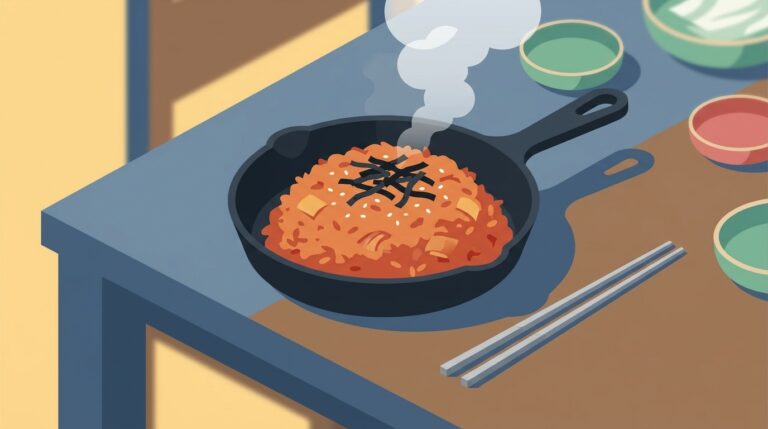
Why Koreans Call Fried Rice ‘Dessert’: The Ultimate K-Food Guide
Phase 1: Empathy (Story-Driven Opening)
안녕하세요! (Annyeonghaseyo!) I’m your Daily Hangul editor and cultural navigator. Picture this: You’re at a buzzing Dakgalbi (spicy stir-fried chicken) spot in Seoul with Korean friends. You’ve eaten until your stomach is bursting. You put down your chopsticks, lean back, and sigh, “I’m totally full.” Suddenly, your Korean friend looks at you with sparkling eyes and says, “Great! Now it’s time for dessert. Waiter, please fry two bowls of rice!”
You freeze. Rice? For dessert? After eating meat for two hours?
If you’ve ever felt bewildered by this phenomenon, you are not alone! For Koreans, a meal cooked on a grill, pot, or pan—whether it’s Gamjatang, Tteokbokki, Gopchang, or Samgyeopsal—is never officially finished until rice hits that seasoned iron plate. This isn’t just extra carbs; it’s a sacred communal ritual known jokingly as the true “K-Dessert” (케이-디저트). Mastering this cultural nuance and the expressions that go with it will instantly transform you from a wide-eyed tourist into an insider foodie. Let’s dive into the delicious world of Korean rice culture!
Phase 2: Core 3 Expressions Deep Dive
1. 볶음밥 2개만 볶아주세요 (Bokkeumbap du-gae-man bokk-a-juseyo)
- Pronunciation: [Bok-keum-bap doo-gae-mahn bok-ah-joo-seh-yo] (Sounds like “Boke-oom-bop” with a crisp ‘p’ finish)
- Meaning: “Please stir-fry just two portions of fried rice for us.”
- K-Culture Moment: In food reality shows like Delicious Rendezvous or K-Dramas like Let’s Eat, this is the triumphant climax of the meal where everyone leans forward to watch the server work their spatula magic.
- Editor’s Insight: The particle ~만 (-man, only/just) softens the request. Even if four people are dining, ordering “just two” (2개만) shows polite moderation while still guaranteeing everyone gets a taste.
- Situation Spectrum: Casual ✅ | Semi-formal ✅ | Formal ⚠️
- 🤔 Think About It: In many Western dining contexts, ordering food is an individualized affair. Why do Koreans count fried rice servings by communal portions for the entire table?
2. 밑에 누룽지 긁어먹어야 제맛이죠 (Mit-e nurungji geulgeo-meogeoya jemas-ijyo)
- Pronunciation: [Meeteh noo-roong-jee geul-guh-muh-guh-yah jeh-mah-see-jyo]
- Meaning: Direct: “You must scrape and eat the scorched rice at the bottom for the real flavor.” -> Nuance: “The crispy crust at the bottom is the absolute best part!”
- K-Culture Moment: Seen whenever variety show hosts battle fiercely with metal spoons to scrape every last crunchy grain off the cast iron pan.
- Editor’s Insight: 누룽지 (Nurungji) refers to the toasted, crispy rice layer. Saying 제맛이다 (jemasida) means something tastes “just as it authentically should.”
- Situation Spectrum: Casual ✅ | Semi-formal ✅ | Formal 🚫
- 🤔 Think About It: What food texture in your culture has a dedicated word of endearment similar to Korea’s beloved crunchy nurungji?
3. 배불러도 밥 배는 따로 있어요 (Baebulleodo bap bae-neun ttaro isseoyo)
- Pronunciation: [Bae-bool-luh-doh bap bae-neun ttah-roh ee-ssuh-yoh]
- Meaning: Direct: “Even if I’m full, there is a separate stomach for rice.” -> Nuance: “There is always room for carbs!”
- K-Culture Moment: A playful twist on the universal phrase “There’s always room for dessert” (디저트 배는 따로 있다), frequently declared by K-pop idols doing Mukbang V-Logs.
- Editor’s Insight: 밥 배 (Bap bae) literally means “rice belly.” It playfully justifies indulging in rice even after declaring you are 100% full.
- Situation Spectrum: Casual ✅ | Semi-formal ✅ | Formal ⚠️
- 🤔 Think About It: How does phrasing stomach capacity as separate compartments (rice belly, dessert belly) reflect a culture’s emotional relationship with feasting?
Phase 3: Textbook Korean vs. Real Korean
Situation 1: Ordering the post-meal stir-fry
- 📖 Textbook Korean: 이제 후식을 주문하겠습니다. (Ije husig-eul jumunhagetseumnida. – “I will now order dessert.”)
- 🗣️ Real Korean: 사장님, 여기 밥 하나 볶아주세요! 치즈 추가도 되나요? (Sajangnim, yeogi bap hana bokk-a-juseyo! Chijeu chuga-do doenayo? – “Boss, please stir-fry one rice here! Can we add cheese too?”)
- 💡 Why is it different? Nobody refers to post-meal fried rice with the formal Sino-Korean word 후식 (husik, dessert) in a casual diner. Referring to the owner as 사장님 (sajangnim) and asking for cheese toppings (치즈 추가) reflects authentic modern Korean dining habits.
Situation 2: Waiting for the rice to get crispy
- 📖 Textbook Korean: 밥이 솥 바닥에 눌어붙을 때까지 기다리십시오. (Babi sot badage nureobeuteul ttaekkaji gidarisipsio. – “Please wait until the rice sticks to the bottom of the pot.”)
- 🗣️ Real Korean: 조금만 더 눌려 먹자. 불 끄지 마! (Jogeumman deo nullyeo meokja. Bul kkeuji ma! – “Let’s let it crisp up a bit more. Don’t turn off the stove yet!”)
- 💡 Why is it different? In colloquial Korean, 눌리다 (nullida) is used transitively by foodies to describe pressing and crisping the rice against the pan surface before turning off the flame.
Phase 4: K-Culture Deep Dive & Non-verbal Etiquette
4-1. 눈치 (Nunchi) & Table Etiquette: The Golden Sauce Rule
When enjoying meals like Dakgalbi, Gamjatang, or Ddukbokki, never finish all the sauce and meat!
* The Nunchi Move: Leave approximately 10-15% of the sauce, chopped vegetables, and a couple of pieces of meat in the pan. The server cuts these leftovers into tiny pieces with metal tongs and shears to flavor your fried rice.
* The Spoon Rest: Once the server spreads the rice thin and flat with their spatula, wait 60 to 90 seconds without touching it. Eating it immediately is considered an amateur mistake—letting it sizzle undisturbed is how the sacred nurungji forms.
4-2. Cultural Code: The Philosophy of 밥심 (Bapsim)
To understand the K-dessert, you must understand 밥심 (Bapsim – the strength derived from eating rice). Historically, rice was the staple fuel of Korea’s agrarian society. Even after modern diets diversified, rice remains the psychological anchor of satisfaction. Meat is viewed as an accompaniment or appetizer; only when rice enters the system does the brain register: “The meal is officially complete.”
Phase 5: Interactive Roleplay Scenario
Setting: A legendary Dakgalbi joint in Chuncheon. You are dining with your Korean friend Minho (민호) and the restaurant owner (이모님 – Imonim).
- 민호: 아, 배 터지겠다! 고기 진짜 맛있었지? (Ah, bae teojigetda! Gogi jinjja masisseotji?)
- (🎭 Patting his stomach with a satisfied smile)
- “Ah, I’m stuffed! The meat was incredible, right?”
- You (Alex): 응, 진짜 배불러. 이제 일어날까? (Eung, jinjja baebulleo. Ije ireonalkka?)
- (🎭 Starting to put on your jacket)
- “Yeah, I’m so full. Shall we head out now?”
- 민호: 무슨 소리야! 닭갈비 먹고 볶음밥을 안 먹으면 유죄야. (Museun soriya! Dakgalbi meokgo bokkeumbabeul an meogeumyeon yujwoeya.)
- (🎭 Looking at you with mock horror)
- “What are you talking about! Not eating fried rice after Dakgalbi is a crime.”
- 이모님: 학생들, 밥 볶아줄까? (Haksaengdeul, bap bokk-ajulkkka?)
- (🎭 Approaching with a bowl of warm rice, seasoned seaweed, and sesame oil)
- “Students, should I stir-fry some rice for you?”
🔀 Your Turn: How do you respond?
- Option A: “아니요, 너무 배불러서 못 먹어요. 계산해 주세요.” (Aniyo, neomu baebulleoseo mot meogeoyo. Gyesanhae juseyo. – “No, we are too full to eat. Bill please.”)
- Option B: “이모님! 볶음밥 하나만 볶아주시고, 치즈 추가해 주세요!” (Imonim! Bokkeumbap hanaman bokk-ajusigo, chijeu chugahae juseyo! – “Auntie! Please stir-fry just one portion, and add cheese please!”)
- Option C: “네, 볶음밥 4인분 주세요. 다 먹을 수 있어요.” (Ne, bokkeumbap sa-inbun juseyo. Da meogeul su isseoyo. – “Yes, please give us 4 portions of fried rice. We can eat it all.”)
💡 Feedback on Your Choice:
- Option A (Risk): Culturally safe, but Minho will look heartbroken! You miss out on the true highlight of the meal.
- Option B (Best! ⭐): Perfection! Calling the server “이모님” (friendly honorific), ordering 1 portion to share between two stuffed people, and requesting cheese shows 100% local fluency.
- Option C (Bad): Dangerous! Post-meal fried rice is extremely filling. Ordering 4 portions for 2 people after a full meal will result in wasted food and an uncomfortable food coma.
Phase 6: 10-Second Emotion Shadowing Drill
Practice speaking with native rhythm and emotional inflection. Slashes (/) indicate natural breath pauses.
[😋 Cheerful & Anticipating]- 배불러도 / 볶음밥 들어갈 배는 / 따로 있잖아요!
- (Baebulleodo / bokkeumbap deureogal baeneun / ttaro itjanayo!)
- “Even if we’re full / the belly for fried rice / is separate, you know!”
[🔥 Passionate Foodie Wisdom]- 잠깐만! / 지금 긁으면 안 돼. / 누룽지 생길 때까지 / 기다려!
- (Jamkkanman! / Jigeum geulgeumyeon an dwae. / Nurungji saenggil ttaekkaji / gidaryeo!)
- “Wait a sec! / You shouldn’t scrape it now. / Until the crispy crust forms / wait!”
[😍 Pure Delight & Ecstasy]- 와, / 역시 한국인의 디저트는 / 볶음밥이 진리다!
- (Wa, / yeoksi hangugin-ui dijeoteuneun / bokkeumbabi jinrida!)
- “Wow, / as expected, the Korean dessert / fried rice is the absolute truth!”
Phase 7: K-Culture Mini Dictionary
- 누룽지 (Nurungji): The golden, crunchy scorched crust of rice at the bottom of a pot or pan. Highly prized for its savory, nutty aroma (guso-han mat).
- 밥심 (Bapsim): “Rice power.” The cultural belief that Koreans derive their vitality, endurance, and mood specifically from eating rice.
- K-디저트 (K-Dessert): A viral modern slang term referencing how Koreans humorously treat post-meal fried rice as their dessert rather than cakes or pastries.
- 볶음밥 장인 (Bokkeumbap Jang-in): “Fried Rice Artisan.” A playful title given to a friend or restaurant server who displays extraordinary speed and skill with dual spatulas while mixing the rice.
Phase 8: Traveler’s Survival Kit
Top 3 Survival Phrases
- “밥 볶아주세요.” (Bap bokk-a-juseyo) — “Please stir-fry the rice.”
- Pro Tip: Say this while pointing at your grill/pot when you have finished the main ingredients.
- “치즈 사리 추가해 주세요.” (Chijeu sari chugahae juseyo) — “Please add a cheese topping.”
- Pro Tip: “사리 (Sari)” means an add-on topping (cheese, ramen noodles, rice cakes).
- “불 좀 줄여주세요.” (Bul jom juryeojuseyo) — “Please turn down the heat/flame.”
- Pro Tip: Use this if your rice is starting to smoke too intensely.
🧳 Editor’s Travel Note
When looking for famous local grill restaurants in Korea, avoid relying solely on international search engines. Use the local search tool by downloading the Naver Map application and searching terms like 철판 볶음밥 맛집 (Iron-plate fried rice famous spots). Most dining spots accept international credit cards, but having table manners ready will earn you extra hospitality from the staff!
Phase 9: One Step Deeper (Reflective Essay)
In Western dining traditions, dessert signifies a transition into sweetness—a solitary slice of cake or an espresso to close the palate. In Korea, finishing with fried rice is an act of communal completion. The iron plate sits in the exact physical center of the table, and everyone’s spoons converge on that single pan, scraping together until the metal shines clean. It symbolizes egalitarian sharing: no matter who ordered what cut of meat, the finale is shared equally grain by grain. Food in Korea is rarely just fuel; it is relational glue.
💬 Your Turn: What is the ultimate “comfort carb” or communal finale food in your home country? Share your food stories in the comments below!
Phase 10: FAQ & Common Mistakes
Q: Can I order fried rice at ANY Korean restaurant?
A: No. Fried rice after a meal is standard at restaurants with built-in table stoves or pans—such as Dakgalbi, Gamjatang, Tteokbokki, Gopchang, and Samgyeopsal (with stone plates). You cannot request this at soup restaurants serving individual stone bowls (Ddukbaegi).
Q: Do I have to stir-fry the rice myself?
A: In 90% of Korean restaurants, the staff will bring the ingredients (rice, seaweed, sesame oil, kimchi) and stir-fry it right in front of you. If they simply leave the bowl of ingredients at your table, it means it’s self-service!
Q: What if I don’t eat spicy food? Can the fried rice be non-spicy?
A: Because the rice is mixed with the remaining sauce in the pan, it will carry the spice level of your main dish. However, adding mozzarella cheese (치즈 추가) softens the heat significantly!
🚨 Common Mistakes Alert!
- Mistake: Clearing the entire pan completely before ordering rice.
- Correct Action: Leave 2-3 spoonfuls of sauce and veggies so the rice has flavor!
- Mistake: Scraping the non-stick coated pan too violently with sharp spoons.
- Correct Action: Scrape gently, especially if the pan is Teflon rather than traditional cast iron.
- Mistake: Assuming “1 portion” (1인분) won’t be enough for two people.
- Correct Action: Post-meal rice portions are surprisingly generous. Start with 1 portion for 2 people.
Phase 11: Action Missions & Community
- 🥉 Bronze Mission: Stand in front of your mirror and practice saying: “사장님, 볶음밥 하나만 볶아주세요!” with confidence and a friendly smile.
- 🥈 Silver Mission: Post a picture of your favorite rice dish on Instagram or Threads and tag
#DailyHangul #KDessert #KoreanRiceCulture. - 🥇 Gold Mission: Visit a local Korean barbecue or hot-pot restaurant this weekend, finish your meal, and successfully order post-meal fried rice in Korean!
- 🎮 K-Culture Mission: Watch an episode of a Korean food show (like Street Food Fighter or Three Meals a Day) and spot the exact moment the cast starts scraping the pan for nurungji.
Phase 12: Interactive Quiz Challenge
1. Situational Judgment: You are eating spicy stir-fried octopus with your coworker. There is a little sauce left. What is the most natural Korean sentence to suggest finishing with fried rice?
* (A) 후식으로 아이스크림 먹으러 가실래요? (Shall we go eat ice cream for dessert?)
* (B) 양념 좀 남았는데, 밥 하나 볶아 먹을까요? (There’s some sauce left, shall we fry one portion of rice?)
* (C) 밥이 타버렸으니까 그냥 나갑시다. (The rice is burned, so let’s just leave.)
2. Fill-in-the-blank: When the rice is pressed flat on the hot pan, the crispy crunchy layer at the bottom is called ( ).
3. True or False: In Korea, saying “배불러도 밥 배는 따로 있다” means you are too full to eat any more rice.
👉 Click here to reveal Answers & Explanations!
- Answer: (B)
- Explanation: Suggesting to fry rice using the remaining sauce (양념) is the quintessential B2 natural conversation starter.
- Answer: 누룽지 (Nurungji)
- Explanation: Nurungji is the beloved crusty, toasted rice layer at the bottom of the pan.
- Answer: False
- Explanation: It means the exact opposite! It playfully claims you always have a separate stomach reserved just for rice.
- Explanation: It means the exact opposite! It playfully claims you always have a separate stomach reserved just for rice.







