

Phase 1: Empathy & Immersion Opening
안녕하세요! 매일한글 에디터입니다.
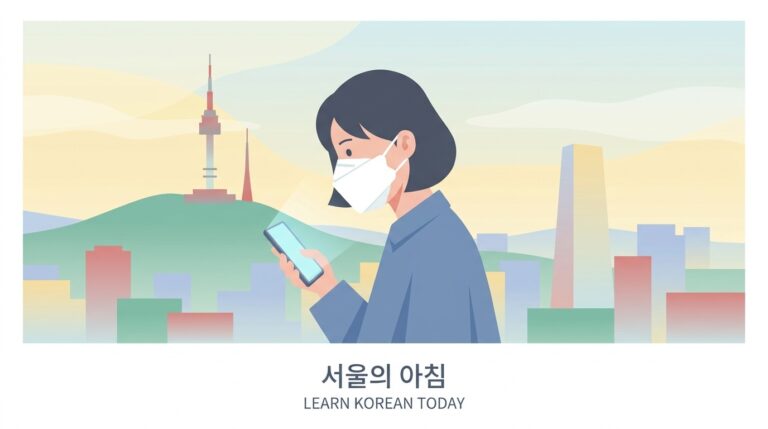
Picture this: You wake up in Seoul on a breezy spring morning. You have planned the ultimate day out—renting a bike at Yeouido Hangang Park, admiring cherry blossoms, and café hopping in Seongsu-dong. You step out onto the balcony or look out your Airbnb window, expecting crisp blue skies, but everything is blanketed in a milky, grayish-yellow haze. Within fifteen minutes outside, your eyes feel gritty and your throat feels strangely scratchy. You look around, and almost every local walking by is calmly strapping on a sleek white or black KF94 mask while checking their smartphones.
Welcome to “Fine Dust Season” in Korea! If you’ve watched modern K-dramas or reality shows like I Live Alone, you’ve probably noticed characters obsessively checking air quality alerts or discussing whether they should eat Samgyeopsal (pork belly) to wash down the dust. Navigating fine dust (미세먼지, misemeonji) and yellow dust (황사, hwangsa) isn’t just about the weather—it is a deeply ingrained lifestyle phenomenon in Korea. Mastering the natural, intermediate-level Korean expressions around air quality and mask etiquette will help you protect your health, blend in seamlessly with locals, and sound like a seasoned resident. This guide is crafted directly from real learner experiences and practical linguistic nuances so you can navigate dusty days with complete confidence!
Phase 2: Deep Dive into 3 Essential Expressions
1. 오늘 미세먼지 수치 어때요? (Oneul misemeonji suchi eottaeyo?)
- Pronunciation: Oh-neul mee-seh-meon-jee soo-chee uh-ttae-yo? (Sounds like “Mee-seh” as in ‘mission’ without ‘on’, and “Suchi” as in ‘sushi’ with a sharp ‘ch’).
- Meaning: Literal: “What is today’s fine dust numerical value?” | Nuance: “How bad is the air quality index today?”
- K-Culture Moment: Coworkers or friends checking weather apps together before deciding whether to eat lunch outside or head down to the building’s basement food court.
- Editor’s Insight: At the B2 level, instead of just saying “날씨가 나빠요” (The weather is bad), asking specifically for the 수치 (suchi – numerical index/value) shows that you understand how Koreans track AQI levels using color-coded metrics (Blue, Green, Yellow, Red).
- Situation Spectrum: Casual ✅ | Semi-formal ✅ | Formal ✅
- 🤔 Think About It: In many Western countries, “weather” focuses purely on precipitation and temperature. Why has “air quality numerical value” become an indispensable part of daily morning small talk in modern Korean society?
2. 목이 칼칼해서 마스크 꼭 써야겠어요. (Mogi kalkalhaeseo maseukeu kkok sseoyagesseoyo.)
- Pronunciation: Mohg-ee kahl-kahl-hae-seo mah-seu-keu kkok ssuh-yah-geh-ssuh-yo. (The word “kalkal” mimics the dry, scratchy sensation in the back of your throat).
- Meaning: Literal: “Because my throat is scratchy, I definitely must wear a mask.” | Nuance: “My throat feels so irritated from the dust that I really need to put on a mask.”
- K-Culture Moment: Seen in vlog content when someone steps off the subway and realizes the outdoor air is harsh, pulling out a packaged mask from their tote bag.
- Editor’s Insight: 칼칼하다 (kalkalhada) is a wonderfully descriptive onomatopoeic/sensory adjective. It can describe a spicy, zesty soup broth, but when applied to 목 (throat), it specifically conveys that dry, dusty, irritated feeling before coughing.
- Situation Spectrum: Casual ✅ | Semi-formal ✅ | Formal ⚠️ (Use ‘목이 따끔거려서’ in strictly formal presentations)
- 🤔 Think About It: Korean has a vast spectrum of sensory words (따끔따끔, 칼칼하다, 텁텁하다). How does having distinct words for throat irritation change the way people express physical discomfort?
3. 일반 덴탈 마스크 말고 KF94로 챙기는 편이 나아요. (Ilban dental maseukeu malgo KF-gusa-ro chaenggineun pyeoni naayo.)
- Pronunciation: Eel-bahn den-tahl mah-seu-keu mahl-goh Kay-Eff-goo-sah-roh chaeng-gee-neun pyuh-nee nah-ah-yo.
- Meaning: Literal: “Rather than a regular dental mask, it is better to pack a KF94 mask.” | Nuance: “You’d better grab a KF94 filter mask instead of a regular thin surgical one.”
- K-Culture Moment: A pharmacy (약국) interaction or a Korean friend looking out for you before heading to an outdoor music festival.
- Editor’s Insight: The grammar pattern ~는 편이 낫다 (~neun pyeoni natda) means “it’s on the side of being better / you’d rather do X.” It is the quintessential intermediate pattern for offering soft, polite advice without sounding bossy or overly commanding.
- Situation Spectrum: Casual ✅ | Semi-formal ✅ | Formal ✅
- 🤔 Think About It: How does softening a recommendation with ~는 편이다 reflect the Korean cultural emphasis on indirectness and harmony in social interactions?
Phase 3: Textbook Korean vs. Real Korean
Situation 1: Describing awful air quality
- 📖 교과서 한국어 (Textbook): 대기 오염이 심하니 외출을 자제하십시오. (Daegi oyeomi simhani oechureul jajehasipsio. – “Atmospheric pollution is severe, so please refrain from going outdoors.”)
- 🗣️ 진짜 한국어 (Real-life): 오늘 공기 완전 텁텁하고 뿌얘서 나가지 않는 게 좋겠어요. (Oneul gonggi wanjeon teopteophago ppyu-yaeseo nagaji anneun ge jotaesseoyo. – “The air feels totally suffocating and looks so murky today; we’d better not go out.”)
- 💡 왜 다를까? Textbook Korean uses rigid Sino-Korean bureaucratic vocabulary (대기 오염, 외출 자제). Native speakers use vivid visual and tactile descriptors like 뿌옇다 (murky/milky haze) and 텁텁하다 (stuffy/dry mouthfeel).
Situation 2: Checking if someone has a spare mask
- 📖 교과서 한국어 (Textbook): 혹시 마스크를 하나 소지하고 계십니까? (Hoksi maseukeureul hana sojihago gyesimnikka? – “By any chance, do you possess a mask on your person?”)
- 🗣️ 진짜 한국어 (Real-life): 혹시 마스크 여분 남는 거 있어요? (Hoksi maseukeu yeobun namneun geo isseoyo? – “Do you happen to have a spare mask to spare?”)
- 💡 왜 다를까? Words like 소지하다 (to possess) sound like police interrogations. Real Koreans use 여분 (spare/extra) combined with the natural conversational phrase 남는 거 (leftover/extra thing).
Phase 4: K-Culture Deep Dive & Non-Verbal Manners
4-1. 눈치 (Nunchi) & Mask Etiquette
In Korea, wearing a mask during high fine dust alerts is viewed as a sign of smart self-care and communal responsibility. If you enter an indoor public setting like a subway train or university lecture hall while coughing dryly without a mask on a bad dust day, you may catch subtle glances (눈치). When blowing your nose due to allergic rhinitis or dust irritation, avoid loud, aggressive nose-blowing at dining tables or crowded subway seats—turn slightly away and dab gently with a tissue.
4-2. The Cultural Myth: Samgyeopsal (Pork Belly) on Dusty Days
If you ask a Korean friend what to eat on a day with a severe fine dust warning (미세먼지 경보), nine out of ten will jokingly say: “삼겹살 먹으러 가자! (Let’s go eat grilled pork belly!)” Historically, Korean coal miners and factory workers in the 1960s–70s believed the rich oil of pork belly cleansed coal soot from their throats. While modern science disproves the detoxifying claim, it remains a beloved national tradition and cultural excuse to gather around a sizzling grill with friends!
Phase 5: Real-Life Roleplay Scenario
Setting: Outside a café in Mangwon-dong. Minjun (민준) and Sarah (사라) planned an outdoor Han River picnic, but the sky is overcast with yellow fine dust.
- 민준: 사라 씨, 오늘 하늘 봤어요? 완전 뿌옇죠? (Sarah ssi, oneul haneul bwasseoyo? Wanjeon ppyu-yeotjyo?)
- 🎭 Looking up at the gray sky with a disappointed sigh.
- (Sarah, did you see the sky today? It’s completely hazy, right?)
- 사라: 네, 아침에 일어나자마자 목이 칼칼하더라고요. (Ne, achime ireonajamaja mogi kalkalhadeoragoyo.)
- 🎭 Lightly clearing her throat with a grimace.
- (Yeah, as soon as I woke up this morning, my throat felt so scratchy.)
- 민준: 오늘 초미세먼지 수치 ‘매우 나쁨’이래요. 한강 피크닉은 무리겠죠? (Oneul chomisemeonji suchi ‘maeu nappeum’iraeyo. Hangang pikeunigeun murigetjyo?)
- 🎭 Showing his phone screen with a red warning badge.
- (They say the ultra-fine dust level is ‘Very Bad’ today. A Han River picnic is probably out of the question, right?)
- 사라: 아쉽지만 오늘은 실내에 있는 편이 낫겠어요. (Aswipjiman oneureun silnaee inneun pyeoni natgesseoyo.)
- 🎭 Nodding in agreement.
- (It’s a bummer, but we’d better stay indoors today.)
- 민준: 맞아요. 저 편의점 들러서 KF94 마스크 하나 사 올게요. (Majayo. Jeo pyeon-uijeom deulleoseo KF-gusa maseukeu hana sa olgeyo.)
- 🎭 Pointing toward a nearby GS25 convenience store.
- (Agreed. I’ll drop by that convenience store and grab a KF94 mask.)
- 사라: 제 가방에 마스크 여분 하나 있는데, 이거 쓰실래요? (Je gabange maseukeu yeobun hana inneunde, igeo sseusillaeyo?)
- 🎭 Unzipping her tote bag and pulling out a clean, individually wrapped mask.
- (I have a spare mask in my bag, would you like to use this one?)
- 민준: 와, 사라 씨 센스 최고네요! 정말 고마워요. (Wa, Sarah ssi senseu choegoneyo! Jeongmal gomaweoyo.)
- 🎭 Accepting the mask with both hands and smiling.
- (Wow, Sarah, you have such great foresight! Thank you so much.)
- 사라: 별말씀을요. 그럼 오늘은 코엑스몰이나 실내 카페로 갈까요? (Byeolmalsseumeullyo. Geureom oneureun Coex-mall-ina silnae kapero galkkayo?)
- 🎭 Checking indoor transit directions.
- (Don’t mention it. Shall we head over to COEX Mall or an indoor café instead?)
🔀 Interactive Decision Branch
What should Sarah say if Minjun asks, “피크닉 대신 삼겹살 먹으러 갈래요?” (Shall we go eat pork belly instead of having a picnic?)
- Option A: “먼지 씻어내려면 삼겹살에 볶음밥까지 코스로 달려야죠!” (To wash away the dust, we must do the full course from pork belly to fried rice!)
- 👉 Feedback [Best]: Demonstrates 100% cultural fluency with enthusiastic native slang (달려야죠).
- Option B: “돼지고기 기름은 의학적으로 먼지를 제거하지 못합니다.” (Pork fat does not medically remove dust.)
- 👉 Feedback [Bad]: Overly clinical and kills the friendly social vibe immediately.
- Option C: “마스크를 벗으면 위험하니까 밥을 먹지 맙시다.” (Eating is dangerous because we have to take off our masks, so let’s not eat.)
- 👉 Feedback [Risk]: Sounds overly anxious and anti-social in a casual friendship context.
Phase 6: 10-Second Emotion Shadowing Drill
Practice pausing at the / marks and mimicking the exact emotional cues below!
[😮 걱정스럽고 답답하게 / Worried & Baffled]- 오늘 미세먼지 수치 / 왜 이렇게 높아요? (Oneul misemeonji suchi / wae ireoke nop-ayo?)
[😷 목이 칼칼해서 불편한 톤 / Irritated & Raspy]- 목이 너무 칼칼해서 / 마스크 없이는 / 못 나가겠어요. (Mogi neomu kalkalhaeseo / maseukeu eopsineun / mot nagagesseoyo.)
[🤝 배려심 넘치고 다정하게 / Warm & Caring]- 가방에 마스크 여분 남는 거 있는데 / 하나 드릴까요? (Gabange maseukeu yeobun namneun geo inneunde / hana deurilkkayo?)
Phase 7: K-Culture Mini Dictionary
- 초미세먼지 (Chomisemeonji) | Ultra-fine particles (PM 2.5)
- Unlike regular dust (미세먼지 – PM 10), 초미세먼지 penetrates deep into lung tissue. Koreans track this specific value rigorously.
- KF94 (Kei-efu-gu-sa) | Korean Filter 94% Standard Mask
- The gold-standard protective mask certified by the Korean Ministry of Food and Drug Safety, blocking over 94% of micro-particles.
- 삼겹살 데이 (Samgyeopsal-dei) | Pork Belly Day (March 3rd)
- Coinciding with peak spring yellow dust season, this commercial holiday celebrates eating pork belly with friends and family.
- 공기청정기 (Gong-gi-cheong-jeong-gi) | Air Purifier
- An essential appliance found in every Korean household, classroom, office, and café, often glowing blue (clean) or red (dusty).
Phase 8: Traveler’s Survival Kit
Top 3 Survival Expressions for Travelers
- “KF94 마스크 개별 포장된 걸로 주세요.” (KF-gusa maseukeu gaebyeol pojangdoen geollo juseyo.)
- Pro Tip: Convenience stores and pharmacies sell both multipacks and individually wrapped (개별 포장) masks.
- “오늘 야외 좌석 대신 실내 자리로 앉을게요.” (Oneul ya-oe jwaseok daesin silnae jariro anjeulgeyo.)
- Pro Tip: Ideal when a host offers outdoor patio terrace seating on a dusty afternoon.
- “따뜻한 보리차 한 잔 부탁드려요.” (Ttatteuthan boricha han jan butakdeuryeoyo.)
- Pro Tip: Warm roasted barley tea (보리차) soothes a dry, dust-irritated throat at traditional eateries.
🧳 Editor’s Travel Note
Before stepping out, download the Korean air monitoring app 미세미세 (MisaeMisae) on the App Store / Google Play. It uses intuitive color-coded icons (from laughing blue faces to gas-mask wearing red demons) based on WHO standards. Pair it with the 네이버 지도 (Naver Map) 길찾기 기능 to find connected underground shopping malls (like Express Bus Terminal Goto Mall or COEX) so you can enjoy Seoul without inhaling dust!
Phase 9: A Step Deeper (한 발 더 깊이)
In many Western cultures, wearing a mask outdoors was historically associated exclusively with medical workers or severe infectious illness. In Korea, however, public masking was normalized long before 2020 due to seasonal yellow dust blows from the Gobi Desert. Wearing a protective mask is seen as a hallmark of proactive self-management (자기관리) and social consideration for those around you. When public safety notices (재난문자) ring in unison on the subway, you are witnessing Korea’s highly synchronized civic awareness in action.
💬 Your Turn: How does your home country handle poor air quality or seasonal pollen? Have you ever had to change outdoor plans due to weather alerts? Share your story in the comments below!
Phase 10: FAQ & Common Mistakes
Q: Can I just wear a regular fashion cotton mask or dental mask on high dust days?
A: While better than nothing, regular fabric or dental masks (덴탈 마스크) do not filter micro-particles (PM 2.5). Look specifically for the KF94 or KF80 mark on packaging at any olive young, convenience store, or pharmacy.
Q: What is the difference between 미세먼지 (Misemeonji) and 황사 (Hwangsa)?
A: 황사 (Yellow Dust) refers to natural mineral sand blown from Chinese/Mongolian deserts, predominantly in spring. 미세먼지 (Fine Dust) refers to industrial micro-pollutants and exhaust smog that can occur all year round.
Q: How do I know if an indoor café has good air quality?
A: Look near the entrance or corners for a tall 공기청정기 (Air Purifier). Most modern Korean cafes keep them running 24/7 with LED indicators showing blue (safe) or green (moderate).
🚨 Common Mistakes Alert
- Calling all masks simply ‘마스크’ without checking the grade: Asking a pharmacist for just 마스크 might get you a simple surgical one. Always specify KF94 마스크.
- Using the literal translation “먼지를 씻다” for food: Don’t say 삼겹살이 먼지를 씻어요 (grammatically awkward). Instead, say 목의 먼지를 씻어내리다 (wash down the dust from one’s throat).
- Confusing ‘뿌옇다’ (hazy/opaque) with ‘흐리다’ (cloudy): 흐리다 means overcast with rain clouds. 뿌옇다 specifically describes air thick with smoke, dust, or fog.
Phase 11: Action Missions
- 🥉 Bronze Level (Solo Drill): Stand in front of a mirror and practice saying: “목이 칼칼해서 KF94 마스크를 챙겨 나왔어요” smoothly in under 4 seconds.
- 🥈 Silver Level (Social Sharing): Screenshot today’s air quality index in your city, post it to your Instagram story with the caption: “오늘 우리 동네 미세먼지 수치는? #매일한글 #미세먼지”.
- 🥇 Gold Level (Real-Life Mastery): Step into a local Korean convenience store or pharmacy and ask the staff: “혹시 KF94 마스크 개별 포장된 거 어디에 있어요?”
- 🎮 K-Culture Mission: Watch a recent Korean street vlog or slice-of-life drama. Spot how many times characters mention 공기청정기 or check weather apps before leaving home!
Phase 12: Interactive Quiz Challenge
1. Situational Judgment: You are meeting a Korean friend for lunch, but the fine dust AQI is over 150 (Very Bad). Which suggestion sounds most natural at an intermediate B2 level?
* A) 비가 올 것 같으니 우산을 챙기세요.
* B) 오늘 공기가 너무 뿌얘서 실내 몰에서 만나는 편이 낫겠어요.
* C) 대기 환경이 위험하므로 평생 나가지 맙시다.
2. Fill-in-the-Blank: Complete the sentence with the appropriate sensory adjective for throat irritation.
* “미세먼지 때문에 목이 __________ 따뜻한 물 좀 마셔야겠어요.”
3. True or False: Scientifically, eating Samgyeopsal completely cleanses micro fine dust from your lungs in Korea.
* (True / False)
🔍 Click here to view Answers & Explanations
- Answer: B | 오늘 공기가 너무 뿌얘서 실내 몰에서 만나는 편이 낫겠어요. (Expresses visual haziness with 뿌옇다 and makes a polite suggestion using ~는 편이 낫다).
- Answer: 칼칼해서 (or 따끔거려서) | 목이 칼칼하다 is the most authentic Korean expression for a dry, dust-irritated throat.
- Answer: False | While it is a beloved Korean cultural ritual and running joke, pork belly does not medically detoxify the respiratory tract from fine dust!







