Phase 1: Empathy & Storytelling Opening
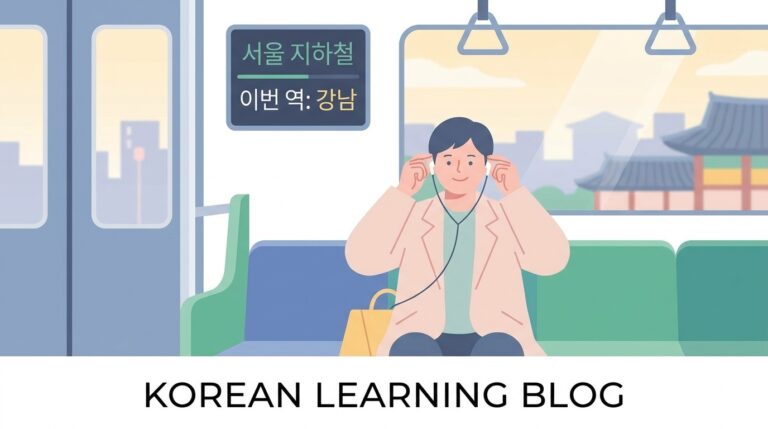
안녕하세요! (Annyeonghaseyo!) I’m your Daily Hangul editor and cultural navigator. Picture this: You’re riding the bustling Seoul Metro Line 2 during rush hour after a long day of exploring Hongdae. Your favorite K-Pop track is playing, you’re tapping your foot, and life feels like an episode of a K-Drama. But suddenly, you notice the elderly gentleman or the office worker next to you giving you subtle, repeated sideways glances. You pull out one earbud and realize with horror: your volume was blasting, and everyone within a two-meter radius could hear every single beat. In Korea’s quiet public transit, sound leakage (소리 새어 나감) is one of the most common accidental faux pas for travelers.
Don’t worry—you are definitely not alone! This guide is crafted from real learner experiences to help you master audio etiquette, speak naturally with confidence, and navigate Korean subways and buses like a respectful local insider.
Phase 2: Core 3 Expressions Deep-Dive
1. 혹시 소리 새어 나가나요? (Hoksi sori saeeo naganayo?)
- Pronunciation: Hok-shee soh-ree seh-uh nah-gah-nah-yo? (Sounds like ‘hawk-she’ + ‘sorry’ with a soft ‘s’)
- Meaning: Literal: “By any chance, is sound leaking out?” | Real Nuance: “Excuse me, can you hear my music through my headphones?”
- K-Culture Moment: Asking a friendly seatmate on the KTX bullet train when you want to ensure your volume isn’t disturbing them.
- Editor’s Insight: Adding ‘혹시 (hoksi – by any chance)’ instantly softens any question, making you sound polite and mindful of others’ comfort.
- Situation Spectrum: Casual ⚠️ | Semi-formal ✅ | Formal ✅
- 🤔 Think About It: Why do you think Korean uses the word ‘새어나가다’ (to leak out like water) to describe sound escaping headphones?
2. 볼륨 좀 줄일게요, 죄송해요! (Bollyum jom jurilgeyo, joesonghaeyo!)
- Pronunciation: Bohl-lyum johm joo-reel-geh-yoh, jweh-song-heh-yoh!
- Meaning: Literal: “I will reduce the volume a bit, I am sorry!” | Real Nuance: “Oops, my bad! I’ll turn it down right away.”
- K-Culture Moment: When someone glances toward your phone or earphones on a quiet city bus and you immediately fix it with a friendly nod.
- Editor’s Insight: Using ‘-ㄹ게요 (-lgeyo)’ shows personal commitment and proactive action rather than a simple passive apology.
- Situation Spectrum: Casual ⚠️ | Semi-formal ✅ | Formal ✅
- 🤔 Think About It: In your home country, is it more common to just apologize, or do you also explicitly state your next action?
3. 이어폰 연결 잘 됐나요? (Ieopon yeongyeol jal dwaennayo?)
- Pronunciation: Ee-uh-pohn yuhn-gyuhl jahl dwen-nah-yoh?
- Meaning: Literal: “Are earphones connected well?” | Real Nuance: “Is my Bluetooth audio playing through the earbuds, not the speaker?”
- K-Culture Moment: Double-checking with a travel buddy when starting a drama episode in a quiet cafe or waiting lounge.
- Editor’s Insight: Bluetooth pairing fails happen to everyone! This question prevents the dreaded accidental speaker blast.
- Situation Spectrum: Casual ✅ | Semi-formal ✅ | Formal ⚠️
- 🤔 Think About It: What is your biggest public tech nightmare when commuting?
Phase 3: Textbook Korean vs. Real Korean
Situation 1: Asking if your audio is too loud
- 📖 교과서 한국어 (Textbook Korean): 제 이어폰 음량이 너무 큽니까? (Je ieopon eumryangi neomu keumnikka?)
- 🗣️ 진짜 한국어 (Real Korean): 소리 밖으로 들려요? (Sori bakk-euro deullyeoyo?)
- 💡 왜 다를까? (Why the difference?): Textbook phrases rely on formal Sino-Korean nouns like ‘음량 (volume magnitude)’. Native speakers prefer active sensory verbs like ‘들리다 (to be heard)’.
Situation 2: Telling someone gently that their sound is audible
- 📖 교과서 한국어 (Textbook Korean): 당신의 음악 소리를 낮추어 주십시오. (Dangsin-ui eum-ak sorireul najchueo jusipsio.)
- 🗣️ 진짜 한국어 (Real Korean): 저기요, 소리가 조금 새어 나오는 것 같아요. (Jeogiyo, soriga jogeum saeeo naoneun geot gat-ayo.)
- 💡 왜 다를까? (Why the difference?): Direct commands and the pronoun ‘당신 (dangsin)’ can sound confrontational. Real Koreans use indirect phrasing like ‘~것 같아요 (it seems like…)’ to preserve harmony.
Phase 4: K-Culture Deep-Dive & Non-Verbal Manners
4-1. 눈치 (Nunchi) & Subway Body Language
In Korean public transport, silence is collective care. If you want to check if your sound is leaking:
* The Quick Earbud Tap: Lightly touch one earbud, tilt your head slightly, and make brief eye contact with an apologetic smile.
* The Lowered Head (Mok-nye): A subtle 15-degree head bow while adjusting your phone’s volume slider communicates instant respect without needing long conversations.
4-2. Cultural Codes: The Sacred Commute Silence
Korean subways (especially during rush hour or late-night lines) function as shared rest zones for tired students and workers. Blaring TikTok clips or leaky treble from open-back earphones is considered ‘민폐 (minpye – an inconvenience to others)’. Keeping audio strictly inside your ears is considered basic civil etiquette.
Phase 5: Real-Life Roleplay Scenario
Setting: A crowded Line 9 subway car during evening rush hour.
Character: Minseo (a mindful Korean office commuter standing next to you).
- Minseo: (힐끔 쳐다보며 조심스럽게 / Glances over carefully) 저기 혹시… 소리가 조금 들리는 것 같아서요. (Jeogi hoksi… soriga jogeum deullineun geot gat-aseoyo. / Excuse me… I think a little sound might be coming through.)
- You: (깜짝 놀라며 이어폰을 만지작거린다 / Surprised, touching your earbud) 앗, 정말요? 소리 새어 나가요? (At, jeongmalyo? Sori saeeo nagayo? / Oh really? Is the sound leaking out?)
- Minseo: (미소를 지으며 / Smiling gently) 네, 베이스 소리가 살짝 울려요. (Ne, beiseu soriga saljjak ullyeoyo. / Yes, the bass sound is vibrating slightly.)
- You: (화면을 보며 즉시 볼륨을 내린다 / Looking at your screen, immediately lowering volume) 아이고, 몰랐어요. 볼륨 바로 줄일게요! (Aigo, mollasseoyo. Bollyum baro jurilgeyo! / Oh no, I didn’t realize. I’ll turn it down right away!)
- Minseo: (가볍게 목례하며 / Giving a light nod) 감사합니다. (Gamsahamnida. / Thank you.)
- You: (조심스럽게 다시 묻는다 / Asking cautiously once more) 지금은 어떠세요? 괜찮나요? (Jigeumeun eotteoseyo? Gwaenchanhnayo? / How about now? Is it okay?)
- Minseo: (안도하며 끄덕인다 / Nodding with relief) 네! 이제 전혀 안 들려요. 편하게 들으세요. (Ne! Ije jeonhyeo an deullyeoyo. Pyeonhage deureuseyo. / Yes! Now I can’t hear it at all. Enjoy your listening comfortably.)
- You: (밝게 웃으며 / Smiling warmly) 알려주셔서 감사합니다! 좋은 하루 보내세요. (Allyeojusyeoseo gamsahamnida! Joeun haru bonaeseyo. / Thank you for letting me know! Have a great day.)
🔀 Interactive Choice Point
What would you do if someone gives you the ‘Nunchi glance’ on the train?
* Option A: Remove one earphone, smile, and say: “소리 새어나가나요? 줄일게요!” (Sori saeeonaganayo? Jurilgeyo!)
* Option B: Stare back blankly and keep listening with high volume.
* Option C: Loudly shout: “죄송합니다! 제 음악이 시끄럽습니까?!” (Joesonghamnida! Je eum-agi sikkeureopseumnikka?!)
- Option A Feedback (Best ⭐⭐⭐): Perfect! You acknowledged their comfort politely and resolved the issue with natural phrasing.
- Option B Feedback (Bad ❌): This creates awkward tension and labels you as creating ‘민폐 (minpye)’.
- Option C Feedback (Risk ⚠️): While polite in grammar, shouting inside a quiet train makes everyone even more uncomfortable!
Phase 6: 10-Second Emotion Shadowing Drill
Practice matching rhythm and emotion:
[😳 당황스럽고 조심스럽게 / Flustered & Cautious]
앗, / 혹시 / 소리 새어 나가나요? / (At, / hoksi / sori saeeo naganayo?)[⚡ 즉각적이고 상냥하게 / Quick & Gentle]
볼륨 바로 줄일게요, / 죄송해요! / (Bollyum baro jurilgeyo, / joesonghaeyo!)[😊 안도하며 따뜻하게 / Relieved & Warm]
알려주셔서 / 정말 감사해요! / (Allyeojusyeoseo / jeongmal gamsahaeyo!)
Phase 7: K-Culture Mini Dictionary
- 소음 공해 (So-eum Gong-hae) | Noise pollution | Often used on subway announcement posters warning against loud speaker calls and headphone leaks.
- 민폐 (Min-pye) | Nuance of being a public nuisance | Causing unintended discomfort in shared communal spaces.
- 음소거 (Eum-so-geo) | Mute / Silent mode | Essential phone setting before boarding Korean public transit or entering silent library cars.
- 만원 지하철 (Man-won Ji-ha-cheol) | Packed rush-hour subway | High-density situations where personal audio containment is most critical.
Phase 8: Traveler’s Survival Kit
Top 3 Survival Phrases
- 혹시 들리세요? (Hoksi deulliseyo?) | Can you hear this by any chance? | Pro Tip: Use when sitting in ultra-quiet zones like the KTX Cinema car.
- 볼륨 낮췄어요. (Bollyum natchwosseoyo.) | I turned down the volume. | Pro Tip: Pair this with a subtle smile and nod.
- 블루투스 끊겼어요! (Beullutuseu kkeun-gyeosseoyo!) | My Bluetooth disconnected! | Pro Tip: Say this if audio suddenly bursts from your phone speaker so people know it was an accident.
Editor’s Travel Note
Before hopping onto the subway, make sure you download the Naver Map Navigation App on iOS and Android for real-time quiet car info and transfer routes. Also, remember that subway announcements in Korea often emphasize turning mobile devices to vibration mode (진동 모드).
Phase 9: One Step Deeper
Korean subway etiquette isn’t about rigid policing; it is rooted in the philosophy of 배려 (Baeryeo – thoughtful consideration). In a high-density society like Seoul, preserving a quiet sensory boundary allows millions of commuters to unwind and decompress in shared public spaces. Respecting each other’s quiet space is how urban coexistence works harmoniously.
💬 Your Turn: Have you ever experienced a funny or awkward sound-leak moment on public transport? How did people react in your country? Share in the comments below!
Phase 10: FAQ & Common Mistakes
Q: Is it rude to listen to music with open-ear headphones on Korean subways?
A: Bone-conduction or open-ear headphones frequently leak high treble frequencies in crowded cars. If sitting close to others, keep the volume at under 50% or switch to in-ear noise-isolating buds.
Q: What if an elderly passenger taps my shoulder without speaking?
A: They are likely letting you know your sound is leaking or your backpack is bumping someone. Simply give a slight nod, check your audio level, and say: “죄송합니다 (Joesonghamnida).”
Q: Can I take phone calls on the subway?
A: Brief, whispered calls (“네, 지금 지하철이에요. 곧 도착해요.”) are acceptable, but loud or prolonged phone conversations are frowned upon.
🚨 Common Mistakes Warning Board
- Mistake: Using formal dictionary words like “음량을 감축하겠습니다”.
- Correct Action: Use spoken phrasing: “볼륨 바로 줄일게요!”
- Mistake: Ignoring glances because you think nobody can hear your music.
- Correct Action: Take one earbud off and test the sound level with your hand.
- Mistake: Answering phone calls on speakerphone.
- Correct Action: Switch immediately to handset mode and keep your voice to a whisper.
Phase 11: Action Missions
- 🥉 Bronze Mission: Stand in front of your mirror and practice saying “소리 새어나가나요?” with a gentle smile 3 times.
- 🥈 Silver Mission: Take your earphones off at arm’s length to check your current listening volume level.
- 🥇 Gold Mission: Use “볼륨 좀 줄일게요” next time you commute with a Korean speaker or friend!
- 🎮 K-Culture Mission: Watch a scene from My Liberation Notes (나의 해방일지) and observe how quiet and respectful Korean subway commuters are during their daily journeys.
Phase 12: Interactive Quiz Challenge
1. Situational Judgment:
You notice the person sitting next to you on the bus keeps looking toward your lap. What is the most polite reaction?
* A) Stare back with an annoyed expression.
* B) Remove one earbud and ask: “혹시 소리 새어 나가나요?”
* C) Turn up the volume higher to drown out the awkwardness.
👉 Click to Reveal Answer & Explanation
Correct Answer: B
Asking politely with ‘혹시 (by any chance)’ allows you to clarify if your audio is leaking while showing top-tier Korean etiquette (배려).
2. Fill-in-the-Blank:
To say “I will turn down the volume right away”, fill in the blank:
“볼륨 바로 ________!”
👉 Click to Reveal Answer & Explanation
Correct Answer: 줄일게요 (jurilgeyo)
‘줄이다’ means to reduce/lower, and the ending ‘-ㄹ게요’ expresses your friendly immediate intention to act.
3. True or False:
True or False: In Korea, it is totally fine to play mobile games on the subway with game sound turned on as long as the volume is low.
👉 Click to Reveal Answer & Explanation
Correct Answer: False
Playing any mobile game sound or video through speakers without earphones in public transit is considered impolite. Always use earphones or mute (음소거).