

Phase 1: Empathy (Story-Driven Opening)
안녕하세요! 매일한글 에디터입니다. (Hello! I’m your Daily Hangul editor.)
Picture this: You wake up on a peaceful Sunday morning, grab your iced americano, open your favorite social media app, and suddenly your timeline is in pure chaos. Screencaps of news articles are flying everywhere, Korean hashtags are trending, and your ultimate K-drama bias is in the headlines alongside another top star. You click on the Korean entertainment article with a racing heart, but wait—what does “열애설이 불거졌다” or “좋은 감정으로 알아가는 중” actually mean? Are they confirmed dating, just friends grabbing coffee, or is the agency denying it?
Deciphering Korean entertainment news can feel like translating a secret code. Traditional textbooks teach you formal grammar, but they never prepare you for the unique, polite, and cryptic PR vocabulary of the Korean entertainment industry. Over the years, countless Daily Hangul learners have told me, “I can pass basic listening tests, but entertainment articles look like a whole new language!”
Don’t worry! Today, we are breaking down the art of reading and discussing celebrity dating rumors (연예인 열애설). By the end of this guide, you will be able to read headlines with lightning speed, understand official agency statements, and chat naturally with your fellow K-culture fan friends in authentic Korean!
Phase 2: Core 3 Expressions Deep Dive
Let’s master the three most critical expressions you will see in every dating news headline and agency statement.
1. 열애설이 터지다 (Yeol-ae-seori teojida)
- Pronunciation: [Yeol-ae-seol-i teo-ji-da] (Think of teojida popping like popcorn: ‘teo’ as in ‘tub’ and ‘ji-da’)
- Meaning: Literal: “A passionate love rumor exploded” ➔ Actual Nuance: “A dating scandal/rumor just broke out!”
- K-Culture Moment: Used by netizens and fans in online community threads (Theqoo, Pann, X) the second an exclusive breaking report goes live on entertainment portals.
- Editor’s Insight: ‘열애’ (passionate love) + ‘설’ (rumor/theory) + ‘터지다’ (to burst/explode). While news anchors say ‘열애설이 불거지다’ (a dating rumor surfaced), fans and friends almost always use the dynamic verb ‘터지다’ in everyday conversation.
- Situation Spectrum: Casual: ✅ | Semi-formal: ⚠️ | Formal: 🚫
- 🤔 Think About It: In English, we often say “a scandal broke.” Why do you think Korean uses the word “explode (터지다)”? Reflect on how instantly information spreads across Korea’s hyper-connected digital landscape.
2. 좋은 감정으로 알아가는 중 (Joeun gamjeongeuro al-aganeun jung)
- Pronunciation: [Jo-eun gam-jeong-eu-ro al-ah-ga-neun joong]
- Meaning: Literal: “Currently getting to know each other with good feelings” ➔ Actual Nuance: “Yes, they are officially dating (Agency PR confirmation statement).”
- K-Culture Moment: The iconic, polished official response released by entertainment agencies (like HYBE, SM, or YG) after confirming the report with their artists.
- Editor’s Insight: Korean public culture places great emphasis on humility and cautious modesty. Rather than bluntly saying “사귀고 있어요” (They are dating), agencies use this polite euphemism to show that the couple is taking things seriously and respectfully.
- Situation Spectrum: Casual: ⚠️ | Semi-formal: ✅ | Formal: ✅
- 🤔 Think About It: How does your culture announce celebrity relationships? Is it direct and casual, or carefully moderated like in Korea?
3. 사실무근이라고 부인하다 (Sasilmugeun-irago bu-inhada)
- Pronunciation: [Sa-sil-moo-geun-ee-ra-go boo-in-ha-da]
- Meaning: Literal: “To deny, saying it is completely groundless without fact” ➔ Actual Nuance: “To strongly deny the dating rumor as totally fake news.”
- K-Culture Moment: When two actors who just filmed a drama together are spotted having lunch, and their agencies instantly release a statement shutting down romance rumors.
- Editor’s Insight: ‘사실무근’ (Sasilmugeun) comes from Hanja: 사실 (fact) + 무 (none) + 근 (root/basis). It literally means “no root of truth whatsoever.”
- Situation Spectrum: Casual: ⚠️ (Use ‘완전 헛소문이래’ instead) | Semi-formal: ✅ | Formal: ✅
- 🤔 Think About It: Notice how Korean media uses formal Hanja idioms for legal clarity and reputation protection.
Phase 3: Textbook Korean vs. Real Korean
Let’s compare how textbooks teach dating news versus how real Koreans react over coffee or in group chats.
Situation 1: Talking about an ongoing dating rumor
- 📖 교과서 한국어 (Textbook): “그 두 연예인은 현재 사귀고 있는 중입니까?” (Geu du yeon-ye-in-eun hyeon-jae sagwigo inneun jung-imnikka? – Are those two celebrities currently dating?)
- 🗣️ 진짜 한국어 (Real Korean): “걔네 둘이 진짜 사귄대? 대박, 완전 의외다!” (Gyaene duri jinjja sagwandae? Daebak, wanjeon ui-oeda! – Are those two really dating? Wow, that’s totally unexpected!)
- 💡 Why is it different? Friends use the indirect quotation suffix -ㄴ대/대 (short for -다고 해) to share rumors and gossip, paired with the omnipresent ‘대박’.
Situation 2: Checking if the agency confirmed it
- 📖 교과서 한국어 (Textbook): “소속사의 공식 발표를 기다려 봅시다.” (Sosoksaui gongsik balpyoreul gidaryeo bopsida. – Let us wait for the official announcement of the agency.)
- 🗣️ 진짜 한국어 (Real Korean): “소속사에서 공식입장 냈어? 인정했대?” (Sosoksa-eseo gongsik-ipjang naesseo? Injeong-haettae? – Did the agency release an official stance? Did they admit it?)
- 💡 Why is it different? Real conversation shortens “official statement” to ‘공식입장’ and uses the verb ‘인정하다’ (to acknowledge/admit) rather than lengthy explanatory sentences.
Phase 4: K-Culture Deep Dive & Non-Verbal Manners
4-1. Nunchi & Reaction Etiquette
When talking about celebrity news with Korean friends, read the room (눈치, Nunchi):
1. Check Fandom Allegiances: Before saying “대박! 너무 잘 어울린다!” (Wow! They match so well!), make sure your friend isn’t a heartbroken hardcore fan of that idol! If they look stunned, soften your tone to: “헐… 괜찮아? 많이 놀랐지?” (OMG… Are you okay? You must be so shocked).
2. Hand-over-mouth gasp: In Korea, hearing sudden breaking news is often accompanied by a light gasp while gently covering the mouth with one hand and nodding rapidly.
4-2. The Anatomy of K-Entertainment News Releases
In Korea, dating reports follow a strict ritual cycle. Often starting with photo exclusives from paparazzi media outlets (like Dispatch on New Year’s Day), news portals flood with headlines within minutes. Within 1–2 hours, agencies either state “본인 확인 중입니다” (Currently checking with the artist), followed by the definitive “좋은 감정으로 알아가는 단계” (Confirmation) or “친한 동료 사이일 뿐” (Just close colleagues).
Phase 5: Real-Life Roleplay Scenario
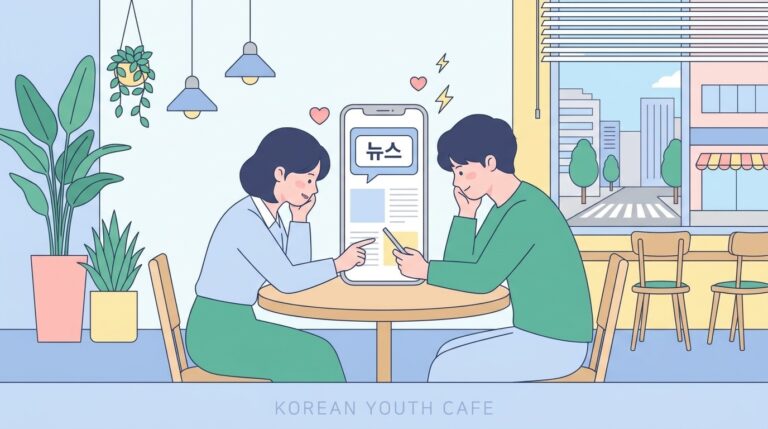
Setting: A cozy cafe in Hongdae. Minji (민지) and you are drinking iced lattes while scrolling through your phones.
- 민지 (Minji): 헐, 대박! 방금 기사 뜬 거 봤어? (Heol, daebak! Bang-geum gisa tteun geo bwasseo?)
🎭 Gasps, tapping her phone screen rapidly and turning it toward you.
“OMG, no way! Did you see the article that just popped up?” - You: 아니, 무슨 일인데? 누가 열애설 났어? (Ani, museun irinde? Nuga yeol-ae-seol nasseo?)
🎭 Leaning in with curious eyes.
“No, what happened? Who got caught in a dating rumor?” - 민지 (Minji): 너 좋아하는 그 배우랑 아이돌 멤버! 디스패치 사진 떴어! (Neo johahaneun geu bae-urang aidol membeo! Diseupaechwi sajin tteosseo!)
🎭 Showing you the paparazzi photos.
“That actor you like and that top idol member! Dispatch photos just dropped!” - You: 헐, 진짜로? 둘이 사귄다고 소속사에서 인정했어? (Heol, jinjaro? Duri sagwindago sosoksa-eseo injeong-haesseo?)
🎭 Covering your mouth in shock.
“OMG, seriously? Did the agencies confirm they are dating?” - 민지 (Minji): 아직! 소속사에서는 ‘본인 확인 중’이라고만 밝혔어. (Ajik! Sosoksa-eseoneun ‘bon-in hwag-in jung’-iragoman balkyeosseo.)
🎭 Refreshing the portal search tab.
“Not yet! The agency only stated they are ‘currently checking with the artist.'” - You: 와, 사진 보니까 데이트하는 거 빼박인데? (Wa, sajin bonikka de-iteuhaneun geo ppaebag-inde?)
🎭 Squinting at matching caps and couple sneakers.
“Wow, looking at the photos, it’s undeniable proof (pe-bak) they are on a date!” - 민지 (Minji): 맞지? 곧 ‘좋은 감정으로 알아가는 중’이라고 공식입장 뜰 것 같아. (Matji? Got ‘joeun gamjeongeuro al-aganeun jung’-irago gongsik-ipjang tteul geot gata.)
🎭 Smirking knowingly.
“Right? I bet they’ll release an official statement saying ‘getting to know each other with good feelings’ soon.” - You: 둘이 은근 잘 어울린다. 예쁘게 오래 만났으면 좋겠어! (Duri eungeun jal eo-ullinda. Yeoppeuge orae mannasseumyeon jokgesseo!)
🎭 Smiling genuinely.
“They actually match surprisingly well. I hope they date happily for a long time!”
🔀 Interactive Decision Branch
What would you say next to Minji?
- Option A: “기사 댓글 반응은 어때? 팬들도 응원해?” (Gisa daetgeul ban-eung-eun eottae? Paendeuldo eung-wonhae? – How are the comments on the article? Are the fans supportive too?)
- Option B: “경찰에 신고해야 하는 거 아니야?” (Gyeongchal-e sin-gohaeya haneun geo aniya? – Shouldn’t we report this to the police?)
- Option C: “사귀든 말든 내 알 바 아니야.” (Sagwideun maldeun nae al ba aniya. – Whether they date or not, it’s none of my business.)
Feedback:
* Option A (Best): 🌟 Excellent natural conversation flow! Asking about netizens’ reactions (댓글 반응) is how Koreans chat about trends.
* Option B (Bad): ❌ Dating rumors are entertainment news, not a crime! This response would confuse your friend.
* Option C (Risk): ⚠️ A bit too blunt and dismissive! It abruptly ends an exciting friendly chat.
Phase 6: 10-Second Emotion Shadowing Drill
Practice reading these headline reactions with real native rhythm and pauses (/ indicates micro-pause):
[😲 충격과 호기심 / Shock & Curiosity]
“헐, / 대박! / 둘이 진짜 사귄대?”
(Heol, / daebak! / Duri jinjja sagwandae?)
➔ “OMG, / seriously?! / Are the two of them really dating?”-
[🤔 담담하고 분석적으로 / Analytical & Calm]
“소속사에서 / 사실무근이라고 / 공식입장 냈어.”
(Sosoksa-eseo / sasilmugeun-irago / gongsik-ipjang naesseo.)
➔ “The agency / released an official statement / saying it is groundless.” -
[🥰 따뜻하고 훈훈하게 / Supportive & Sweet]
“둘이 너무 잘 어울린다! / 예쁘게 만났으면 좋겠다.”
(Duri neomu jal eo-ullinda! / Yeoppeuge mannasseumyeon jokgetda.)
➔ “They look so good together! / I hope they date happily.”
Phase 7: K-Culture Mini Dictionary
- 공식입장 (Gongsik-ipjang) | Official Statement / Stance
Usage: The formal press statement released by an agency regarding scandals, dating rumors, or contract renewals. - 럽스타그램 (Leopseutageuraem) | Lovestagram
Usage: A portmanteau of “Love” and “Instagram,” referring to subtle couple posts, matching outfits, or photos taken at the same secret location. - 빼박 (Ppaebak) | Undeniable / Dead to rights
Usage: Short for ‘빼도 박도 못하다’. Used when photo evidence is so clear that neither party can deny the relationship. - 결별설 (Gyeolbyeolseol) | Breakup Rumor
Usage: The counterpart of dating rumors (열애설). Refers to media reports claiming a celebrity couple has parted ways.
Phase 8: Media Consumer & Traveler Survival Kit
Top 3 Survival Lines for Reading News & Talking to Locals
- 이 기사 헤드라인 무슨 뜻이에요? (I gisa hedeurain museun tteus-ieyo?)
Meaning: “What does this news headline mean?”
Pro Tip: Perfect when you want a Korean friend to summarize a complex entertainment article. - 공식 입장 아직 안 나왔죠? (Gongsik ipjang ajik an nawatchyo?)
Meaning: “The official statement hasn’t come out yet, right?”
Pro Tip: Use this when discussing developing breaking news. - 둘이 열애설 인정했대요. (Duri yeol-ae-seol injeong-haetdaeyo.)
Meaning: “They said the two admitted to the dating rumors.”
Editor’s Travel & Media Note
- When staying in Korea, use the Naver News Entertainment section on the Naver app to track the daily Top 10 real-time entertainment rankings. It’s the single best reading tool for intermediate learners!
- If you want to discuss music chart entries and news on the go, practice checking comments on melon or community boards via high-speed subway Wi-Fi.
Phase 9: Think Deeper (한 발 더 깊이)
In many Western cultures, a celebrity’s dating life is treated casually as personal privacy. However, in Korean entertainment culture, a dating rumor carries significant commercial and emotional weight. Because the idol-fan relationship is built on intense parasocial dedication, agencies act as mediators who carefully craft statements like “따뜻한 시선으로 지켜봐 주세요” (Please look upon them with warmth and kindness).
Notice how the language always asks for the public’s understanding and blessings. Language is a mirror of society: in Korea, public harmony and mutual respect between stars and their community of fans shape every single word chosen in the news.
💬 Your Turn: How are celebrity dating scandals treated in your home country? Do agencies make formal statements, or do stars post directly on their own social media? Share your thoughts below in Korean or English!
Phase 10: FAQ & Common Mistakes
Q: What is the difference between 연애 (Yeon-ae) and 열애 (Yeol-ae)?
A: 연애 (Yeon-ae) is the everyday standard word for dating/romance (e.g., 연애하고 싶다 = I want to date). 열애 (Yeol-ae) means “passionate love” and is almost exclusively used in media headlines and news reports (열애설).
Q: What does “친한 선후배 사이” mean in an official statement?
A: Literally “close senior-junior colleagues.” It is the polite industry euphemism for: “We are not dating, we are just co-workers who get along well.”
Q: When can I use the slang “빼박 (Ppaebak)”?
A: Use it only with close friends in casual settings when indisputable photo evidence surfaces. Avoid using it in formal writing or speaking tests!
🚨 Common Mistakes Warning Board
- Mistake: Saying “그들은 사랑을 발표했어요” (They announced love).
👉 Correct Action: Say “열애를 공식 인정했어요” (They officially acknowledged their relationship). - Mistake: Confusing 부인하다 (to deny) with 부인 (wife).
👉 Correct Action: In news contexts, 부인하다 means to deny/reject a claim. - Mistake: Using “좋은 감정으로 알아가는 중” to your date on day one.
👉 Correct Action: This is a PR phrase! In real life with someone you like, simply say “우리 더 알아가요” (Let’s get to know each other more).
Phase 11: Action Missions
- 🥉 Bronze Mission (Solo Practice): Read out loud the phrase “좋은 감정으로 알아가는 중입니다” 5 times with calm, polite press-conference intonation.
- 🥈 Silver Mission (Social/Study): Find one Korean entertainment article headline today and identify whether the agency 인정 (acknowledged) or 부인 (denied) the rumor.
- 🥇 Gold Mission (Real Life): Leave a supportive comment in Korean under your favorite celebrity’s news post: “두 분 예쁜 사랑 응원합니다!” (Supporting your beautiful love!).
- 🎮 K-Culture Mission: Watch an episode of a Korean variety show (like Knowing Bros or Running Man) and spot when cast members tease each other about a past 열애설!
Phase 12: Interactive Quiz Challenge
Q1. When an agency confirms a dating rumor politely, which phrase do they use?
a) 사실무근입니다
b) 좋은 감정으로 알아가는 중입니다
c) 법적 대응 하겠습니다
🔍 Click to reveal the Answer & Explanation
Correct Answer: b) 좋은 감정으로 알아가는 중입니다
Explanation: (a) means “It is completely groundless,” and (c) means “We will take legal action.” Option (b) is the standard polite confirmation phrase!
Q2. Fill in the blank:
“디스패치 사진 보니까 커플링까지 꼈네. 이건 완전 (____)이다!” (Looking at the Dispatch photo, they even have couple rings. This is undeniably obvious!)
🔍 Click to reveal the Answer & Explanation
Correct Answer: 빼박 (Ppaebak)
Explanation: 빼박 is the slang term used when photographic evidence is undeniable.
Q3. [True / False] In Korean news, “열애설” and “연애설” are used interchangeably in headline titles.
🔍 Click to reveal the Answer & Explanation
Correct Answer: False
Explanation: News journalists almost exclusively use the term 열애설 (Yeol-ae-seol) rather than 연애설 for dramatic media headlines!







