

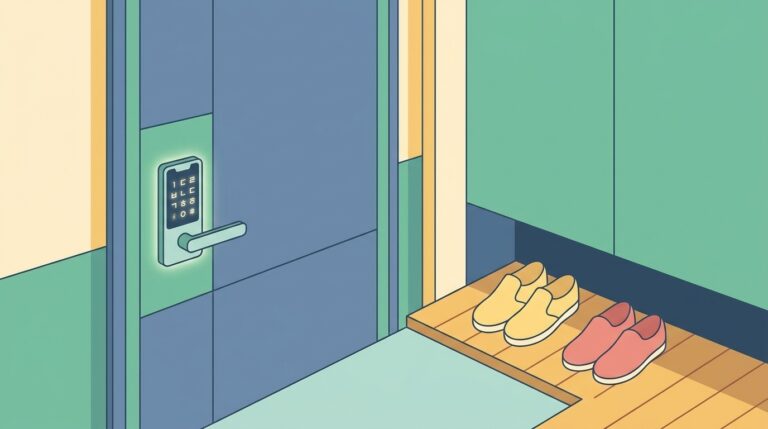
Phase 1: Empathy (Story-Driven Opening)
안녕하세요! I’m your Daily Hangul editor and your Korean cultural bestie. Have you ever watched a K-Drama where the main character frantically taps a digital keypad outside an apartment while dramatic music swells, or awkwardly turns their back to hide the screen from a roommate? In South Korea, physical keys are practically ancient history. Almost every apartment, officetel, and studio uses a smart digital door lock (도어락).
When foreign travelers and students first arrive in Korea, one of the most relatable panic moments happens right in the hallway: standing outside your Airbnb or friend’s door, staring at a sleek black touchscreen, wondering what to say when someone asks for the code, or awkwardly staring at someone’s fingers while they type. Through coaching hundreds of beginner Korean learners, we know that mastering simple phrases around entering passwords instantly removes apartment anxiety, prevents awkward social blunders, and makes you feel right at home. Let’s make you confident with Korean home door locks today!
Phase 2: Top 3 Core Expressions Deep Dive
1. 비밀번호 뭐예요? (Bimilbeonho mwoyeyo?)
- Pronunciation: [Bi-mil-beon-ho mwo-ye-yo?] (Think: ‘Bee-meal-bun-ho mwo-yay-yo’)
- Meaning: Literal: “What is the secret number?” | Natural: “What’s the door code / password?”
- K-Culture Moment: When arriving at your Korean friend’s apartment gathering with fried chicken and drinks, asking for the entrance pin right in front of the lobby door.
- Editor’s Insight: Koreans shorten “비밀번호” (password) to “비번” (Bibeon) in quick, casual daily speech. At the A2 level, saying 비밀번호 뭐예요? is polite, clear, and perfectly natural.
- Situation Spectrum: Casual: ✅ | Semi-formal: ✅ | Formal: ⚠️
- 🤔 Think About It: In English, we say “passcode” or “key code.” Why does Korean use “secret number” (비밀번호) even for standard front doors?
2. 잠시만 뒤돌아봐 주세요 (Jamsiman dwidorabwa juseyo)
- Pronunciation: [Jam-si-man dwi-do-ra-bwa ju-se-yo] (Think: ‘Jahm-she-mahn dwee-doe-rah-bwah joo-say-yo’)
- Meaning: Literal: “Please look back for a brief moment.” | Natural: “Could you turn around for just a second?”
- K-Culture Moment: When you are entering your private passcode and want to politely ask a delivery person, acquaintance, or guest to give you privacy.
- Editor’s Insight: In Korean culture, protecting privacy without offending the other person relies on soft phrasing like 잠시만 (just a moment) paired with ~해 주세요 (please do for me).
- Situation Spectrum: Casual: ✅ | Semi-formal: ✅ | Formal: ✅
- 🤔 Think About It: How does your home culture handle privacy when typing a pin code in front of company?
3. 문 열렸어요 (Mun yeollyeosseoyo)
- Pronunciation: [Mun yeol-lyeo-sseo-yo] (Think: ‘Moon yul-lyuh-ssuh-yo’)
- Meaning: Literal: “The door has opened.” | Natural: “The door is unlocked / It’s open!”
- K-Culture Moment: That satisfying multi-tone chime (삐리릭~) rings after punching in the digits, and you happily invite your friends to step inside.
- Editor’s Insight: Rather than saying “I unlocked it” (내가 열었어), Koreans naturally describe the state of the door: 문 열렸어요 (The door opened).
- Situation Spectrum: Casual: ✅ | Semi-formal: ✅ | Formal: ✅
- 🤔 Think About It: Notice how Korean often highlights the resulting state of an object rather than the person performing the action.
Phase 3: Textbook Korean vs. Real Korean
Situation 1: Asking for the door code
- 📖 Textbook Korean: 현관문 암호가 무엇입니까? (Hyeongwanmun amhoga mueosimnikka? – “What is the front door cipher code?”)
- 🗣️ Real Korean: 비번 뭐예요? (Bibeon mwoyeyo? – “What’s the pin?”)
- 💡 Why the difference? “암호” sounds like a military espionage code! Real Koreans use the contracted everyday slang “비번” (short for 비밀번호).
Situation 2: Telling someone the door unlocked automatically
- 📖 Textbook Korean: 제가 문 잠금을 해제했습니다. (Jega mun jamgeumeul haejehaessseumnida. – “I have deactivated the door locking mechanism.”)
- 🗣️ Real Korean: 문 열렸어요, 들어오세요! (Mun yeollyeosseoyo, deureooseyo! – “It’s open, come on in!”)
- 💡 Why the difference? Native speakers focus on welcoming the guest quickly rather than describing technical mechanical actions.
Phase 4: K-Culture Deep Dive & Non-Verbal Manners
4-1. Nunchi (눈치) & Physical Manners at the Doorpad
When someone in Korea is typing their door lock code, proper etiquette is vital:
1. The Polite Turn-Away: Always take a step back and angle your body 45 to 90 degrees away from the keypad. Staring directly at someone’s hands while they input digits is considered intrusive.
2. The Hand Shield: If you are the one typing the passcode, lightly cover the top of the keypad with your free hand. It’s a standard habit in Korea to prevent anyone or hallway security cameras from capturing your combination.
4-2. Cultural Code: The Doorlock Melody in K-Dramas
Every Korean door lock plays distinct acoustic feedback. There is the single beep for each key press, the melodic celebratory tune when the code is correct (diddle-un-ddi!), and the harsh, jarring warning beep (삐- 삐- 삐-!) when the wrong pin is entered three times. In K-Thrillers and romance dramas alike, this beep is a classic suspense tool used right before an unexpected visitor enters!
Phase 5: Real-World Roleplay Scenario
Setting: Outside Minji’s modern officetel in Hongdae. You (Alex) and Minji just arrived with take-out tteokbokki.
- Minji: 다 왔다! 여기가 우리 집이에요. (Da watda! Yeogiga uri jibieyo. / “We’re here! This is my place.”) 🎭 [Minji reaches toward the keypad and looks back gently]
- Alex: 우와, 깔끔하다! 비번 눌러야 해요? (Uwa, kkalkkeumhada! Bibeon nulleoya haeyo? / “Wow, so neat! Do you need to enter the pin?”) 🎭 [Alex steps back slightly]
- Minji: 네, 잠시만 뒤돌아봐 줄래요? (Ne, jamsiman dwidorabwa jullaeyo? / “Yes, could you look away for just a second?”) 🎭 [Minji places one hand above the keypad to shield the numbers]
- Alex: 아, 물론이죠! 편하게 누르세요. (A, mullonijyo! Pyeonhage nureuseyo. / “Oh, of course! Take your time typing.”) 🎭 [Alex turns around and looks at the hallway poster]
- Minji: [Beep-beep-beep-beep… 삐리릭!] 문 열렸어요! (Mun yeollyeosseoyo! / “It’s open!”) 🎭 [The digital lock chimes cheerfully as the handle unlocks]
- Alex: 오, 소리가 귀여워요! (O, soriga gwiyeowoyo! / “Oh, that chime is so cute!”) 🎭 [Alex smiles and turns back]
- Minji: 얼른 들어와요. 배고프죠? (Eolleun deureowayo. Baegopeujyo? / “Come on in quickly. You’re hungry, right?”) 🎭 [Minji holds the door open and points to the slippers]
- Alex: 네, 잘 먹겠습니다! (Ne, jal meokgetseumnida! / “Yes! Thank you for having me!”) 🎭 [Alex steps inside and takes off shoes]
🔀 Interactive Branching Choice:
What should you do right after Minji says “네, 잠시만 뒤돌아봐 줄래요?”
- Option A: Stare closely at her fingers and say “제가 외울게요!” (I will memorize it!)
- Option B: Turn slightly away and say “네, 천천히 누르세요.” (Sure, take your time entering it.)
- Option C: Push the door handle immediately before she enters the code.
Feedback:
* Option A [Bad]: Super creepy! Passwords in Korea are private personal security boundaries.
* Option B [Best]: 100% natural, polite Korean manner (Nunchi score: 10/10)!
* Option C [Risk]: The door lock will trigger a loud emergency siren if pulled before unlocking.
Phase 6: 10-Second Emotion Shadowing Drill
Practice matching these rhythm breaks (/) and emotional cues:
[🤫 조심스럽고 정중하게 - Polite & discreet]- 잠시만 / 뒤돌아봐 / 주세요. (Jam-si-man / dwi-do-ra-bwa / ju-se-yo.)
[😄 반갑고 시원시원하게 - Cheerful & welcoming]- 문 열렸어요, / 어서 들어오세요! (Mun yeol-lyeo-sseo-yo, / eo-seo deul-eo-o-se-yo!)
[😮 살짝 당황하며 친근하게 - Friendly curiosity]- 어? / 비번 / 까먹었어요? (Eo? / Bi-beon / kka-meog-eo-sseo-yo? – “Uh? Did you forget the pin?”)
Phase 7: K-Culture Mini Dictionary
- 도어락 (Doeorak): Digital door lock. Used universally across 95%+ of modern Korean households.
- 비번 (Bibeon): Short contraction of 비밀번호 (Password/PIN). Most common term used among friends and family.
- 별표 (Byeolpyo): The asterisk key (). Most Korean door locks require pressing [] before or after the pin number.
- 현관 (Hyeongwan): The entryway/foyer inside the front door where shoes must be removed.
Phase 8: Traveler’s Survival Kit
Top 3 Survival Phrases
- 비번 다시 알려주세요. (Bibeon dasi allyeojuseyo. / “Please let me know the passcode again.”) — Pro Tip: Crucial when checking into an Airbnb late at night!겁
- 별표 눌러야 해요? (Byeolpyo nulleoya haeyo? / “Do I need to press the star key?”) — Pro Tip: Many door locks won’t open until you tap the [] key at the end.*
- 배터리 방전됐어요. (Baeteori bangjeondwaesseoyo. / “The door lock battery is dead.”) — Pro Tip: If the keypad doesn’t light up, you can touch a 9V rectangular battery to the emergency terminal underneath!
Editor’s Travel Note
Navigating Korean residential buildings is smooth with the right tools. We recommend saving your door code in your secure notes app and using the Naver Map Navigation App to pinpoint building entrance numbers, which often require a separate ground-floor lobby code (공동현관 비번).
Phase 9: Think Deeper
In many Western cultures, a physical key is handed over as a symbolic gesture of hospitality. In Korea’s hyper-digitalized society, sharing a home passcode (비번) carries that exact intimate weight. Giving someone your door lock code means: “You are welcome in my sanctuary anytime.” It reflects Korea’s blend of advanced smart-home technology with traditional communal trust.
💬 Your Turn: Does your home country use smart digital locks or physical keys? How would you feel about sharing your door code with a close friend? Share below in the comments!
Phase 10: FAQ & Common Mistakes
Q: What does it mean when the lock beeps repeatedly and won’t open?
A: It usually means either the code was incorrect, or the deadbolt is jammed. Lightly pull the door toward you to align the bolt, then re-enter the code followed by the asterisk [*].
Q: Why do people touch the screen with their whole palm after typing?
A: Many Korean locks feature a “random touch / palm cover” security function that blurs fingerprint smudges across the entire screen so nobody can guess which numbers you tapped!
Q: What is “이중잠금” (Double Lock)?
A: When you are inside your home, holding the internal lock button for 3 seconds activates “Safe Mode” (이중잠금), preventing anyone outside from opening the door even if they know the passcode.
🚨 Common Mistakes Alert
- ❌ Mistake: Forgetting to press [] (Star) after typing the 4-6 digits.
👉 Correct Action: Most Korean locks require: [Digits] + []. - ❌ Mistake: Yanking the door handle immediately while the lock motor is still turning.
👉 Correct Action: Wait for the short chime melody (삐리릭) before pulling the handle. - ❌ Mistake: Staring intently at the host while they type their pin.
👉 Correct Action: Turn your head slightly away to give polite privacy.
Phase 11: Action Mission Challenge
- 🥉 Bronze Mission: Practice saying 비번 뭐예요? and 문 열렸어요! 5 times aloud.
- 🥈 Silver Mission: Write a mini dialogue in the comments pretending you just arrived at an Airbnb.
- 🥇 Gold Mission: When visiting a Korean friend or lodging, practice the polite turn-away gesture and confirm with 별표 눌러요?
- 🎮 K-Culture Mission: In the next K-Drama episode you watch, spot the brand or the chime sound of the apartment door lock!
Phase 12: Interactive Quiz Challenge
Q1. What is the most natural, casual Korean slang word for “password/PIN”?
A) 암호 (Amho)
B) 비번 (Bibeon)
C) 키넘버 (Kinheombeo)
🔍 Click to reveal the Answer & Explanation
Correct Answer: B) 비번 (Bibeon)
Explanation: While 비밀번호 is the standard word, Koreans in everyday life contract it to 비번.
Q2. Fill in the blank: When the lock unlocks, you can tell your friend: “문 __________!” (The door is open!)
A) 닫혔어요 (Dathyeosseoyo)
B) 열렸어요 (Yeollyeosseoyo)
C) 고장났어요 (Gojangnasseoyo)
🔍 Click to reveal the Answer & Explanation
Correct Answer: B) 열렸어요 (Yeollyeosseoyo)
Explanation: 열렸어요 means “it opened / it is open.”
Q3. True or False: In Korea, it is considered polite to look directly at the keypad when someone enters their code so you can help them remember it.
🔍 Click to reveal the Answer & Explanation
Correct Answer: False
Explanation: You should always glance away or turn around briefly (Nunchi) to respect their privacy.







