

Phase 1: 공감 (The Anatomy of the 1+1 Temptation)
안녕하세요! 매일한글 에디터입니다. Have you ever stepped into a neon-lit Korean convenience store (편의점) at midnight just to grab a carton of banana milk, only to emerge ten minutes later juggling two iced coffees, four bags of potato chips, and a suspicious surplus of ramyeon you never intended to buy? You tell yourself you saved money because it was a 1+1 (One-Plus-One, or Won-plus-won) deal, yet your digital receipt tells a starkly different story.
In South Korea’s hyper-dense convenience retail ecosystem, 1+1 (원플러스원) and 2+1 (투플러스원) bundled promotions are not mere discounts; they are sophisticated psychological gambits designed around loss aversion, spatial economics, and convenience-driven consumer sociology. For advanced learners navigating nuanced socioeconomic conversations or simply mastering native-level transactional dynamics, understanding this retail psychology and expressing the fine line between a genuine bargain and consumer regret is an essential milestone. Based on real classroom anecdotes and field feedback from seasoned expats, this guide equips you with C2-level discourse to articulate the subtle psychology of impulsive consumerism and convenience store mechanics.
Phase 2: 핵심 표현 3선 심층 분석 (Core Expressions)
1. 배보다 배꼽이 더 크다 (Bae-boda baekkop-i deo keuda)
- Pronunciation: Bae-boh-dah bae-kkop-ee duh keu-dah (Rhymes loosely with “pay board-a back-cup-ee the could-ah”)
- Meaning: Literal: “The belly button is bigger than the belly.” | Actual Nuance: Ancillary costs or side effects end up eclipsing the principal item (Penny wise, pound foolish; the tail wagging the dog).
- K-Culture Moment: In workplace K-Dramas like Misaeng or Agency, characters use this idiom when marketing budgets, delivery charges, or uncalculated bundle purchases spiral out of proportion compared to the base product value.
- Editor’s Insight: At a C2 level, using this idiom illustrates that you grasp how “free” gifts (증정품) seduce shoppers into splurging on overpriced original products.
- Situation Spectrum: Casual (✅) / Semi-formal (✅) / Formal (⚠️ Business meetings require contextual discretion)
- 🤔 Think About It: Why does Korean folk imagery use the anatomical disproportion of a belly button to criticize economic irrationality? How does your native language express disproportionate secondary costs?
2. 미끼 상품에 낚이다 (Mikki sangpum-e nakk-ida)
- Pronunciation: Mee-kkee sang-poom-eh nahk-kkee-dah (Think of “me-key song-poom-eh knock-ee-dah”)
- Meaning: Literal: “To be hooked by a bait product.” | Actual Nuance: Falling victim to a loss-leader marketing tactic or decoy pricing.
- K-Culture Moment: Variety shows like Workman or YouTube lifestyle vlogs frequently zoom in on promotional display stands with captions shouting, “미끼 상품에 제대로 낚임!” (Completely fell for the decoy item!).
- Editor’s Insight: While 미끼 (bait) stems from fishing terminology, pairing it with the passive verb 낚이다 (to be hooked) denotes self-deprecating acknowledgment that the seller’s psychological trap worked perfectly.
- Situation Spectrum: Casual (✅) / Semi-formal (✅) / Formal (🚫 Use 유인 상품의 마케팅 전략에 반응하다 in academic/formal writing)
- 🤔 Think About It: Do loss-leader strategies in your home country elicit humor or consumer outrage compared to Korea’s lighthearted acceptance of convenience retail culture?
3. 합리적 소비인 척하는 과소비 (Hamnicheok sobi-in cheokhaneun gwasobi)
- Pronunciation: Hahm-nee-jeok soh-bee-een chuk-hah-neun gwa-soh-bee
- Meaning: Literal: “Overspending masquerading as rational consumption.” | Actual Nuance: The cognitive dissonance of buying bulk promotional items under the illusion of frugality.
- K-Culture Moment: Used analytically in Korean personal finance channels (e.g., SyuKa World) discussing the behavioral economics of young single households (1인 가구).
- Editor’s Insight: C2 learners should leverage compound grammatical constructions like -(으)ㄴ 척하다 (to pretend to be) combined with Sino-Korean economic nouns (합리적 소비 vs. 과소비) to critique modern hyper-consumerism.
- Situation Spectrum: Casual (✅) / Semi-formal (✅) / Formal (✅)
- 🤔 Think About It: How does modern urban infrastructure create social pressures that normalize buying surplus perishable goods?
Phase 3: 교과서 한국어 vs 진짜 한국어 (Textbook vs. Real Korean)
Situation 1: Deciding whether to take the bundled free item
- 📖 교과서 한국어: “이 물건은 하나를 사면 하나를 더 주므로 경제적입니다.” (I mulgeon-eun hana-reul samyeon hana-reul deo jumeuro gyeongjejeog-imnida. – This item is economical because if you buy one, they give one more.)
- 🗣️ 진짜 한국어: “1+1이라고 무턱대고 담다간 결국 쓰지도 않고 유통기한 지나서 버리기 일쑤예요.” (Won-plus-won-irago muteokdaego damdagan gyeolguk sseujido anko yutonggihan jinaseo beorigi ilssu-yeyo. – If you mindlessly sweep up 1+1 items, you usually end up tossing them past their expiration date without even using them.)
- 💡 왜 다를까?: Native speakers replace robotic economic terms with vivid idiomatic verbs (담다, 버리기 일쑤이다) and realistic lifestyle friction points like expiration dates (유통기한/소비기한).
Situation 2: Storing the extra item in a mobile app locker
- 📖 교과서 한국어: “남은 상품을 스마트폰 애플리케이션에 저장해 주십시오.” (Nameun sangpum-eul seumateupon aepeullikeisyeon-e jeojanghae jusipsio. – Please store the remaining merchandise in the smartphone application.)
- 🗣️ 진짜 한국어: “교차 증정 안 되면 남은 하나는 앱에 키핑해 둘게요.” (Gyocha jeungjeong an doemyeon nameun hana-neun aebe kipinghae dulgeyo. – If cross-flavor exchange isn’t allowed, I’ll just keep the spare one in the app locker.)
- 💡 왜 다를까?: Native urbanites use high-frequency loanwords like 키핑하다 (keeping) and industry terms like 교차 증정 (cross-promotional selection) rather than generic textbook descriptions.
Phase 4: K-Culture 딥다이브 & 비언어적 매너 (Deep Dive & Manners)
4-1. 눈치(Nunchi) & Non-Verbal Gestures
When grabbing a 1+1 item off the shelf, always pick up both units and present them together at the counter. Cashiers in South Korea operate under intense scanning speed metrics; presenting only one unit forces the clerk to ask, “하나 더 가져오셔야 해요” (You need to bring one more), halting the queue and creating mutual social friction. If you only want one, tap the counter lightly with your smartphone open to the brand’s proprietary app (GS25’s 우리동네GS or CU’s 포켓CU) and say you will “keep” it.
4-2. Cultural Code: The Single Household (1인 가구) Paradox
In Korean megacities, micro-apartments (원룸) have minuscule refrigerators. The 1+1 promotion is an engineering paradox: retailers provide wholesale per-unit pricing to single consumers without forcing them to visit bulk warehouses like Costco. However, because Korean convenience stores place fresh prepared meals (도시락) right next to bundled drinks, the 1+1 serves as the primary decoy item (미끼 상품) to drive foot traffic for high-margin hot snacks and instant meals.
Phase 5: 실전 롤플레이 시나리오 (Roleplay Dialogue)
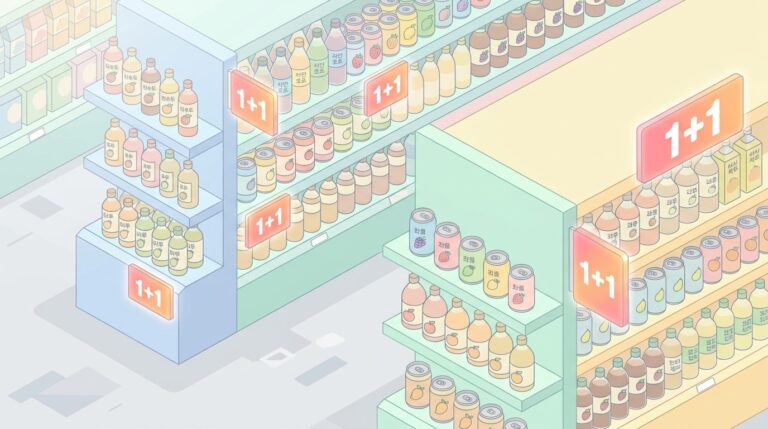
- Setting: A buzzing GS25 in Gangnam at 11:30 PM. The shelves are packed with neon “1+1” and “2+1” promotional badges.
- Characters: Min-woo (Experienced retail clerk) & Sarah (C2 Advanced Learner analyzing her shopping basket).
- Min-woo: 손님, 이거 탄산수 1+1 행사 상품인데 교차 증정으로 다른 맛 하나 더 안 챙기세요? (🎭 바코드를 스캔하다 멈추며 눈짓으로 음료 매대를 가리킨다)
Son-nim, igeo tansansu won-plus-won haengsa sangpum-inde gyocha jeungjeong-euro dareun mat hana deo an chaeng-gise-yo?
(Customer, this sparkling water is on a 1+1 promotion. Aren’t you going to grab another flavor via cross-bundle?) -
Sarah: 아, 교차 증정이 되는 품목이었군요! 쟁여두면 마시긴 하겠지만 솔직히 들고 가기엔 짐이라서요. (🎭 장바구니 무게를 가늠하듯 살짝 들어 보인다)
A, gyocha jeungjeong-i doeneun pummog-ieossgunyo! Jaeng-yeodumyeon masigin hagetjiman soljikhi deulgo gagien jim-iraseoyo.
(Ah, cross-bundle was allowed for this item! I’d drink it if I stockpiled it, but honestly it’s a hassle to carry.) -
Min-woo: 그러시면 편의점 앱 바코드 보여주시면 남은 한 병은 ‘나만의 냉장고’ 앱에 보관 처리해 드릴 수 있습니다. (🎭 포스기 모니터를 톡톡 두드린다)
Geureosimyeon pyeon-uijeom aep bakodeu boyeojusimyeon nameun han byeong-eun ‘naman-ui naengjanggo’ aebe bogwan cheorihae deuril su itseumnida.
(In that case, if you show me your convenience store app barcode, I can process and store the remaining bottle in your virtual fridge app.) -
Sarah: 와, 진짜 세상 좋아졌네요. 공짜로 하나 더 준다는 말에 혹해서 충동구매하는 미끼 상품인 줄만 알았는데, 보관까지 되다니요. (🎭 스마트폰을 꺼내 앱 멤버십 바코드를 띄운다)
Wa, jinjja sesang joajyeotneyo. Gongjjaro hana deo jundaneun mare hokhaeseo chungdonggumehaneun mikki sangpum-in julman aratneunde, bogwankkaji doedaniyo.
(Wow, technology has really come a long way. I thought it was just a decoy item luring me into impulse buying with a ‘free extra’ pitch, but I can even store it!) -
Min-woo: 하하, 맞아요. 단가로 치면 대형마트 못지않게 저렴하니까 다들 그렇게 키핑해 두고 나중에 찾아가세요. (🎭 능숙하게 스마트폰 바코드를 찍는다)
Haha, majayo. Danggaro chimyeon daehyeongmateu motjianke jeoryeomhanikka dadeul geureoke kipinghae dugo najung-e chajagaseyo.
(Haha, exactly. Per-unit cost rivals large hypermarkets, so everyone just keeps them digitally and redeems them later.) -
Sarah: 결국엔 이 앱 때문에 다음 주에 또 발걸음하게 만드니, 마케팅 심리학이 참 치밀하네요. (🎭 감탄 섞인 헛웃음을 지으며 결제 카드를 내민다)
Gyeolguk-en i aep ttaemune daeum jue tto balgeoreumhage mandeuni, maketing simnihag-i cham chimilhagoyo.
(In the end, this app draws my footsteps right back in next week—retail marketing psychology is truly meticulous.) -
Min-woo: 에이, 들키셨네요! 영수증 모바일로 넣어 드렸고, 보관 상품 유효기간은 30일입니다! (🎭 쇼핑백에 정갈하게 물건을 담아 건넨다)
Ei, deul-kisyeotneyo! Yeongsujeung mobaillo neo-eo deuryeotgo, bogwan sangpum yuhyogigan-eun samsibir-imnida!
(Ah, you saw right through us! The receipt is in your app, and the validity of your stored item is 30 days!) -
Sarah: 네, 감사합니다! 유효기간 지나서 배보다 배꼽이 더 커지기 전에 얼른 찾아가야겠어요. (🎭 가볍게 목례하며 편의점 문을 나선다)
Ne, gamsahamnida! Yuhyogigan jinaseo bae-boda baekkop-i deo keojigi jeone eolleun chajagayagesseoyo.
(Thank you! I must redeem it promptly before it expires and my incidental costs eclipse the savings.)
🔀 인터랙티브 분기점 (Interactive Branching)
What should Sarah do if she encounters a 2+1 promotion on perishable yogurt cups she cannot finish alone?
* Choice A: Buy all 3, force herself to eat them tonight, and boast about saving 33%.
* Choice B: Ask the clerk: “혹시 2+1 상품도 남은 수량 앱에 보관 가능한가요?” (Can I store remaining 2+1 promo items in the app too?).
* Choice C: Demand a 33% cash discount on a single cup at the register.
- Detailed Feedback:
- Choice A (Risk): Classic sunk-cost fallacy (매몰 비용의 오류). You risk stomach distress and food waste.
- Choice B (Best): Perfect pragmatic cultural fluency! Most major convenience apps support multi-unit digital storage (증정품 키핑).
- Choice C (Bad): Retail POS systems in Korea do not allow manual single-unit cash deductions on bundled marketing deals; this causes awkward embarrassment (민망한 상황).
Phase 6: 10초 감정 섀도잉 드릴 (Emotion Shadowing Drill)
[😏 은근히 찔리고 자조적인 톤]
1+1이라고 / 좋아하다가 / 결국 배보다 배꼽이 / 더 커진 꼴이네요.
(Won-plus-won-irago / joahadaga / gyeolguk bae-boda baekkop-i / deo keojin kkor-ineyyo.)-
[🧐 분석적이고 날카로운 톤]
소비자가 / 알뜰하게 샀다고 착각하게 만드는 / 전형적인 미끼 상품이에요.
(Sobijaga / alteulhage satdago chakgakhage mandeuneun / jeonhyeongjeogin mikki sangpum-ieyo.) -
[💡 깨달음을 얻고 감탄하는 톤]
어차피 쓸 생필품이라면 / 교차 증정으로 / 쟁여두는 게 / 이득이죠!
(Eochapi sseul saengpilpum-iramyeon / gyocha jeungjeong-euro / jaeng-yeoduneun ge / ideuk-ijyo!)
Phase 7: K-Culture 미니 사전 (Mini Dictionary)
- 쟁여두다 (Jaeng-yeoduda): To stockpile or hoard goods strategically at home during flash sales or promotional windows.
- 교차 증정 (Gyocha Jeungjeong): Cross-promotional entitlement, allowing buyers to select different flavors or variants within the same price tier in a 1+1 or 2+1 deal.
- 나만의 냉장고 / 키핑 (Naman-ui Naengjanggo / Keeping): A digital retail locker ecosystem where unclaimed promotional gift items are stored in your mobile account for up to 30 days.
- 가성비 집착 (Gaseongbi Jipchak): Obsession with price-to-performance ratio, a defining behavioral trait in Korea’s youth consumer culture.
Phase 8: 여행자를 위한 생존 키트 (Survival Kit)
Top 3 Survival Phrases
- 교차 증정 가능한가요? (Gyocha jeungjeong ganeunghangayo?) – Can I mix and match flavors for this promotion?
- 증정품은 앱에 보관해 주세요. (Jeungjeongpum-eun aebe bogwanhae juseyo.) – Please store the promotional bonus item into my app locker.
- 행사 적용된 가격 맞나요? (Haengsa jeog-yongdoen gagyeok mannayo?) – Is the promotional discount correctly applied to this total?
Editor’s Travel Note
Before roaming Seoul’s streets, install the 우리동네GS 편의점 앱 다운로드 or 포켓CU 편의점 멤버십 앱 다운로드. Even foreign phone numbers verified via roaming SMS can utilize digital keeping features, ensuring you never carry surplus heavy bottles during your subway commute!
Phase 9: “한 발 더 깊이” (Deep Cultural Reflection)
In South Korea’s hyper-dense cityscape, convenience stores are not merely commercial outposts; they function as communal pantries for an urban society defined by single-person households (1인 가구). The ubiquitous 1+1 promotion reconciles the tension between hyper-dense living spaces lacking storage and the deep-seated cultural imperative of 알뜰함 (frugal resourcefulness). When you navigate these bundled deals, you are participating in a living economic ritual that balances commercial marketing psychology against urban survival strategies.
💬 Your Turn: Have you ever experienced a moment where a promotional “deal” in Korea tricked you into buying something completely unnecessary? Share your funniest convenience store haul in the comments below!
Phase 10: FAQ & 오해 방지 (FAQ Schema)
Q: 1+1 행사 상품 중 하나만 계산대로 가져가면 50% 할인되나요?
A: 절대로 자동 할인되지 않습니다. 한국 편의점 포스(POS) 시스템은 2개의 바코드가 스캔되어야 프로모션 0원 처리가 들어갑니다. 하나만 가져오면 정가 그대로 1개 가격이 청구되므로 반드시 2개를 모두 챙기거나 모바일 앱에 보관을 요청해야 합니다.
Q: 교차 증정(Cross-promotion)은 동일 브랜드의 모든 상품에 적용되나요?
A: 아닙니다. 가격표 태그 하단에 작은 글씨로 ‘교차 가능’ 또는 동일 가격대의 동일 용량 라인업(예: 탄산수 레몬맛 & 라임맛)으로 한정되어 명시됩니다. 계산 전에 태그를 확인하거나 점원에게 확인하는 것이 안전합니다.
Q: 편의점 앱에 키핑한 증정품은 전국 어느 지점에서나 찾을 수 있나요?
A: 네, 동일 브랜드(예: GS25에서 키핑한 상품은 전국 모든 GS25) 매장에서 유효기간(통상 30일) 내에 바코드 제시만으로 교환 가능합니다. 단, 해당 매장에 재고가 있어야 수령할 수 있습니다.
🚨 흔한 실수 (Common Mistakes)
- Mistake 1: Leaving the second 1+1 item on the shelf thinking the cashier will grab it.
Correct Action: Bring both items to the counter personally before scanning begins. - Mistake 2: Assuming 2+1 deals allow you to take only 2 items for a discounted price.
Correct Action: You must present all 3 items to get the third unit for free. - Mistake 3: Ignoring the promotional duration tag (e.g., month-end transitions).
Correct Action: Promotions reset on the 1st of every month; verify the printed promotional dates on shelf tags.
Phase 11: 액션 미션 & 참여 유도 (Action Missions)
- 🥉 Bronze Mission: Stand in front of your mirror and practice saying: “이거 1+1 교차 증정 되나요?” smoothly in under 3 seconds.
- 🥈 Silver Mission: Next time you visit a Korean mart or convenience store, identify one loss-leader item (미끼 상품) and explain the psychological hook in your study notebook.
- 🥇 Gold Mission: Enter a convenience store, purchase a 1+1 or 2+1 product, and successfully ask the clerk to store the extra item into your app locker (앱에 키핑해 주세요) without switching to English!
- 🎮 K-Culture Mission: Watch a convenience store mukbang or variety show episode (like Workman) and spot 3 real-life examples of promotional shelf tags (행사 매대).
Phase 12: 인터랙티브 퀴즈 챌린지 (Quiz Challenge)
Q1. 상황 판단: 편의점에서 1+1 커피 2개를 가져왔는데, 점원이 “이 상품은 교차 증정이 안 되세요”라고 말했다. 가장 적절한 대처는?
👉 정답 및 해설 확인하기
- 정답: 동일한 맛의 상품으로 하나를 바꿔오거나, 다른 1+1 교차 가능 제품으로 변경한다.
- 해설: 교차 증정이 불가한 품목은 바코드 분류가 달라 전산상 1+1 할인이 묶이지 않습니다. 동일 플레이버로 교체해야 프로모션이 정상 적용됩니다.
Q2. 빈칸 채우기: 겉으로는 알뜰한 구매처럼 보이지만 실제로는 불필요한 지출을 유발하는 상황을 가리켜 “배보다 ______이 더 크다”고 한다.
👉 정답 및 해설 확인하기
- 정답: 배꼽 (Belly button)
- 해설: 본체(배)보다 부속물(배꼽)이 더 크다는 뜻으로, 덤 상품에 눈이 멀어 본말이 전도된 과소비를 풍자하는 고급 관용구입니다.
Q3. True / False: 한국 편의점의 1+1 행사에서 증정품 1개를 당장 들고 가기 싫다면 모바일 앱에 보관(키핑)할 수 있다.
👉 정답 및 해설 확인하기
- 정답: True (참)
- 해설: GS25(우리동네GS), CU(포켓CU) 등 주요 편의점 프랜차이즈 앱의 ‘보관/키핑’ 기능을 통해 증정품을 가상 보관함에 넣고 추후 전국 매장에서 수령할 수 있습니다.







