

Phase 1: Empathy (Story-driven Opening)
안녕하세요! 매일한글 에디터입니다. (Hello! This is your Daily Hangul editor.)
Picture this: You are walking down a vibrant alley in Hongdae after enjoying delicious K-BBQ with friends. Suddenly, you realize someone is frantically following a lost tourist, or you witness an escalating dispute, or worse—your bag containing your passport has just been snatched. Your heart races, your palms sweat, and your mind goes completely blank. You want to ask a nearby store owner or passerby for help, but in the heat of the moment, English fails to bridge the gap.
In high-stakes emergency situations, every second counts. Freezing up because you do not know how to say “Please call the police!” is every traveler’s silent nightmare. Our Daily Hangul community members frequently tell us: “I know how to order iced Americano, but when an urgent situation happened, I panicked!”
Today, we will equip you with clear, life-saving A2 Korean phrases that roll off your tongue effortlessly. You do not need complex grammar to stay safe—just a few punchy, natural expressions.
Phase 2: 3 Core Expressions Deep-Dive
1. 경찰 좀 불러주세요 (Gyeongchal jom bulleo-juseyo)
- Pronunciation: Gyeong-chal jom bool-luh-joo-seh-yo (Sounds like: Gyung-chahl + zhom + bool-luh-joo-seh-yo)
- Meaning: Literal: “Please call the police a little.” ➔ Actual Nuance: “Please call the police for me right away!”
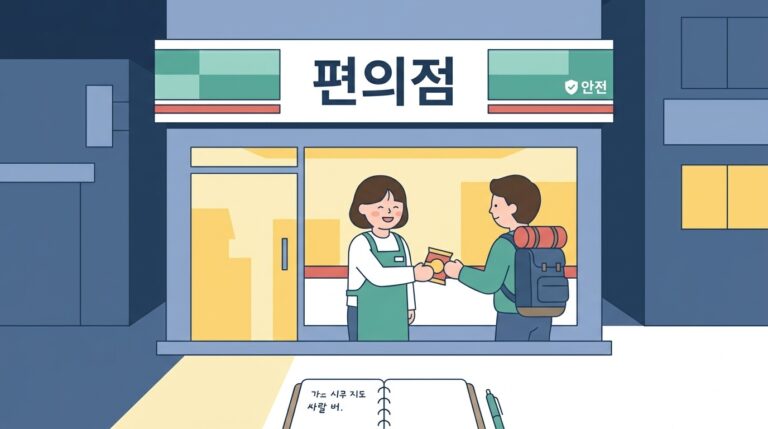
- K-Culture Moment: You hear this constantly in intense K-thrillers like Signal or Voice when a bystander rushes into a 24-hour convenience store to report an incident.
- Editor’s Insight: The tiny word 좀 (jom) literally means “a little,” but in Korean, it acts as a magical softener that makes urgent requests sound natural rather than rude.
- Situation Spectrum: Casual: 🚫 | Semi-formal: ✅ | Formal: ✅
- 🤔 Think About It: In English, adding “a little” to an emergency sounds counterproductive, but in Korean, it creates polite urgency. Why does Korean culture value softening particles even during emergencies?
2. 도와주세요! (Dowajuseyo!)
- Pronunciation: Do-wa-joo-seh-yo (Sounds like: Doh-wah-zoo-seh-yo)
- Meaning: Literal: “Please help.” ➔ Actual Nuance: “Help me! / I need help!”
- K-Culture Moment: The iconic line shouted by leads in drama cliffhangers when cornered by antagonists or seeking urgent medical/safety assistance.
- Editor’s Insight: Short, punchy, and universally recognized. If your mind goes blank and you cannot remember “police,” screaming 도와주세요! will instantly draw every Korean’s attention.
- Situation Spectrum: Casual: ⚠️ (Use ‘도와줘’ with close friends) | Semi-formal: ✅ | Formal: ✅
- 🤔 Think About It: Notice how Korean verbs combine ‘help’ (도왔다) and ‘give’ (주다). You are asking someone to “give help” toward your direction.
3. 112에 신고해 주세요 (Il-il-i-e singohae juseyo)
- Pronunciation: Eel-eel-ee-eh shin-go-hae joo-seh-yo (Sounds like: Eel-eel-ee-eh sheen-go-heh-joo-seh-yo)
- Meaning: Literal: “Please report to 112.” ➔ Actual Nuance: “Please dial 112 and report this!”
- K-Culture Moment: When a store manager quickly picks up the landline phone while keeping a distressed customer safe behind the counter.
- Editor’s Insight: 112 is South Korea’s official police dispatch number (equivalent to 911 in the US or 999 in the UK). Saying the exact number 112 (일일이) is unmistakable.
- Situation Spectrum: Casual: 🚫 | Semi-formal: ✅ | Formal: ✅
- 🤔 Think About It: Why do you think Koreans say 신고하다 (singohada – to officially report) rather than just 전화하다 (jeonhwahada – to call) in emergencies?
Phase 3: Textbook Korean vs. Real Korean
Situation 1: Asking a bystander to contact the police
- 📖 교과서 한국어 (Textbook): 경찰관에게 전화를 걸어 주시겠습니까? (Gyeongchalgwanege jeonhwareul georeo jusigesseumnikka? – “Would you be so kind as to make a phone call to a police officer?”)
- 🗣️ 진짜 한국어 (Real-Life): 경찰 좀 불러주세요! (Gyeongchal jom bulleo-juseyo!)
- 💡 Why is it different? In a crisis, textbook honorific endings like ~주시겠습니까 are too long and unnatural. Real native speakers cut straight to the verb with polite urgency.
Situation 2: Shouting for emergency intervention
- 📖 교과서 한국어 (Textbook): 저에게 도움을 베풀어 주십시오. (Jeoege doumeul bepuleo jusipsio. – “Please bestow assistance upon me.”)
- 🗣️ 진짜 한국어 (Real-Life): 여기 좀 도와주세요! 저기요, 도와주세요! (Yeogi jom dowajuseyo! Jeogiyo, dowajuseyo!)
- 💡 Why is it different? Native Koreans use location/attention pointers like 여기 (here) and 저기요 (excuse me/over here) to direct immediate public eye contact.
Phase 4: K-Culture Deep Dive & Non-Verbal Manners
4-1. Nunchi (눈치) & Gestures in Korean Emergencies
- Eye Contact & Direction: If you run into a convenience store or subway station booth, maintain firm eye contact with the clerk. Do not look around hesitantly. Point directly at your phone or mimic a phone-call gesture by putting your fist to your ear.
- Two Hands Rule: Even in an emergency, handing your phone to someone with two hands (두 손) shows immediate respect and sincere distress, triggering Korean “Jeong” (communal empathy) faster than frantic one-handed waving.
4-2. Cultural Code: The 24-Hour Safe Haven Network
In South Korea, 24-hour convenience stores (CU, GS25, 7-Eleven, Emart24) double as official Women’s Safe Havens (여성안심지킴이집). Most cash registers have an emergency direct-link button under the counter that connects directly to the nearest police precinct (지구대).
Phase 5: Real-Life Roleplay Scenario
Setting: 11:30 PM. A street in Mapo-gu. You lost your passport and wallet, and an aggressive stranger is demanding money. You run into a brightly lit CU convenience store.
NPC: Minho (23, University student working the night shift).
- Turn 1 (You): 🎭 [Running through the sliding doors, breathing heavily] 저기요, 제발 도와주세요! (Jeogiyo, jebal dowajuseyo! / Excuse me, please help me!)
- Turn 2 (Minho): 🎭 [Surprised, putting down stock items] 네? 무슨 일이세요? 괜찮으세요? (Ne? Museun iriseyo? Gwaenchaneuseyo? / Yes? What happened? Are you okay?)
- Turn 3 (You): 🎭 [Pointing outside with trembling hands] 밖에 이상한 사람이 있어요. 경찰 좀 불러주세요! (Bakke isanghan sarami isseoyo. Gyeongchal jom bulleo-juseyo! / There is a strange person outside. Please call the police!)
- Turn 4 (Minho): 🎭 [Looking outside through the glass window, nodding firmly] 알겠습니다. 안쪽으로 들어오세요. (Algetseumnida. Anjjogeuro deureo-oseyo. / Understood. Please step inside behind the counter.)
- Turn 5 (You): 🎭 [Holding hands together gratefully] 감사합니다. 112에 신고해 주세요. (Gamsahamnida. Il-il-i-e singohae juseyo. / Thank you. Please report it to 112.)
- Turn 6 (Minho): 🎭 [Pressing the emergency line button and dialing] 네, 지금 112에 전화하고 있어요. 진정하세요. (Ne, jigeum il-il-i-e jeonhwahago isseoyo. Jinjeonghaseyo. / Yes, I am calling 112 right now. Please calm down.)
- Turn 7 (You): 🎭 [Breathing a sigh of relief] 네… 정말 감사합니다. (Ne… jeongmal gamsahamnida. / Yes… thank you so much.)
- Turn 8 (Minho): 🎭 [Handing you a warm cup of water] 경찰관 금방 올 거예요. 여기 앉아 계세요. (Gyeongchalgwan geumbang ol geoyeyo. Yeogi anja gyeseyo. / The police will be here in a moment. Please sit here.)
🔀 Interactive Choice Point
The stranger knocks aggressively on the store glass. What do you do?
- Option A: Shout “야! 저리 가!” (Ya! Jeori ga! – Hey! Go away!) and step outside.
- Option B: Tell the clerk calmly “문 좀 잠가 주세요.” (Mun jom jamga juseyo. – Please lock the door.)
- Option C: Run out the back exit without telling the clerk.
-
Feedback on Choices:
- Option A (Risk): ❌ Highly risky. Provoking the aggressor escalation before police arrive can lead to physical harm.
- Option B (Best): ✅ Perfect! Secures your safety inside the commercial premises while the police unit is en route.
- Option C (Bad): ⚠️ Dangerous. You lose the safety of the CCTV surveillance network and staff protection.
Phase 6: 10-Second Emotion Shadowing Drill
Read each phrase aloud matching the emotional cue. Notice the rhythm pause /:
[🚨 Panic & Short of Breath]
저기요! / 도와주세요! / 경찰 좀 / 불러주세요!
(Jeogiyo! / Dowa-juseyo! / Gyeongchal jom / bulleo-juseyo!)-
[🙏 Desperate and Urgent]
지금 / 112에 / 신고해 주세요!
(Jigeum / il-il-i-e / singohae juseyo!) -
[🥺 Relieved and Polite]
감사합니다… / 경찰 올 때까지 / 여기 있어도 돼요?
(Gamsahamnida… / Gyeongchal ol ttaekkaji / yeogi isseodo dwaeyo? / Thank you… Can I stay here until the police come?)
Phase 7: K-Culture Mini Dictionary
- 경찰서 (Gyeongchalseo): Police Station. The main district headquarters handling serious investigations and official alien registration issues.
- 지구대 / 파출소 (Jigudae / Pachulso): Neighborhood Police Box / Substation. The localized, street-level police stations you see on corners throughout Seoul and Busan. This is where patrol cars dispatch from.
- 112 (일일이 – Il-il-i): Emergency Police Hotline. South Korea’s toll-free direct emergency number offering foreign language interpretation services (via the BBB Korea translation bridge).
- 신고 (Singo): Official Report / Alert. Used in emergency contexts like 범죄 신고 (crime report) or 화재 신고 (fire report).
Phase 8: Traveler’s Survival Kit
Top 3 Survival Phrases
- 여기 도둑이 있어요! (Yeogi dodugi isseoyo! – “There is a thief here!”)
- Pro Tip: Use this if your phone or backpack has been grabbed in a crowded night market.
- 영어로 말씀해 주실 수 있나요? (Yeong-eoro malsseumhae jusil su innayo? – “Could you speak in English?”)
- Pro Tip: Police dispatchers can connect you to English/Japanese/Chinese translators within 20 seconds.
- 제 여권을 잃어버렸어요. (Je yeogwoneul ileobeoryeosseoyo. – “I lost my passport.”)
- Pro Tip: Keep a photo of your passport on your phone to show the officers instantly.
Editor’s Travel Note
- Install the Emergency Ready App by Korean Government on your smartphone prior to departure.
- Look out for red emergency SOS buttons installed on yellow street poles near residential alleys—pressing them speaks directly to the district CCTV monitoring center.
Phase 9: One Step Deeper (Reflection)
South Korea is globally renowned for its low street crime rates and high civic safety. You will often see laptops left unattended on cafe tables for hours! However, because crime is rare, Koreans take public disturbances very seriously. The traditional concept of Jeong (정) creates a strong sense of community vigilance—if you clearly express genuine distress with 도와주세요, bystanders are culturally compelled to step up and assist.
💬 Your Turn: Have you ever experienced an emergency in a foreign country? How do people usually react to calls for help where you live? Let us know in the comments below!
Phase 10: FAQ & Common Mistakes
Q: Can I dial 112 from a foreign SIM card or mobile phone without roaming?
A: Yes! All mobile devices in South Korea can connect to 112 emergency dispatch free of charge, even without a local SIM card or roaming plan.
Q: Do Korean police officers speak English?
A: While street patrol officers have varying degrees of English fluency, the 112 call center provides immediate 3-way translation services with fluent English speakers.
Q: What is the difference between 112 and 119 in Korea?
A: 112 is exclusively for police and crime reports. 119 is for fire, rescue, and medical ambulances.
🚨 Common Mistakes Alert
- Mistake: Dialing 911 in Korea.
- Correct Action: Dial 112 for police or 119 for ambulance/fire.
- Mistake: Using casual 반말 like “도와줘!” to strangers.
- Correct Action: Keep the polite ending “도와주세요!” to ensure people take you seriously without confusion.
- Mistake: Trying to explain complicated backstories in English when asking for help.
- Correct Action: Keep it short: “경찰 좀 불러주세요!” and let the police handle details via translator.
Phase 11: Action Missions
- 🥉 Bronze Mission (Solo Practice): Stand in front of a mirror and say “경찰 좀 불러주세요!” 5 times with an urgent facial expression in under 10 seconds.
- 🥈 Silver Mission (Note Check): Write down 112에 신고해 주세요 on your phone’s lock screen wallpaper as emergency text.
- 🥇 Gold Mission (Interactive Drill): Voice-record the Phase 5 roleplay dialogue with a study partner or Korean tutor.
- 🎮 K-Culture Mission: Watch an episode of a Korean drama (e.g., Itaewon Class or Vincenzo) and spot how characters ask for emergency help.
Phase 12: Interactive Quiz Challenge
Question 1: Scenario Judgment
You are at a subway station and witness a theft. Which phrase is the most natural and polite way to ask the station worker to call the police?
A) 경찰 불러 (Gyeongchal bulleo)
B) 경찰 좀 불러주세요 (Gyeongchal jom bulleo-juseyo)
C) 경찰관님 어서 오십시오 (Gyeongchalgwannim eoseo osipsio)
👉 Click to Reveal Answer & Explanation
Correct Answer: B
Explanation: Option B uses the respectful request ending ~주세요 with the softening word 좀 (jom), making it the most natural A2 emergency sentence. Option A is impolite casual language, and Option C means “Welcome, Mr. Police Officer.”
Question 2: Fill in the Blank
“Help me! Please report this to 112!”
= “도와주세요! 112에 [ ] 주세요!”
👉 Click to Reveal Answer & Explanation
Correct Answer: 신고해 (singohae)
Explanation: The full phrase is 신고해 주세요 (Please report) from the verb 신고하다.
Question 3: True or False
In South Korea, dialing 119 connects you to the police.
👉 Click to Reveal Answer & Explanation
Correct Answer: False (F)
Explanation: 119 is for fire and medical emergencies. For police emergencies, always call 112!







