

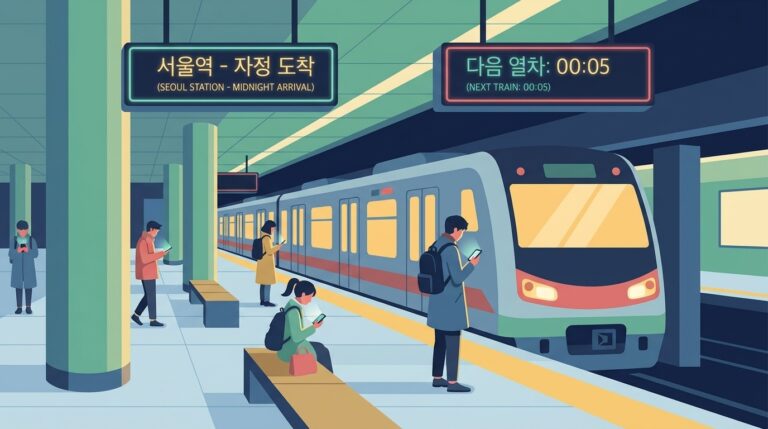
How to Catch the Last Train in Korea: Essential Phrases & Survival Guide
Phase 1: Empathy (Story-driven Opening)
안녕하세요! I’m your Daily Hangul editor. Imagine this scene straight out of an upbeat K-drama: You’re spending a magical evening in Hongdae with friends, munching on crispy Korean fried chicken and drinking somaek. The neon lights are glowing, laughter is flowing, and time just flies by. Suddenly, someone at the table looks at their smartphone, their eyes widen in shock, and they shout: “Wait, what time is the last subway?!”
A quiet panic sweeps the table. You check your phone, but the subway map apps feel overwhelming in Korean, and you don’t know the right polite phrase to ask station staff or your friends before the turnstiles shut down for the night. Missing the last train (막차) in Seoul often means negotiating midnight taxi lines or heading to an all-night noraebang.
Don’t worry! Catching the last train is a universal rite of passage in Korea. Today, we’ll equip you with practical B1-level expressions, subway etiquette, and cultural navigation hacks so you never get stranded after midnight again.
Phase 2: Top 3 Core Expressions In-Depth
1. 막차 몇 시예요? (Makcha myeot si-yeyo?)
- Pronunciation: Mak-cha myut-she-ye-yo? (Think of “Mock-tea” but replace “tea” with “cha” like herbal chai, followed by “mutt” and “she-yeah-yo”)
- Meaning: Literal: “What time is the last vehicle?” | Natural: “What time is the last train/bus?”
- K-Culture Moment: Seen in almost every slice-of-life K-drama gathering when a responsible character taps their watch to signal it’s time to head home.
- Editor’s Insight: 막 (mak) means “last” or “final,” and 차 (cha) stands for vehicle (subway train or bus). This 4-syllable combo is your ultimate emergency phrase.
- Situation Spectrum: Casual: ⚠️ (Use 막차 몇 시야?) | Semi-formal: ✅ | Formal: ✅ (막차 시간이 어떻게 됩니까?)
- 🤔 Think About It: In your home city, do people rely on a strict “last vehicle” concept, or does public transit run 24/7?
2. 이 열차가 종착역까지 가나요? (I yeolchaga jongchak-yeok-kkaji ganayo?)
- Pronunciation: Ee yul-cha-ga jong-chahk-yuck-kkah-jee gah-nah-yo?
- Meaning: Literal: “Does this train go all the way to the final terminal station?”
- K-Culture Moment: Late-night trains often end their route midway (like running only up to Seoul National University instead of the full Line 2 loop).
- Editor’s Insight: Late-night subways in Seoul frequently have truncated routes (끊기는 구간). Asking this prevents you from getting dumped at an unfamiliar station at 12:45 AM.
- Situation Spectrum: Casual: ⚠️ | Semi-formal: ✅ | Formal: ✅
- 🤔 Think About It: Notice how Korean specifies the vehicle type (열차 – train) when asking route specifics to avoid ambiguity.
3. 아직 차 안 끊겼어요? (Ajik cha an kkeunkyosseoyo?)
- Pronunciation: Ah-jeek chah ahn kkuhn-kyuh-ssuh-yo?
- Meaning: Literal: “Has the vehicle not been cut off yet?” | Natural: “Are the trains/buses still running?”
- K-Culture Moment: Spoken by coworkers at a late-night company dinner (hoesik) when debating whether to order one last round of drinks.
- Editor’s Insight: The verb 끊기다 (to be cut/disconnected) is vividly used for transit schedules. When service stops, Koreans say “차 끊겼어” (The transit is cut off).
- Situation Spectrum: Casual: ✅ (아직 차 안 끊겼어?) | Semi-formal: ✅ | Formal: ⚠️
- 🤔 Think About It: Metaphors of “threads cutting” illustrate how connected transportation networks feel to daily urban life in Korea.
Phase 3: Textbook Korean vs. Real Korean
Situation 1: Asking if the last train has already left
- 📖 교과서 한국어: 마지막 지하철이 이미 출발했습니까? (Majimak jihacheori imi chulbalhaesseumnikka? – Has the last subway departed already?)
- 🗣️ 진짜 한국어: 막차 끊겼어요? (Makcha kkeunkyosseoyo? – Did the last train already stop running?)
- 💡 왜 다를까? Textbook Korean uses formal, descriptive terms like 마지막 지하철, but native speakers universally compress this to the dynamic, punchy word 막차.
Situation 2: Checking if you need to run to catch the connection
- 📖 교과서 한국어: 우리는 빨리 달려가야 합니다. (Urineun ppalli dallyeogaya hamnida. – We must run quickly.)
- 🗣️ 진짜 한국어: 지금 안 뛰면 막차 놓쳐요! (Jigeum an ttwimyeon makcha nochyeoyo! – If we don’t sprint right now, we’ll miss the last train!)
- 💡 왜 다를까? Koreans focus on the immediate consequence (막차 놓치다 – missing the last train) to inject urgency.
Phase 4: K-Culture Deep Dive & Non-Verbal Manners
4-1. Nunchi & Late-Night Station Etiquette
When rushing for the late-night train in Korea, keep your eyes on the overhead LED display boards above the platform. If you see text flashing in red stating 당역도착 (Arriving at this station) or 전역출발 (Departed previous station), step briskly! When inquiring with station staff in the glass booth (고객안전실), lightly bow your head at a 15-degree angle, show your transit card or destination app screen, and ask politely. Avoid shouting across the turnstiles.
4-2. The Cultural Code: Makcha Sprint & Midnight Taxis
In Korean nightlife culture, the “Makcha Sprint” is an Olympic-level sport. Between 11:45 PM and 12:30 AM, major hub stations like Gangnam, Hongdae, and Jonggak see thousands of commuters sprinting down stairs in unison. Missing the 막차 triggers the notorious midnight taxi battle (택시 대란), where hailing a cab via apps becomes competitive due to night surcharges (심야 할증).
Phase 5: Real-World Roleplay Scenario
Setting: 11:55 PM at Hapjeong Station. You are trying to get back to your guesthouse in Myeongdong, and you approach a friendly station officer (역무원).
- You: 🎭 (Rushing slightly, tapping your T-Money card) 저기요, 실례지만 명동 가는 막차 아직 있나요? (Jeogiyo, sillyejiman Myeongdong ganeun makcha ajik innayo? / Excuse me, is there still a last train heading toward Myeongdong?)
- 역무원 (Officer): 🎭 (Checking the screen) 2호선 타고 을지로입구역 가시나요? (I-hoseon tago Euljiro-ipgu-yeok gasinayo? / Are you taking Line 2 to Euljiro 1-ga Station?)
- You: 네, 맞아요! (Ne, majayo! / Yes, that’s right!)
- 역무원 (Officer): 이번 열차가 막차예요. 1분 뒤에 들어옵니다. (Ibeon yeolchaga makchayeyo. Il-bun dwie deureoomnida. / This upcoming train is the last one. It arrives in 1 minute.)
- You: 🎭 (Relieved) 다행이네요! 을지로입구까지 쭉 가나요? (Dahaeng-ineyyo! Euljiro-ipgu-kkaji jjuk ganayo? / What a relief! Does it go all the way to Euljiro 1-ga?)
- 역무원 (Officer): 네, 성수행이니까 을지로입구 지나갑니다. 빨리 내려가세요! (Ne, Seongsu-haeng-inikka Euljiro-ipgu jinagamnida. Ppalli naeryeogaseyo! / Yes, it’s bound for Seongsu, so it passes Euljiro 1-ga. Hurry down!)
- You: 감사합니다! (Gamsahamnida! / Thank you!)
- 역무원 (Officer): 🎭 (Waving kindly) 계단 조심하세요! (Gyedan josimhaseyo! / Watch your step on the stairs!)
🔀 Interactive Choice Point
You get to the platform, but two trains arrive on opposite sides, and the doors are about to close. What do you say to the person next to you?
- Option A: “이거 명동 가요?” (Igeo Myeongdong gayo?)
- Feedback [Best]: Direct, clear, and perfectly suited for an urgent semi-casual query on the platform.
- Option B: “왜 열차가 지금 와요?” (Wae yeolchaga jigeum wayo?)
- Feedback [Bad]: This means “Why is the train coming now?”—confusing and doesn’t solve your destination dilemma.
- Option C: “막차 타지 마세요!” (Makcha taji maseyo!)
- Feedback [Risk]: This means “Don’t get on the last train!”—the commuter will look at you with total confusion!
Phase 6: 10-Second Emotion Shadowing Drill
[😰 Anxious & Urgent]저기요, / 명동행 막차 / 아직 안 끊겼죠? (Jeogiyo, / Myeongdong-haeng makcha / ajik an kkeunkyeotjyo?)[🏃 Breathing heavily while running]지금 안 뛰면 / 진짜 놓쳐요! (Jigeum an ttwimyeon / jinjja nochyeoyo!)[😮💨 Relieved & Joyful]휴, / 다행히 / 막차 탔어요! (Hyu, / dahaenghi / makcha tasseoyo!)
Phase 7: K-Culture Mini Dictionary
- 막차 (Makcha): The final scheduled bus or train of the day. Essential for late-night survival.
- 첫차 (Cheotcha): The first scheduled vehicle of the early morning (usually around 5:30 AM).
- 심야버스 / 올빼미 버스 (Simya-beoseu / Olppaemi Beoseu): Seoul’s late-night “Owl Buses” operating between midnight and 4:00 AM (labeled with ‘N’ like N13).
- 할증 (Haljeung): Late-night taxi surcharge applied between 10:00 PM / 11:00 PM and 4:00 AM.
Phase 8: Traveler’s Survival Kit
Top 3 Survival Phrases
- 막차 놓쳤어요. (Makcha nochyeosseoyo. / I missed the last train.) Pro Tip: Use this when calling a friend or negotiating plans.
- 심야 버스 어디서 타요? (Simya beoseu eodiseo tayo? / Where do I catch the night bus?)
- 택시 승차장이 어디예요? (Taeksi seungchajang-i eodiyeyo? / Where is the taxi stand?)
Editor’s Travel Note
Always check accurate transit schedules in real-time. Download the KakaoMetro App Download on App Store or Naver Map Route Planner Download. These platforms display the exact countdown for the last train based on your target station, including intermediate transfer deadlines.
Phase 9: Stepping Deeper (Cultural Reflection)
In many Western metropolitan areas, night life relies heavily on 24-hour rail systems or personal automobiles. In Korea, the absolute deadline of 막차 creates a unique shared social rhythm. When midnight approaches, social gatherings reach a sharp climax: groups either rapidly disperse with affectionate goodbyes to catch the train, or make a conscious collective pact to stay out until 첫차 (the first morning train).
💬 Your Turn: Have you ever had a thrilling dash to catch the final train in your own city or while traveling? Share your story in the comments below!
Phase 10: FAQ & Common Mistakes
Q: What time does the subway in Seoul usually stop running?
A: Most subways stop around midnight on weekends and 1:00 AM on weekdays. However, trains that complete full long-distance lines stop departing earlier (around 11:30 PM).
Q: Can I transfer between subway lines on the last train?
A: Be very careful! Even if your first train is running, the connecting transfer line might already be closed. Transit apps indicate transfers with a warning icon.
Q: What should I do if I miss the last train completely?
A: You have three great options: take an Owl Night Bus (N-Bus), hail a Kakao T taxi, or spend a cozy few hours at a nearby Jjimjilbang (Korean sauna) until the 5:30 AM first train.
🚨 Common Mistakes Alert!
- Mistake: Assuming the last train runs to the very end of the line.
Correct Action: Check the destination headsign (e.g., 성수행 vs 신도림행). - Mistake: Confusing 마지막 (general adjective for last) with compound terms.
Correct Action: Use the natural noun 막차 instead of saying 마지막 차. - Mistake: Waiting until exactly 12:00 AM to enter the station.
Correct Action: Always arrive on the platform at least 10–15 minutes before the listed last time.
Phase 11: Action Missions
- 🥉 Bronze Mission: Practice saying “막차 몇 시예요?” 5 times aloud using our pronunciation guide.
- 🥈 Silver Mission: Open your Naver Map or KakaoMap app, search your favorite Seoul station, and locate the 막차 icon for tonight.
- 🥇 Gold Mission: Next time you are in Korea or practicing in language exchange, ask your partner when their 막차 leaves!
- 🎮 K-Culture Bonus: Watch an episode of a slice-of-life drama (like My Liberation Notes or Hospital Playlist) and listen for the characters shouting “막차 시간 다 됐다!” (It’s time for the last train!).
Phase 12: Interactive Quiz Challenge
1. Situation Quiz: You are at a restaurant at 11:40 PM and need to ask your Korean friend if the subways are still operating. Which expression is most natural?
* (A) 차 끊겼어요?
* (B) 첫차 탔어요?
* (C) 비행기 표 있어요?
2. Fill in the Blank:
“지금 빨리 안 뛰면 [ ] 놓쳐요!” (If we don’t run right now, we’ll miss the last train!)
3. True or False: In Seoul, late-night “Owl Buses” with an ‘N’ prefix operate even after the subway stops.
* (True / False)
🔍 Click here to check the answers & explanations!
- Answer: (A) 차 끊겼어요? is the native way to check if transit service has stopped for the night.
- Answer: 막차 (Makcha)
- Answer: True! Seoul’s N-Buses (심야버스) run throughout the night between 11:30 PM and 6:00 AM.







