

Phase 1: Empathy (Story-driven Hook)
안녕하세요! 매일한글 에디터입니다. (Hello! I’m your Daily Hangul editor.)
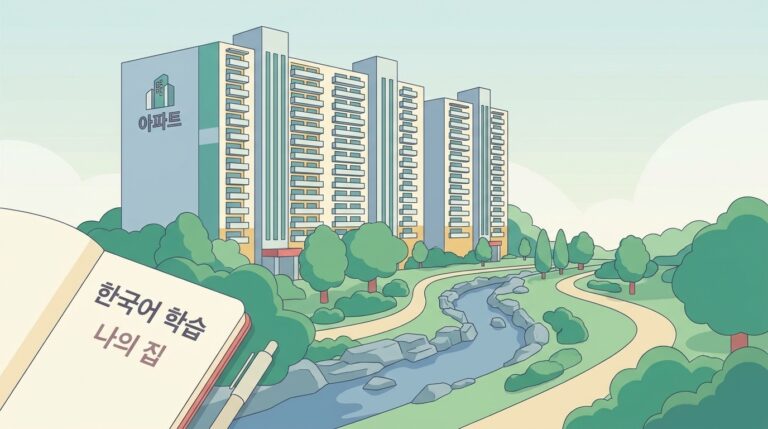
If you have ever watched a modern K-drama—like Crash Landing on You where characters marvel at Seoul’s skyline or family dramas where couples hunt for their dream home—you might have noticed something unique. In Korea, apartments aren’t just concrete residential blocks; they are mini self-contained eco-cities! From massive brand names like Xi, Raemian, and Hillstate to private artificial waterfalls, walking trails, and sunken tea gardens, Korean apartment landscaping (조경, jogyeong) is an architectural art form.
Yet, for many intermediate learners visiting Korea, stepping into a friend’s new apartment complex (아파트 단지) can feel overwhelming. How do you compliment the garden design without sounding stiff? Why do Koreans obsess over which brand built the complex? In this guide, backed by real feedback from our intermediate Korean learners living in Seoul, we will decode the architectural language of Korean apartment brands and landscapes so you can converse naturally and understand this central pillar of modern Korean lifestyle.
Phase 2: Deep-Dive into 3 Core Expressions
1. 조경이 진짜 잘 되어 있네요 (Jogyeongi jinjja jal doe-eo inne-yo)
- Pronunciation: [Jo-gyeong-i jin-jja jal dwe-eo in-ne-yo] (Think: “Joe-gyung-ee” like “Joe” + “young” with a soft ‘g’, “jin-jja” like “gin-jah”)
- Meaning: “The landscaping is really well-designed!”
- K-Culture Moment: Used whenever you walk inside a newly built residential complex and spot miniature rock mountains (seokgasan), manicured pine trees, and serene pond walkways.
- Editor’s Insight: 조경 (landscaping) comes from Hanja (造景, creating scenery). Saying this demonstrates sophisticated B2-level cultural observation rather than simply saying “동네가 예뻐요” (The neighborhood is pretty).
- Situation Spectrum: Casual (⚠️ omit -요) / Semi-formal (✅) / Formal (✅)
- 🤔 Think About It: In many Western suburbs, landscaping is private to each house’s front/back yard. In Korea, why did shared, communal residential landscaping become the ultimate luxury standard?
2. 지상에 차가 안 다녀서 쾌적해요 (Jisang-e chaga an danyeoseo kwoejeok-haeyo)
- Pronunciation: [Ji-sang-e cha-ga an da-nyeo-seo kwoe-jeok-hae-yo] (Think: “Ji-sahng-eh chah-gah ahn dahn-yuh-suh kweh-juck-heh-yo”)
- Meaning: “It’s so pleasant and refreshing because there are no cars on the ground level.”
- K-Culture Moment: Seen in family vlog content or apartment tour videos (랜선 집들이) where children ride scooters freely through the flower paths because all parking is strictly underground.
- Editor’s Insight: Modern Korean premium apartment brands pride themselves on the “park-style design” (공원형 단지). Using the adjective 쾌적하다 (pleasant, refreshing, clean air/environment) hits the exact emotional chord Korean homeowners care about.
- Situation Spectrum: Casual (⚠️ -쾌적해) / Semi-formal (✅) / Formal (✅)
- 🤔 Think About It: How does prioritizing underground parking reflect the collective social value of child safety and pedestrian tranquility in high-density urban planning?
3. 대단지 브랜드 아파트라 인프라가 좋아요 (Daedanji beuraendeu apateura inpeuraga joayo)
- Pronunciation: [Dae-dan-ji beu-raen-deu a-pa-teu-ra in-peu-ra-ga jo-a-yo]
- Meaning: “Since it’s a large-scale branded apartment complex, the infrastructure/amenities are great.”
- K-Culture Moment: Frequently heard in reality shows like I Live Alone (나 혼자 산다) or real-estate Youtube channels when guests explore on-site cafes, fitness centers, and study libraries.
- Editor’s Insight: 대단지 typically refers to complexes with over 1,000 households. The brand (e.g., Acro, Prugio Summit, DH) dictates not just construction quality, but community pride and property value.
- Situation Spectrum: Casual (⚠️) / Semi-formal (✅) / Formal (✅)
- 🤔 Think About It: How does the fusion of English loanwords like 브랜드 (brand) and 인프라 (infrastructure) with native Korean compound words reflect modern economic status markers?
Phase 3: Textbook Korean vs. Real Korean
Situation 1: Complimenting the apartment environment
- 📖 Textbook Korean: 이 아파트는 주변에 나무와 풀이 많습니다. (This apartment has many trees and grass around it.)
- 🗣️ Real Korean: 여기 완전 숲세권이네요! 산책로가 예술이에요. (This place is totally surrounded by forest! The walking trail is a work of art.)
- 💡 Why is it different? Native speakers use buzzwords like 숲세권 (sup-se-gwon, a combination of forest and commercial district) and figurative slang like 예술이다 (“is art” = stunning) to express aesthetic admiration.
Situation 2: Asking about community facilities inside the complex
- 📖 Textbook Korean: 아파트 안에 운동하는 곳이 있습니까? (Is there a place for exercising in the apartment?)
- 🗣️ Real Korean: 단지 내 커뮤니티 센터에 헬스장이랑 골프연습장도 다 있죠? (The community center inside the complex has both a gym and a golf simulator, right?)
- 💡 Why is it different? Highlighting 단지 내 (inside the complex) and 커뮤니티 센터 (resident community facility) reflects how modern Koreans actually refer to integrated multi-purpose amenities.
Phase 4: K-Culture Deep Dive & Non-verbal Manners
4-1. Nunchi (눈치) & Courteous Gestures
When visiting a modern Korean apartment complex:
* Lower your voice in central plazas: Even though the park grounds resemble public parks, they are residential zones. Avoid loud phone calls on speakerphone near lower-floor balconies.
* Respecting Security Access: Most brand complexes have automatic gates (공동현관 로비폰). Never tailgate closely behind residents unless you are accompanied, as privacy and security are highly guarded.
* Expressing appreciation to your host: When stepping into a friend’s complex, glancing around at the central fountain or garden pavilion (티하우스) and offering a compliment before entering their front door shows great social awareness (센스).
4-2. Cultural Code Analysis: The Evolution of the “Brand Complex”
In the 1980s and 90s, Korean apartments were uniform gray slabs stamped with numbers (101동, 102동). However, in the early 2000s, construction conglomerates launched specialized brands (Raemian by Samsung, Xi by GS, e-Pyeonhansesang by DL). Today, high-end complexes hire world-renowned landscape architects to install seokgasan (artificial miniature stone peaks with waterfalls), botanical greenhouses, and high-tech pet trails. Owning or renting in a well-landscaped brand complex is seen as achieving urban serenity in the heart of fast-paced Seoul.
Phase 5: Real-Life Roleplay Scenario
- Setting: You are visiting your Korean colleague Minji (민지), who recently moved into a newly constructed brand apartment in Mapo-gu.
- Characters:
- 민지 (Minji): Proud homeowner, excited to show you the complex garden.
- You: An intermediate Korean speaker enjoying a casual walk before dinner.
Dialogue:
1. 민지: 우리 동네까지 오느라 고생 많았어요! 단지 안쪽으로 들어와요. (Thanks for making the long trip to my neighborhood! Come inside the complex.)
* 🎭 Gesturing with an open hand toward the garden entrance.
2. You: 와, 입구부터 분위기가 다르네요. 조경이 진짜 잘 되어 있어요! (Wow, the vibe is different right from the entrance. The landscaping is really well-done!)
* 🎭 Looking up with genuine admiration at the pine trees and stone stream.
3. 민지: 고마워요. 이번에 새로 지은 브랜드 아파트라 조경에 신경을 많이 썼대요. (Thank you. Since it’s a newly built branded apartment, they said they paid extra attention to landscaping.)
* 🎭 Smiling modestly while checking your reaction.
4. You: 지상에 차가 전혀 안 다녀서 공원 산책하는 느낌이에요. (Because there are no cars at all on the ground level, it feels like walking in a park.)
* 🎭 Taking a relaxed breath and pointing toward the car-free walkway.
5. 민지: 맞아요! 주차장이 전부 지하에 있어서 아이들도 안전하게 뛰어놀아요. (Exactly! The parking lots are all underground, so kids can run around safely.)
* 🎭 Nodding in agreement as a mother walks past with a stroller.
6. You: 저기 보이는 유리 건물은 카페인가요? (Is that glass building over there a cafe?)
* 🎭 Pointing toward a modern pavilion surrounded by a pond.
7. 민지: 네, 입주민 전용 티하우스예요. 차 한잔 마시면서 쉴 수 있어요. (Yes, it’s a resident-only tea house. You can relax while having a cup of tea.)
* 🎭 Walking toward the entrance with pride.
8. You: 대단지 아파트라 그런지 커뮤니티 시설이 정말 알차네요! (Perhaps because it’s a large complex, the community facilities are truly substantial!)
* 🎭 Nodding with an impressed smile.
🔀 Interactive Decision Point
After stepping inside the tea house, Minji asks how your current neighborhood is. What do you say?
- Option A: “저희 집 근처는 차도 많고 복잡해서 이런 쾌적한 조경이 정말 부러워요.” (My neighborhood has lots of cars and is crowded, so I’m really envious of this pleasant landscaping.)
- 👉 Feedback [Best]: Modest, compliments her living space sincerely, and naturally reinforces the B2 vocabulary learned today.
- Option B: “우리 동네가 여기보다 훨씬 비싼 브랜드인데 조경은 비슷하네요.” (My neighborhood is a much more expensive brand than here, but the landscaping is similar.)
- 👉 Feedback [Bad]: Culturally offensive; comparing real-estate prices creates instant awkwardness.
- Option C: “여기는 집값이 얼마나 해요? 살 만해요?” (How much is the house price here? Is it worth buying?)
- 👉 Feedback [Risk]: A bit too blunt for a casual house visit unless you are extremely close friends or discussing real estate investments intentionally.
Phase 6: 10-Second Emotion Shadowing Drill
Practice matching native intonation and emotional inflection. Follow the pause markers (/):
[😊 Genuinely impressed]- 와! / 조경이 / 진짜 잘 되어 있네요. / 마치 수목원에 온 것 같아요.
- Wa! / Jogyeongi / jinjja jal doe-eo inne-yo. / Machi sumogwone on geot gat-ayo.
- (Wow! / The landscaping / is really well done. / It feels like being in an arboretum.)
[🌿 Peaceful & relaxed]- 지상에 차가 없어서 / 공기가 훨씬 쾌적한 것 같아요.
- Jisang-e chaga eopseoseo / gonggiga hwolssin kwoejeok-han geot gat-ayo.
- (Since there are no cars on the ground / the air feels so much fresher.)
[🤩 Amazed & complimentary]- 단지 안에 / 이런 폭포랑 산책로가 있다니 / 대박이에요!
- Danji ane / ireon pokporang sanchaekroga itdani / daebak-ieyo!
- (To think there is a waterfall and walking trail inside the complex / that’s incredible!)
Phase 7: K-Culture Mini Dictionary
- 숲세권 (Sup-se-gwon) | “Forest-adjacency Zone”
- A trendy portmanteau of 숲 (forest) + 역세권 (station area). Refers to residential areas blessed with parks, mountains, and greenery within walking distance.
- 석가산 (Seok-ga-san) | “Artificial Miniature Rock Mountain”
- High-end traditional Korean-style artificial rock installations with cascading streams placed in central apartment courtyards.
- 티하우스 (Ti-ha-u-seu) | “Resident Pavilion / Community Cafe”
- Modern architectural glass pavilions built amidst ponds or landscaped gardens where residents gather to read, work, or drink coffee.
- 지상 공원화 (Ji-sang Gong-won-hwa) | “Ground-level Parkification”
- The urban architectural trend of moving all vehicle traffic and parking underground, converting 100% of ground space into pedestrian parks.
Phase 8: Traveler’s & Resident’s Survival Kit
Top 3 Survival Expressions
- 1. 경비실/관리사무소가 어디에 있나요? (Gyeongbisil / gwanrisamusoga eodie innayo?)
- Pro Tip: Essential if you get lost inside a 2,000-unit mega-complex looking for a specific building number (동/호수).
- 2. 방문 차량 등록은 어떻게 하나요? (Bangmun charyang deungrogeun eotteoke hanayo?)
- Pro Tip: If you take a rented car or taxi to a friend’s complex, you’ll need the host to register your license plate electronically.
- 3. 단지 내 산책로 외부인도 이용 가능한가요? (Danji nae sanchaekro oebuingdo iyong ganeunghangayo?)
- Pro Tip: Most open garden paths allow courteous public walking, but some amenities are resident-card only.
Editor’s Travel Note
- Navigation Essential: Searching apartment building numbers on generic global maps is notoriously inaccurate in Korea. Make sure to download and utilize [Naver Map Route Finder Application] to locate exact building gates (e.g., “104동 3-4 라인 입구”).
- Architecture Walking Spots: If you want to admire top-tier Korean modern landscape architecture, take a walk through public-accessible trails around Banpo Raemian One Bailey or Acro Seoul Forest near Seoul Forest station.
Phase 9: A Step Deeper (Cultural Reflection)
In many Western cultures, the ideal dream home is often depicted as an isolated single-family house with a private fenced lawn. In South Korea, however, historical rapid urbanization transformed apartments into the ultimate collective sanctuary. Modern Koreans view the landscaped apartment complex as an extension of their living room—a communal backyard where children play safely, neighbors greet each other by the pond, and busy professionals decompress beneath manicured pine trees without leaving their neighborhood bubble.
💬 Your Turn: How does residential architecture in your home country compare? Do people prefer private detached yards or shared community park complexes? Share your thoughts below!
Phase 10: FAQ & Common Mistakes
Q: Why do Koreans refer to apartment complexes as ‘Danji’ (단지)?
A: 단지 (團地) means a grouped residential block designed as an integrated community with its own administrative offices, sports amenities, kindergartens, and parks.
Q: Can tourists enter and walk around Korean apartment gardens freely?
A: While gated entryways to individual apartment buildings are locked with keypads, the outdoor ground-level pedestrian pathways in open complexes are generally accessible. However, always remain quiet and respectful of residents’ privacy.
Q: Why are brand names like Raemian, Xi, or Acro printed in huge letters on the building facade?
A: In Korea, construction brands represent build quality, interior finish standards, and long-term asset value. Prominent branding builds community prestige and helps visitors identify complexes from afar.
🚨 Common Mistakes Top 3
- Mistake: Calling the entire neighborhood “아파트 방” (Apartment room).
- Correct Action: Refer to the complex as 아파트 단지 (apateu danji) and an individual unit as 우리 집 (uri jip) or 몇 동 몇 호 (myeot-dong myeot-ho).
- Mistake: Assuming ground walkways allow electric scooters and motorbikes.
- Correct Action: Modern park complexes strictly prohibit motorbikes and delivery scooters on pedestrian paths; delivery riders often use underground parking or walk their bikes.
- Mistake: Saying “나무가 많아서 자연스러워요” when praising intentional architecture.
- Correct Action: Say “조경이 감각적으로 잘 되어 있어요” (The landscaping is tastefully well-designed).
Phase 11: Action Missions
- 🥉 Bronze Mission (Solo Practice): Stand in front of your mirror and practice the emotion shadowing sentence: “조경이 진짜 잘 되어 있네요!” with a bright, enthusiastic smile.
- 🥈 Silver Mission (Social Share): Take a photo of a pretty park or garden near you and post it with the Korean hashtag
#숲세권and#조경예술. - 🥇 Gold Mission (Real Application): Next time you watch a K-drama house tour or visit Korea, spot a seokgasan (artificial rock waterfall) and compliment the complex using 쾌적하다!
- 🎮 K-Culture Mission: Watch a Seoul apartment tour vlog on YouTube and write down 2 new architectural loanwords you hear.
Phase 12: Interactive Quiz Challenge
1. Situational Judgment
You are strolling through a Korean friend’s new apartment complex and see a beautiful artificial rock waterfall surrounded by walking paths. What is the most natural, native-like compliment?
* (A) 집이 너무 좁아서 아쉽네요.
* (B) 단지 내 조경이랑 석가산이 정말 멋지네요!
* (C) 여기서 축구 경기 해도 되겠어요.
2. Fill-in-the-Blank
“요즘 아파트는 지상에 차가 안 다녀서 훨씬 ______________.”
(Modern apartments have no cars on the ground level, so it’s much more pleasant/refreshing.)
* Choice: [ 쾌적해요 / 시끄러워요 / 지저분해요 ]
3. True / False Cultural Check
- Q: In Korea, the term 숲세권 (Sup-se-gwon) refers to apartments that are completely isolated deep inside wild mountain ranges with no subway access.
- [ True / False ]
👉 Click here for Answers & Explanations!
- Answer: (B)
- Explanation: Complimenting the complex landscaping (조경) and the rock feature (석가산) shows high cultural fluency.
- Answer: 쾌적해요 (Kwoejeok-haeyo)
- Explanation: 쾌적하다 means clean, pleasant, and comfortably refreshing—ideal for car-free green complexes.
- Answer: False
- Explanation: 숲세권 describes convenient urban complexes that enjoy both prime city amenities and close proximity to lush green parks or walking trails.
- Explanation: 숲세권 describes convenient urban complexes that enjoy both prime city amenities and close proximity to lush green parks or walking trails.







