

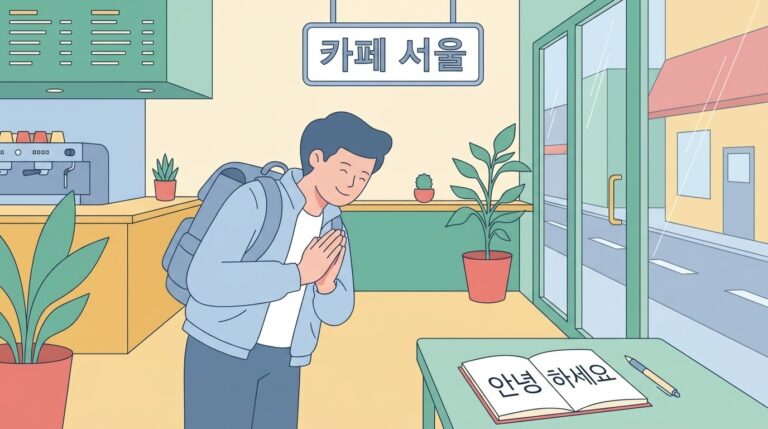
Speak Like a Local: Your Ultimate Guide to Korean Politeness and Jondaetmal
Phase 1: Hello from Daily Hangul!
안녕하세요! (Annyeonghaseyo!) I am your friendly Daily Hangul editor and your 24/7 Korean culture navigator. Have you ever watched a K-Drama where a character suddenly drops their formal tone and everyone in the room gasps in shock? Or maybe you walked into a cozy convenience store in Seoul, cheerfully shouted “Annyeong!” to the elderly cashier, and received an awkward, frozen stare?
Don’t panic—every single Korean learner has been there! Navigating Korean politeness (Jondaetmal, 존댓말) feels intimidating for beginners because English usually relies on tone and “please,” while Korean embeds respect directly into verbs and word endings. Based on real feedback from hundreds of beginner students at Daily Hangul, mastering just a few basic honorific habits transforms you from an awkward tourist into an instantly respected, beloved guest. Let’s make politeness effortless and fun together!
Phase 2: Core Expressions Breakdown
1. 안녕하세요 (Annyeonghaseyo)
- Pronunciation: [An-nyeong-ha-se-yo] (Sounds like: Ahn-young-ha-say-yo)
- Meaning: “Are you at peace?” / “Hello / Good day”
- K-Culture Moment: Every K-Drama office scene or variety show entrance always starts with a bright, bowed “안녕하세요!”
- Editor’s Insight: This is your golden master key. Adding the magic ending -yo (-요) instantly softens your sentence into polite speech suitable for strangers and elders.
- Situation Spectrum: Casual: ⚠️ | Semi-formal: ✅ | Formal: ✅
- 🤔 Think About It: English greetings usually comment on the time of day (“Good morning”), while Korean asks about your inner peace and well-being. What does that say about social connection?
2. 감사합니다 (Gamsahamnida)
- Pronunciation: [Gam-sa-ham-ni-da] (Sounds like: Gahm-sah-hahm-nee-dah)
- Meaning: “I give you my gratitude” / “Thank you”
- K-Culture Moment: Idols accepting awards at music shows shouting “Gamsahamnida!” to their fandoms.
- Editor’s Insight: While Gomawoyo (고마워요) is polite, Gamsahamnida carries a crisp, formal layer of genuine respect, perfect for clerks, drivers, and new acquaintances.
- Situation Spectrum: Casual: ⚠️ | Semi-formal: ✅ | Formal: ✅
- 🤔 Think About It: Notice how formal endings switch from -yo to -nida. Why do you think Korean maintains distinct levels of formality depending on social distance?
3. 죄송합니다 (Joesonghamnida)
- Pronunciation: [Joe-song-ham-ni-da] (Sounds like: Jway-song-hahm-nee-dah)
- Meaning: “I feel deeply apologetic” / “I am truly sorry”
- K-Culture Moment: When a character accidentally bumps into their CEO in an elevator and quickly bows.
- Editor’s Insight: For minor mistakes or bumping into someone, Joesonghamnida shows sincerity. Avoid using the casual Mianhae (미안해) with anyone older than you!
- Situation Spectrum: Casual: ⚠️ | Semi-formal: ✅ | Formal: ✅
- 🤔 Think About It: In many Western cultures, apologizing can imply admitting legal guilt. In Korea, saying sorry often simply restores interpersonal harmony.
Phase 3: Textbook Korean vs. Real Korean
Situation 1: Saying goodbye to someone staying behind
- 📖 Textbook Korean: 안녕히 계십시오. (Annyeonghi gyesipsio.)
- 🗣️ Real Korean: 안녕히 계세요! (Annyeonghi gyeseyo!)
- 💡 Why is it different? While -sipsio is ultra-formal (used in airport announcements or military), modern Koreans naturally use the warm and polite -seyo ending in daily shops and cafes.
Situation 2: Asking for something politely
- 📖 Textbook Korean: 이것을 저에게 주시겠습니까? (Igeoseul jeoege jusigesseumnikka?)
- 🗣️ Real Korean: 이거 주세요! (Igeo juseyo!)
- 💡 Why is it different? Textbook phrases are often over-engineered. Simply saying “Item + 주세요 (Juseyo)” with a smile is standard, natural etiquette.
Phase 4: K-Culture Deep Dive & Non-Verbal Manners
4-1. Nunchi (눈치) & The Two-Hand Rule
In Korea, respect is 50% language and 50% body language. Whenever you hand over a credit card, receive your iced Americano, or accept change, use both hands (or support your right forearm with your left hand). Combine this with a subtle 15-degree nod. Making intense, unbroken eye contact while bowing is seen as confrontational—soften your gaze slightly downward.
4-2. Cultural Code: Age and Honorifics in K-Media
In Korean society, establishing relative age determines speech style. This is why K-Pop members or drama protagonists ask each other’s birth year within five minutes of meeting! Until mutual permission to speak casually (Banmal, 반말) is given, default to Jondaetmal to show thoughtful upbringing.
Phase 5: Real-Life Roleplay Scenario
Setting: Ordering a drink at a bustling cafe in Hongdae. You are interacting with Minho, a friendly 20-something barista.
- Turn 1 (Minho): 어서 오세요! 주문하시겠어요? (Eoseo oseyo! Jumunhasigesseoyo?) – 🎭 Smiling behind the counter
- Turn 2 (You): 안녕하세요! 아이스 아메리카노 하나 주세요. (Annyeonghaseyo! Aiseu amerikano hana juseyo.) – 🎭 Greeting with a gentle nod
- Turn 3 (Minho): 네, 테이크아웃이세요? (Ne, teikeuaus-iseyo?) – 🎭 Tapping the POS screen
- Turn 4 (You): 네, 테이크아웃해 주세요. (Ne, teikeuaut-hae juseyo.) – 🎭 Holding card with both hands
- Turn 5 (Minho): 결제 도와드리겠습니다. (Gyeolje dowadeurigesseumnida.) – 🎭 Receiving your card
- Turn 6 (You): 감사합니다. (Gamsahamnida.) – 🎭 Bowing slightly
- Turn 7 (Minho): 영수증 필요하세요? (Yeongsujeung piryohaseyo?) – 🎭 Holding receipt
- Turn 8 (You): 아니요, 괜찮아요! (Aniyo, gwaenchanayo!) – 🎭 Shaking hand lightly with a polite smile
🔀 Interactive Branching Choice: Minho hands you your coffee cup. What do you do?
- Option A: Grab it with one hand while looking at your phone and say “Gomawo!”
- Option B: Receive the cup using two hands, make brief polite eye contact, and say “감사합니다!”
- Option C: Say nothing, bow a full 90 degrees to the floor, and back out of the cafe slowly.
Feedback:
* Option A (Bad): Using casual speech (Banmal) and one hand to a stranger comes off as dismissive.
* Option B (Best!): Perfect! Natural two-handed gesture paired with crisp honorifics makes you an etiquette rockstar.
* Option C (Risk): A 90-degree deep bow is reserved for formal apologies or ancestral rites; it might startle your barista!
Phase 6: 10-Second Emotion Shadowing Drill
Practice matching rhythm and emotion using slash marks (/) for breathing pauses:
[😊 Bright & Welcoming]안녕하세요! / 만나서 반가워요! (Annyeonghaseyo! / Mannaseo bangawoyo!)[🙏 Sincere & Polite]저기요, / 물 좀 주세요. (Jeogiyo, / mul jom juseyo.)[🥺 Apologetic & Respectful]죄송합니다, / 다시 말씀해 주세요. (Joesonghamnida, / dasi malsseumhae juseyo.)
Phase 7: K-Culture Mini Dictionary
- 존댓말 (Jondaetmal): Polite/honorific language used with elders, strangers, and coworkers.
- 반말 (Banmal): Informal/casual language used only with close friends of the same age or younger people.
- 예의 (Yeeui): Etiquette/manners; high social courtesy valued in modern Korean life.
- 수고하세요 (Sugohaseyo): “Keep up the great work”—the ultimate polite parting phrase when leaving a shop or taxi.
Phase 8: Traveler Survival Kit
- Top 1: 저기요! (Jeogiyo!) – “Excuse me!” (Use to call waitstaff politely at restaurants).
- Top 2: 이거 얼마예요? (Igeo eolmayeyo?) – “How much is this?”
- Top 3: 수고하세요! (Sugohaseyo!) – “Thank you, have a good day!” (Say this when stepping out of a cab).
Editor’s Travel Note: When traveling across South Korea, make sure to download the Naver Map Navigation App instead of international map apps for pinpoint transit and local opening hours. Also, always hold your T-Money transit card with two hands when reloading at subway kiosks!
Phase 9: A Step Deeper (Reflection)
Korean speech levels reflect deep relational awareness. Rather than individual hierarchy, Jondaetmal creates a safe, considerate space that honors mutual dignity in public. By speaking politely, you show that you acknowledge the shared harmony of the social environment.
💬 Your Turn: In your home language, how do you express respect to strangers? Share your thoughts in the comments below!
Phase 10: FAQ & Common Mistakes
Q: Can I just add “-yo” to any English word to sound polite?
A: While Koreans might find it cute in casual slang, it doesn’t work grammatically. Stick to standard Korean verb stems with -yo (e.g., Ha-seyo, Ju-seyo) for true etiquette!
Q: Is bowing mandatory every single time I say hello?
A: A full torso bow is not needed. A gentle head nod combined with a verbal Annyeonghaseyo is ideal for daily encounters.
Q: What if an older person speaks informally (Banmal) to me first?
A: As a learner and younger party, continue using Jondaetmal. Elders often use friendly Banmal affectionately, but staying polite keeps you safe.
🚨 Common Mistakes Alert
- Saying “안녕 (Annyeong)” to servers: Action: Always use 안녕하세요 (Annyeonghaseyo).
- One-handed payment card swipe: Action: Hand your card using both hands.
- Overusing “미안해 (Mianhae)”: Action: Swap with 죄송합니다 (Joesonghamnida) with strangers.
Phase 11: Action Missions
- 🥉 Bronze Mission (Solo): Stand before a mirror, practice bowing 15 degrees, and say 안녕하세요 5 times.
- 🥈 Silver Mission (Social): Leave a polite comment in Korean on your favorite idol’s social media: 오늘도 수고했어요! (Great work today!)
- 🥇 Gold Mission (Real Life): Visit a local Korean restaurant or grocery mart and say 감사합니다 using two hands when taking your receipt.
🎮 K-Culture Mission: Watch an episode of your favorite K-Drama and count how many times characters switch between -yo and -nida endings!
Phase 12: Interactive Quiz Challenge
1. Fill in the blank: When asking for water at a restaurant, you say: “물 [ ]!”
2. True or False: It is perfectly fine to say “안녕 (Annyeong)” to a taxi driver if you are in a rush.
👉 Click to Reveal Answers and Explanations!
- 1. Answer: 주세요 (Juseyo) – Explanation: “물 주세요 (Mul juseyo)” means “Please give me water.” It is polite, concise, and standard.
- 2. Answer: False – Explanation: “Annyeong” is casual speech (Banmal). You should always say “안녕하세요 (Annyeonghaseyo)” or “감사합니다 (Gamsahamnida)” to drivers.







