

Phase 1: Empathy (Story-Driven Opening)
안녕하세요! 매일한글 에디터입니다. (Hello! This is your Daily Hangul editor.)
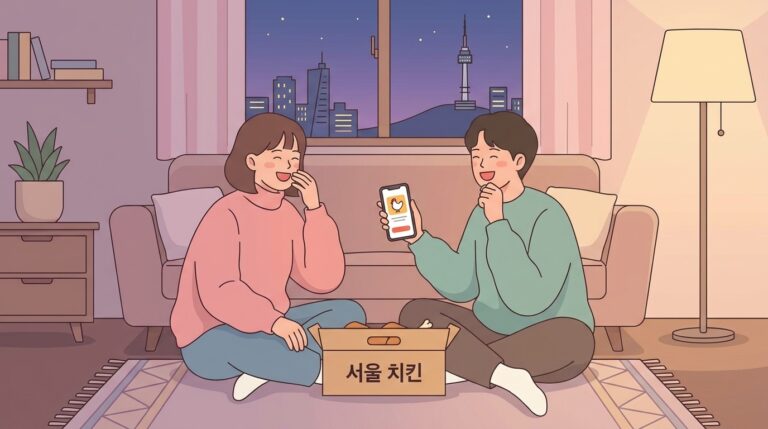
Picture this: It is 11:15 PM on a cool Friday night in Seoul. You and your Korean friends are lounging in the living room after a long week, laughing over a variety show on TV. Suddenly, during a commercial break, a golden, sizzling plate of Korean fried chicken appears on screen. The room falls silent for a second, and you hear a familiar stomach growl. Everyone looks at each other. You know this is the legendary Korean Yasik (late-night snack) hour, and fried chicken is practically a national religion at this time of night.
You want to take the lead and suggest ordering, but your mind freezes. Do you say “치킨을 주문하시겠습니까?” (which sounds like an automated telemarketer from 2005)? Or do you just awkwardly point at your phone?
Don’t worry! As an editor who has coached hundreds of Korean learners through their late-night food cravings, I can tell you that mastering casual delivery banter is the ultimate social lubricant in Korea. Today, you will learn natural, high-frequency B1 expressions that will make your Korean friends cheer and hand you the delivery app immediately!
Phase 2: Core Expressions Deep Dive
1. 출출한데 치킨 시켜 먹을래? (Chulchulhande chikin sikyeo meogeullae?)
- Pronunciation: [Chool-chool-han-deh chee-keen she-kyeo meo-geul-lae?] (Sounds like “Chool-chool” matching the soft rumble of a stomach)
- Meaning: Literal: “I’m a bit peckish, do you want to order and eat chicken?” / Real Nuance: “Hey, I’m getting kind of hungry—down for some chicken?”
- K-Culture Moment: The quintessential line used in K-dramas right when two characters are studying late or bonding over late-night work.
- Editor’s Insight: 출출하다 (chulchulhada) is much softer and more casual than 배고프다 (baegopeuda – to be hungry). It specifically refers to that light, late-night craving feeling.
- Situation Spectrum: Casual: ✅ | Semi-formal: ⚠️ | Formal: 🚫
- 🤔 Think About It: In English, we often ask “Are you hungry?” directly, but Koreans often state their own gentle state first (출출한데…) to avoid putting pressure on others. How does your native language soften food suggestions?
2. 반반으로 시키자! (Banbaneuro sikija!)
- Pronunciation: [Bahn-bahn-eu-roh she-kee-jah!] (Rhymes with “Bahn” as in Bahn Mi)
- Meaning: Literal: “Let’s order as half-half!” / Real Nuance: “Let’s get half original crispy and half sweet-spicy!”
- K-Culture Moment: The iconic compromise when one friend wants Fried (후라이드) and the other wants Yangnyeom (양념).
- Editor’s Insight: 반반 (banban) is a cultural cornerstone in Korean dining. Using -자 (-ja) creates an enthusiastic, egalitarian vibe among peers.
- Situation Spectrum: Casual: ✅ | Semi-formal: ✅ (with -요: 반반으로 시켜요) | Formal: 🚫
- 🤔 Think About It: Korean food culture values shared harmony over individual separate plates. How does ordering shared food reflect group bonding in Korea?
3. 배달비 아까우니까 같이 시키자. (Baedalbi akkaunikka gachi sikija.)
- Pronunciation: [Bae-dahl-bee ah-kkah-oo-nee-kkah gah-chee she-kee-jah.] (Emphasize the double ‘kk’ like ‘c’ in ‘sky’)
- Meaning: Literal: “Because delivery fees are wasteful, let’s order together.” / Real Nuance: “Delivery fees are high nowadays, so let’s combine our order!”
- K-Culture Moment: Commonly heard among university students living in dorms or young professionals ordering late-night snacks in officetels.
- Editor’s Insight: 아깝다 (akkapda) expresses the feeling of something being a waste of money or effort. It is an empathetic, relatable justification to order food together.
- Situation Spectrum: Casual: ✅ | Semi-formal: ✅ | Formal: ⚠️
- 🤔 Think About It: Why is splitting delivery fees not seen as cheap, but rather as smart and considerate teamwork in modern Korean urban life?
Phase 3: Textbook Korean vs. Real-Life Korean
Situation 1: Asking if someone has late-night cravings
- 📖 교과서 한국어 (Textbook): “당신은 지금 야식을 먹고 싶습니까?” (Dangsineun jigeum yasigeul meoggo sipseumnikka? – Do you want to eat late-night food now?)
- 🗣️ 진짜 한국어 (Real-Life): “지금 입 심심하지 않아? 치킨 땡기지?” (Jigeum ip simsimhaji ana? Chikin ttaenggiji? – Isn’t your mouth bored right now? Craving chicken?)
- 💡 Why is it different? Koreans rarely use the second-person pronoun 당신 (dangsin) in casual talk. Instead, they use idiomatic expressions like 입이 심심하다 (mouth feels bored/craving a chew) or 땡기다 (to crave/pull).
Situation 2: Proposing to place an order on an app
- 📖 교과서 한국어 (Textbook): “제가 배달 애플리케이션으로 치킨을 주문하겠습니다.” (Jega baedal aepeullikeisyeoneuro chikineul jumunhagetseumnida.)
- 🗣️ 진짜 한국어 (Real-Life): “배민 켤 테니까 메뉴 골라봐!” (Baemin kyeol tenikka menyu gollabwa! – I’ll open Baemin [delivery app], pick the menu!)
- 💡 Why is it different? Real Koreans refer directly to brand abbreviations like 배민 (Baemin – short for Baedal Minjok) and offer to hold the phone while the other picks items.
Phase 4: K-Culture Deep Dive & Non-Verbal Manners
4-1. 눈치 (Nunchi) & Gestures
When suggesting delivery late at night, whip out your phone, open the delivery app, and slightly tilt the screen toward your friend. This non-verbal cue signals: “I am ready to order, let’s decide together.” If your friend hesitates, gently tap the screen and say “내가 쏠게!” (Naega ssolge! – My treat!) or “N빵 하자!” (En-ppang haja! – Let’s split 50/50!).
4-2. Cultural Code: The Sacred “Chimaek & Yasik” Ritual
Yasik is not merely late-night eating; it is an emotional decompression ritual. Korean delivery speeds are lightning-fast, and fried chicken paired with cold drinks (치맥 – Chimaek) serves as the ultimate stress reliever after long study or work hours. Sharing a box of chicken with bone-discard containers and plastic gloves represents intimate friendship.
Phase 5: Real-Life Roleplay Scenario
Setting: 11:30 PM, a cozy officetel living room in Hongdae. Minho (Korean roommate) and Alex (you) are finishing a movie.
- 민호: (기지개를 켜며 리모컨을 내려놓는다) 아, 영화 진짜 재밌었다. 근데 슬슬 배고프지 않냐?
(A, yeonghwa jinjja jaemisseotda. Geunde seulseul baegopeuji annya?)
🎭 Stretching and putting down the remote: “Ah, that was a great movie. But aren’t you getting kind of hungry?” - Alex: (배를 톡톡 두드리며) 인정! 출출한데 치킨 시켜 먹을래?
(Injeong! Chulchulhande chikin sikyeo meogeullae?)
🎭 Patting stomach in agreement: “Agreed! I’m peckish, wanna order chicken?” - 민호: (눈을 반짝이며 배달 앱을 켠다) 오, 치킨 좋지! 어디서 시킬까? 교촌? BHC?
(O, chikin joji! Eodiseo sikilkka? Gyochon? BHC?)
🎭 Eyes lighting up, opening app: “Oh, chicken sounds awesome! Where should we order from? Kyochon? BHC?” - Alex: (핸드폰 화면을 같이 보며) BHC 뿌링클 어때? 아니면 반반으로 시킬까?
(BHC Bburingkeul eottae? Animyeon banbaneuro sikilkka?)
🎭 Looking at phone screen together: “How about BHC Bburinkle? Or should we do half-and-half?” - 민호: 뿌링클에 치즈볼 추가하자. 배달비 3천 원 나오네.
(Bburingkeure chijeubol chugahaja. Baedalbi samcheon won naone.)
🎭 Adding items into cart: “Let’s add cheese balls to Bburinkle. Delivery fee is 3,000 won.” - Alex: 배달비 아까우니까 사이드 더 넣길 잘했다! 내가 결제할게, 넌 이따 송금해 줘.
(Baedalbi akkaunikka saideu deo neokil jalhaetda! Naega gyeoljehalke, neon itta songgeumhae jwo.)
🎭 Taking out card: “Glad we added sides to make delivery worth it! I’ll pay, just wire me later.” - 민호: (엄지 척을 하며) 나이스! 내가 테이블 세팅하고 콜라 꺼내둘게.
(Naiseu! Naega teibeul setinghago kolla kkeonaedulge.)
🎭 Giving a thumbs up: “Nice! I’ll set the table and grab the cola.” - Alex: (배달 완료 알림을 보며) 30분 걸린대. 세팅하고 기다리자!
(Samsipbun geollindae. Setinghago gidarija!)
🎭 Checking tracking screen: “Says 30 minutes. Let’s set up and wait!”
🔀 Interactive Branching Choice
Minho asks: “야, 순살로 시킬까 뼈로 시킬까?” (Hey, should we order boneless or bone-in?)
- Choice A: “당연히 뼈지! 치킨은 뜯어야 제맛이지.” (Dang-yeon-hi ppyeoji! Chigineun tteudeoya jemasiji. – Bone-in of course! Tearing meat off the bone is the true taste.)
- Feedback (Best!): Highly authentic! Koreans love the phrase 뜯어야 제맛 (tastes best when tearing off the bone).
- Choice B: “아무거나 상관없어요.” (Amugeona sanggwaneopseoyo. – Anything doesn’t matter.)
- Feedback (Bad): A bit too indifferent and stiff for a late-night bonding moment.
- Choice C: “순살로 해, 뒤처리하기 편하잖아!” (Sunsallo hae, dwichoorihagi pyeonhajana! – Get boneless, cleaning up is way easier!)
- Feedback (Great/Practical): Shows consideration for cleaning food waste (음식물 쓰레기).
Phase 6: 10-Second Emotion Shadowing Drill
[🤤 입맛을 다시며 - Salivating & Craving]- “출출한데… / 치킨 시켜 먹을래? / 나 진짜 배고파!”
- (Chulchulhande… / chikin sikyeo meogeullae? / na jinjja baegopa!)
[🤩 신나고 단호하게 - Excited & Decisive]- “고민하지 말고 / 반반으로 시키자! / 치즈볼도 추가해!”
- (Gomin-haji malgo / banbaneuro sikija! / chijeuboldo chugahae!)
[🤝 든든하고 다정하게 - Reliable & Warm]- “배달비 아까우니까 / 같이 시키자! / 내가 먼저 결제할게.”
- (Baedalbi akkaunikka / gachi sikija! / naega meonjeo gyeoljehalke.)
Phase 7: K-Culture Mini Dictionary
- 야식 (Yasik): Late-night meals eaten after dinner hours (usually between 10 PM and 2 AM).
- 치맥 (Chimaek): The legendary portmanteau of 치킨 (Chicken) and 맥주 (Beer).
- 반반무많이 (Banban Mu Mani): “Half fried, half seasoned, with extra pickled radish.” The classic delivery order mantra.
- 땡기다 (Ttaenggida): Slang meaning “to intensely crave” a certain food or activity (e.g., 치킨 땡긴다).
Phase 8: Traveler’s Survival Kit
Top 3 Survival Lines for Delivery
- 🍗 “치킨 무 많이 주세요.” (Chikin mu mani juseyo.) – “Please give us extra pickled radish.” (Pro Tip: Pickled radish resets palate fatigue!)
- 🚪 “문 앞에 두고 벨 눌러주세요.” (Mun ape dugo bel nulleojuseyo.) – “Please leave it at the door and ring the bell.” (Standard contactless delivery note).
- 💸 “각자 얼마씩 보내면 돼?” (Gakja eolmassik bonaemyeon dwae?) – “How much should each of us send?”
Editor’s Travel Note
If you don’t have a Korean bank card or phone verification, order using foreigner-friendly services or check out the [네이버 지도 앱 배달 기능 가이드 (Naver Map Delivery Guide)] to pick up orders directly without local registration.
Phase 9: Think Deeper (Cultural Reflection)
In many Western cultures, ordering takeout is an individualized decision. In Korea, food delivery is an extension of the 우리 (Uri – We/Our) collective mindset. Ordering food together at midnight is an act of shared comfort, breaking individual barriers over a single steaming cardboard box.
💬 Your Turn: What is your culture’s ultimate late-night comfort food? Would you prefer boneless (순살) or bone-in (뼈) Korean chicken? Let me know in the comments below!
Phase 10: FAQ & Common Mistakes
Q: Can I use “치킨 먹자” with older coworkers?
A: In a formal workplace setting, soften it to “치킨 시켜 드실래요?” (Chikin sikyeo deusillaeyo?). Save casual suggestions (“치킨 시켜 먹을래?”) for close colleagues or same-age peers.
Q: What does “순살” (Sunsal) mean on the menu?
A: 순살 means 100% boneless meat (often bites of thigh or breast), whereas 뼈 (Ppye) is traditional bone-in chicken.
Q: How do Koreans split delivery costs?
A: One person pays first via the app, and others instantly transfer their share via banking apps like KakaoPay or Toss using the phrase “N빵 (En-ppang)”.
🚨 Common Mistakes Alert!
- Saying “당신 배고파요?”: Never use 당신 with friends. Say “배고프지 않아?” instead.
- Forgetting to select sauce options: Forgetting to specify sauce on the app leads to plain chicken with no dip. Always check 소스 추가.
- Leaving chicken bones in normal trash: In Korea, chicken bones are categorized as General Waste (일반쓰레기), NOT Food Waste (음식물쓰레기).
Phase 11: Action Missions
- 🥉 Bronze Mission (Solo Practice): Read the Phase 6 Shadowing drills aloud 3 times, focusing on natural pauses.
- 🥈 Silver Mission (Social Media): Post a picture of your favorite snack and caption it: “오늘 야식은 치킨 땡긴다!”.
- 🥇 Gold Mission (Real Life): Next time you hang out with Korean friends, suggest ordering food with “출출한데 치킨 시켜 먹을래?”.
- 🎮 K-Culture Mission: Watch an episode of Weightlifting Fairy Kim Bok-joo or Crash Landing on You and spot how characters eat Chimaek together!
Phase 12: Interactive Quiz Challenge
Q1. Which expression naturally describes having a light late-night craving?
* A) 배가 터지겠다 (Baega teojigetda)
* B) 출출하다 (Chulchulhada)
* C) 식사합시다 (Siksahapsida)
👉 Click to see the answer and explanation!
Answer: B) 출출하다
Explanation: 출출하다 describes being slightly peckish, perfect for late-night snack suggestions!
Q2. Fill in the blank: “반반(________) 시키자!” (Let’s order half-and-half!)
👉 Click to see the answer and explanation!
Answer: 으로 (euro)
Full Sentence: 반반으로 시키자! (-으로 indicates the choice/method of order).
Q3. True or False: Chicken bones belong in the food waste (음식물 쓰레기) bin in Korea.
👉 Click to see the answer and explanation!
Answer: False
Explanation: Animal bones cannot be processed as animal feed, so they must be thrown into general waste (일반 쓰레기) bags!







