

Exploring Korean History: Master Easy Phrases to Understand Great Figures and Historical Sites
Phase 1: Empathy (Story-Driven Opening)
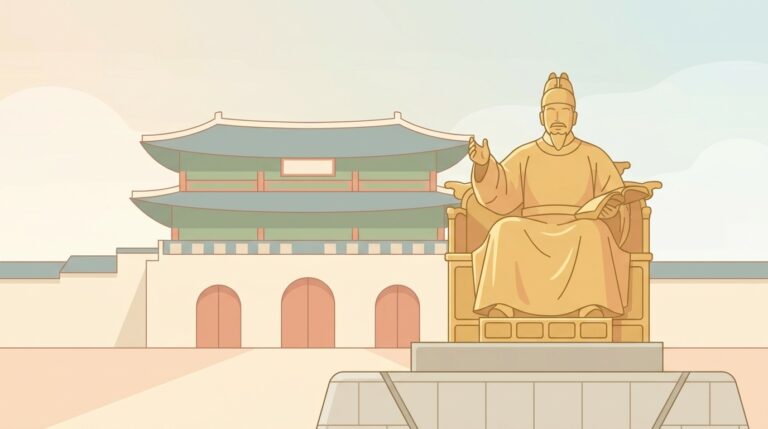
안녕하세요! It’s your Daily Hangul editor and cultural navigator. Have you ever stood in the middle of Gwanghwamun Square in Seoul, looked up at that gigantic golden statue of King Sejong or the imposing Admiral Yi Sun-sin, and thought, “I know these people are legends, but how do I even start talking about them in Korean without sounding like an ancient history book?”
Maybe you wandered into the iconic Kyobo Book Centre nearby, picked up an illustrated Korean biography (위인전 – wi-injeon), and immediately felt overwhelmed by formal grammar and archaic vocabulary. You’re not alone! Many of our A2 learners tell us they love historical K-dramas (사극 – sageuk) and want to explore Korea’s majestic palaces, but they freeze up when trying to ask simple questions about Korean historical figures.
Here is the great news: You don’t need a PhD in Joseon Dynasty history to appreciate and talk about Korea’s greatest heroes. With just a handful of conversational A2-level phrases and the right cultural cues, you can explore historical sites with confidence, chat naturally with local guides, and understand children’s biography books. Let’s jump right in!
Phase 2: Core 3 Expressions Deep-Dive
1. 이 분은 누구예요? (I buneun nuguyeyo?)
- Pronunciation: ee boo-neun noo-goo-yay-yo? (Sounds like “E-boon-un noo-goo-yay-yo”)
- Meaning: Literal: “Who is this honorable person?” | Actual Nuance: “Who is this?” (Respectful)
- K-Culture Moment: Used when pointing at a portrait in a palace, a statue in a public park, or a character in a historical drama.
- Editor’s Insight: In Korean, using 이 사람 (this person) for historical heroes or elders sounds slightly impolite. Using 이 분 (this honorable person) instantly makes you sound well-mannered and culturally savvy.
- Situation Spectrum: Casual: ⚠️ (Stick to close peers) | Semi-formal: ✅ (Perfect for tours/chats) | Formal: ✅
- 🤔 Think About It: In English, we simply say “Who is this?” regardless of age or status. How does using honorific nouns like 분 (bun) change the way we express respect for history?
2. 어떤 일을 하셨어요? (Eotteon ireul hasyeosseoyo?)
- Pronunciation: ut-tton ee-reul ha-syeot-ssuh-yo? (Think of uh-tteon + ear-eul + ha-shyut-o)
- Meaning: Literal: “What kind of work did they do?” | Actual Nuance: “What are they famous for?” / “What did they accomplish?”
- K-Culture Moment: Asking a Korean friend or museum docent about the achievements of a figure featured on Korean currency (like Shin Saimdang on the 50,000 won bill).
- Editor’s Insight: Notice the honorific infix -시- (-si- in hasyeosseoyo). It shows reverence for the historical figure’s lifelong deeds.
- Situation Spectrum: Casual: ⚠️ | Semi-formal: ✅ | Formal: ✅
- 🤔 Think About It: Does your native culture elevate historical achievements using specific grammatical forms, or through descriptive adjectives?
3. 정말 대단해요! (Jeongmal daedanhaeyo!)
- Pronunciation: jung-mahl day-dahn-hay-yo!
- Meaning: Literal: “It’s really great!” | Actual Nuance: “That is truly amazing/inspiring!”
- K-Culture Moment: Reacting when learning that King Sejong created Hangul so common people could read and write freely.
- Editor’s Insight: This is the ultimate, natural reaction phrase in Korean. It expresses genuine admiration without sounding overly dramatic or academic.
- Situation Spectrum: Casual: ✅ | Semi-formal: ✅ | Formal: ✅
- 🤔 Think About It: Why is sharing emotional reactions (추임새 – chuimsae) so vital in Korean conversations compared to just nodding silently?
Phase 3: Textbook Korean vs. Real Korean
Situation 1: Asking about a famous figure at a museum
- 📖 교과서 한국어 (Textbook): 이 역사적 인물은 누구입니까? (I yeoksajeok inmureun nuguimnikka? – Who is this historical figure?)
- 🗣️ 진짜 한국어 (Real Korean): 이 분은 어떤 분이에요? (I buneun eotteon bunieyo? – What kind of person was he/she? / Who is this?)
- 💡 Why the difference? Textbook phrasing sounds like an exam prompt. Real Koreans prefer the warm, polite noun 분 (bun) combined with everyday conversational endings.
Situation 2: Expressing admiration for an invention or achievement
- 📖 교과서 한국어 (Textbook): 그 업적은 참으로 훌륭합니다. (Geu eopjeogeun chameuro hullyunghamnida. – That achievement is truly magnificent.)
- 🗣️ 진짜 한국어 (Real Korean): 와, 진짜 대단하신 것 같아요! (Wa, jinjja daedanhasin geot gat-ayo! – Wow, they really seem incredible!)
- 💡 Why the difference? Modern native speakers express admiration using softeners like -것 같아요 (it seems like) along with energetic interjections like 와 (wa).
Phase 4: K-Culture Deep Dive & Non-Verbal Manners
4-1. 눈치 (Nunchi) & Non-Verbal Manners at Historical Sites
When visiting historical sites, shrines (like Jongmyo), or statues of national heroes:
* Two-Handed Gestures: If pointing to an informational placard, painting, or statue, use an open palm with both hands or your right hand supported by your left at the wrist. Avoid pointing with a single index finger.
* Gentle Volume: Inside memorial halls (기념관 – ginyeomgwan), keep your reaction phrases soft and appreciative to show respect for the solemn atmosphere.
4-2. Cultural Code: The Nation’s Eternal Heroes
In Korea, figures like 세종대왕 (King Sejong the Great) and 이순신 장군 (Admiral Yi Sun-sin) are not distant textbook names—they are omnipresent cultural icons. King Sejong represents wisdom, compassion, and the gift of literacy (Hangul), while Admiral Yi symbolizes resilience and selfless courage. You’ll see their statues right in the heart of Seoul and their faces on Korean banknotes. Knowing just 2–3 key facts about them instantly earns warmth and respect from locals!
Phase 5: Real-Life Roleplay Scenario
Setting: Kyobo Book Centre near Gwanghwamun. You and your Korean friend Minji are browsing the children’s history section.
- You: 민지 씨, 저기 책에 있는 분은 누구예요? 🎭 [Pointing gently with an open palm toward a colorful book cover]
(Minji-ssi, jeogi chaege inneun buneun nuguyeyo? / Minji, who is the person on that book over there?) - Minji: 아, 이 분은 이순신 장군이에요! 거북선을 만든 유명한 장군이에요.
(A, i buneun I Sun-sin janggunieyo! Geobukseoneul mandeun yumyeonghan janggunieyo. / Ah, this is Admiral Yi Sun-sin! He’s a famous general who built the Turtle Ship.) - You: 거북선이요? 어떤 일을 하셨어요? 🎭 [Tilting head with genuine curiosity]
(Geobukseon-iyo? Eotteon ireul hasyeosseoyo? / Turtle ship? What did he do?) - Minji: 바다에서 나라를 지키셨어요. 아주 용감한 영웅이에요.
(Bada-eseo narareul jikisyeosseoyo. Aju yonggamhan yeong-ung-ieyo. / He protected the country at sea. He is a very brave hero.) - You: 와, 정말 대단해요! 위인전을 더 읽어보고 싶어요. 🎭 [Smiling brightly while flipping through the pages]
(Wa, jeongmal daedanhaeyo! Wi-injeoneul deo ilgeobogo sipeoyo. / Wow, that is truly amazing! I want to read more biographies.) - Minji: 이 책은 쉬워서 읽기 편할 거예요. 같이 볼까요?
(I chaegeun swiwoseo ilgi pyeonhal geoyeyo. Gachi bolkkayo? / This book is easy, so it will be comfortable to read. Shall we check it out together?) - You: 네, 좋아요! 추천해 줘서 고마워요. 🎭 [Nodding gratefully with both hands holding the book]
(Ne, joayo! Chucheonhae jwoseo gomawoyo. / Yes, sounds great! Thank you for recommending it.) - Minji: 별말씀을요! 역사 이야기 재미있죠?
(Byeolmalsseumeullyo! Yeoksa iyagi jaemiitjyo? / You’re welcome! Isn’t history fun?)
🔀 Interactive Branching Moment
Minji asks you: “Who is the most famous historical figure in your home country?” How do you reply?
- Option A: “우리나라에는 세종대왕 같은 위대한 지도자가 있어요.” (In my country, there is a great leader like King Sejong.)
- 👉 Feedback (Best!): Perfect! Comparing your hero to King Sejong builds immediate cultural rapport and shows thoughtful communication.
- Option B: “몰라요. 역사에 관심 없어요.” (I don’t know. I’m not interested in history.)
- 👉 Feedback (Bad): A bit too blunt! Even if you aren’t a history buff, saying “잘 모르지만 찾아볼게요” (I’m not sure, but I’ll look into it) sounds much softer.
- Option C: “그 사람은 이순신보다 더 멋있어요!” (That person is way cooler than Admiral Yi!)
- 👉 Feedback (Risk): Comparing heroes competitively might unintentionally sound dismissive. It’s safer to highlight each figure’s unique strengths.
Phase 6: 10-Second Emotional Shadowing Drill
Read these out loud, matching the emotion and rhythm marked by the slashes (/):
[😊 Curious & Respectful]- 이 분은 / 누구예요? / 알려주세요!
- (I buneun / nuguyeyo? / Allyeojuseyo!)
[😲 Amazed & Inspired]- 와! / 한글을 만드셨다니 / 정말 대단해요!
- (Wa! / Hangeureul mandeusyeottani / jeongmal daedanhaeyo!)
[🥺 Eager to learn]- 쉬운 위인전 / 하나만 / 추천해 주세요!
- (Swiun wi-injeon / hanaman / chucheonhae juseyo!)
Phase 7: K-Culture Mini Dictionary
- 위인 (Wi-in) | Great Historical Figure / Hero
- Used in terms like 위인전 (biography of great figures). Children in Korea grow up reading these inspiring illustrated books.
- 훈민정음 (Hunminjeongeum) | The Proper Sounds for the Education of the People
- The original historical name and document for the Korean alphabet (Hangul) created by King Sejong in 1443.
- 거북선 (Geobukseon) | Turtle Ship
- The famous iron-clad warship shaped like a turtle, deployed strategically by Admiral Yi Sun-sin.
- 유적지 (Yujeokji) | Historical Site / Heritage Location
- Used when referring to palaces, ancient fortresses, or royal tombs (e.g., “경복궁은 유명한 역사 유적지예요”).
Phase 8: Traveler’s Survival Kit
Top 3 Survival Phrases
-
- 한국어 설명서 있어요? (Hangugeo seolmyeongseo isseoyo? – Do you have an informational brochure in Korean/English?)
- 💡 Pro Tip: Useful at ticket booths in Gyeongbokgung or Deoksugung.
-
- 사진 찍어도 돼요? (Sajin jjigeodo dwaeyo? – May I take a photo?)
- 💡 Pro Tip: Always ask inside exhibition halls where flash photography might damage artifacts.
-
- 여기가 가장 유명한 곳이에요? (Yeogiga gajang yumyeonghan gosieyo? – Is this the most famous spot here?)
- 💡 Pro Tip: Great for asking tour guides about photo spots.
Editor’s Travel Note
When exploring historical sites in Seoul, install the Naver Map App to find walking routes around Gwanghwamun, Gyeongbokgung, and Kyobo Book Centre. For audio guides at major palaces, look for QR codes near palace entrance gates to listen to multilingual audio commentary directly on your smartphone.
Phase 9: “One Step Deeper” (Cultural Reflection)
In Korea, historical biographies (위인전) are not merely about memorizing dates; they are tools for moral and emotional education. Korean society places high value on leaders who practiced 애민정신 (Aemin-jeongsin)—a deep, compassionate love for the common people. When Koreans revere King Sejong, it is not just because he was royalty, but because he cared so deeply about empowering ordinary citizens through reading and writing. Learning about Korean figures gives you an intimate window into the core virtues of modern Korean society: empathy, community resilience, and dedication.
💬 Your Turn: Who is a historical figure from your country that you admire most? Drop their name in the comments in Korean using the formula: “[Name]은/는 정말 대단한 위인이에요!”
Phase 10: FAQ & Common Mistakes
Q: Can I use “이 사람” when talking about King Sejong?
A: It is grammatically correct, but socially it sounds disrespectful. In Korean culture, historical heroes, teachers, and elders should always be referred to as 이 분 (i bun).
Q: What is the easiest way to read biographies in Korean at the A2 level?
A: Look for 어린이 위인전 (Children’s Biographies) or 만화 위인전 (Webtoon/Comic Biographies) at bookstores. They feature vivid illustrations, simplified grammar, and basic vocabulary.
Q: Why do sentences about historical figures end with “-셨어요”?
A: The suffix -(으)시- is an honorific marker added to verbs to elevate the subject. Since historical figures are held in high esteem, Korean speakers naturally use 하셨어요 (they did), 만드셨어요 (they created), and 지키셨어요 (they protected).
🚨 Common Mistakes Alert!
- ❌ Mistake: Pointing at a portrait and asking “이 애는 누구예요?” (Who is this kid?)
- ✔️ Correct Action: Say “이 분은 누구예요?” (Who is this honorable person?).
- ❌ Mistake: Saying “세종대왕이 한글을 만들었다” to a local guide.
- ✔️ Correct Action: Use polite honorifics: “세종대왕이 한글을 만드셨어요.”
- ❌ Mistake: Touching relics or statues when posing for photos.
- ✔️ Correct Action: Keep a respectful distance of 1–2 steps and use simple photo poses.
Phase 11: Action Missions
- 🥉 Bronze Mission (Solo Practice): Stand in front of a mirror and practice saying: “이 분은 누구예요? 정말 대단해요!” three times with natural intonation.
- 🥈 Silver Mission (SNS Challenge): Find a picture of a Korean palace or statue online, post it to your Instagram story, and caption it with: “역사 유적지 공부 중!” (Studying historical sites!).
- 🥇 Gold Mission (Real Life): Visit a bookstore or library, find a Korean children’s book about King Sejong or Admiral Yi Sun-sin, and read the first 2 pages!
🎮 K-Culture Mission: Watch an episode of any historical K-Drama (사극) and listen closely for the word 전하 (Jeonha – Your Majesty) or the honorific verb ending -옵소서 / -셨습니까!
Phase 12: Interactive Quiz Challenge
1. Situation Judgment: You are standing before the statue of King Sejong at Gwanghwamun Square with a tour guide. How should you ask about him?
* A) 이 사람은 누구야?
* B) 이 분은 어떤 일을 하셨어요?
* C) 이 친구 뭐 했어요?
🔍 Click to reveal the Answer & Explanation
Correct Answer: B) 이 분은 어떤 일을 하셨어요?
Explanation: Option B uses the honorific noun 분 and the honorific verb form 하셨어요, making it the most respectful and natural choice for historical figures.
2. Fill in the Blank:
“와, 한글을 만드신 왕이라니 정말 _______!” (Wow, a king who made Hangul is truly amazing!)
* A) 심심해요
* B) 대단해요
* C) 피곤해요
🔍 Click to reveal the Answer & Explanation
Correct Answer: B) 대단해요
Explanation: 대단해요 means it’s amazing / inspiring. (A means boring, C means tired).
3. True or False: In Korean culture, it is considered polite to use the word 이 사람 instead of 이 분 when asking about national heroes.
🔍 Click to reveal the Answer & Explanation
Correct Answer: False
Explanation: 이 분 is the respectful term. 이 사람 is too casual and can sound dismissive when discussing historical heroes.







