

Don’t Let Your Leftovers Spoil! How to Master Using the Fridge in Korea (A1 Guide)
Phase 1: Empathy (Story-Driven Opening)
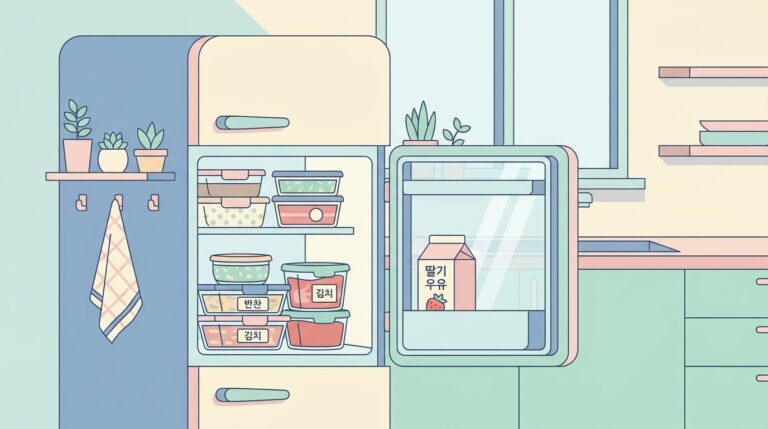
안녕하세요! (Annyeonghaseyo!) I’m your Daily Hangul editor and your Korean bestie. Picture this: you just moved into a cozy share-house in Hongdae or checked into an Airbnb in Seoul. You brought back delicious late-night spicy fried chicken (chimaek) and some fresh strawberry milk from the convenience store. You stand in front of the sleek kitchen, looking at your Korean roommate or host, holding your food containers, wondering… How do I ask if I can put this in the fridge? Where do I store this side dish?
Many beginner learners freeze up (pun intended!) because textbook Korean often teaches ultra-stiff dictionary terms. Based on feedback from hundreds of our global learners, mastering everyday home appliance verbs like “냉장고에 넣다” (to put in the fridge) builds immediate confidence in daily living, shared housing, and Airbnbs. Let’s make you sound completely natural in just a few minutes!
Phase 2: Deep Dive into 3 Core Expressions
1. 냉장고에 넣어요 (Naengjanggo-e neo-eoyo)
- Pronunciation: [Naeng-jang-go-eh nuh-uh-yo] (Think: “Naeng” like cold + “jang-go” like cargo + “nuh-uh-yo” like gently putting something in)
- Meaning: Literal: “Put in refrigerator” | Actual Nuance: “I put it in the fridge” or politely “Please put it in the fridge / Let’s put it in the fridge.”
- K-Culture Moment: In K-Dramas like Hospital Playlist, you often hear roommates reminding each other after cooking: “남은 거 냉장고에 넣어요!” (Put the leftovers in the fridge!)
- Editor’s Insight: In Korean, the particle -에 (-e) acts like “into / in”, and 넣다 (neota) means “to insert or put inside a container”.
- Situation Spectrum: Casual: ⚠️ (Use ‘넣어’) | Semi-formal: ✅ | Formal: ✅ (냉장고에 넣으세요)
- 🤔 Think About It: Why does Korean frequently omit “it” or “my food”? Korean culture naturally relies on shared visual context rather than explicitly stating obvious pronouns!
2. 냉장고에 넣어도 돼요? (Naengjanggo-e neoeodo dwaeyo?)
- Pronunciation: [Naeng-jang-go-eh nuh-uh-do dway-yo?]
- Meaning: Literal: “Even if I put in the fridge, is it okay?” | Actual Nuance: “May I put this in the fridge? / Can I store this in the fridge?”
- K-Culture Moment: Common in variety shows when guest stars visit someone’s house and want to store a cake or a cold gift drink.
- Editor’s Insight: The grammar pattern -아/어도 돼요 (-a/eodo dwaeyo) is the magic key for asking polite permission anywhere in Korea.
- Situation Spectrum: Casual: ⚠️ | Semi-formal: ✅ | Formal: ✅
- 🤔 Think About It: How do permission questions in your native language reflect boundaries compared to Korean polite verb endings?
3. 냉장 보관해 주세요 (Naengjang bogwanhae juseyo)
- Pronunciation: [Naeng-jang boh-gwan-hae joo-seh-yo]
- Meaning: Literal: “Please do cold storage.” | Actual Nuance: “Please keep this refrigerated.”
- K-Culture Moment: Printed on food delivery boxes of raw meat, fresh milk, and banchan (side dishes) packaging across Korea.
- Editor’s Insight: While 넣다 (neota) is pure conversational Korean, 보관 (bogwan) is the functional Sino-Korean word for “storage”.
- Situation Spectrum: Casual: 🚫 | Semi-formal: ✅ | Formal: ✅
- 🤔 Think About It: Notice how Korean has two layers of vocabulary—everyday native words and formal Sino-Korean roots.
Phase 3: Textbook Korean vs. Real Korean
Situation 1: Telling a roommate to put milk in the fridge
- 📖 교과서 한국어 (Textbook): “우유를 냉장고 안에 넣으십시오.” (Uyu-reul naengjanggo ane neoeusipsio.)
- 🗣️ 진짜 한국어 (Real Korean): “우유 냉장고에 넣어 둬!” (Uyu naengjanggo-e neoeo dwo! – Casual) or “우유 냉장고에 넣으세요~” (Uyu naengjanggo-e neoeuseyo~ – Polite)
- 💡 왜 다를까?: Native speakers drop unnecessary particles like “-안에” (inside) and use softer verb endings in casual shared spaces.
Situation 2: Asking if leftovers should be chilled
- 📖 교과서 한국어 (Textbook): “이것을 냉장고에 보관해야 합니까?” (Igeoseul naengjanggo-e bogwanhaeya hamnikka?)
- 🗣️ 진짜 한국어 (Real Korean): “이거 냉장고에 넣을까요?” (Igeo naengjanggo-e neoeulkkayo?)
- 💡 왜 다를까?: Real conversational Korean prefers the friendly suggestion form -을까요? over stiff business question structures.
Phase 4: K-Culture Deep Dive & Non-Verbal Manners
4-1. Nunchi & Fridge Etiquette in Korea
When using a shared refrigerator in a Korean guesthouse, university dorm (Gisuksa), or homestay, subtle etiquette matters! Always label your food with a marker (이름 – Name) or ask with both hands handing over items if the host is organizing the space. Placing your items neatly in designated bins shows great 눈치 (Nunchi – situational tact).
4-2. The Secret World of the Kimchi Fridge (김치냉장고)
Did you know almost every Korean home has two refrigerators? Alongside the standard fridge, you will see a specialized 김치냉장고 (Kimchi Fridge). It maintains precise, freezing-free temperature zones tailored for fermenting kimchi, storing seasonal fruits, and keeping beverages icy cold.
Phase 5: Real-Life Roleplay Scenario
Setting: You just returned to your Seoul Airbnb after buying fresh fruit and kimbap. Host Min-ji is wiping down the kitchen counter.
- Turn 1 (Min-ji): 장 보고 오셨어요? (Jang bogo osyeosseoyo? / Did you finish grocery shopping?)
🎭 Smiling warmly - Turn 2 (You): 네! 날씨가 더워서 음료수 샀어요. (Ne! Nalssiga deowoseo eumryosu sasseoyo. / Yes! The weather was hot so I bought drinks.)
🎭 Holding up shopping bag - Turn 3 (Min-ji): 시원하게 드셔야겠네요! (Siwonhage deusyeoyagetneyo! / You should enjoy them cold!)
- Turn 4 (You): 저… 이거 냉장고에 넣어도 돼요? (Jeo… igeo naengjanggo-e neoeodo dwaeyo? / Um… may I put this in the fridge?)
🎭 Gesturing politely towards the fridge - Turn 5 (Min-ji): 그럼요! 둘째 칸에 자리 많아요. (Geureomyo! Duljjae kane jari manayo. / Of course! There is plenty of room on the second shelf.)
🎭 Opening the fridge door for you - Turn 6 (You): 여기에 넣을게요. 감사합니다! (Yeogie neoeulgeyo. Gamsahamnida! / I will put it right here. Thank you!)
🎭 Placing the bottle carefully - Turn 7 (Min-ji): 김치도 있으니까 편하게 드세요. (Gimchido isseunikka pyeonhage deuseyo. / There is kimchi too, so please feel free to eat.)
🎭 Pointing to the side containers - Turn 8 (You): 와, 진짜 감사해요! 잘 먹겠습니다. (Wa, jinjja gamsahaeyo! Jal meokgetseumnida. / Wow, thank you so much! I will enjoy it.)
🎭 Bowing lightly with a happy smile
🔀 Interactive Choice Point
What would you say if you want to store leftover pizza for tomorrow morning?
* Choice A: “피자 냉장고에 넣어도 돼요?” (Pija naengjanggo-e neoeodo dwaeyo?)
* Choice B: “피자 먹어라.” (Pija meogeora.)
* Choice C: “피자 버려요.” (Pija beoryeoyo.)
Feedback:
* Choice A (Best): Perfect! Polite, clear, and natural permission request.
* Choice B (Risk): Rude command meaning “Eat the pizza!”. Only use this with close younger siblings.
* Choice C (Bad): Means “Throw away the pizza.” Your delicious pizza will go straight into the trash!
Phase 6: 10-Second Emotion Shadowing Drill
[😊 Polite & Inquiring]이거 / 냉장고에 / 넣어도 돼요? (Igeo / naengjanggo-e / neoeodo dwaeyo?)[🧊 Crisp & Clear]우유는 / 냉장고에 / 넣어요! (Uyuneun / naengjanggo-e / neoeoyo!)[🙏 Grateful & Friendly]시원하게 / 잘 보관할게요. (Siwonhage / jal bogwanhalgeyo.)
Phase 7: K-Culture Mini Dictionary
- 냉장실 (Naengjang-sil) | Refrigerator compartment / Regular chilling zone | Used to describe the upper or middle shelves where everyday drinks and side dishes stay fresh.
- 냉동실 (Naengdong-sil) | Freezer compartment | Used for ice cream, frozen dumplings (mandu), and ice trays.
- 반찬통 (Banchan-tong) | Side-dish storage container | The airtight containers (like Lock&Lock) filled with kimchi, pickled radish, and seasoned spinach.
- 유통기한 (Yutong-gihan) | Expiration date | Essential reading on Korean milk cartons and yogurt tubs before putting them away.
Phase 8: Traveler’s Survival Kit
TOP 3 Survival Phrases
- 냉장고 어디에 있어요? (Naengjanggo eodie isseoyo?) – “Where is the refrigerator?” (Pro Tip: Useful when checking into pensions or Hanok stays!)
- 이거 차갑게 보관해 주세요. (Igeo chagapge bogwanhae juseyo.) – “Please keep this cold/refrigerated.” (Pro Tip: Great when buying cakes or pharmacy medicine.)
- 냉동실 써도 돼요? (Naengdong-sil sseodo dwaeyo?) – “Can I use the freezer?” (Pro Tip: Handy when buying ice packs in summer.)
Editor’s Travel Note
When traveling around Korea with fresh snacks, keep the Naver Map App Download ready to locate nearby convenience stores with ice cups (eoreum-keop), and remember most subway station lockers do not offer refrigeration!
Phase 9: A Step Deeper (Reflection)
In Korean culture, the refrigerator is not merely a piece of metal—it is the hearth of hospitality (jeong, 정). Opening up one’s fridge to a guest or sharing homemade side dishes stored in airtight boxes symbolizes deep trust and warmth. When you say “냉장고에 넣을게요” respectfully, you honor your host’s personal domestic space.
💬 Your Turn: What is the most unique food item you would store in a Korean refrigerator? Let us know in the comments below!
Phase 10: FAQ & Common Mistakes
Q: Can I use “냉장고에 둬요” instead of “냉장고에 넣어요”?
A: Yes! “두다 (duda)” means to place/leave something. “냉장고에 둬요” naturally translates to “Leave it in the fridge.”
Q: How do I tell someone to take something OUT of the fridge?
A: Use the verb 꺼내다 (kkeonaeda). Say: “냉장고에서 꺼내 주세요” (Please take it out of the fridge).
Q: What is the difference between 냉장 (naengjang) and 냉동 (naengdong)?
A: 냉장 (Naengjang) is cooling/refrigeration above 0°C, while 냉동 (Naengdong) is deep sub-zero freezing.
🚨 Common Mistakes Warning Board
- ❌ Saying “냉장고를 넣어요” (Grammar mistake: using object marker 를 on fridge instead of location marker 에).
- Correct Action: Always attach -에 to the appliance: 냉장고에 넣어요.
- ❌ Confusing 넣다 (neota – to put in) with 놓다 (nota – to place on top).
- Correct Action: Use 넣다 because food goes inside the fridge compartment.
- ❌ Using blunt imperative “넣어라!” to hosts or elders.
- Correct Action: Use polite request “넣어 주세요” or “넣으세요”.
Phase 11: Action Missions
- 🥉 Bronze Mission: Open your own fridge today and say aloud 3 times: “냉장고에 넣어요!”
- 🥈 Silver Mission: Take a photo of your favorite Korean drink (like Banana Milk) and post an Instagram story with the caption: “냉장고에 넣어도 돼요?”
- 🥇 Gold Mission: Next time you stay at an Airbnb or visit a Korean friend, ask politely before placing your food inside.
- 🎮 K-Culture Mission: Watch an episode of a Korean reality cooking show and spot how many times they say “냉장고”!
Phase 12: Interactive Quiz Challenge
Question 1 (Situation): You want to politely ask your Airbnb host if you can put your strawberries in the fridge. What do you say?
* A) 딸기 냉장고에 넣어도 돼요?
* B) 딸기 냉동실에 버려요.
* C) 딸기 냉장고를 나가요.
Question 2 (Fill in the Blank): 우유를 냉장고___ 넣으세요. (Put the milk ___ the fridge.)
* A) 를
* B) 에
* C) 가
Question 3 (True or False): In Korea, a “김치냉장고” is an appliance solely used to heat food.
* True / False
🔍 Click here to reveal Answers & Explanations!
- Answer: A | “딸기 냉장고에 넣어도 돼요?” is the exact polite phrasing for asking permission.
- Answer: B | The location particle 에 (e) denotes destination into the fridge.
- Answer: False | A 김치냉장고 is a dedicated cold-storage appliance designed for optimal fermentation and chilling.







