

Phase 1: 공감 (Story Opening)
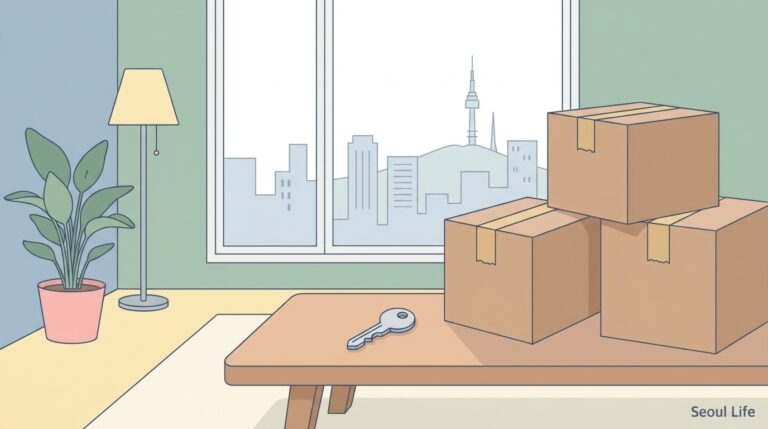
안녕하세요! 매일한글 에디터입니다. Have you ever watched a slice-of-life K-Drama where the main character stands on a sunlit Seoul street surrounded by blue plastic moving crates, eating black bean noodles (jajangmyeon) right off a cardboard box? Moving into a new home in Korea is an iconic milestone, but the logistics behind the scenes can quickly turn overwhelming if you don’t know the exact phrasing to coordinate with realtors and landlords.
Imagine this: your current lease ends on the 15th, but your new landlord casually mentions the previous tenant won’t move out until 1:00 PM on that exact day—and the professional move-in cleaning (입주 청소, ipju cheongso) team needs at least four hours before you can bring your luggage in! Panic starts setting in. How do you negotiate moving times politely yet assertively? How do you confirm whether the deep cleaning is scheduled properly without sounding demanding? Based on hundreds of real coaching cases with foreign residents in Korea, this intermediate (B2) guide equips you with the exact conversational tools, cultural nuance, and high-impact negotiation phrases to navigate your Korean moving day smoothly and stress-free.
Phase 2: 핵심 표현 3선 심층 분석 (Top 3 Key Expressions)
1. 이사 날짜를 며칠 앞당길 수 있을까요? (Isa naljjareul myeochil apdang-gil su isseulkkayo?)
- Pronunciation: [Ee-sah nal-jjah-reul myeo-chil ahp-dang-gil soo ee-sseul-kkah-yo?] (Sound analogy: “ap-dang-gil” feels like leaning forward into an appointment)
- Meaning: Literal: “Can the moving date be pulled forward a few days?” | Nuance: “Is there any flexibility to move in a bit earlier?”
- K-Culture Moment: Seen in dramas like Because This Is My First Life when the protagonist realizes their sublet transition timeline is cut short.
- Editor’s Insight: Using the verb ‘앞당기다’ (to pull forward/advance) combined with ‘~ㄹ 수 있을까요?’ softens the request into a polite inquiry rather than an abrupt demand.
- Situation Spectrum: Casual (⚠️ with friends only: 날짜 좀 당겨도 돼?) | Semi-formal (✅ 중개사/Landlord: 앞당길 수 있을까요?) | Formal (✅ 앞당기는 것이 가능하겠습니까?)
- 🤔 Think About It: In many Western leases, moving dates are fixed months in advance. In Korea, date adjustments often happen through rapid negotiations between three parties (you, previous tenant, landlord). Why is indirect polite phrasing crucial here?
2. 입주 청소는 잔금 치르기 전에 끝나는 거죠? (Ipju cheongssoneun jangeum chireugi jeone kkeutnaneun geojyo?)
- Pronunciation: [Eep-joo cheong-so-neun jan-geum chee-reu-gee jeo-ne kkeut-nah-neun geo-jyo?]
- Meaning: Literal: “The move-in cleaning finishes before paying the final balance, right?” | Nuance: “Just confirming that the deep clean will be 100% completed before I transfer the final deposit amount.”
- K-Culture Moment: An expat YouTuber checking their new officetel in Gangnam, ensuring the range hood and window tracks are spotless before wire-transferring millions of won.
- Editor’s Insight: The ending ‘~는 거죠?’ confirms an expectation gently while signaling that releasing the final funds (잔금) is tied to the clean condition of the apartment.
- Situation Spectrum: Casual (🚫) | Semi-formal (✅ Real estate agent/Landlord) | Formal (✅)
- 🤔 Think About It: Why does tying ‘잔금’ (final balance) to ‘입주 청소’ (deep cleaning) give the tenant healthy leverage in Korean rental contracts?
3. 혹시 도배나 청소 상태 미리 확인해 봐도 될까요? (Hoksi dobaena cheongso sangtae miri hwaginhae bwado doelkkayo?)
- Pronunciation: [Hok-shee doh-bae-nah cheong-so sang-tae mee-ree hwa-geen-hae bwah-doh doel-kkah-yo?]
- Meaning: Literal: “By any chance, may I check the wallpaper and cleaning status in advance?” | Nuance: “Could I inspect the unit beforehand to ensure the wallpaper and cleaning are up to standard?”
- K-Culture Moment: A careful tenant visiting the studio the day before move-in to document pre-existing mold or wallpaper peeling with their smartphone camera.
- Editor’s Insight: Adding ‘혹시’ (by any chance) acts as a linguistic buffer, making your inspection request feel routine and professional rather than distrustful.
- Situation Spectrum: Casual (⚠️) | Semi-formal (✅) | Formal (✅)
- 🤔 Think About It: ‘도배’ (wallpapering) is a major standard maintenance item in Korean rentals. How does inspecting it early prevent security deposit disputes later?
Phase 3: 교과서 한국어 vs 진짜 한국어 (Textbook vs. Real-Life Korean)
Situation 1: Asking if moving in early on the day is possible
- 📖 Textbook Korean: 이사 시간을 오전 9시로 변경해 주십시오. (Isa siganeul ojeon ahopsiro byeong-gyeonghae jusipsio. – “Please change the moving time to 9:00 AM.”)
- 🗣️ Real Korean: 기존 세입자분 나가는 시간이랑 겹치지 않게, 오전 일찍 들어갈 수 있는 방법이 있을까요? (Gijon seipjabun naganeun sigan-irang gyeopchiji anke, ojeon iljjik deureogal su inneun bangbeobi isseulkkayo? – “Could we find a way for me to enter early in the morning without overlapping with the outgoing tenant?”)
- 💡 Why It Differs: Direct imperatives sound confrontational in Korean contract negotiations. B2 speakers frame requests collaboratively around the common obstacle (the outgoing tenant’s schedule).
Situation 2: Emphasizing thorough move-in cleaning
- 📖 Textbook Korean: 청소를 깨끗하게 해 주시기 바랍니다. (Cheongsoreul kkaekkeuthage hae jusigi baramnida. – “I hope you clean it cleanly.”)
- 🗣️ Real Korean: 구석이나 창틀, 에어컨 필터 위주로 꼼꼼하게 입주 청소 신경 써 주시면 감사하겠습니다. (Guseogina changteul, eeokeon pilteo wijuro kkomkkomhage ipju cheongso singyeong sseo jusimyeon gamsahagetseumnida. – “I’d really appreciate it if the cleaners could pay special attention to the corners, window frames, and AC filters.”)
- 💡 Why It Differs: Vague requests yield vague results. Specifying notorious problem areas like window sills (창틀) and AC filters (에어컨 필터) shows you know Korean housing standards.
Phase 4: K-Culture 딥다이브 & 비언어적 매너 (Deep Dive & Manners)
4-1. Nunchi & Non-Verbal Manners in Real Estate
- The Two-Handed Document Handover: Always receive contract modifications and keycards with both hands and a 15-degree nod.
- The Beverage Courtesy (음료수 매너): When the professional cleaning team (입주 청소팀) or ladder-truck movers (사다리차 기사님) arrive, handing them a cold 6-pack of Vita500 or canned iced coffees sets a cooperative, friendly atmosphere. It often results in extra care taken with your unit.
- Tone Modulation: When pointing out uncleaned areas, use a questioning rise in tone rather than a falling flat tone (e.g., “여기 조금 먼지가 남아 있는 것 같아요~” instead of “여기가 더러워요”).
4-2. Cultural Code: Son Eomneun Nal (손 없는 날) & Moving Day Jajangmyeon
- Auspicious Moving Days (손 없는 날): In Korean tradition, Son (손) refers to wandering spirits that cause bad luck. Days ending in the lunar calendar with numbers 9 and 0 (e.g., 9, 10, 19, 20, 29, 30) are deemed spirit-free. Moving and deep cleaning fees are noticeably higher on these days! Always check if your agreed move-in date lands on a Son Eomneun Nal to budget accordingly.
- Moving Day Jajangmyeon: Because cooking utensils are packed away, ordering Jajangmyeon and Sweet & Sour Pork (Tangsuyuk) on top of newspaper or empty boxes is the time-honored celebration of settling into a Korean home.
Phase 5: 실전 롤플레이 시나리오 (Real Roleplay Scenario)
Setting: Office of “Happy Realty” (행복부동산) near Mapo Station. You are discussing final moving logistics with Mr. Kim (licensed real estate agent).
- 중개사 김영호: 민수 씨, 계약서 특약 사항 다 확인하셨죠? 이사 날짜가 다음 주 목요일 15일이에요. (Minsu ssi, gyeyakseo teugyak sahang da hwaginhasyeotjyo? Isa naljjaga daeum ju mogyoil siboil-ieyo.)
- Translation: “Minsu, you reviewed all the special clauses in the contract, right? The moving date is next Thursday, the 15th.”
- 민수 (Learner): 🎭 [Politely leaning forward with a note] 네, 확인했습니다. 그런데 혹시 기존 세입자분 나가는 시간이 언제로 잡혀 있나요? (Ne, hwaginhaetseumnida. Geureonde hoksi gijon seipjabun naganeun sigani eonjero japhyeo innayo?)
- Translation: “Yes, I checked. By the way, what time is the outgoing tenant scheduled to move out?”
- 중개사 김영호: 그분이 오전 11시쯤 짐을 뺀다고 하네요. 잔금 정리하고 나면 12시쯤 될 겁니다. (Geubuni ojeon yeol-hansi-jjeum jimeul ppaendago haneyo. Jangeum jeongrihago namyeon yeol-dusi-jjeum doel geomnida.)
- Translation: “They say they will clear out their stuff around 11:00 AM. After settling the final balance, it will be around 12:00 PM.”
- 민수 (Learner): 🎭 [Looking slightly concerned but respectful] 아, 그렇군요. 제가 계약한 입주 청소 업체가 세 시간 정도 걸린다고 하거든요. (Ah, geureokgunyo. Jega gyeyakhan ipju cheongso eopchega se sigan jeongdo geollindago hageodeunyo.)
- Translation: “Ah, I see. The move-in cleaning company I booked mentioned it takes about three hours.”
- 중개사 김영호: 그럼 민수 씨 이삿짐은 오후 3시 반 이후에 들어와야겠네요. 집주인분께 말씀드려 둘게요. (Geureom Minsu ssi isatjimeun ohu se-si ban ihue deureowayagetneyo. Jipjuinbun-kke malsseumdeuryeo dulgeyo.)
- Translation: “Then your moving boxes should come in after 3:30 PM. I will let the landlord know.”
- 민수 (Learner): 🎭 [Nodding with gratitude] 감사합니다. 혹시 청소 상태 확인하고 잔금 송금해도 괜찮을까요? (Gamsahamnida. Hoksi cheongso sangtae hwaginhago jangeum song-geumhaedo gwaenchaneulkkayo?)
- Translation: “Thank you. Would it be okay if I inspect the cleaning status before wire-transferring the final balance?”
- 중개사 김영호: 물론이죠! 비밀번호 미리 받아서 청소 끝나는 대로 상태 같이 확인합시다. (Mullon-ijyo! Bimilbeonho miri badaseo cheongso kkeutnaneun daero sangtae gachi hwaginhapssida.)
- Translation: “Of course! I will get the digital lock passcode in advance so we can inspect the condition together once cleaning wraps up.”
- 민수 (Learner): 🎭 [Smiling brightly with both hands resting on the desk] 중개사님 덕분에 안심이 되네요. 당일 날 잘 부탁드립니다! (Jung-gaesanim deokbune ansimei doeneyo. Dangil nal jal butakdeurimnida!)
- Translation: “Thanks to you, I feel relieved. I really appreciate your help on moving day!”
🔀 Interactive Branch Point:
What should you say if the landlord demands the full deposit balance before the cleaning team even arrives?
* Choice A (Best): “원활한 계약 이행을 위해, 청소 완료 및 시설물 확인 후 즉시 잔금을 송금해 드리겠습니다.” (Professional, protective, polite)
* Choice B (Bad): “청소도 안 끝났는데 돈을 왜 지금 줘요? 절대 못 줍니다.” (Aggressive, ruins landlord relationship)
* Choice C (Risk): “그냥 달라고 하시니까 지금 바로 다 보내드릴게요.” (High risk: if appliances are broken or cleaning is botched, you lose leverage)
Phase 6: 10초 감정 섀도잉 드릴 (10-Sec Shadowing Drill)
[😊 정중하고 조심스럽게 / Polite & cautious]
이사 날짜를 / 며칠만 / 앞당길 수 있는 / 여유가 있을까요?
(Isa naljjareul / myeochilman / apdang-gil su inneun / yeoyuga isseulkkayo?)-
[🧐 꼼꼼하고 명확하게 / Detailed & clear]
입주 청소 후에 / 창틀이랑 / 싱크대 배수구 / 상태 확인하고 / 잔금 보낼게요.
(Ipju cheongso hue / changteul-irang / singkeudae baesugu / sangtae hwaginhago / jangeum bonaelgeyo.) -
[🤝 든든하고 상냥하게 / Reassuring & warm]
중개사님 덕분에 / 일정 조율이 / 깔끔하게 끝났네요. / 정말 감사합니다!
(Jung-gaesanim deokbune / iljeong joyuri / kkalkkeumhage kkeutnatneyo. / Jeongmal gamsahamnida!)
Phase 7: K-Culture 미니 사전 (Mini Dictionary)
- 손 없는 날 (Son Eomneun Nal): Spirit-free auspicious days for moving according to traditional Korean lunar folklore. Booking movers on these dates incurs a premium.
- 입주 청소 (Ipju Cheongso): Professional deep cleaning service hired before moving into a newly built or previously tenanted apartment, covering grease, mold, and dust.
- 잔금 (Jangeum): The final remaining balance (usually 80-90% of total deposit/rent) paid strictly on moving day upon handover of keys/passcode.
- 사다리차 (Sadari-cha): High-altitude ladder trucks used extensively in Korean multi-story apartments to load/unload furniture through large balcony windows.
Phase 8: 여행자 & 거주자를 위한 생존 키트 (Survival Kit)
Survival Phrases Top 3
- 비밀번호 임시로 설정해 주셨나요? (Bimilbeonho imsiro seoljeonghae jusyeonnayo? – “Did you set a temporary passcode for the door lock?”) -> Pro Tip: Change it immediately after the cleaners leave!
- 이삿짐 사다리차 주차 공간 확보되었나요? (Isatjim sadaricha jucha gonggan hwakbodoeeonnayo? – “Has parking space for the ladder truck been secured?”)
- 하자 있는 부분 사진 찍어 뒀습니다. (Haja inneun bubun sajin jjigeo dwotseumnida. – “I took photos of existing defects/damages.”)
Editor’s Expat Note
Before moving day, download the [네이버 지도 (Naver Map) App] to locate the local Jumin Center (주민센터) for registering your move-in address (전입신고) within 14 days. You can also search quotes for trusted cleaning teams on matching platforms like [숨고 (Soomgo) Service App] to compare rates easily.
Phase 9: 한 발 더 깊이 (Cultural Thought Essay)
Korean rental transitions operate like a tightly synchronized relay race. Because high security deposits (Jeonse or large Wolse sums) are passed directly from the incoming tenant to the outgoing tenant on the exact same morning, move-in times are calculated down to the hour. This demands extraordinary communication (Nunchi and flexibility) from realtors and residents alike. When you learn to coordinate timelines with polite conditional phrases, you are not just speaking Korean—you are successfully integrating into the communal rhythm of Korea’s hyper-efficient urban ecosystem.
💬 Your Turn: Have you ever experienced a moving day mishap in your home country or in Korea? How did you negotiate the timeline? Share in the comments below!
Phase 10: FAQ & 흔한 실수 (FAQ Schema)
Q: Can I request the landlord to pay for the move-in cleaning (입주 청소)?
A: In standard Korean residential rentals, basic move-in cleaning is usually paid by the incoming tenant unless negotiated beforehand as a special contract clause (특약), or if the previous tenant left excessive trash.
Q: What if the previous tenant’s move-out is delayed past our scheduled time?
A: Notify your realtor (부동산 중개인) immediately. They will coordinate between both moving crews and adjust the ladder truck queue.
Q: Is it necessary to do a walk-through inspection before sending the final balance (잔금)?
A: Yes! Always inspect hot water, heating, AC, and window fixtures. Once 잔금 is paid, getting prompt repairs from landlords becomes significantly harder.
🚨 흔한 실수 (Common Mistakes)
- ❌ Mistake 1: Paying the final balance (잔금) days in advance before entering the room. -> Correct Action: Pay it on moving morning after confirming keycode/entry.
- ❌ Mistake 2: Forgetting to ask for waste disposal stickers (대형폐기물 스티커) for old furniture. -> Correct Action: Buy stickers at the local convenience store or via district office apps.
- ❌ Mistake 3: Failing to document pre-existing scratches on the floor. -> Correct Action: Take timestamped photos and send them via KakaoTalk to the agent right away.
Phase 11: 액션 미션 (Action Missions)
- 🥉 Bronze Mission (Solo Practice): Read the Phase 6 Shadowing Drill aloud 3 times, focusing on the polite tone rise with ‘~있을까요?’.
- 🥈 Silver Mission (SNS Sharing): Write down your favorite Korean phrase from this post and tag
@DailyHangul_Officialon your Instagram story. - 🥇 Gold Mission (Real Life Application): Use the phrase “혹시 ~ 상태 미리 확인해 봐도 될까요?” in your next KakaoTalk chat with your Korean agent or landlord.
- 🎮 K-Culture Mission: Watch an episode of a Korean variety show like Home Alone (나 혼자 산다) and spot how celebrities talk to realtors when house hunting!
Phase 12: 인터랙티브 퀴즈 챌린지 (Quiz Challenge)
Q1. Which word refers to auspicious moving days in traditional Korean culture?
1) 비 오는 날
2) 손 없는 날
3) 잔금 날
Q2. Fill in the blank:
“입주 청소 끝난 후에 방 상태를 미리 (________) 봐도 될까요?”
1) 취소해
2) 확인해
3) 포장해
Q3. [True / False] In Korea, it is considered polite and customary to transfer the final deposit balance (잔금) weeks before seeing the cleaned apartment.
👉 Click here to reveal the answers and explanations!
- Q1 Answer: 2) 손 없는 날 (Son Eomneun Nal) – Traditionally spirit-free days for moving and ceremonies.
- Q2 Answer: 2) 확인해 (Hwaginhae) – “확인해 봐도 될까요?” means “May I check/inspect in advance?”.
- Q3 Answer: False – You should always inspect the unit and verify that deep cleaning is done on moving morning before sending the 잔금.







