

Conquering the Han River Trails: What to Say When You Get a Flat Tire in Korea
Phase 1: Empathy & Immersion
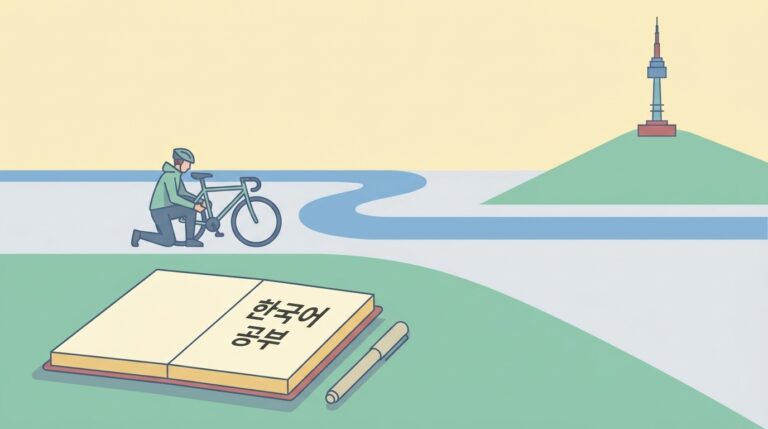
안녕하세요! It’s your friendly Daily Hangul editor here. Picture this: It’s a crisp autumn Saturday along the sparkling Han River (Hangang). You’re cruising smoothly on your road bike past Banpo Bridge, soaking in the view of N Seoul Tower, when suddenly—hissssss—your rear tire gives out. You pull over onto the grassy shoulder, realizing you either left your patch kit at home or need a portable pump immediately. In K-Dramas, this is usually the exact moment a charming stranger stops to offer a hand, but in reality, asking another cyclist or entering a local bike shop (jajeon-geo bang) in fluent, nuanced Korean can feel daunting. At a C1 level, you don’t just want to point and stammer; you want to converse naturally, ask for specific repair tools like CO2 cartridges or tire levers, and navigate the rider community etiquette like a true local. Based on feedback from hundreds of advanced learners living in Seoul, mastering mechanical and situational riding vocab is the ultimate milestone to becoming fully independent on Korean trails.
Phase 2: Deep Dive into Key Expressions
1. 펑크가 났는데, 혹시 펑크 패치나 펌프 좀 빌릴 수 있을까요? (Peongkeuga nanneunde, hoksi peongkeu paechina peompeu jom billil su isseulkkayo?)
- Pronunciation: Pung-kuh-gah nahn-neun-deh, hoke-shi pung-kuh pae-chee-nah pum-peu jom bill-leel soo eess-eul-kkah-yoh? (Sounds like English ‘punk’ but with a sharp pop on the ‘P’).
- Meaning: Literal: “A puncture happened, by any chance could I borrow a puncture patch or pump?” / Nuance: A polite, considerate request for roadside assistance among fellow cyclists.
- K-Culture Moment: Heard in web dramas where athletic protagonists bond along the cycling path after a sudden mishap.
- Editor’s Insight: Notice the word 펑크 (peongkeu)—it is Konglish derived from ‘puncture’ (or German Punktur). Using it with 나다 (nada – to occur) is the most natural native collocation.
- Situation Spectrum: Casual: ⚠️ | Semi-formal: ✅ | Formal: ✅
- 🤔 Think About It: Notice how Korean uses indirect softening (혹시, ~ㄴ데) before making a request to strangers to reduce social imposition.
2. 튜브에 실펑크가 난 것 같은데 때워야 할 것 같아요. (Tyubeue silpeongkeuga nan geot gateunde ttaewoya hal geot gat-ayo.)
- Pronunciation: Tyoo-beu-eh sheel-pung-kuh-gah nahn got gah-teun-deh ttae-woh-yah hal got gah-tah-yoh.
- Meaning: Literal: “It seems like a thread-puncture happened to the tube, so I think I need to patch it.” / Nuance: “I think there’s a slow pinhole leak in my inner tube, so I’ll have to patch it up.”
- K-Culture Moment: Used by seasoned riders explaining their mechanical issues at community cycle hubs in Yangpyeong or Ttukseom.
- Editor’s Insight: 실펑크 (sil-peongkeu) combines 실 (sil – thread) with puncture, referring to a slow, microscopic leak. 때우다 (ttaewuda) literally means to patch or fill a hole.
- Situation Spectrum: Casual: ✅ | Semi-formal: ✅ | Formal: ⚠️
- 🤔 Think About It: How does your native language describe micro-leaks compared to Korean’s tactile visual metaphor of a ‘thread puncture’?
3. 공기압 체크하고 실란트 보충 좀 부탁드릴게요. (Gong-giap chekeuhago sillanteu bochung jom butakdeurilgeyo.)
- Pronunciation: Gong-gee-ap cheh-keu-hah-go sheel-lahn-teu boh-choong jom boo-tak-deu-reel-geh-yoh.
- Meaning: Literal: “Please check the air pressure and replenish the sealant.” / Nuance: Technical and clear service request at a professional bike maintenance shop.
- K-Culture Moment: Commonly spoken at high-end bike repair cafés along the Namhansanseong riding courses.
- Editor’s Insight: C1 speakers stand out by using technical terminology accurately—공기압 (gong-gi-ap – pneumatic pressure) and 보충 (bochung – replenishment/top-up).
- Situation Spectrum: Casual: 🚫 | Semi-formal: ✅ | Formal: ✅
- 🤔 Think About It: Using Sino-Korean nouns (공기압, 보충) shows professional fluency and commands instant respect from mechanics.
Phase 3: Textbook Korean vs. Real Korean
Situation A: Explaining a flat tire
- 📖 교과서 한국어 (Textbook): 자전거 타이어의 바람이 빠져서 움직일 수 없습니다. (Jajeon-geo taieo-ui barami ppajyeoseo umjigil su eopseumnida. – The bicycle tire lost air so it cannot move.)
- 🗣️ 진짜 한국어 (Real-life): 뒷바퀴 펑크 나서 주행이 불가능하네요. (Dwitbakwi peongkeu naseo juhaeng-i bulganeunghaneyo. – The rear tire blew out, so riding is impossible.)
- 💡 왜 다를까? (Why is it different?): Native riders specify which wheel (앞바퀴/뒷바퀴) and use concise terms like 주행 불가능 instead of lengthy textbook descriptions.
Situation B: Asking to borrow a multi-tool/tire levers
- 📖 교과서 한국어 (Textbook): 자전거를 고치는 기구를 가지고 계십니까? (Jajeon-georeul gochineun gigureul gajigo gyesimnikka? – Do you possess tools for fixing bicycles?)
- 🗣️ 진짜 한국어 (Real-life): 혹시 타이어 레버나 육각 렌치 세트 있으신가요? (Hoksi taieo reobeona yukgak renchi seteueosseusingayo? – Do you happen to have tire levers or an Allen key set?)
- 💡 왜 다를까? (Why is it different?): Advanced natural Korean names the specific cycling tool (타이어 레버, 육각 렌치) rather than vague words like ‘기구’ (instrument).
Phase 4: K-Culture Deep Dive & Non-Verbal Etiquette
4-1. 눈치 (Nunchi) & Riding Etiquette
When approaching a fellow rider on the Han River trail for assistance:
* Body Angle & Distance: Step off the bike lane completely onto the designated pedestrian or rest zone before initiating contact. Korean cycling paths have strict speed lines; stopping on the track is considered dangerous and inconsiderate (민폐).
* Eye Contact & Tone: Lower your chin slightly and open your palms in an apologetic, polite posture when asking for a tool: “실례지만 잠시만요…” (Excuse me for a brief moment…).
* Returning the Tool: Always wipe down borrowed tools with a wet wipe or cloth before returning them with two hands (두 손으로 건네기), accompanied by a polite nod.
4-2. Cultural Code: The Han River Convenience Store Culture
Korea’s riverbanks are dotted with convenience stores equipped with automated instant noodle cookers (한강 라면). These spots are informal rallying points for cyclists. If someone lends you a patch kit or air pump, the customary expression of gratitude is offering them a cold energy drink or an iced coffee (아바라 or 아아) right from the nearest convenience store.
Phase 5: Real-Life Roleplay Scenario
Setting: A sunny afternoon at Ttukseom Han River Park resting bench. Min-jun, a seasoned cyclist with full cycling gear, is adjusting his chain.
- You: 저기요, 죄송하지만 혹시 휴대용 펌프나 CO2 카트리지 있으신가요? (Jeogiyo, joesonghajiman hoksi hyudaeyong peompeuna CO2 kateuriji isseusingayo? / Excuse me, I’m sorry to bother you, but do you happen to have a portable pump or CO2 cartridge?)
🎭 Slightly bowing with an apologetic smile while holding your bike wheel - Min-jun: 네, 안장 가방에 미니 펌프 있어요. 타이어 펑크 나셨어요? (Ne, anjang gabang-e mini peompeu isseoyo. Taieo peongkeu nasyeosseoyo? / Yes, I have a mini pump in my saddle bag. Did you get a flat tire?)
🎭 Unzipping his saddle bag and taking out a sleek hand pump - You: 네, 턱을 넘다가 뱀에 물린 것처럼 스네이크 바이트가 난 것 같아요. (Ne, teog-eul neomdaga baeme mullin geotcheoreom seuneikeu baiteuga nan geot gat-ayo. / Yes, I went over a curb and I think I got a snakebite pinch flat.)
🎭 Pointing at the deflated tire rim - Min-jun: 아이고, 림에 찍히셨군요. 튜브 교체하셔야겠네요. 여분 튜브 있으세요? (Aigo, rime jjikhisyeotgunyo. Tyubeu gyochehasyeoyagetneyo. Yeobun tyubeu isseuseyo? / Oh no, it got pinched against the rim. You’ll need to swap the tube. Do you have a spare?)
🎭 Checking the tire bead with his thumb - You: 네, 다행히 여분 튜브랑 레버는 챙겨왔는데 펌프만 깜빡했거든요. (Ne, dahanghi yeobun tyubeurang reobeoneun chaenggyeowanneunde peompeuman kkamppakhaetgeodeunyo. / Yes, fortunately I packed a spare tube and levers, but I forgot my pump.)
🎭 Pulling out a neatly rolled spare inner tube - Min-jun: 여기 펌프요. 프레스타 방식이니까 밸브 코어 풀고 쓰세요. (Yeogi peompeuyo. Peureseuta bangsik-inikka baelbeu koeo pulgo sseuseyo. / Here is the pump. It’s for Presta valves, so unscrew the valve core first.)
🎭 Handing over the mini pump with both hands - You: 빌려주셔서 정말 감사합니다! 덕분에 집까지 타고 갈 수 있겠어요. (Billyeojusyeoseo jeongmal gamsahamnida! Deokbune jipkkaji tago gal su itgesseoyo. / Thank you so much for lending it to me! Thanks to you, I’ll be able to ride home.)
🎭 Fastening the pump onto the valve and pumping rhythmically - Min-jun: 천천히 조심해서 가세요. 라이더끼리는 서로 돕는 거죠! (Cheoncheonhi josimhaeseo gaseyo. Raideokkireeneun seoro domneun geojyo! / Ride safely and take your time. Cyclists always help each other out!)
🎭 Giving an encouraging nod and thumbs-up
🔀 Interactive Choice Point
What would you say next to show authentic Korean rider camaraderie?
* A. “정말 감사해요! 저기 편의점에서 시원한 이온음료 하나 사드릴게요!” (I’m so grateful! Let me buy you a cold sports drink at the convenience store over there!)
* B. “얼마 드리면 될까요? 계좌번호 알려주세요.” (How much should I pay you? Please give me your bank account number.)
* C. “네, 그럼 갈게요! 안녕!” (Yeah, I’ll be going now! Bye!)
Feedback:
* Option A (Best): Perfect! Buying a beverage at a riverside convenience store is the quintessential, warm Korean way of returning a favor without causing awkwardness.
* Option B (Risk): Too transactional. Roadside mutual aid among cyclists is a courtesy; offering cash for lending a hand pump can feel awkward.
* Option C (Bad): Overly abrupt and uses casual speech (안녕) with a stranger, which is impolite.
Phase 6: 10-Second Emotion Shadowing Drill
[🥺 Desperate & Polite]
저기요… / 죄송하지만 / 펌프 좀 / 빌릴 수 있을까요? / (Jeogiyo… / joesonghajiman / peompeu jom / billil su isseulkkayo?)[😮 Relieved & Impressed]
와, / CO2 인플레이터 쓰시니까 / 순식간에 공기가 차네요! / (Wa, / CO2 inpeulleiteo sseusinikka / sunsikgane gong-giga chaneyo!)[🤝 Heartfelt & Warm]
라이더님 덕분에 / 살았습니다. / 안전 라이딩 하세요! / (Raideonim deokbune / sarasseumnida. / Anjeon raiding haseyo!)
Phase 7: K-Culture Mini Dictionary
- 안라 (An-ra – [An-rah]): Short for 안전 라이딩 (Safe Riding). Used as an ubiquitous farewell among cyclists both online and offline.
- 역풍 (Yeok-pung – [Yeok-poong]): Headwind. Often used metaphorically in Korean culture for enduring life struggles or tough workout segments.
- 자덕 (Ja-deok – [Jah-deok]): Portmanteau of 자전거 (Bicycle) + 덕후 (Enthusiast/Otaku). Refers to passionate cycling geeks who know every component by heart.
- 흘내리다 / 흐르다 (Heureuda – [Heu-reu-dah]): Slang meaning “to get dropped from the pack” during a group ride when you lose stamina.
Phase 8: Traveler’s Survival Kit
Survival Expressions TOP 3
- 가장 가까운 자전거포가 어디예요? (Gajang gakkaun jajeon-geopoga eodiyeyo?)
- Pro Tip: Older Koreans often use 자전거포 (jajeon-geopo) or 자전거방 (jajeon-geobang) instead of English ‘bicycle shop’.
- 튜브 규격이 700c에 28c인데, 호환되는 재고 있나요? (Tyubeu gyugyeogi 700c-e 28c-inde, hohwandoeneun jaego innayo?)
- Pro Tip: Stating the exact tire dimensions in mm/inches ensures the mechanic gets the right tube instantly.
- 공임비는 얼마인가요? (Gong-im-bineun eolma-ingayo?)
- Pro Tip: 공임비 (gong-im-bi) refers strictly to the labor fee, separate from parts cost.
Editor’s Travel Note
- Install the KakaoMap app or Naver Map app to search for “자전거 수리점” (bicycle repair shops) along the river. Both apps show dedicated cycling path overlays.
- Han River public bicycle tire pumps (무료 공기주입기) are installed near major bridge intersections like Mapo, Banpo, and Jamsil, supporting both Schrader and Presta valves.
Phase 9: A Step Deeper (Reflection)
In Korea, cycling is more than a solo sport; it is an extension of collective community consciousness (정, Jung). The unspoken code along the Han River is that mechanical failure is a shared human struggle. Even total strangers will gladly share tools, tire levers, or CO2 cartridges because every rider remembers a day they were stranded in the wind.
💬 Your Turn: Have you ever experienced a sudden breakdown while cycling or traveling in Korea? How did you ask for help? Share your stories below!
Phase 10: FAQ & Common Mistakes
Q: Can I take my bicycle onto the Seoul Subway if I get an unfixable flat tire?
A: Yes, but with restrictions! Full-sized bikes are generally allowed on designated subway lines (Lines 1-8) only on weekends and public holidays (in the first/last car). On weekdays, Line 7 and the Gyeongui-Jungang Line allow bikes during specific off-peak hours. Foldable bikes (접이식 자전거) are permitted anytime if folded.
Q: What is the fastest emergency term to shout if I lose control or blow a tire near other riders?
A: Shout clearly: “지나갑니다!” (Passing through!) or “잠시 정차합니다!” (Stopping temporarily!) to warn those behind you.
Q: Do Han River convenience stores sell tire repair kits?
A: Most general convenience stores do not stock inner tubes or specialized patch kits, but large branches near cycling hubs (like Yeouido or Ttukseom) occasionally sell portable mini-pumps and basic multi-tools.
🚨 Common Mistakes Warning Board
- Mistake: Using “타이어가 죽었어요” (My tire is dead).
- Correct Action: Say “타이어 펑크 났어요” (Taieo peongkeu nasseoyo).
- Mistake: Saying “고쳐주세요” directly to a random passerby without asking if they have tools first.
- Correct Action: Ask first: “혹시 공구 있으신가요?” (Do you happen to have tools?).
- Mistake: Stopping in the middle of the bike lane to check tire pressure.
- Correct Action: Pull onto the grassy curb before examining your bike.
Phase 11: Action Missions
- 🥉 Bronze Mission (Solo): Practice saying “뒷바퀴에 실펑크가 나서 바람이 계속 빠져요” out loud 5 times with natural intonation.
- 🥈 Silver Mission (Social): Leave a comment on a Korean cycling YouTube video or Instagram reel using the rider cheer: “오늘도 안라하세요!”.
- 🥇 Gold Mission (Real Life): Next time you ride a Ddareungi (Seoul public bike) or personal bike, visit a local repair shop and ask to check your tire pressure: “공기압 좀 체크해주실 수 있나요?”.
🎮 K-Culture Mission: Watch a Han River cycling vlog on YouTube (search: 한강 야간 라이딩) and identify how many times riders say 안라 or mention 펑크!
Phase 12: Interactive Quiz Challenge
Question 1: Situational Judgment
You got a slow puncture along the Han River. You see another rider with a repair kit bag. How should you politely ask to borrow their pump?
* A. 펌프 내놓으세요. (Hand over the pump.)
* B. 실례지만 펑크가 나서 그런데, 펌프 좀 빌릴 수 있을까요? (Excuse me, but I have a flat tire; could I borrow your pump?)
* C. 자전거 수리해 줘. (Fix my bike.)
🔍 Click to reveal the Answer & Explanation
Correct Answer: B
Explanation: Option B uses the considerate softening marker (~ㄴ데) and polite honorific phrasing (빌릴 수 있을까요), making it respectful and natural. Option A is an aggressive command, and Option C uses rude informal speech.
Question 2: Fill-in-the-Blank
“A slow, tiny pinhole leak in the tire tube is called a (______)” in Korean cycling slang.
🔍 Click to reveal the Answer & Explanation
Correct Answer: 실펑크 (sil-peongkeu)
Explanation: Combines 실 (thread) and 펑크 (puncture) to describe a slow microscopic leak.
Question 3: True / False Cultural Check
True or False: In Korea, when returning a borrowed roadside tool to another cyclist, it is common courtesy to hand it back using both hands.
🔍 Click to reveal the Answer & Explanation
Correct Answer: True
Explanation: Handing objects with both hands (두 손으로 건네기) shows respect and gratitude toward someone who assisted you on the trail.







