

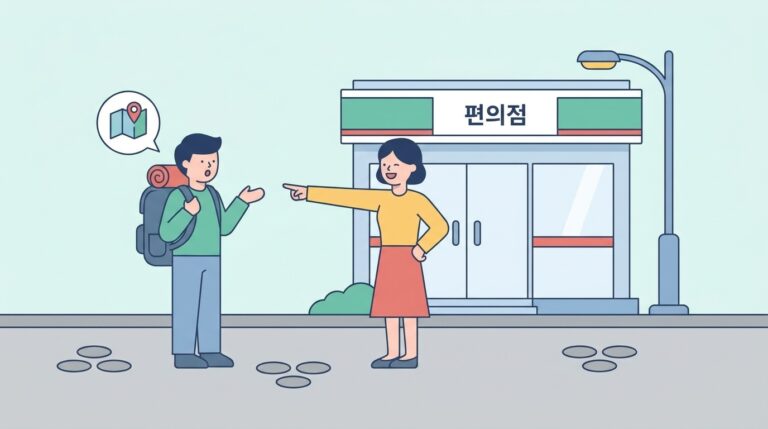
Asking “Is It Nearby?” in Korean: A Complete Beginner’s Guide
Phase 1: Empathy (Story-Driven Opening)
안녕하세요! 매일한글 에디터입니다. (Hello! I’m your Daily Hangul Editor.)
Picture this: You just landed in Seoul, the vibrant neon signs of Hongdae are calling your name, your phone battery drops to 2%, and you desperately need a convenience store to buy a T-money card or charging cable. You pull up Google Maps, only to realize it doesn’t show walking routes accurately in Korea! You spot a friendly local walking a cute Shiba Inu, but your mind goes blank. How do you ask, “Is there a convenience store nearby?” without sounding robotic or panicking?
This is one of the most common hurdles for beginner Korean learners (A1 level). You know basic nouns like “cafe” or “station,” but stringing them together into a polite, natural question feels intimidating. Don’t worry! By mastering one simple sentence pattern, you will comfortably navigate Korean streets, find hidden street food stalls, and explore subway stations like a seasoned local. This guide is built on real beginner feedback to give you instant confidence.
Phase 2: Top 3 Core Expressions
1. 근처에 있어요? (Geuncheo-e isseoyo?)
- Pronunciation: [Geun-cheo-eh ee-sseo-yo] (Sounds like “gun-chuh-eh eat-saw-yo”)
- Meaning: Literal: “Is it in the vicinity?” / Real Nuance: “Is it nearby?” or “Is there one close by?”
- K-Culture Moment: Seen in classic slice-of-life K-Dramas when the protagonist arrives in a new neighborhood and asks a kind neighbor where the local laundromat or market is.
- Editor’s Insight:
근처(geuncheo) means “nearby / vicinity,” and있어요?(isseoyo?) means “is there / do you have?” This 2-word combo is your magic wand for spatial navigation. - Situation Spectrum: Casual: ⚠️ (Say ‘근처에 있어?’) | Semi-formal: ✅ | Formal: ✅ (Say ‘근처에 있습니까?’)
- 🤔 Think About It: In English, we often ask “Where is the nearest…?” but Korean often prefers the simpler question of existence: “Does one exist nearby?”
2. [장소] 어디예요? ([Place] eodiyeyo?)
- Pronunciation: [Place + uh-dee-yay-yo] (Sounds like “uh-dee-yeah-yo”)
- Meaning: Literal: “Where is [Place]?” / Real Nuance: “Where can I find [Place]?”
- K-Culture Moment: K-Pop idols running around during variety shows like Running Man, frantically asking staff members: “화장실 어디예요?!” (Where is the restroom?!)
- Editor’s Insight: Just attach any noun directly in front of
어디예요?. For example,화장실 어디예요?(Restroom, where is it?) or지하철역 어디예요?(Subway station, where is it?). - Situation Spectrum: Casual: ⚠️ (어디야?) | Semi-formal: ✅ | Formal: ✅
- 🤔 Think About It: Notice how Korean drops prepositions like “at” or “in” in everyday spoken questions, keeping it super punchy!
3. 여기서 멀어요? (Yeogiseo meoreoyo?)
- Pronunciation: [Yeo-gi-seo muh-raw-yo] (Sounds like “yaw-gee-saw muh-law-yo”)
- Meaning: Literal: “Is it far from here?” / Real Nuance: “Is it a long walk? / Is it far?”
- K-Culture Moment: When friends are deciding whether to walk or catch a taxi to the late-night Pojangmacha (street food tent).
- Editor’s Insight:
여기서means “from here,” and멀어요?comes from멀다(to be far). If they shake their hands and say “안 멀어요” (An meoreoyo), you can easily walk there in 5 minutes. - Situation Spectrum: Casual: ⚠️ (여기서 멀어?) | Semi-formal: ✅ | Formal: ✅
- 🤔 Think About It: Asking whether a place is far is an indirect, polite way to gauge whether you need step-by-step directions or just a general finger point.
Phase 3: Textbook Korean vs. Real Korean
Situation 1: Asking if there is a convenience store nearby
- 📖 Textbook Korean: 이 근처에 편의점이 존재합니까? (I geuncheoe pyeon-uijeomi jonjaehamnikka? – “Does a convenience store exist in this vicinity?”)
- 🗣️ 진짜 Korean: 편의점 근처에 있어요? (Pyeon-uijeom geuncheoe isseoyo? – “Is there a convenience store nearby?”)
- 💡 Why it differs: Textbook Korean overuses formal markers and stiff vocabulary like
존재하다(to exist). Real Koreans drop subject particles and place the key noun right up front for clarity.
Situation 2: Asking for the subway station entrance
- 📖 Textbook Korean: 지하철역으로 가려면 어느 방향으로 가야 합니까? (Jihacheol-yeogeuro garyeomyeon eoneu banghyang-euro gaya hamnikka?)
- 🗣️ 진짜 Korean: 역 어디로 가요? (Yeok eodiro gayo? – “Which way to the station?”)
- 💡 Why it differs: Spoken Korean values speed. Shortening
지하철역to simply역(station) and using어디로 가요?(where do I go?) is natural and understood instantly.
Phase 4: K-Culture Deep Dive & Non-Verbal Manners
4-1. Nunchi & Body Gestures
When asking for directions on the street in Korea:
1. The Gentle Approach: Start with a polite, soft bow (around 15 degrees) and say 저기요... (Jeogiyo… / Excuse me…). Never tap someone abruptly on the shoulder.
2. Hand Direction Etiquette: When pointing or receiving directions, Koreans use an open flat palm rather than an index finger to show respect.
3. Eye Contact & Smile: Make brief, gentle eye contact accompanied by a slight nod. Korean people are eager to help travelers, especially if you show humble body language.
4-2. Cultural Insight: The Land of Convenience Stores (Pyeon-ui-jeom)
In Korea, convenience stores (GS25, CU, 7-Eleven) are not just grocery spots; they are neighborhood landmarks, late-night cafes, and life-savers. When Koreans give directions, they almost always use convenience stores as navigational anchors: “Turn right at the CU, then walk straight!” Knowing how to ask for them will save your travel itinerary.
Phase 5: Real-Life Roleplay Scenario
Setting: You are on a bustling street in Myeongdong looking for an ATM/bank to get cash.
Characters: You (Traveler) & Min-su (A friendly university student waiting for a friend).
- Turn 1 (You): 🎭 (Approaches with a polite bow and timid smile) 저기요, 실례합니다! (Jeogiyo, sillyehamnida! / Excuse me!)
- Turn 2 (Min-su): 🎭 (Takes out one earbud, smiling) 네, 안녕하세요! (Ne, annyeonghaseyo! / Yes, hello!)
- Turn 3 (You): 은행 근처에 있어요? (Eunhaeng geuncheoe isseoyo? / Is there a bank nearby?)
- Turn 4 (Min-su): 🎭 (Points down the street with an open hand) 아, 은행요? 저쪽 사거리에 있어요. (A, eunhaeng-yo? Jeojjok sageorie isseoyo. / Ah, a bank? There is one at that intersection.)
- Turn 5 (You): 여기서 멀어요? (Yeogiseo meoreoyo? / Is it far from here?)
- Turn 6 (Min-su): 아니요, 걸어서 3분? 진짜 가까워요. (Aniyo, georeoseo sambun? Jinjja gakkaweoyo. / No, 3 minutes on foot? It’s really close.)
- Turn 7 (You): 🎭 (Bright smile with a deep nod) 감사합니다! 좋은 하루 보내세요! (Gamsahamnida! Joeun haru bonaeseyo! / Thank you! Have a great day!)
- Turn 8 (Min-su): 🎭 (Waves kindly) 네, 여행 잘하세요! (Ne, yeohaeng jalhaseyo! / Yes, enjoy your trip!)
🔀 Interactive Branch: What would you say if you didn’t understand Min-su’s direction?
- Option A: “한 번만 다시 말씀해 주세요.” (Han beonman dasi malsseumhae juseyo. – Please say it one more time.)
- Feedback: BEST! Polite, natural, and shows you want to understand.
- Option B: “뭐라고요?” (Mworagoyo? – What did you say?)
- Feedback: RISK! Can sound blunt or impatient if the intonation is flat.
- Option C: Turn and walk away silently.
- Feedback: BAD! Leaving without acknowledging the person’s effort is awkward.
Phase 6: 10-Second Emotion Shadowing Drill
Practice these with the rhythm pauses (/) and emotional tone indicators:
[🥺 Hesitant & Polite]저기요… / 근처에 / 약국 있어요? (Jeogiyo… / geuncheoe / yakguk isseoyo? – Excuse me… is there a pharmacy nearby?)[🤔 Curious & Checking]여기서 / 걸어서 / 멀어요? (Yeogiseo / georeoseo / meoreoyo? – Is it far / on foot / from here?)[😊 Relieved & Bright]아, / 가까워요? / 감사합니다! (A, / gakkaweoyo? / Gamsahamnida! – Ah, it’s close? Thank you!)
Phase 7: K-Culture Mini Dictionary
- 편의점 (Pyeon-ui-jeom) | Convenience Store | The 24/7 lifeline in Korea for transit cards, hot ramyeon, and quick ATM withdrawals.
- 화장실 (Hwajangsil) | Restroom | Essential survival word! Often located inside subway stations and commercial buildings.
- 지하철역 (Jihacheol-yeok) | Subway Station | Korea’s world-class public transit hubs, designated by numbered exit gates (e.g., 1번 출구).
- 약국 (Yakguk) | Pharmacy | Marked with a red or green cross sign (약); essential for band-aids and headache medicine.
Phase 8: Traveler’s Survival Kit
Top 3 Survival Phrases
- Phrase 1: 화장실 근처에 있어요? (Hwajangsil geuncheoe isseoyo?) – Is there a restroom nearby? (Pro Tip: Subway stations have free, clean restrooms!)
- Phrase 2: 오른쪽이에요, 왼쪽이에요? (Oreunjjogieyo, oenjjogieyo?) – Is it right or left?
- Phrase 3: 지도 보여드려도 돼요? (Jido boyeodeuryeodo dwaeyo?) – May I show you my map?
Editor’s Travel Note
- Navigation in Korea: Google Maps has limited walking route support due to local data security regulations. Before flying, search and install the [Naver Map Navigation App on iOS/Android] or [KakaoMap Transit Guide] for real-time walking and bus routes in English.
- T-Money Cards: Always carry a small amount of physical cash (10,000 KRW) to reload your transportation card at any station or convenience store.
Phase 9: A Step Deeper (Reflection)
In many Western cultures, asking strangers for directions often begins with an apology like “Sorry to bother you.” In Korea, while 실례합니다 (excuse me / I am being impolite) exists, people more frequently use 저기요 (“Over there,” equivalent to “Pardon me”) paired with warm, respectful honorifics (-요). This reflects the communal mindset of Jeong (정)—the shared understanding that helping a neighbor or visitor navigate is a natural community duty.
💬 Your Turn: Have you ever gotten lost while traveling abroad? Which Korean place word do you want to master first? Let us know in the comments below!
Phase 10: FAQ & Avoiding Misunderstandings
Q: Can I just point at my phone and say “여기?” (Yeogi?)
A: While people will understand, saying just 여기? (Here?) is informal (반말) and can sound demanding to older adults. Always add -요 and ask 여기 어디예요? (Yeogi eodiyeyo? – Where is this place?).
Q: What is the difference between 저기요 (Jeogiyo) and 실례합니다 (Sillyehamnida)?
A: 저기요 is used to get someone’s attention (like calling a server or a passerby). 실례합니다 literally means “I am committing a discourtesy” and is used when squeezing past someone or interrupting an ongoing conversation.
Q: How do I know if they are telling me to go straight?
A: Listen for the magic words 직진 (Jikjin) or 쭉 가세요 (Jjuk gaseyo), which mean “go straight ahead!”
🚨 Common Mistakes Top 3
- Mistake: Forgetting the politeness suffix
-요(근처에 있어? to a stranger).- Correct Action: Always end with
있어요?(isseoyo?).
- Correct Action: Always end with
- Mistake: Confusing
여기(here) and저기(over there).- Correct Action: Use
여기서(from here) when asking about distances.
- Correct Action: Use
- Mistake: Pointing directly with one index finger into someone’s face.
- Correct Action: Use an open, cupped hand gesture toward the direction.
Phase 11: Action Mission & Engagement
- 🥉 Bronze Mission: Stand in front of your mirror and repeat
근처에 있어요?5 times with a bright, welcoming intonation. - 🥈 Silver Mission: Write a sentence in the comments asking for your favorite place in Korean (e.g.,
카페 근처에 있어요?). - 🥇 Gold Mission: Spot a K-Drama scene where a character asks for directions, and write down the exact question they used!
Phase 12: Interactive Quiz Challenge
Question 1: You need to find a restroom quickly. What is the most natural sentence?
* A) 화장실 어디예요?
* B) 화장실이 집에 있어요?
* C) 화장실 안 가요.
Question 2: Fill in the blank: “편의점 _______ 있어요?” (Is there a convenience store nearby?)
* A) 멀리 (far)
* B) 근처에 (nearby)
* C) 어제 (yesterday)
Question 3 (True/False): In Korea, it is polite to point at directions using a single index finger directly at someone’s chest.
🔍 Click here to reveal Answers & Explanations!
- Answer: A (
화장실 어디예요?means “Where is the restroom?”). - Answer: B (
근처에means “in the vicinity / nearby”). - Answer: FALSE! Koreans politely indicate directions using an open palm gesture.







