

안녕하세요! 매일한글 에디터입니다.
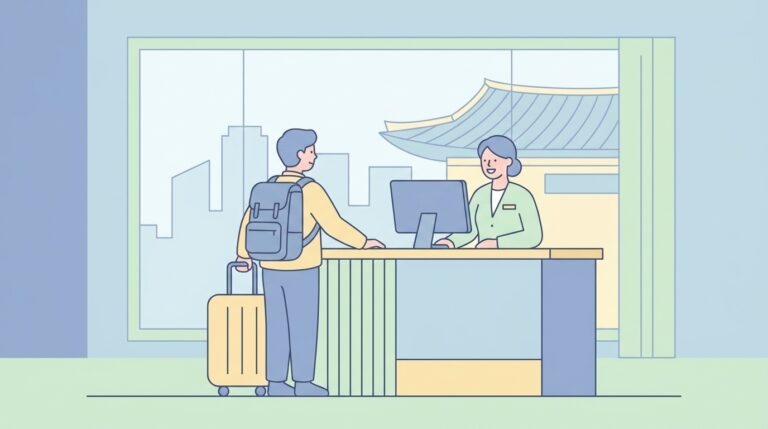
Imagine this: After a long 12-hour flight to Seoul, dragging two heavy suitcases through the bustling streets of Myeongdong, you finally enter the calm, air-conditioned lobby of your hotel. You approach the front desk with high hopes, but suddenly your mind goes blank. The polite receptionist bows and greets you with rapid-fire Korean: “어서오세요, 고객님! 예약하셨습니까?” (Eoseo-oseyo, gogaeknim! Yeyakhasyeossseumnikka?)
In that split second, you panic, fumble for your passport, and point awkwardly at your booking confirmation screen. Many of our Daily Hangul learners tell us that hotel check-in is where anxiety hits the hardest during their Korea trip. You want to speak Korean, but fear getting stuck in complex honorifics.
Don’t worry at all! Checking into a hotel in South Korea actually requires just a handful of warm, polite phrases. Today, we will guide you through practical A2-level Korean expressions so you can confidently check in, drop your bags, and start your K-adventure with a proud smile.
Phase 2: 3 Essential Expressions for Hotel Check-In
1. 체크인하고 싶어요. (Chek-eu-in ha-go sip-eo-yo.)
- Pronunciation: [Check-in ha-go ship-eo-yo] (Think of ‘Check-in’ blended smoothly with ‘ha-go’ like ‘hug-o’ + ‘ship-oh-yo’)
- Meaning: Literal: “I want to do check-in.” | Real Nuance: “Hello, I’d like to check in, please.”
- K-Culture Moment: You hear this in every romantic K-Drama trip scene—like when the main leads arrive at a cozy Jeju Island boutique hotel in Crash Landing on You or King the Land.
- Editor’s Insight: Using
~고 싶어요 (~go sip-eo-yo)is the gold standard for A2 learners expressing polite desire. It is soft, respectful, and crystal clear. - Situation Spectrum: Casual: ⚠️ (체크인할래) | Semi-formal: ✅ (체크인하고 싶어요) | Formal: ✅ (체크인 부탁드립니다)
- 🤔 Think About It: In English, we often say “I have a reservation under…” right away. Why do Koreans prefer stating the general intent (“I want to check in”) first?
2. 예약자 이름은 [이름]이에요. (Ye-yak-ja i-reum-eun [Name]-i-e-yo.)
- Pronunciation: [Ye-yak-ja ee-reum-eun [Name]-ee-eh-yo] (Say ‘ye-yak’ like ‘yeah-yak’)
- Meaning: Literal: “Reservation person name is [Name].” | Real Nuance: “The booking is under [Name].”
- K-Culture Moment: Used whenever you book anything in Korea—from luxury hotels in Gangnam to glamping sites in Gangwon-do.
- Editor’s Insight: If your name ends in a vowel (like Sarah), say
~예요 (~ye-yo). If it ends in a consonant (like Tom), say~이에요 (~i-e-yo). - Situation Spectrum: Casual: 🚫 | Semi-formal: ✅ | Formal: ✅
- 🤔 Think About It:
예약자 (Ye-yak-ja)adds the suffix-자 (-ja), meaning ‘person’. Notice how Korean builds words logically by stacking building blocks!
3. 짐을 맡길 수 있을까요? (Jim-eul mat-gil su iss-eul-kka-yo?)
- Pronunciation: [Jeem-eul maht-geel soo ees-seul-gga-yo?]
- Meaning: Literal: “Can luggage be entrusted?” | Real Nuance: “Could I leave my luggage here before check-in / after check-out?”
- K-Culture Moment: Arrived at 11:00 AM before the 3:00 PM check-in? Drop your bags with this magic line and head straight out for Tteokbokki!
- Editor’s Insight:
~을 수 있을까요? (~eul su iss-eul-kka-yo?)is the polite “Is it possible to…?” structure that softens requests and instantly wins favor with hotel staff. - Situation Spectrum: Casual: 🚫 | Semi-formal: ✅ | Formal: ✅
- 🤔 Think About It: Asking politely rather than demanding reflects Korean jeong (warmth) and social harmony.
Phase 3: Textbook Korean vs. Real Korean
Situation 1: Giving your passport / credit card
- 📖 Textbook Korean: 여기 제 여권과 신용카드가 있습니다. (Yeogi je yeogwon-gwa sin-yong-ka-deu-ga iss-seumnida.)
- 🗣️ Real Korean: 여기 여권이랑 카드요! (Yeogi yeogwon-irang kadeu-yo!)
- 💡 Why is it different? Real-life Korean trims down unnecessary subjects and uses natural connectors like
~이랑 (~irang)instead of stiff book conjunctions like~과 (~gwa).
Situation 2: Asking for the Wi-Fi password
- 📖 Textbook Korean: 와이파이 비밀번호를 가르쳐 주시겠습니까? (Wa-i-pa-i bi-mil-beon-ho-reul gareuchyeo jusigessseumnikka?)
- 🗣️ Real Korean: 와이파이 비밀번호 뭐예요? (Wa-i-pa-i bi-mil-beon-ho mwo-ye-yo?)
- 💡 Why is it different? In casual semi-formal settings, asking simply “What is the Wi-Fi password?” is polite enough without lengthy honorific stacks.
Phase 4: K-Culture Deep Dive & Non-Verbal Manners
4-1. Nunchi & Hand Manners at the Front Desk
When handing over your passport, payment card, or room keycard, always use two hands (or support your right elbow/forearm with your left hand). In Korean culture, handing items with one casual flick of the wrist can come across as dismissive. A gentle slight bow of the head (15 degrees) while saying “감사합니다 (Gamsahamnida)” completes your polite traveler look.
4-2. The 3:00 PM Check-in & Early Luggage Culture
Korean hotels strictly uphold the standard 3:00 PM check-in time (체크인 시간, Chek-eu-in si-gan). However, Korean hospitality excels at luggage holding (짐 보관, Jim bo-gwan). You never need to drag bags around; reception desks have dedicated tag systems ready for early arrivals.
Phase 5: Real-Life Roleplay Scenario
Setting: Front desk of Hotel Namsan, Seoul. Staff member Min-ji greets you with a warm smile.
- Min-ji (Staff): 어서 오세요! 체크인 도와드릴까요? 🎭 Bows politely at the counter
(Eoseo oseyo! Chek-eu-in dowa-deurilkka-yo? – Welcome! May I help you check in?) - You (Traveler): 안녕하세요! 체크인하고 싶어요. 🎭 Smiles and walks up
(Annyeonghaseyo! Chek-eu-in ha-go sip-eo-yo. – Hello! I would like to check in.) - Min-ji (Staff): 네! 예약자 성함이 어떻게 되세요?
(Ne! Ye-yak-ja seong-ham-i eotteoke doeseyo? – Sure! What is the name on the reservation?) - You (Traveler): 예약자 이름은 알렉스예요. 🎭 Pronounces name clearly
(Ye-yak-ja i-reum-eun Alex-ye-yo. – The reservation is under Alex.) - Min-ji (Staff): 확인되었습니다. 여권 확인 부탁드립니다.
(Hwagin-doe-eoss-seumnida. Yeogwon hwagin bu-tak-deu-rimnida. – Confirmed. Passport, please.) - You (Traveler): 네, 여기 여권이요. 🎭 Hands passport with both hands
(Ne, yeogi yeogwon-i-yo. – Yes, here is my passport.) - Min-ji (Staff): 감사합니다. 702호 카드 키 여기 있습니다. 조식은 7시부터입니다.
(Gamsahamnida. Chil-baek-i-ho kadeu ki yeogi iss-seumnida. Jo-sig-eun ilgop-si-buteo-imnida. – Thank you. Here is your key for room 702. Breakfast starts at 7:00 AM.) - You (Traveler): 감사합니다! 좋은 하루 보내세요. 🎭 Bows lightly
(Gamsahamnida! Joeun haru bonaeseyo. – Thank you! Have a great day.)
🔀 Interactive Choice Point: You arrived at 1:00 PM (2 hours early). What do you say?
- Choice A: 방 지금 들어가도 돼요? (Bang jigeum deureo-gado dwaeyo? – Can I go into the room now?)
- Choice B: 체크인 전에 짐을 맡길 수 있을까요? (Chek-eu-in jeon-e jim-eul mat-gil su iss-eul-kka-yo? – Could I leave my luggage before check-in?)
- Choice C: 왜 아직 안 돼요? (Wae ajik an dwaeyo? – Why isn’t it ready yet?)
Feedback:
* Choice A (Risk): Understandable, but might sound blunt if the room isn’t cleaned yet.
* Choice B (Best! ⭐): Natural, super polite, and solves your luggage problem smoothly!
* Choice C (Bad ❌): Very rude in Korean service culture. Avoid this!
Phase 6: 10-Second Emotion Shadowing Drill
Practice reading these out loud with rhythm and feeling:
[😊 Confident & Friendly]안녕하세요! / 체크인하고 싶어요.
(An-nyeong-ha-se-yo! / Chek-eu-in ha-go sip-eo-yo.)[🤝 Polite & Clear]예약자 이름은 / [Alex]예요.
(Ye-yak-ja i-reum-eun / [Alex]-ye-yo.)[🥺 Courteous Request]혹시 / 짐을 맡길 수 있을까요?
(Hok-si / jim-eul mat-gil su iss-eul-kka-yo?)
Phase 7: K-Culture Mini Dictionary
- 체크인 / 체크아웃 (Chek-eu-in / Chek-eu-a-ut): Check-in and Check-out. Loanwords used universally across all Korean accommodations.
- 조식 (Jo-sik): Breakfast / Morning meal. You’ll often hear: “조식 포함이에요? (Is breakfast included?)”.
- 카드 키 (Ka-deu ki): Room keycard. Always keep it close; elevator buttons in modern Korean hotels require a card tap!
- 짐 보관 (Jim bo-gwan): Luggage storage service. Essential phrase for early arrivals or late flights.
Phase 8: Traveler’s Survival Kit
Top 3 Instant Survival Lines:
- 와이파이 비밀번호가 뭐예요? (Wa-i-pa-i bi-mil-beon-ho-ga mwo-ye-yo?) – Pro Tip: Most hotels print this right on your keycard paper sleeve!
- 수건 더 주실 수 있나요? (Su-geon deo ju-sil su innayo?) – Pro Tip: Perfect when you need extra fresh towels.
- 체크아웃 몇 시예요? (Chek-eu-a-ut myeot si-ye-yo?) – Pro Tip: Standard time is usually 11:00 AM.
Editor’s Travel Note:
Make sure you download the Naver Map Navigation App before checking in. Google Maps has limited walking directions in South Korea, whereas Naver Map allows you to find your hotel entrance and nearby 24-hour convenience stores with pinpoint accuracy.
Phase 9: One Step Deeper (Cultural Reflection)
In Korean hospitality culture, the front desk is seen not just as a transaction counter, but as a welcoming threshold (mun-t턱). Korean staff use elevated honorifics (존댓말, Jondaetmal) to honor you as an esteemed guest (고객님, Gogaeknim). Responding with respectful two-handed gestures and clear, pleasant language creates instant goodwill.
💬 Your Turn: Have you ever checked into a hotel abroad in a foreign language? What was your most nerve-wracking moment? Tell us in the comments below!
Phase 10: FAQ & Common Mistakes
Q: Can I speak English if I get confused during check-in?
A: Absolutely! Most hotel front desk staff in major tourist hubs (Seoul, Busan, Jeju) speak English. Starting in Korean and switching if necessary is warmly appreciated!
Q: Do Korean hotels require a passport upon check-in?
A: Yes. Under South Korean hospitality regulations, foreign visitors must present their passport for identity verification.
Q: What is the Korean word for a non-smoking room?
A: “금연 객실 (Geum-yeon gaek-sil)”. You can say: “금연 객실로 부탁해요 (Geum-yeon gaek-sil-ro bu-tak-hae-yo).”
🚨 Common Mistakes Warning Board:
- Mistake 1: Handing your credit card with one hand. (Correction: Use both hands!)
- Mistake 2: Saying “너 이름 뭐야?” (What’s your name?) instead of giving your reservation name. (Correction: “예약자 이름은 ~예요”)
- Mistake 3: Forgetting to ask for Wi-Fi info before going up to the room.
Phase 11: Action Missions
- 🥉 Bronze Mission: Practice saying “체크인하고 싶어요!” in front of your mirror 5 times with a bright smile.
- 🥈 Silver Mission: Write down your own name in Korean script and create your personalized check-in sentence.
- 🥇 Gold Mission: Use this exact phrase when checking into your next accommodation or guesthouse in Korea!
- 🎮 K-Culture Mission: Watch an episode of a modern travel K-variety show (like Youth Over Flowers or Twogether) and spot whenever guests check into their lodgings.
Phase 12: Interactive Quiz Challenge
Q1. Fill in the blank:
“예약자 ________ [이름]이에요.”
(The reservation name is [Name].)
🔍 Click to reveal the answer!
Answer: 이름은 (i-reum-eun)
Explanation: ‘이름’ means name, and ‘은’ is the topic marker attached to consonant-ending words.
Q2. True or False:
In Korea, it is considered polite to toss your passport onto the counter with one hand.
🔍 Click to reveal the answer!
Answer: False ❌
Explanation: You should always hand your passport and card over using two hands as a sign of respect.







