

Phase 1: 공감 (Story Immersion Opening)
안녕하세요! 매일한글 에디터입니다.
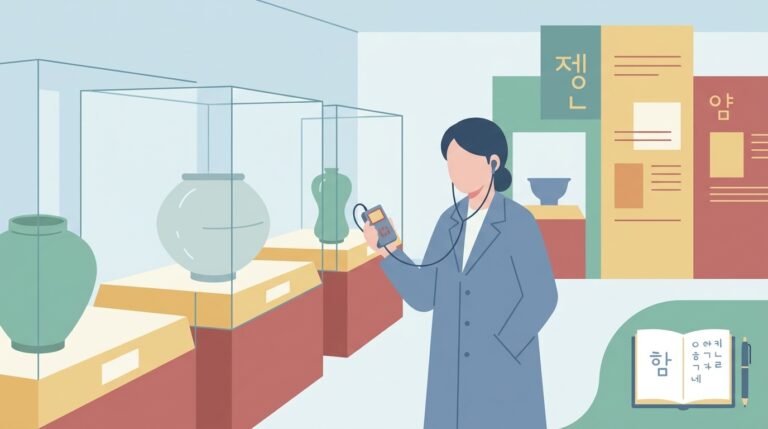
Picture this: You step into the grand, sunlit atrium of the National Museum of Korea in Ichon. You’re ready to explore centuries of dynastic history, royal treasures, and intricate celadon vases. But as you look at the massive exhibition halls spanning three floors, you realize that reading every single dense description plaque in Korean might take until next dynasty!
You spot the information counter where sleek audio guide devices are lined up. You want to walk up and rent one with English commentary, but your mind races: How do I ask if they support English? Do I need to leave my passport? What if I accidentally sound too blunt or informal?
Don’t worry! Renting an audio guide is the single best life-hack for unlocking Korea’s rich historical treasures at your own pace. With just three versatile B1-level speech patterns, you’ll not only sound naturally polite to museum docents, but you’ll also navigate museum desks like a seasoned Seoul resident. Let’s dive into the essential language tools that turn a confusing museum visit into an immersive cultural journey!
Phase 2: 핵심 표현 3선 심층 분석 (Core Expressions)
1. 오디오 가이드 대여하고 싶은데요 (O-di-o ga-i-deu dae-yeo-ha-go si-peun-de-yo)
- Pronunciation: oh-dee-oh gah-ee-deu dae-yeo-hah-goh shee-peun-deh-yoh (Sounds like ending with a gentle, trailing “-deyo” which softens your request like saying “I’d like to…”)
- Meaning: Literal: “I want to rent an audio guide, and…” | Real Nuance: “Hello, I’d like to rent an audio guide, please.”
- K-Culture Moment: In historical dramas or modern reality travel shows (Welcome, First Time in Korea?), whenever visitors approach cultural front desks, ending sentences in -ㄴ/은/는데요 sets a welcoming, polite, and non-demanding atmosphere.
- Editor’s Insight: Using 대여하다 (to rent/hire) instead of just 빌리다 (to borrow) gives your Korean a polished, intermediate touch that fits official cultural facilities.
- Situation Spectrum: Casual: ⚠️ | Semi-formal: ✅ | Formal: ✅
- 🤔 Think About It: Why does Korean prefer soft sentence endings like
-는데요instead of direct imperative statements when making requests?2. 영어 지원 되나요? (Yeong-eo ji-won doe-na-yo?)
- Pronunciation: yeong-uh jee-won dweh-nah-yoh? (Rhymes with “dweh” as in “dwell” without the ‘ll’)
- Meaning: Literal: “Is English support done/supported?” | Real Nuance: “Is English available on this device?”
- K-Culture Moment: Commonly heard in tech-savvy Korea at smart kiosk counters, tourist information desks, and ticket booths.
- Editor’s Insight: 지원 (Support / Availability) is a powerhouse word in modern Korean tech and public services. You can substitute any language: 일본어 지원 되나요? (Is Japanese supported?) or 중국어 지원 되나요? (Is Chinese supported?).
- Situation Spectrum: Casual: 🚫 | Semi-formal: ✅ | Formal: ✅
- 🤔 Think About It: English speakers ask “Do you have English?” while Koreans ask “Does the device/system support English?” Notice the shift in subject!
3. 신분증 맡겨야 하나요? (Sin-bun-jeung mat-gyeo-ya ha-na-yo?)
- Pronunciation: sheen-boon-jeung maht-gyuh-yah hah-nah-yoh (The ‘mat’ sound has a clean, clipped stop before ‘gyeo’)
- Meaning: Literal: “Must I leave my identification card in deposit?” | Real Nuance: “Do I need to leave an ID as a deposit?”
- K-Culture Moment: In Korea, public facilities often hold an ID or small refundable deposit during electronic device rentals.
- Editor’s Insight: The verb 맡기다 means to entrust or deposit something temporarily for safekeeping. It shows you understand local operational etiquette.
- Situation Spectrum: Casual: ⚠️ | Semi-formal: ✅ | Formal: ✅
- 🤔 Think About It: Entrusting personal items builds mutual accountability. How does administrative trust operate in your home country?
Phase 3: 교과서 한국어 vs 진짜 한국어 (Textbook vs. Real Korean)
Situation 1: Asking to rent the guide
- 📖 교과서 한국어: 오디오 가이드를 빌려 주십시오. (O-di-o ga-i-deu-reul bil-lyeo ju-sip-si-o.)
- 🗣️ 진짜 한국어: 저기요, 오디오 가이드 대여 좀 부탁드릴게요. (Jeo-gi-yo, o-di-o ga-i-deu dae-yeo jom bu-tak-deu-ril-ge-yo.)
- 💡 왜 다를까?: Textbook imperatives ending in
-십시오sound like public safety announcements or military orders. Real Koreans use 저기요 + [Noun] + 좀 부탁드릴게요 to sound courteous and approachable.
Situation 2: Returning the device
- 📖 교과서 한국어: 이 기기를 반납합니다. (I gi-gi-reul ban-nap-ham-ni-da.)
- 🗣️ 진짜 한국어: 잘 썼습니다! 여기 반납할게요. (Jal sseot-seum-ni-da! Yeo-gi ban-nap-hal-ge-yo.)
- 💡 왜 다를까?: Instead of stating a dry administrative action, native speakers thank the staff with 잘 썼습니다 (I used it well / Thank you) before handing it over.
Phase 4: K-Culture 딥다이브 & 비언어적 매너 (Deep Dive & Manners)
4-1. 눈치 (Nunchi) & Polite Hand Gestures
When exchanging your passport, ARC (Alien Registration Card), or payment card at the rental counter, never hand it over with one hand. Support your right wrist or forearm with your left hand, or hold the card with both hands with a subtle 15-degree head nod. This non-verbal gesture instantly communicates respect.
4-2. Cultural Code: Deciphering the Relics
Museums like the National Museum of Korea or the Gyeongju National Museum house national treasures like the Pensive Bodhisattva (Bangasayusang) and Goryeo Celadon. When listening to the audio guide, you’ll encounter historical vocabulary that elevates your appreciation of K-Dramas and historical Sageuk series!
Phase 5: 실전 롤플레이 시나리오 (Roleplay Dialogue)
Setting: Information & Rental Desk, 1st Floor of the National Museum of Korea.
Characters: Alex (Intermediate learner) and Min-ji (Friendly museum desk clerk).
- Alex: 안녕하세요! 오디오 가이드 대여하고 싶은데요. 🎭 (Approaches the counter with a warm smile)
(Annyeonghaseyo! O-di-o ga-i-deu dae-yeo-ha-go si-peun-de-yo.)
“Hello! I’d like to rent an audio guide, please.” -
Min-ji: 네, 안녕하세요! 일반 오디오 가이드와 어린이용 가이드가 있는데 어떤 걸로 드릴까요? 🎭 (Points to the device display)
(Ne, annyeonghaseyo! Ilban o-di-o ga-i-deu-wa eorin-i-yong ga-i-deu-ga inneunde eotteon geollo deurilkkayo?)
“Yes, hello! We have standard audio guides and children’s guides. Which would you like?” -
Alex: 일반용으로 부탁드려요. 혹시 영어 지원 되나요? 🎭 (Listens attentively and tilts head slightly)
(Ilbanyong-euro bu-tak-deu-ryeo-yo. Hok-si yeong-eo ji-won doe-na-yo?)
“Standard, please. Does it support English by any chance?” -
Min-ji: 네, 한국어, 영어, 일본어, 중국어 모두 지원됩니다. 🎭 (Taps the touchscreen to configure language settings)
(Ne, hangugeo, yeong-eo, ilboneo, junggugeo modu jiwondoemnida.)
“Yes, it supports Korean, English, Japanese, and Chinese.” -
Alex: 다행이네요! 대여료는 얼마인가요? 🎭 (Reaches into bag)
(Dahaeng-i-ne-yo! Dae-yeo-ryo-neun eol-ma-in-ga-yo?)
“That’s a relief! How much is the rental fee?” -
Min-ji: 한 대에 삼천 원입니다. 그리고 보증용으로 신분증 하나 맡겨주셔야 해요. 🎭 (Shows the card reader)
(Han dae-e sam-cheon won-im-ni-da. Geurigo bojeung-yong-euro sinbunjeung hana mat-gyeo-ju-syeo-ya hae-yo.)
“It’s 3,000 KRW per unit. Also, you need to leave an ID as a deposit guarantee.” -
Alex: 네, 여기 카드랑 여권 있습니다. 🎭 (Hands over the card and passport using both hands)
(Ne, yeogi kadeurang yeogwon itseumnida.)
“Okay, here is my payment card and passport.” -
Min-ji: 감사합니다. 반납은 관람 끝나시고 5시 반 전까지 여기로 해주세요! 🎭 (Hands over the audio guide and receipt with strap)
(Gamsahamnida. Bannabeun gwanram kkeutnasigo daseot-si ban jeonkkaji yeogiro hae-juseyo!)
“Thank you. Please return it here before 5:30 PM after your tour!”
🔀 Interactive Choice Point: You finished your tour and want to return the guide!
What do you say as you approach the counter?
- Choice A: “야! 이거 받아!” (Ya! I-geo bat-a! – Hey, take this!)
- Feedback (Bad): Extremely rude banmal (informal speech). The clerk will be shocked!
- Choice B: “여기 반납할게요. 설명 덕분에 잘 관람했습니다!” (Yeo-gi ban-nap-hal-ge-yo. Seol-myeong deok-bun-e jal gwan-ram-haet-seum-ni-da!)
- Feedback (Best! ⭐): Perfect nuance! You politely indicate return and thank them for the informative guide.
- Choice C: “기기 던집니다.” (Gi-gi deon-jim-ni-da – I throw the machine.)
- Feedback (Risk): Grammatically sounds like an announcement in a video game before throwing an explosive device. Avoid!
Phase 6: 10초 감정 섀도잉 드릴 (Emotion Shadowing Drill)
Practice reading with pause markers (/) and natural intonation:
[😊 Politeness & Gentle Request]
저기요, / 오디오 가이드 / 한 대 대여하고 싶은데요. / 혹시 영어 지원 되나요?
(Jeo-gi-yo, / o-di-o ga-i-deu / han dae dae-yeo-ha-go si-peun-de-yo. / hok-si yeong-eo ji-won doe-na-yo?)-
[🤔 Inquiring & Prepared]
신분증 / 맡겨야 하나요? / 여권도 / 괜찮죠?
(Sin-bun-jeung / mat-gyeo-ya ha-na-yo? / yeo-gwon-do / gwaen-chan-cho?) -
[😄 Grateful & Cheerful Return]
관람 잘 했습니다! / 여기 기기랑 영수증 / 반납할게요.
(Gwan-ram jal haet-seum-ni-da! / yeo-gi gi-gi-rang yeong-su-jeung / ban-nap-hal-ge-yo.)
Phase 7: K-Culture 미니 사전 (Mini Dictionary)
- 대여 (Dae-yeo) | Rental / Lease | Used across museum desks, public bike stations (like Seoul Ttareungi), and traditional Hanbok rental shops.
- 신분증 (Sin-bun-jeung) | Identification Card | Covers ARC, Korean Driver’s License, or Foreign Passports at check-in desks.
- 상설전시 (Sang-seol-jeon-si) | Permanent Exhibition | The permanent collection of a museum (usually free admission in major national Korean museums!).
- 반납 (Ban-nap) | Return (of borrowed items) | Vital word for libraries, locker keys, rental cars, and audio guide counters.
Phase 8: 여행자를 위한 생존 키트 (Traveler Survival Kit)
Top 3 Survival Phrases
- 이어폰 꽂을 수 있나요? (I-eo-pon kko-jeul su in-na-yo?)
Pro Tip: Check if you can plug in your own standard 3.5mm wired earphones for comfort. - 한국어 해설도 포함되어 있나요? (Han-guk-eo hae-seol-do po-ham-doe-eo in-na-yo?)
Pro Tip: Great for intermediate learners who want to challenge themselves by switching between English and Korean audio tracks. - 보증금은 언제 돌려받나요? (Bo-jeung-geum-eun eon-je dol-lyeo-bam-na-yo?)
Pro Tip: If paying a cash deposit instead of leaving an ID card, ask this to verify return procedure.
Editor’s Travel Note
Most major national museums in Seoul provide high-tech mobile alternatives. Make sure to download the official museum guide companion via the 국립중앙박물관 공식 모바일 앱 다운로드 to turn your own smartphone into an interactive AR audio guide!
Phase 9: 한 발 더 깊이 (Cultural Insights)
In Korean public institutions, the process of depositing an ID (신분증 보관) reflects a culture rooted in institutional trust and shared responsibility. By handing over identification, both parties enter a mutual agreement of care for shared cultural amenities. Rather than feeling like a rigid inspection, it is a routine communal practice designed to preserve high-tech public educational resources for everyone.
💬 Your Turn: Have you ever used an audio guide in another country? How does the rental deposit system in your hometown compare with Korea’s ID check?
Phase 10: FAQ & 오해 방지 (FAQ Schema)
Q: Can I use a photocopy of my passport or a digital photo on my phone as an ID?
A: Usually, major national museums require a physical, hard-copy ID card (Passport, Alien Registration Card, or Driver’s License) to hold onto while you use the device. It is always safest to bring your physical passport.
Q: Is the audio guide rental free in Korea?
A: General admission to permanent exhibitions in national museums is frequently free in Korea, but electronic audio guide devices usually charge a nominal maintenance fee of around 1,000 KRW to 3,000 KRW.
Q: What if I lose or damage the audio guide during my tour?
A: Report immediately to the rental desk (대여소). You will be guided through a simple replacement/compensation form, which is why keeping the rental receipt (영수증) is helpful.
🚨 Common Mistakes Alert
- Calling the staff “아줌마 (Ajumma)” 🚫 ➔ Use “저기요 (Excuse me)” or “선생님 (Teacher/Respectful term)” ✅
- Handing ID cards with a single flick of the fingers 🚫 ➔ Hold the card with both hands with a slight bow ✅
- Forgetting to check the museum closing time 🚫 ➔ Audio counters stop returns 30 minutes before museum closing! ✅
Phase 11: 액션 미션 & 참여 유도 (Action Mission)
- 🥉 Bronze Mission (Solo): Stand in front of a mirror and practice saying: “오디오 가이드 대여하고 싶은데요, 영어 지원 되나요?” with two-handed card-giving gestures.
- 🥈 Silver Mission (Social): Share your favorite Korean historical relic name in Korean on your social media story with the hashtag
#DailyHangulMuseum. - 🥇 Gold Mission (Real Life): Visit a Korean museum or cultural heritage site (like Gyeongbokgung Palace) and rent an audio guide completely in Korean without switching to English!
- 🎮 K-Culture Mission: Watch an episode of a modern drama where characters visit a gallery (like Her Private Life or Encounter) and spot how Koreans ask for exhibition brochures.
Phase 12: 인터랙티브 퀴즈 챌린지 (Interactive Quiz)
Test what you’ve learned today! Click on the spoiler dropdowns to reveal the answers.
Q1. Situation Judgment
You want to ask if the audio guide provides English commentary. Which sentence is the most natural?
1) 영어 주십시오.
2) 영어 지원 되나요?
3) 영어로 말하세요.
🔍 Click to view Answer & Explanation
Answer: 2) 영어 지원 되나요?
Explanation: “지원 되나요?” (Is [language] supported?) is the standard, natural expression for tech devices and tour services.
Q2. Fill in the Blank
“보증용으로 _________ 하나 맡겨주시겠어요?” (Could you leave an ID for deposit guarantee?)
🔍 Click to view Answer & Explanation
Answer: 신분증 (Sin-bun-jeung)
Explanation: 신분증 means identification card (such as a passport or ARC).
Q3. True or False
In Korea, it is polite to slide your credit card or passport onto the desk using only your left hand.
🔍 Click to view Answer & Explanation
Answer: False (X)
Explanation: Always use both hands or support your right arm with your left hand when handing over cards or documents in Korea!







