

Phase 1: Empathy & K-Culture Opening
안녕하세요! 매일한글 에디터입니다. (Hello! This is your Daily Hangul editor.)
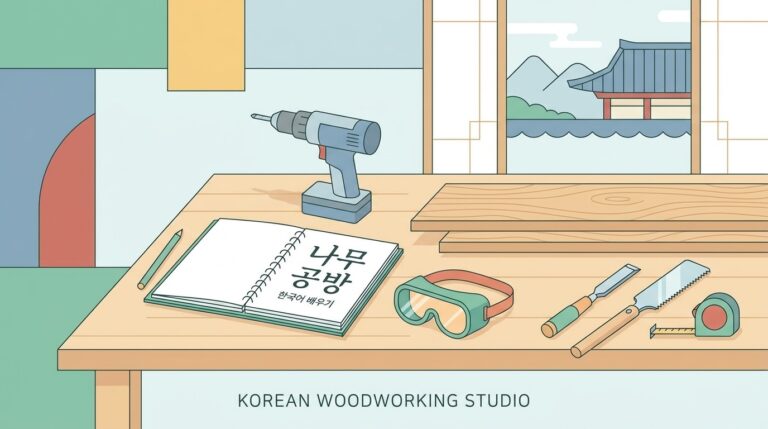
Picture this: You’ve just moved into a cozy officetel in Mapo-gu, inspired by the aesthetic room makeover vlogs of your favorite K-YouTubers. You ordered a sleek DIY flat-pack bookshelf from Today’s House (오늘의집), and now you’re holding a hefty cordless power drill. Suddenly, you freeze. In Korean apartment culture, one wrong move at 8 PM can trigger an immediate noise complaint from downstairs, or worse, a ruined piece of timber. You want to ask a neighbor or the local woodworking workshop (mokgongso) master for advice on drill bits, torque adjustment, and safety precautions without sounding like a textbook robot.
Navigating specialized tasks like power tool safety in Korean requires nuanced C1-level fluency—where technical precision blends seamlessly with polite workshop etiquette and social nunchi. Based on feedback from our advanced learners tackling practical life in Korea, this comprehensive guide will equip you with native expressions, safety protocols, and workshop culture mastery.
Phase 2: Deep Dive into 3 Core Expressions
1. 토크 조절을 잘못하면 나사산이 뭉개질 수 있어요 (Tokeu jojeor-eul jalmot-hamyeon nasasani mung-gae-jil su isseoyo)
- Pronunciation: [toh-keu joh-jeol-eul jal-mot-ha-myeon na-sa-sahn-ee moong-gae-jil soo ee-sseo-yo] (Think of ‘torque’ with a soft Korean ‘eu’ vowel, and ‘mung-gae’ rolling smoothly like ‘squishing soft clay’)
- Meaning: Literal: “If you adjust the torque incorrectly, the screw thread can be crushed.” / Nuance: “Be careful with the torque setting, or you’ll strip the screw head completely.”
- K-Culture Moment: Often heard on variety shows like I Live Alone (나 혼자 산다) when a celebrity struggles with furniture assembly and strips a screw due to excessive drill power.
- Editor’s Insight: ‘나사산이 뭉개지다’ (to strip a screw thread) is the authentic term used by carpenters. Textbook Korean often uses generic words like ‘고장 나다’ (to break), but using ‘뭉개지다’ signals high-level practical fluency.
- Situation Spectrum: Casual: ✅ | Semi-formal: ✅ | Formal: ✅
- 🤔 Think About It: Notice how Korean carpentry vocabulary integrates loanwords (토크 – torque) with native descriptive verbs (뭉개지다 – to be squished/crushed). How does your language express minor mechanical mishaps?
2. 헛돌지 않게 드릴을 목재와 직각으로 꽉 밀착시키세요 (Heot-dolji ankye deurireul mokjae-wa jikgak-euro kkwak milchaksikiseoyo)
- Pronunciation: [hut-dohl-jee an-kay deu-ree-reul mok-jae-wah jeek-gahk-eu-roh kkwahk meel-chahk-she-kee-seh-yoh] (The ‘heot-‘ sounds like ‘hut’, expressing empty/useless action)
- Meaning: Literal: “Make the drill adhere tightly perpendicular to the wood so it does not spin uselessly.” / Nuance: “Keep the drill strictly perpendicular and apply firm downward pressure to prevent slipping.”
- K-Culture Moment: Common in YouTube DIY carpentry tutorials when seasoned artisans warn beginners about drill bit slippage (bi-tteu ttwigi).
- Editor’s Insight: ‘헛돌다’ is a versatile prefix-verb combo (‘헛’ + ‘돌다’ = spinning in vain). It is the exact term for when a drill bit slips out of the groove and spins freely, risking personal injury or wood gouging.
- Situation Spectrum: Casual: ⚠️ | Semi-formal: ✅ | Formal: ✅
- 🤔 Think About It: The concept of ‘밀착’ (close adherence/pressing tight) reflects the Korean emphasis on physical stability and precision before initiating action.
3. 안전 고글이랑 방진 마스크는 선택이 아니라 필수예요 (Anjeon gogeul-irang bangjin maseukeuneun seontaegi anira pilsu-yeyo)
- Pronunciation: [ahn-jeon goh-geul-ee-rahng bahng-jeen mah-seu-keu-neun seon-taek-ee ah-nee-rah peel-soo-yeh-yoh]
- Meaning: Literal: “Safety goggles and dust mask are not an option; they are a must.” / Nuance: “Protective eyewear and a dust mask are non-negotiable safety standards.”
- K-Culture Moment: Featured in artisan woodworking workshops across Seongsu-dong and Mullae-dong before beginners are permitted to touch power equipment.
- Editor’s Insight: The phrasing ‘~은/는 선택이 아니라 필수예요’ is a rhetorical pattern widely used in modern Korea to emphasize absolute necessity over optional preference.
- Situation Spectrum: Casual: ✅ | Semi-formal: ✅ | Formal: ✅
- 🤔 Think About It: Why do modern Korean craft spaces prioritize explicit safety affirmations over casual verbal warnings?
Phase 3: Textbook Korean vs. Real Korean
Situation 1: Warning someone about drill kickback or binding
- 📖 교과서 한국어: 전동 드릴이 갑자기 멈추면 손목을 다칠 수 있으니 주의하십시오. (Jeondong deuriri gapjagi meomchumyeon sonmogeul dachil su isseuni ju-uihasipsio.) — “Please be careful as you may injure your wrist if the electric drill suddenly stops.”
- 🗣️ 진짜 한국어: 킥백 현상 일어나면 손목 꺾이니까 보조 손잡이 꼭 잡으세요. (Kikbaek hyeonsang ireonamyeon sonmok kkeokkinikka bojo sonjabi kkok jabeuseyo.) — “If kickback happens, it will snap your wrist, so make sure to hold the auxiliary handle firmly.”
- 💡 왜 다를까?: Real woodworkers use direct jargon (‘킥백 현상’ for kickback) and vivid biomechanical outcome verbs (‘손목이 꺾이다’ vs ‘다치다’) to convey immediate physical urgency.
Situation 2: Asking to pre-drill pilot holes
- 📖 교과서 한국어: 나사를 넣기 전에 작은 구멍을 먼저 뚫어야 합니까? (Nasareul neoki jeone jageun gumeong-eul meonjeo ttulheoya hamnikka?) — “Must I make a small hole before inserting the screw?”
- 🗣️ 진짜 한국어: 목재 갈라짐 방지하려면 이중기리로 길 먼저 내는 게 좋죠? (Mokjae gallajim bangjiharyeomyeon ijunggiriro gil meonjeo naeneun ge jochyo?) — “To prevent the wood from splitting, it’s better to make pilot holes with a countersink bit first, right?”
- 💡 왜 다를까?: Advanced speakers use craft terminology like ‘이중기리’ (countersink drill bit) and the idiomatic expression ‘길을 내다’ (to blaze a trail / create a pilot path) rather than simple vocabulary.
Phase 4: K-Culture Deep Dive & Non-Verbal Manners
4-1. Nunchi & Non-Verbal Workshop Manners
- Tool Handover Etiquette: When handing over a power drill to a master (Moksu-nim) or peer, always remove your finger completely from the trigger, lock the safety switch (anjeon jamgeum), and hold the drill body while presenting the handle toward the receiver with both hands (yangson).
- Noise Nunchi (층간소음 눈치): In Korean residential buildings, using impact drills (hemo deuril) on concrete walls requires informing neighbors beforehand or adhering to standard daytime hours (10:00 AM – 5:00 PM). Never drill late in the evening without prior notice posted on the elevator notice board.
4-2. Cultural Code Analysis: The Renaissance of Mok-gong Workshops
In modern Korean urban culture, especially among millennial and Gen Z professionals in hotspots like Mullae-dong and Yeonhui-dong, woodworking (mokgong) has transformed into a prestigious form of hyusig (mindful healing). Escaping digital burnout by working with raw timber and precision power tools reflects a broader trend of tangible craftsmanship (sugong-ye). Engaging in workshops with the correct professional terminology displays cultural respect and instantly earns the mentor’s confidence.
Phase 5: Real-World Roleplay Scenario
Setting: A communal woodworking studio in Mapo-gu. You are preparing to drill joinery holes into a solid white oak plank, guided by Master Park (박 목수님).
- Master Park: 샌딩 끝났으면 이제 결합부 타공 들어가야죠. 비트는 몇 파이짜리로 물리셨어요? (Now that sanding is done, let’s drill the joints. What millimeter bit did you chuck in?)
- You: 4파이 목공용 드릴 비트로 장착했습니다. 목재가 단단해서 먼저 표시부터 해뒀습니다. (I mounted a 4mm wood drill bit. The timber is dense, so I marked the points first.)
🎭 [비트를 가볍게 돌려 흔들림이 없는지 확인하며] - Master Park: 잘하셨네. 근데 하드우드라 RPM 너무 높이면 목재 타고 비트 날 나가요. (Well done. But since it’s hardwood, if the RPM is too high, the wood will scorch and the bit edge will dull.)
- You: 아, 그럼 속도 조절 다이얼을 1단으로 낮추고 천천히 진입할까요? (Ah, should I lower the speed dial to gear 1 and enter slowly?)
🎭 [드릴 상단의 속도 기어를 1단으로 내리며] - Master Park: 맞아요. 그리고 수평 유지하면서 중간중간 칩 배출해 주는 거 잊지 말고요. (Exactly. And keep it level, don’t forget to pull back intermittently to clear chips.)
- You: 네, 무리하게 힘으로 누르지 않고 회전력으로 뚫어내겠습니다. (Understood, I won’t force it down with brute weight; I will let the rotational force do the cutting.)
🎭 [보호안경을 고쳐 쓰고 자세를 안정적으로 낮추며] - Master Park: 좋아, 자세 나오네! 작업 끝나면 배터리 분리하고 집진기 돌려요. (Good, your posture looks solid! Once done, disconnect the battery and run the dust extractor.)
- You: 알겠습니다. 안전 수칙 철저히 지켜서 깔끔하게 마무리하겠습니다! (Understood. I will strictly follow safety protocols and finish cleanly!)
🔀 Interactive Choice Point
Master Park notices you’re about to drill straight through without a backing board beneath the oak. What do you say?
- Option A: “어차피 밑면은 안 보이니까 그냥 뚫어도 괜찮죠?” (Since the bottom won’t show anyway, is it fine to just drill through?)
- Option B: “뒤쪽에 버(Burr) 생기거나 터질 수 있으니 받침목 하나 대고 작업하겠습니다.” (To prevent tear-out or burrs on the back, I’ll place a backing scrap piece underneath before drilling.)
- Option C: “비트가 길어서 바닥까지 뚫릴 것 같은데 그냥 힘빼고 살살 하면 되나요?” (The bit is long so it might hit the table, should I just gently push?)
Feedback:
* Option A (Bad): ❌ Disregards timber integrity. In woodworking, back tear-out (tear-out/teojim) ruins professional finish.
* Option B (Best): 🌟 Flawless C1 craft awareness! Using terms like ‘받침목’ and anticipating ‘목재 터짐’ earns instant respect.
* Option C (Risk): ⚠️ Passive and risky. Operating tools without a sacrificial board risks damaging the studio worktable.
Phase 6: 10-Second Emotion Shadowing Drill
Practice matching realistic tone, pacing, and stress pauses (/):
- [⚠️ 단호하고 경각심을 담아 / Resolute & Safety-Conscious]
드릴 비트 교체할 땐 / 반드시 / 배터리 팩부터 분리해야 / 오작동을 막을 수 있어요.
(Deuril biteu gyocehal ttaen / bandeusi / baeteori paekbuteo bullihaeya / ojakdongeul mageul su isseoyo.) -
[💡 차분하고 전문가다운 조언 / Calm & Instructive]
나사가 헛돌기 시작하면 / 억지로 누르지 말고 / 역방향으로 풀었다가 / 각도를 다시 잡으세요.
(Nasaga heotdolgi sijakhamyeon / eokjiro nureuji malgo / yeokbanghyang-euro pureotdaga / gakdoreul dasi jabeuseyo.) -
[🤝 겸손하지만 자신감 있게 / Polite & Professional]
타공 깊이 조절을 위해 / 스토퍼를 세팅해 뒀으니 / 오차 없이 깔끔하게 뚫어보겠습니다.
(Tagong gipi jojeoreul wihae / seutopeoreul setinghae dwosseuni / ocha eopsi kkalkkeumhage ttulheobogetsseumnida.)
Phase 7: K-Culture Mini Dictionary
- 이중기리 (Ijung-giri) | Countersink Drill Bit
Essential carpentry tool that drills a pilot hole and a wider pocket simultaneously so screw heads sit flush with the wood surface. - 무부하 회전수 (Mubuha Hoejeonsu) | No-Load RPM (Speed)
The maximum rotational speed of a drill when not meeting resistance; key spec discussed when selecting tools for different woods. - 클러치 세팅 (Keulleochi Seting) | Torque Clutch Setting
The numeric ring selector on a drill driver that disengages power when a set resistance is reached, preventing stripped threads. - 집진 (Jip-jin) | Dust Extraction / Dust Collection
Crucial workshop practice in Korean studios to prevent airborne sawdust inhalation and maintain clean communal spaces.
Phase 8: Traveler’s & Resident’s Survival Kit
Top 3 Survival Phrases
- 비트가 척(Chuck)에 꽉 안 물렸는데 어떻게 조이나요? (Biteuga cheog-e kkwak an mullyeonneunde eotteoke joinayo?)
“The bit isn’t clamped tightly in the chuck; how do I tighten it?”
Pro Tip: Rotate the keyless chuck ring clockwise until you hear distinct clicking ratchets. - 임팩 드릴이랑 드라이버 드릴 중에 목재 조립엔 뭘 써야 하나요? (Impaek deurir-irang deuraibeo deuril jung-e mokjae joriben mwol sseoya hanayo?)
“Between an impact driver and a drill driver, which should I use for wood assembly?”
Pro Tip: Use a drill driver with adjustable torque for precise furniture assembly; impact drills can split fine wood. - 콘크리트 타공용 해머 비트 대여 가능한가요? (Kongeukeuriteu tagong-yong haemeo biteu daeyeo ganeunghangayo?)
“Can I rent a hammer bit for drilling into concrete?”
Pro Tip: Many local Community Service Centers (주민센터) lend basic power tool sets for free to neighborhood residents.
Editor’s Travel Note
If you reside in Korea and need DIY tools, search for local tool rental programs via your neighborhood 정부24 포털 사이트 공공서비스 예약. For purchasing components, download the 오늘의집 인테리어 쇼핑 앱 for quick delivery, or visit specialized hardware districts near Euljiro 4-ga Station.
Phase 9: Think Deeper (한 발 더 깊이)
In Korean woodworking culture, tools are considered an extension of the artisan’s personal discipline (suyang). The workshop environment places extreme value on communal safety (gongdongche anjeon) and cleanliness (jeongri-jeongdon). A drill is never just an instrument of speed; how carefully you clean sawdust, store the battery, and respect the shared acoustics reflects your professional character (insung).
💬 Your Turn: What safety routines or power tool etiquette rules are considered sacred in your home country? Share your DIY experiences in the comments below!
Phase 10: FAQ & Common Pitfalls
Q: What should I do if a screw head is completely stripped (나사산 뭉개짐)?
A: Stop drilling immediately. Place a thick rubber band (gomujul) between the stripped screw head and the screwdriver bit, apply heavy downward body weight, and slowly reverse (yeokbanghyang) the drill.
Q: Can I use power tools late at night in a Korean apartment?
A: Avoid any drilling after 6:00 PM. Impact drilling into concrete transmits heavy structural vibration throughout the entire building complex, resulting in immediate security desk interventions.
Q: How do I know if I am using the right torque setting on wood?
A: Start at a lower torque setting (e.g., level 3–5). If the drill clutches out before the screw sits flush, increase the torque setting one notch at a time.
🚨 Common Mistakes Warning Board
| Mistake | Consequence | Correct Action |
|---|---|---|
| 1. Tilting drill mid-operation | Snaps fragile drill bits | Maintain strict 90-degree alignment (jikgak yuji) |
| 2. Leaving battery plugged while changing bits | Risk of accidental trigger squeeze | Always disconnect battery before handling chuck |
| 3. Over-torquing softwood (Pine/Cedar) | Wood cracks immediately | Use pilot holes (ijunggiri) and lower clutch numbers |
Phase 11: Action Missions
- 🥉 Bronze Mission: Practice verbalizing the 3 key components of a drill in Korean aloud: 척 (Chuck), 토크 다이얼 (Torque Dial), 정역회전 레버 (Forward/Reverse Switch).
- 🥈 Silver Mission: Watch a 5-minute Korean woodworking vlog on YouTube and note how the creator describes wood grain (namugyeol) and pre-drilling.
- 🥇 Gold Mission: Visit a local hardware store (cheolmuljeom) or DIY craft center and ask in fluent Korean for advice on bit diameters for hardwood.
- 🎮 K-Culture Mission: Watch an episode of a Korean home interior show (e.g., 구해줘! 홈즈) and spot moments where DIY renovation safety is discussed.
Phase 12: Interactive Quiz Challenge
1. Contextual Decision
You are driving a 50mm screw into dense walnut timber. Which of the following is the most professional procedure?
* A) Set drill to highest speed and force it down quickly.
* B) Drill a pilot hole with an 이중기리 first, set appropriate torque, and drill perpendicular.
* C) Use an impact hammer mode directly without safety glasses.
🔍 Check Answer & Explanation
Correct Answer: B
Hardwood will split if driven without pilot holes (이중기리). Pre-drilling and setting torque prevents wood splitting and screw stripping.
2. Fill in the Blank
“드릴 비트가 헛돌아서 나사산이 ( ) 않도록 수직으로 밀착시키세요.”
* A) 반짝이지
* B) 뭉개지지
* C) 늘어나지
🔍 Check Answer & Explanation
Correct Answer: B (뭉개지지)
‘나사산이 뭉개지다’ is the authentic C1 technical expression for stripping a screw head.
3. True or False Cultural Quiz
In Korean communal studios, wearing work gloves with loose rubber fringes while operating high-speed rotary spindle drills is encouraged for grip.
🔍 Check Answer & Explanation
Correct Answer: False
Wearing loose gloves around rotating power drill chucks is a serious safety hazard due to entanglement risks (말림 사고). Bare hands or tight, certified anti-vibration fitting gloves are recommended.







