

Phase 1: Empathy & Story Immersion
안녕하세요! 매일한글 에디터입니다. Have you ever watched a gripping K-drama like Misaeng (Incomplete Life) or Agency where two corporate giants clash in a sleek glass conference room in Teheran-ro, Gangnam? The air is freezing, spreadsheets cover the monitor, and after hours of back-and-forth, the deal simply cannot be reached. In Western corporate settings, a sharp “Unfortunately, we cannot agree to these terms, so let’s call it a day” might be accepted as professional clarity. But in Korea, dropping the hammer like that can feel like setting fire to an entire bridge.
Many intermediate Korean learners (B2 level) reach a frustrating plateau here. You know how to debate, you know how to pitch, but when negotiations stall, you either sound overly blunt like a transaction machine, or so apologetic that you sound submissive. In Korean business culture, how you say no and walk away defines whether that company will ever pick up your phone call two years down the road. Today, we are mastering the delicate art of the polite negotiation exit—saving face, preserving jeong (relational bond), and leaving the door wide open for future multimillion-won partnerships.
Phase 2: 3 Essential Expressions Deep Dive
1. 이번에는 인연이 닿지 않았지만, 다음 기회에 꼭 함께하길 바랍니다.
- Pronunciation: [Ibeon-eneun in-yeon-i dachi anatjiman, da-eum gihwe-e kkok hamkkehagil baramnida] (Think: “Ee-bawn-eh-noon in-yawn-ee dah-chi ah-naht-jee-mahn, dah-oom gee-hweh-eh cock hahm-kkeh-hah-geel bah-rahm-nee-dah”)
- Meaning: Literal: “Fate didn’t touch us this time, but I sincerely hope we join hands next time.” / Nuance: “While this deal didn’t work out, we deeply value our connection and look forward to partnering in the future.”
- K-Culture Moment: Used by seasoned CEOs in business dramas when respectfully ending a high-stakes merger pitch without creating enemies.
- Editor’s Insight: Invoking 인연 (in-yeon)—the Buddhist-rooted concept of predestined ties—elevates the breakdown from a transactional failure to a natural matter of timing.
- Situation Spectrum: Casual 🚫 | Semi-formal ⚠️ | Formal ✅
- 🤔 Think About It: How does attributing business outcomes to “timing and cosmic connection (인연)” soften rejection compared to saying “Your terms were unacceptable”?
2. 아쉽지만 이번 제안은 내부 조율상 진행이 어려울 것 같습니다.
- Pronunciation: [Aswipjiman ibeon je-an-eun naebu joyulsang jinhaeng-i eoryeoul geot gatseumnida] (Think: “Ah-swheep-jee-mahn ee-bawn jeh-ahn-oon neh-boo joh-yool-sahng jeen-heng-ee uh-ryuh-ool got gaht-soom-nee-dah”)
- Meaning: Literal: “It is regrettable, but due to internal coordination, this proposal seems difficult to proceed with.” / Nuance: “We regret that after internal deliberations, we are unable to accept this specific proposal.”
- K-Culture Moment: The polite corporate buffer phrase sent via official email or stated at the end of a boardroom deadlock.
- Editor’s Insight: The phrase 내부 조율상 (due to internal alignment) depersonalizes the refusal. It signals that it is an organizational constraint, not personal animosity.
- Situation Spectrum: Casual 🚫 | Semi-formal ✅ | Formal ✅
- 🤔 Think About It: Why is shifting the rationale to “internal coordination” considered polite in group-oriented corporate cultures?
3. 대표팀의 노고에 깊이 감사드리며, 향후 다른 프로젝트로 모시겠습니다.
- Pronunciation: [Daepyotim-ui nogoe gipi gamsadeurimyeo, hyanghu dareun peurojekteuro mosigesseumnida] (Think: “Deh-pyo-teem-ooy noh-goh-eh geep-ee gahm-sah-doo-ree-myuh, hyahng-hoo dah-roon pro-jek-too-roh moh-she-get-soom-nee-dah”)
- Meaning: Literal: “Deeply thanking your team’s hard labor, we will serve/welcome you with another project later.” / Nuance: “We truly appreciate your team’s hard work, and we look forward to collaborating on another project down the road.”
- K-Culture Moment: Spoken during the final handshake after protracted contract renegotiations conclude without an agreement.
- Editor’s Insight: Using 노고 (hard labor/toil) recognizes the other team’s time and emotional investment, validating their dignity even when the deal fails.
- Situation Spectrum: Casual 🚫 | Semi-formal ⚠️ | Formal ✅
- 🤔 Think About It: How does thanking someone for their “labor” (노고) rather than just their “time” change the emotional resonance?
Phase 3: Textbook Korean vs. Real Korean
Situation 1: Finalizing the Decision to Step Back
- 📖 교과서 한국어 (Textbook): 우리는 이 계약을 거절합니다. (We reject this contract.)
- 🗣️ 진짜 한국어 (Real Native): 심사숙고 끝에, 아쉽게도 이번 건은 진행이 어렵다는 결론을 내렸습니다. (After deep deliberation, we have regrettably concluded that it is difficult to move forward with this project.)
- 💡 왜 다를까? Direct words like 거절 (rejection) sound aggressive and confrontational. Native speakers use 심사숙고 끝에 (after careful deliberation) to show immense respect for the proposal.
Situation 2: Parting on Good Terms at the Elevator
- 📖 교과서 한국어 (Textbook): 안녕히 가세요. 다음에 봐요. (Goodbye. See you next time.)
- 🗣️ 진짜 한국어 (Real Native): 좋은 기회로 다시 찾아뵙겠습니다. 오늘 먼 길 와주셔서 정말 감사드립니다. (We will look forward to meeting you again with a great opportunity. Thank you so much for traveling a long way today.)
- 💡 왜 다를까? Business exits require honoring the physical effort made (먼 길 와주셔서) and reassuring them that future opportunities remain a priority.
Phase 4: K-Culture Deep Dive & Non-Verbal Manners
4-1. 눈치 (Nunchi) & Body Language at the Exit
When a negotiation breaks down in Korea, non-verbal etiquette is 70% of the message:
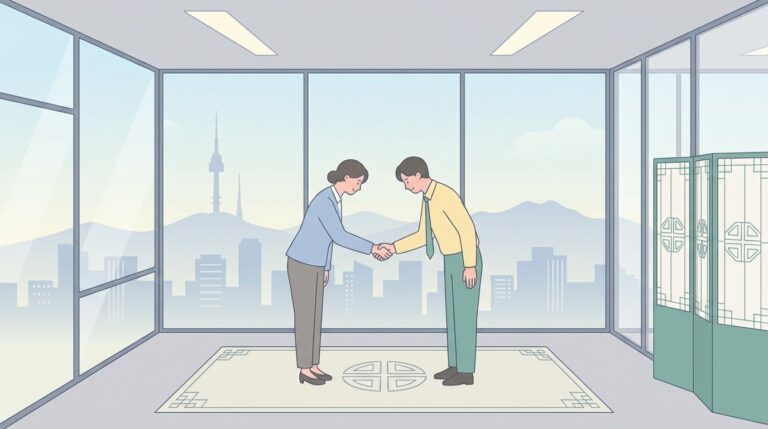
1. The Post-Negotiation Bow (인사): Do not rush to pack your laptop. Stand up, adjust your suit jacket, and bow at a steady 30-to-45-degree angle for a solid two seconds.
2. Handshake Protocol: Use a two-handed handshake (두 손 악수)—right hand clasping theirs, left hand supporting your right wrist or forearm. Maintain warm eye contact with a slightly apologetic, yet composed smile.
3. Elevator Escort (배웅 문화): Always walk the counterpart to the lobby or the elevator doors. Hold the elevator button open until the doors completely close.
4-2. The K-Drama Business Code
In dramas like Reborn Rich, corporate adversaries never storm out screaming unless they are villains destined for downfall. Respected executives maintain absolute stoicism and refined humility. A phrase like “다음에 더 좋은 인연으로 뵙지요” (Let us meet under a better destiny next time) signals emotional maturity and power.
Phase 5: Real-World Roleplay Scenario
Setting: A 15th-floor conference room in Yeouido, Seoul. After 3 rounds of price talks, Team Leader Park (박 팀장) of Hanul Tech and James Miller (Foreign Director) realize their budget margins cannot be reconciled.
- Turn 1 (박 팀장): 제임스 이사님, 저희도 마진을 최대한 양보해 드렸는데 단가 조율이 더는 힘드네요. (James Isa-nim, jeohwido majin-eul choedaehan yangbohae deuryeonneunde danga joyul-i deoneun himdeuneyo. / Director James, we made maximum concessions on margin, but unit price adjustment is no longer possible.)
🎭 한숨을 억누르며 태블릿을 닫는다. - Turn 2 (James): 박 팀장님 말씀 충분히 이해합니다. 저희 본사 기준에서도 이번 단가는 감당하기 어려운 수준이었습니다. (Bak Timjang-nim malsseum chungbunhi ihaehamnida. Jeohui bonsa gijun-eseodo ibeon danganun gamdanghagi eoryeoun sujun-ieosseumnida. / I fully understand your point, Team Leader Park. From our HQ criteria, this unit price was also difficult to absorb.)
🎭 두 손을 테이블 위에 모으고 차분하게 응대한다. - Turn 3 (박 팀장): 그럼 이번 프로젝트는 여기서 정리하는 것으로 할까요? (Geureom ibeon peurojekteuneun yeogiseo jeongrihaneun geoseuro halkkayo? / Shall we wrap up this project here then?)
🎭 조심스러운 눈빛으로 제임스의 반응을 살핀다. - Turn 4 (James): 네, 아쉽지만 이번 제안은 양사 내부 조율상 진행이 어려울 것 같습니다. (Ne, aswipjiman ibeon je-an-eun yangsa naebu joyulsang jinhaeng-i eoryeoul geot gatseumnida. / Yes, it is regrettable, but this proposal seems difficult to proceed with given both sides’ internal constraints.)
🎭 공감하듯 고개를 끄덕인다. - Turn 5 (박 팀장): 몇 달 동안 고생 많으셨는데, 성사시키지 못해 마음이 무겁습니다. (Myeot dal dongan gosaeng maneusyeonneunde, seongsasikiji mothae ma-eum-i mugeopseumnida. / You worked hard for months; my heart is heavy that we couldn’t conclude this.)
🎭 미안한 표정으로 가볍게 목례한다. - Turn 6 (James): 아닙니다. 이번에는 인연이 닿지 않았지만, 다음 기회에 꼭 함께하길 바랍니다. (Animnida. Ibeon-eneun in-yeon-i dachi anatjiman, da-eum gihwe-e kkok hamkkehagil baramnida. / Not at all. Fate didn’t touch us this time, but I sincerely hope we join hands next time.)
🎭 따뜻한 미소를 띠며 손을 내민다. - Turn 7 (박 팀장): 네, 저희도 다음 분기 신사업 때 꼭 먼저 연락드리겠습니다. 엘리베이터까지 모시겠습니다. (Ne, jeohwido da-eum bungi sinsa-eop ttae kkok meonjeo yeollakdeurigesseumnida. Ellibeiteokkaji mosigesseumnida. / Yes, we will definitely reach out to you first during next quarter’s new venture. Let me walk you to the elevator.)
🎭 일어서서 두 손으로 악수를 받는다. - Turn 8 (James): 대표팀의 노고에 진심으로 감사드립니다. (Daepyotim-ui nogoe jinsimeuro gamsadeurimnida. / Thank you sincerely for your team’s tremendous efforts.)
🎭 정중하게 30도 허리를 숙여 인사한다.
🔀 Interactive Choice Branching
What should James say when exiting the meeting room?
* Option A: “단가가 너무 비싸서 계약을 취소합니다.” (Cancel contract because price is too high.)
* Feedback (Bad): Accusatory and abrasive. Burns bridges completely.
* Option B: “오늘 시간 내주셔서 감사하며, 다음 기회에 더 좋은 프로젝트로 다시 뵙길 기대하겠습니다.” (Thank you for your time today; I look forward to meeting again on a better project.)
* Feedback (Best): Perfect poise! Affirms gratitude and future partnership.
* Option C: “죄송합니다. 저희 탓입니다.” (Sorry. It is all our fault.)
* Feedback (Risk): Overly apologetic; gives away professional status and leverage.
Phase 6: 10-Second Emotion Shadowing Drill
Practice these pause markers (/) and tone inflections:
[🤝 차분하고 진중하게 / Calm & Composed]- 아쉽지만 / 이번 제안은 / 내부 조율상 / 진행이 어려울 것 같습니다.
- (A-swip-ji-man / i-beon je-an-eun / nae-bu jo-yul-sang / jin-haeng-i eo-ryeo-ul geot gat-seum-ni-da.)
[Warm & Sincere]- 이번에는 인연이 닿지 않았지만, / 다음 기회에 / 꼭 함께하길 바랍니다.
- (I-beon-e-neun in-yeon-i da-chi a-nat-ji-man, / da-eum gi-hwe-e / kkok ham-kke-ha-gil ba-ram-ni-da.)
[🎩 깊은 존중과 예의 / Deep Respect]- 그동안 쏟아주신 / 팀원분들의 노고에 / 진심으로 감사드립니다.
- (Geu-dong-an sso-da-ju-sin / tim-won-bun-deul-ui no-go-e / jin-sim-eu-ro gam-sa-deu-rim-ni-da.)
Phase 7: K-Culture Mini Dictionary
- 인연 (In-yeon) | Predestined connection / Fate
- Usage: Used to describe relationships or timing beyond human control. It softens rejection by attributing outcomes to timing rather than incompetence.
- 노고 (No-go) | Hard toil / Devoted efforts
- Usage: Formal honorific term applied exclusively to others’ hard work. Never used to describe one’s own efforts.
- 심사숙고 (Sim-sa-suk-go) | Deep and careful contemplation
- Usage: Signals that a decision was not made lightly, showing reverence for the other party’s proposal.
- 배웅 (Bae-ung) | Seeing someone off
- Usage: The essential ritual of escorting guests to the door, elevator, or taxi after a business engagement.
Phase 8: Traveler & Professional Survival Kit
Top 3 On-the-Go Negotiation Phrases
- 다음에 다시 연락드리겠습니다. (Daeume dasi yeollakdeurigesseumnida. / We will contact you again next time.) — Clean and standard.
- 말씀해 주신 조건 검토 후 다시 말씀드리겠습니다. (Malsseumhae jusin jogeon geomto hu dasi malsseumdeurigesseumnida. / I will get back after reviewing the terms discussed.) — Great holding phrase.
- 먼 길 와주셔서 감사합니다. (Meon gil wajusyeoseo gamsadeurimnida. / Thank you for coming a long way.) — Polite hospitality wrap-up.
Editor’s Travel & Business Note
Navigating business districts in Seoul requires localized precision. Download the Naver Map Navigation App Guide to effortlessly locate corporate tower elevators and express subway exits in Yeouido or Teheran-ro. In Korean taxis, maintain business decorum and settle fares quickly via corporate credit card.
Phase 9: Think Deeper (한 발 더 깊이)
In Western contract law, negotiations are largely transactional agreements between legal entities. In Korea, business remains deeply grounded in 관계주의 (relational collectivism). A failed deal today is merely Chapter 1 of an ongoing relationship. When you say “인연이 닿지 않았다” (Our fates didn’t touch this time), you are affirming that you value the human relationship above the bottom line.
💬 Your Turn: How does your home culture handle broken business negotiations? Do you prefer direct closure or relationship-preserving diplomacy? Share your thoughts below!
Phase 10: FAQ & Common Mistakes
Q: Can I use “안 돼요” (An dwaeyo) to reject an offer in a business meeting?
A: Absolutely not in formal B2B negotiations. “안 돼요” sounds like a parent scolding a toddler. Use “진행이 어려울 것 같습니다” (It seems difficult to proceed) instead.
Q: What should I do if the other party insists after I decline?
A: Remain firm yet polite by saying: “양해를 부탁드립니다. 현 시점에서는 추가 조정이 어렵습니다.” (We ask for your understanding. Additional adjustments are difficult at this time.)
Q: Is it necessary to walk the counterpart to the elevator?
A: Yes! Skipping 배웅 (escort) after a failed negotiation is viewed as passive-aggressive or disrespectful.
🚨 Common Mistakes Board
- ❌ Mistake 1: Saying “계약을 거절합니다” (We reject the contract).
- 👉 Fix: Use “이번 건은 진행이 어렵다는 결론을 내렸습니다.”
- ❌ Mistake 2: Using “수고하셨습니다” to senior partners or clients.
- 👉 Fix: Use “노고에 감사드립니다” (Thank you for your dedicated efforts).
- ❌ Mistake 3: Abruptly ending eye contact and leaving immediately.
- 👉 Fix: Perform a two-handed handshake and accompany them to the elevator door.
Phase 11: Action Mission
- 🥉 Bronze Mission: Record yourself shadow-reading Phase 6 with the correct pauses and emotional inflections.
- 🥈 Silver Mission: Write a 2-sentence polite rejection email in Korean in our comment section below.
- 🥇 Gold Mission: Use “인연이 닿지 않았지만” in your next mock business roleplay or real professional exchange.
- 🎮 K-Culture Mission: Spot a polite rejection scene in a business K-drama (Misaeng, Itaewon Class, or Agency) and note the non-verbal cues!
Phase 12: Interactive Quiz Challenge
Q1. Fill in the blank with the most polite phrase:
“이번에는 ________ 않았지만, 다음 기회에 꼭 함께하길 바랍니다.”
(A) 계약하지
(B) 인연이 닿지
(C) 마음에 들지
🔍 Reveal Answer & Explanation
Answer: (B) 인연이 닿지
Explanation: “인연이 닿지 않았다” is the gold standard for expressing that destiny/timing did not align, preserving mutual respect without pointing fingers.
Q2. True or False:
Saying “수고하셨습니다” to an external corporate client or senior director is the most respectful way to thank them for negotiation efforts.
🔍 Reveal Answer & Explanation
Answer: False.
Explanation: “수고하셨습니다” implies evaluation from a superior to an inferior. Always use “노고에 감사드립니다” for clients and senior counterparts.







