

Mastering Cafe Interior & Layout Flow in Korea: The C1 Business Playbook
Phase 1: Empathy & Immersion Opening
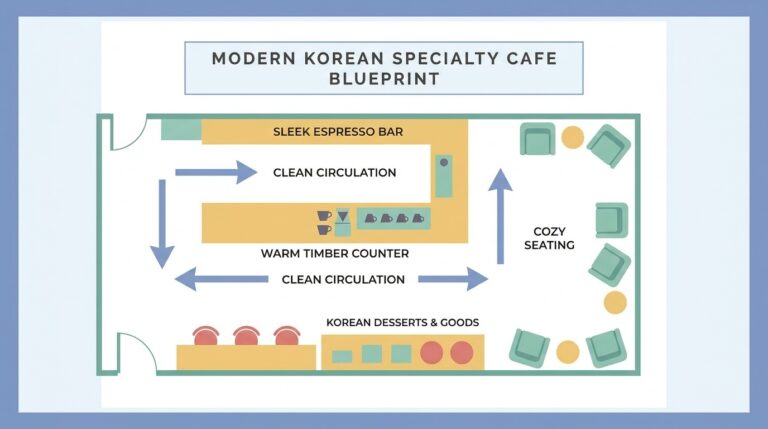
안녕하세요! 매일한글 (Daily Hangul) editor here! Have you ever stepped into an ultra-trendy cafe in Seongsu-dong or Yeonnam-dong and wondered how they seamlessly manage a line out the door while baristas glide effortlessly between espresso machines and pickup counters? Picture this: You’re launching your dream cafe concept in Seoul. You’ve curated rare single-origin beans, but during the soft opening, customers bottleneck at the register, takeaway guests bump into seated laptop users, and baristas collide while frothing milk.
In the competitive Korean cafe market—where aesthetic visual branding meets razor-sharp operational efficiency—interior design isn’t just about pretty terrazzo tiles; it’s about 동선 (dongseon – movement flow/traffic lines) and 회전율 (hoejeonyul – table turnover rate).
This guide draws directly from real-world entrepreneurial coaching and professional consulting frameworks. Mastering high-level Korean terms around spatial dynamics and layout optimization will empower you to collaborate with Korean interior architects, supervise contractors, and negotiate setups like a seasoned local entrepreneur.
Phase 2: Core Expressions Deep Dive
1. 동선이 꼬이지 않게 공간을 분리해야 해요
- Pronunciation: [Dong-seoni kko-i-ji an-ge gong-gan-eul bun-ri-hae-ya hae-yo] (Sounds like: “Dong-sun-ee co-ee-jee ahn-gay gong-gahn-ul boon-lee-hae-ya hae-yo”)
- Meaning: Literal: “We must separate the space so traffic lines do not tangle.” | Nuance: Emphasizes avoiding operational bottlenecks between baristas and customers.
- K-Culture Moment: Heard in business renovation shows like Baek Jong-won’s consulting programs when critiquing cluttered cafe floorplans.
- Editor’s Insight: 꼬이다 (kko-i-da) means “to get twisted/tangled.” In business Korean, using it with 동선 (movement flow) demonstrates an advanced grasp of spatial planning.
- Situation Spectrum: Casual ⚠️ | Semi-formal ✅ | Formal ✅
- 🤔 Think About It: How does your native language describe spatial efficiency compared to the Korean concept of “untangled movement lines”?
2. 테이크아웃 고객과 매장 이용객의 동선을 이원화합시다
- Pronunciation: [Te-i-keu-a-ut go-gaek-gwa mae-jang i-yong-gaek-ui dong-seon-eul i-won-hwa-hap-si-da] (Sounds like: “Take-out go-gaek-gwa mae-jang ee-yong-gaek-wee dong-sun-ul ee-won-hwa-hahp-she-da”)
- Meaning: Literal: “Let us dualize the movement flow of takeout customers and dine-in guests.” | Nuance: Professional architectural strategy proposing two distinct circulation paths.
- K-Culture Moment: Common in Korean startup pitches and franchise strategy meetings.
- Editor’s Insight: 이원화하다 (i-won-hwa-ha-da) elevates conversational Korean into high-level C1 executive discourse.
- Situation Spectrum: Casual 🚫 | Semi-formal ✅ | Formal ✅
- 🤔 Think About It: Why is separating fast takeout traffic from relaxed dine-in visitors so culturally crucial in fast-paced urban Korea?
3. 바 카운터의 조도와 마감재로 개방감을 살려보죠
- Pronunciation: [Ba ka-un-teo-ui jo-do-wa ma-gam-jae-ro gae-bang-gam-eul sal-lyeo-bo-jyo] (Sounds like: “Bah kah-oon-tuh-wee jo-doh-wah mah-gahm-jae-roh gae-bahng-gahm-ul sahl-lyuh-boh-jyo”)
- Meaning: Literal: “Let’s enhance the sense of openness using the bar counter’s illuminance and finishing materials.” | Nuance: Polished collaborative feedback for interior designers.
- K-Culture Moment: Featured in architecture design vlogs exploring aesthetic Seongsu cafes.
- Editor’s Insight: 조도 (illuminance/lighting level) and 개방감 (sense of openness) are essential design industry vocabulary.
- Situation Spectrum: Casual ⚠️ | Semi-formal ✅ | Formal ✅
- 🤔 Think About It: How does lighting shape customer stay duration across different cafe cultures?
Phase 3: Textbook Korean vs. Real Korean
- Situation 1: Requesting a counter layout redesign
- 📖 교과서 한국어 (Textbook): 카운터 위치를 바꾸면 손님이 더 편할 것 같습니다. (Ka-un-teo wi-chi-reul ba-kku-myeon son-nim-i deo pyeon-hal geot gat-seum-ni-da. – If we change the counter position, I think customers will be more comfortable.)
- 🗣️ 진짜 한국어 (Real Native): 주문 동선이랑 픽업존이 겹치니까 카운터를 대면형 아일랜드 구조로 빼는 게 낫겠어요. (Ju-mun dong-seon-i-rang pik-eop-jon-i gyeop-chi-ni-kka ka-un-teo-reul dae-myeon-hyeong a-il-laen-deu gu-jo-ro ppae-neun ge nat-get-seo-yo. – Since the ordering path and pickup zone overlap, it’s better to pull the counter out into an open island layout.)
- 💡 Why the difference? C1 professionals specify the exact structural arrangement (대면형 아일랜드 구조) rather than using generic adjectives like 편하다 (comfortable).
- Situation 2: Balancing table turnover and customer comfort
- 📖 교과서 한국어 (Textbook): 손님이 빨리 나가도록 의자를 불편하게 만듭시다. (Son-nim-i ppal-li na-ga-do-rok ui-ja-reul bul-pyeon-ha-ge man-deup-si-da. – Let’s make chairs uncomfortable so guests leave quickly.)
- 🗣️ 진짜 한국어 (Real Native): 홀 회전율을 고려해서 2인석 위주로 배치하고, 콘센트 위치로 체류 시간을 조율하죠. (Hol hoe-jeon-yul-eul go-ryeo-hae-seo i-in-seok wi-ju-ro bae-chi-ha-go, kon-sen-teu wi-chi-ro che-ryu si-gan-eul jo-yul-ha-jyo. – Considering floor turnover, let’s arrange mainly 2-seater tables and calibrate dwell time via power outlet placement.)
- 💡 Why the difference? Modern Korean cafe strategy avoids overt hostility toward “cagongjok” (laptop workers) by subtly managing 체류 시간 (dwell time) through intentional electrical outlet layouts.
Phase 4: K-Culture Deep Dive & Non-Verbal Manners
4-1. Nunchi & Spatial Etiquette in Design Meetings
When reviewing 2D blueprints (도면 – domyeon) with Korean contractors (소장님 – sojangnim or 실장님 – siljangnim), never mark direct “X” marks in red pen over their sketches without contextual phrasing. Use polite softening markers such as “소장님, 현장 작업성도 중요하지만, 실무자 입장에서 이 부분 동선 간섭이 조금 우려되는데요…” (Sir, while on-site workability is vital, from an operator’s view I’m slightly concerned about movement interference here…). Nodding rhythmically while tracking the blueprint with a closed stylus signals collaborative respect rather than confrontation.
4-2. Cultural Code: The Psychology of “Instagrammable” Zoning (인스타그래머블 포토존)
In Korea, cafe interior flow is fundamentally split into three zones: the Working Zone (Barista Flow), the Circulation Zone (Order/Pickup/Restroom Path), and the “Photo Zone” (포토존). If your photo spot crosses the primary barista transit line, spill accidents and customer friction skyrocket. Korean cafe architects prioritize unbroken sightlines (시야 확보) toward signature accent walls.
Phase 5: Real-World Roleplay Scenario
- Setting: An interior design studio in Gangnam. You are discussing final 3D renderings with Principal Designer Park Min-woo.
-
Turn 1 (Designer Park): 3D 렌더링 시안 나왔습니다. 전체적으로 미니멀한 인더스트리얼 콘셉트입니다. (3D ren-deo-ring si-an na-wat-seum-ni-da. Jeon-che-jeok-eu-ro mi-ni-meol-han in-deo-seu-teu-ri-eol kon-sep-teu-im-ni-da. – The 3D render draft is ready. Overall, it’s a minimal industrial concept.)
🎭 Leaning over the tablet while pointing at the screen. - Turn 2 (You): 렌더링 무드는 훌륭한데, 에스프레소 머신과 퇴식구 동선이 너무 붙어 있는 것 같아요. (Ren-deo-ring mu-deu-neun hul-lyung-han-de, e-seu-peu-re-so meo-sin-gwa toe-sik-gu dong-seon-i neo-mu bu-teo it-neun geot gat-a-yo. – The mood is great, but the espresso machine and return counter paths seem too tight.)
🎭 Tapping the pickup counter boundary on the plan. - Turn 3 (Designer Park): 아, 공간 효율을 극대화하려고 퇴식구를 머신 우측에 배치했습니다. (A, gong-gan hyo-yul-eul geuk-dae-hwa-ha-ryeo-go toe-sik-gu-reul meo-sin u-cheuk-e bae-chi-haet-seum-ni-da. – Ah, to maximize space efficiency, I placed the return zone to the right of the machine.)
🎭 Adjusting glasses thoughtfully. - Turn 4 (You): 피크 시간대에는 바리스타 작업 반경과 고객 퇴식 동선이 간섭을 일으키지 않을까요? (Pi-keu si-gan-dae-e-neun ba-ri-seu-ta jak-eop ban-gyeong-gwa go-gaek toe-sik dong-seon-i gan-seob-eul il-eu-ki-ji an-eul-kka-yo? – During peak hours, won’t the barista’s workspace interfere with the customer tray return flow?)
🎭 Speaking with calm, consultative concern. - Turn 5 (Designer Park): 일리가 있네요. 그럼 퇴식구를 입구 쪽 리턴 테이블로 완전히 뺄까요? (Il-li-ga it-ne-yo. Geu-reom toe-sik-gu-reul ip-gu jjok ri-teon te-i-beul-ro wan-jeon-hi ppael-kka-yo? – That makes sense. Should we move the return tray completely toward the entrance return table?)
🎭 Highlighting the entrance corridor with a stylus. - Turn 6 (You): 네, 그렇게 하면 제조 공간 위생도 지키고 홀 회전도 훨씬 매끄러울 겁니다. (Ne, geu-reoh-ge ha-myeon je-jo gong-gan wi-saeng-do ji-ki-go hol hoe-jeon-do hwol-ssin mae-kkeu-reo-ul geom-ni-da. – Yes, doing so will protect prep hygiene and make floor turnover much smoother.)
🎭 Nodding with decisive confidence. - Turn 7 (Designer Park): 좋습니다. 그리고 바 테이블 조도는 3000K 전구색 펜던트로 맞추겠습니다. (Jot-seum-ni-da. Geu-ri-go ba te-i-beul jo-do-neun sam-cheon-K jeon-gu-saek pen-deon-teu-ro mat-chu-get-seum-ni-da. – Excellent. I will also set the bar counter lighting to a warm 3000K pendant.)
🎭 Noting down specifications. - Turn 8 (You): 완벽하네요. 수정 도면 나오는 대로 전기 배선 설비팀에 공유 부탁드립니다. (Wan-byeok-ha-ne-yo. Su-jeong do-myeon na-o-neun dae-ro jeon-gi bae-seon seol-bi-tim-e gong-yu bu-tak-deu-rim-ni-da. – Perfect. Please share the revised blueprint with the electrical wiring team once ready.)
🎭 Shaking hands politely.
🔀 Interactive Decision Point
How would you respond if the designer suggests putting 4-seater lounge sofas across your tiny 15-pyeong shopfront?
– Option A: “평수 대비 회전율 저하가 심각할 것 같으니, 2인 모듈형 테이블로 교체해 주세요.” (Best: Professionally articulates turnover risk vs footprint with modular solutions.)
– Option B: “소파가 너무 크니까 그냥 의자 아무거나 싼 걸로 바꿔요.” (Bad: Emotionally dismissive and compromises design identity without professional reasoning.)
– Option C: “디자이너님이 원하시면 소파로 가되 커피 가격을 두 배로 올리죠.” (Risk: Unrealistic business trade-off that damages market viability.)
Phase 6: 10-Second Emotion Shadowing Drill
[👔 단호하고 전문적으로 / Resolute & Executive]
피크 타임 병목을 막으려면 / 주문과 픽업 라인을 확실하게 분리해야 합니다.
(Pi-keu ta-im byeong-mok-eul mag-eu-ryeo-myeon / ju-mun-gwa pik-eop ra-in-eul hwak-sil-ha-ge bun-ri-hae-ya ham-ni-da.)-
[💡 부드럽게 설득하며 / Persuasive & Collaborative]
아일랜드 바 구조를 적용하면 / 바리스타 동선 효율이 / 최소 삼십 퍼센트는 개선될 거예요.
(A-il-laen-deu ba gu-jo-reul jeok-yong-ha-myeon / ba-ri-seu-ta dong-seon hyo-yul-i / choe-so sam-sip peo-sen-teu-neun gae-seon-doel geo-ye-yo.) -
[📐 꼼꼼하게 점검하며 / Analytical & Detail-Oriented]
퇴식구 위치가 협소하니 / 리턴 카운터 하부에 / 분리수거 빌트인 수납을 짜 넣죠.
(Toe-sik-gu wi-chi-ga hyeop-so-ha-ni / ri-teon ka-un-teo ha-bu-e / bun-ri-su-geo bil-teu-in su-nab-eul jja neot-jyo.)
Phase 7: K-Culture Mini Dictionary
- 동선 간섭 (Dongseon Ganseop) | Traffic line interference/clash | Crucial terminology used when customer footpaths collide with staff preparation routes.
- 개방감 (Gaebanggam) | Sense of spaciousness / visual openness | Highly valued spatial quality in dense Seoul commercial rentals using low partitions and glass finishes.
- 체류 시간 (Cheryu Sigan) | Dwell time / length of stay | The duration a customer occupies a seat; directly managed via seating comfort and Wi-Fi access.
- 마감재 (Magamjae) | Finishing materials | Surfaces like micro-cement, timber, stainless steel, or stone specified during cafe interior contracting.
Phase 8: Traveler & Entrepreneur Survival Kit
-
Top 3 Survival Expressions:
- 도면상 콘센트 매립 위치 확인 부탁드립니다. (Do-myeon-sang kon-sen-teu mae-rip wi-chi hwak-in bu-tak-deu-rim-ni-da. – Please check the embedded socket locations on the blueprint.) -> Pro Tip: Use this to ensure laptop plugs don’t look messy.
- 주방 방수 공사와 배수 구배는 확실히 잡혔나요? (Ju-bang bang-su gong-sa-wa bae-su gu-bae-neun hwak-sil-hi jap-hyeot-na-yo? – Are the kitchen waterproofing and drainage slopes properly finalized?) -> Pro Tip: Crucial question preventing costly leaks under commercial espresso bars.
- 쇼케이스 조명 색온도를 주백색으로 맞춰주세요. (Syo-ke-i-seu jo-myeong saek-on-do-reul ju-baek-saek-eu-ro mat-chwo-ju-se-yo. – Please set the showcase display lighting color temperature to neutral white.) -> Pro Tip: Highlights dessert freshness naturally.
- Editor’s Travel & Field Note: Download the official 네이버 지도 앱 (Naver Map App) to search for “인테리어 자재 거리” (Interior Material District) around Euljiro 4-ga. When paying contractors or material shops, verify tax invoicing through your corporate business registration number (사업자등록번호).
Phase 9: A Step Deeper (Reflective Essay)
In Korean cafe culture, space is never neutral—it is a live choreography between communal consideration (배려) and rapid efficiency (빨리빨리). Unlike spacious suburban cafes in Western contexts, Seoul’s urban density demands that every square centimeter perform multiple functions. Designing a cafe floorplan in Korea requires you to balance the introverted customer’s desire for privacy with the business imperative of brisk table turnover. When you master spatial Korean terms, you aren’t just learning architectural jargon; you are decoding the subtle social rhythm of contemporary Korean urban life.
💬 Your Turn: If you opened a boutique coffee bar in Seoul, would you prioritize high-turnover bar seating or relaxed lounge booths? Share your strategy in the comments below!
Phase 10: FAQ & Common Mistakes
Q: What is the exact difference between 동선 (dongseon) and 이동 경로 (idong gyeongno)?
A: 이동 경로 simply describes the physical route taken between point A and point B. In contrast, 동선 is a specialized operational term referring to planned spatial circulation lines optimized for efficiency, safety, and business operations.
Q: Can I use the term 꼬이다 (kko-i-da) in formal contractor meetings?
A: Yes! When used as 동선이 꼬이다 (circulation is tangled/interfering), it is standard industry terminology across Korean design, logistics, and architecture meetings.
Q: How do Korean cafe owners formally refer to laptop-working customers?
A: While slang uses 카공족 (cagongjok), in professional layout design discussions, refer to them formally as 장기 체류 고객 (long-stay customers) or 노트북 이용객 (laptop users).
🚨 Common Mistakes Alert
- Mistake: Using “길 (road/way)” instead of “동선 (dongseon)” in design blueprints. -> Correct Action: Say 고객 동선 (customer movement flow) or 주방 동선 (kitchen workflow).
- Mistake: Asking contractors to make a place “예쁘게 (pretty)” without architectural specifics. -> Correct Action: Specify 마감재 톤앤매너 (finishing material tone-and-manner) and 간접 조명 연출 (indirect mood lighting).
- Mistake: Confusing 퇴식구 (tray return counter) with 픽업존 (beverage pickup zone). -> Correct Action: Keep these terms strictly distinct to avoid cross-contamination in drawings.
Phase 11: Action Mission & Community Challenge
- 🥉 Bronze Mission (Self-Practice): Draft a hand-drawn sketch of your ideal 20-seat cafe counter. Label 동선, 주문대, 픽업존, and 퇴식구 in Hangul.
- 🥈 Silver Mission (Social Share): Visit a local cafe today, identify one area where 동선 간섭 occurs, and write a one-sentence Korean critique in our community forum.
- 🥇 Gold Mission (Live Application): Watch a Korean cafe opening vlog on YouTube and identify at least three C1 spatial terms (조도, 마감재, 회전율) used by the owners.
Phase 12: Interactive Quiz Challenge
- Situation Judgment: During morning rush hour, pickup customers block the entrance. Which phrase should you say to your architect?
- A) 문을 더 크게 열어주세요.
- B) 테이크아웃 전용 픽업 윈도우를 파사드에 별도로 신설합시다.
- C) 손님들에게 바깥에 서 있으라고 팻말을 붙이죠.
- Fill-in-the-Blank: 매장 면적이 좁을수록 거울과 낮은 파티션을 활용해 (_____)을 확보해야 답답하지 않습니다.
- (Hint: A noun meaning ‘feeling of spaciousness/openness’)
- True / False: In Korean cafe business discourse, 카공족 동선 관리 means completely banning electrical outlets across all seats.
🔍 Click to Reveal Answers & Detailed Explanations
- Answer: B | 테이크아웃 전용 픽업 윈도우를 파사드에 별도로 신설합시다. (Creating a dedicated street-facing takeout window separates internal and external flows seamlessly.)
- Answer: 개방감 (Gaebanggam) | Low partitions and mirrors amplify visual openness in compact commercial spaces.
- Answer: False | Modern cafe operators strategically locate power outlets at communal high-top tables while leaving small circular tables outlet-free to balance laptop users and rapid turnover without conflict.







