

Phase 1: Empathy (Story-Driven Opening)
안녕하세요! 매일한글 에디터입니다.
Imagine stepping out of Jeju International Airport into the breezy island air. You can practically taste the fresh tangerine juice, and the coastal highway from your favorite K-drama like Our Blues or Welcome to Samdal-ri is calling your name! But as soon as you step up to the rental car counter, your heart starts pounding. The staff smiles and asks, “어떻게 도와드릴까요? (Eotteoke dowadeurilkkayo? – How can I help you?)” and suddenly your mind goes blank. Is it daeyeo? Imdae? Or just rent?
Don’t worry, you are not alone! Many of our elementary (A2) learners share this exact panic. The wonderful news is that native Koreans use surprisingly simple, loanword-friendly expressions at rental desks. By the end of this 5-minute guide—curated from hundreds of real traveler experiences—you’ll walk up to any rental counter in Seoul, Busan, or Jeju with absolute confidence and cruise the open roads like a true local!
Phase 2: Top 3 Core Expressions Deep-Dive
1. 차 렌트하고 싶은데요 (Cha renteuhago sipeundeyo)
- Pronunciation: [Cha ren-teu-ha-go shi-peun-de-yo] (Think of ‘Cha’ like a cup of chai tea, and ‘renteu’ like ‘rent’ with a soft ‘eu’ sound at the end)
- Meaning: Literal: “I want to rent a car, but/and…” ➔ Real Nuance: “Hi, I’d like to rent a car, please.”
- K-Culture Moment: The magic is in the ending -는데요 (-neundeyo). Rather than bluntly demanding “I want a car,” this trailing ending softens your voice and invites the staff to guide you smoothly.
- Editor’s Insight: You will hear Koreans say 렌트 (renteu) far more often than formal Sino-Korean words like 대여 (daeyeo) in everyday conversation.
- Situation Spectrum: Casual ⚠️ | Semi-formal ✅ | Formal ✅
- 🤔 Think About It: In English, we often say “I need a car for 3 days.” Why do you think Korean uses a softer trailing ending like -neundeyo instead of a direct statement?
2. 예약 안 했는데, 오늘 가능한 차 있나요? (Yeyak an haenneunde, oneul ganeunghan cha innayo?)
- Pronunciation: [Ye-yak an haen-neun-de, oh-neul ga-neung-han cha in-na-yo?]
- Meaning: Literal: “Did not reserve, today possible car is there?” ➔ Real Nuance: “I don’t have a reservation, do you have any cars available today?”
- K-Culture Moment: Walk-in travelers in popular spots often use this exact line when spontaneous road trips happen.
- Editor’s Insight: Breaking it down: 예약 안 했는데 (I didn’t reserve) + 가능한 차 (available car) + 있나요? (is there?). Three easy A2 puzzle pieces combined into one powerhouse sentence!
- Situation Spectrum: Casual ⚠️ | Semi-formal ✅ | Formal ✅
- 🤔 Think About It: Notice how “안 (an)” comes right before the verb to make it negative. How does this compare to how you form negatives in your native language?
3. 며칠 동안 빌릴 수 있어요? (Myeochil dongan billil su isseoyo?)
- Pronunciation: [Myeo-chil dong-an bil-lil soo ee-sseo-yo?]
- Meaning: Literal: “How many days during can borrow?” ➔ Real Nuance: “For how many days can I rent it?”
- K-Culture Moment: You’ve found a car you love and want to extend your stay along the romantic Gangwon coastal road.
- Editor’s Insight: The verb 빌리다 (billida) means ‘to borrow’ or ‘to rent.’ Combining it with -(으)ㄹ 수 있어요 (-[eu]l su isseoyo) creates a natural way to ask about possibility and flexibility.
- Situation Spectrum: Casual ⚠️ | Semi-formal ✅ | Formal ✅
- 🤔 Think About It: Korean uses different counting words for days (하루, 이틀, 며칠). Asking with “며칠 (how many days)” keeps it effortless when you aren’t sure of exact dates yet.
Phase 3: Textbook Korean vs. Real Korean
Situation A: Expressing that you want to rent a vehicle
- 📖 교과서 한국어 (Textbook): 자동차를 대여하기를 희망합니다. (Jadongchareul daeyohagireul huimanghamnida.)
- 🗣️ 진짜 한국어 (Real-life): 차 렌트하고 싶은데요. (Cha renteuhago sipeundeyo.)
- 💡 왜 다를까? Textbook Korean often relies on hyper-formal Sino-Korean nouns (대여 – daeyeo). In modern Korea, everyday conversational transactions prefer the smooth loanword 렌트 (renteu) paired with friendly polite speech.
Situation B: Saying you arrived without a prior booking
- 📖 교과서 한국어 (Textbook): 저는 사전에 예약하지 않았습니다. (Jeoneun sajeone yeyakhaji anatseumnida.)
- 🗣️ 진짜 한국어 (Real-life): 예약은 따로 안 했어요. (Yeyageun ttaro an haesseoyo.)
- 💡 왜 다를까? Adding the word 따로 (ttaro – separately/specifically) softens the fact that you walked in without booking, making your statement sound humble and natural.
Phase 4: K-Culture Deep Dive & Non-Verbal Manners
4-1. 눈치 (Nunchi) & Gestures at the Counter
When handing over your International Driving Permit (IDP), passport, and credit card, always present them using both hands (두 손) with a gentle head nod. This non-verbal gesture instantly shows mutual respect and ensures a super warm reception from the rental staff.
4-2. The Joy of Korean Rest Stops (휴게소 – Hyugeso)
Once you get your rental car, the real Korean road trip begins! Driving in Korea isn’t just about reaching your destination; it’s about stopping at a highway rest stop (휴게소 – Hyugeso). Grab iconic snacks like Sotteok-Sotteok (skewered sausage and rice cakes brushed with spicy-sweet sauce) and walnut cakes (Hodu-gwaja), just like Korean celebrities do on road-trip variety shows!
Phase 5: Real-Life Roleplay Scenario
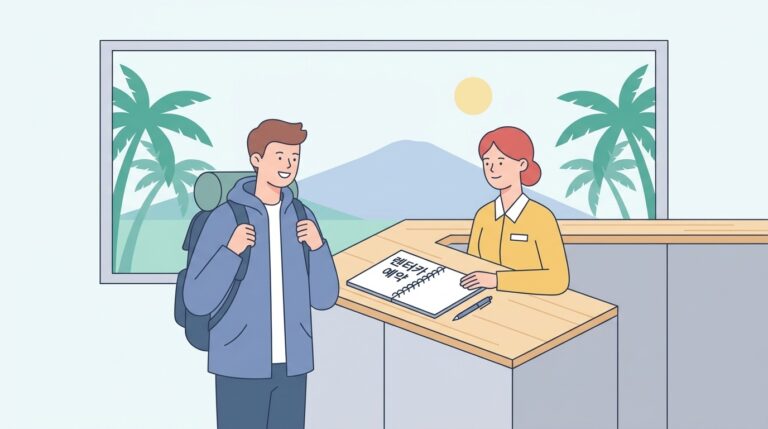
Setting: Jeju Island Rental Car Service Desk. Friendly rental coordinator Minji meets traveler Alex.
- Minji (Staff): 어서 오세요! 예약하고 오셨나요? 🎭 smiling warmly with hands clasped
(Eoseo oseyo! Yeyakhago osyeonnayo? / Welcome! Did you make a reservation?) - Alex (Traveler): 안녕하세요! 예약은 따로 안 했는데요, 차 렌트하고 싶어서요. 🎭 nodding politely
(Annyeonghaseyo! Yeyageun ttaro an haenneundeyo, cha renteuhago sipeoseoyo. / Hello! I didn’t make a reservation separately, but I’d like to rent a car.) - Minji (Staff): 네! 오늘 이용 가능한 준중형 차가 있습니다. 며칠 동안 빌리시겠어요? 🎭 typing on keyboard
(Ne! Oneul iyong ganeunghan junjunghyeong chaga itseumnida. Myeochil dongan billisigesseoyo? / Yes! We have a compact car available today. How many days will you rent it?) - Alex (Traveler): 이틀 동안 빌리고 싶어요. 보험도 포함인가요? 🎭 tilting head curiously
(Iteul dongan billigo sipeoyo. Boheomdo pohamingayo? / I want to rent it for 2 days. Is insurance included?) - Minji (Staff): 기본 보험 포함이고, 완전자차는 추가하실 수 있어요. 운전면허증 보여주시겠어요? 🎭 pointing to the screen menu
(Gibon boheom pohamigo, wanjeonjachaneun chugahasil su isseoyo. Unjeonmyeonheojeung boyeojusigesseoyo? / Basic insurance is included, and full coverage can be added. Could you show me your driver’s license?) - Alex (Traveler): 네, 여기 국제운전면허증이랑 여권이에요. 🎭 handing over documents with both hands
(Ne, yeogi gukje-unjeon-myeonheojeung-irang yeogwon-ieyo. / Yes, here are my International Driving Permit and passport.) - Minji (Staff): 감사합니다. 서류 확인 후 바로 차량 안내해 드릴게요! 🎭 bowing slightly
(Gamsahamnida. Seoryu hwagin hu baro charyang annaehae deurilgeyo! / Thank you. After checking the papers, I will guide you to your vehicle right away!) - Alex (Traveler): 감사합니다! 잘 부탁드립니다. 🎭 giving a big relieved smile
(Gamsahamnida! Jal butakdeurimnida. / Thank you! I look forward to your help.)
🔀 Interactive Choice Point
What should Alex say if he wants to add full coverage insurance right away?
- Option A: 완전자차 보험으로 해주세요. (Wanjeonjacha boheomeuro hae-juseyo.)
- 🏆 Feedback [BEST]: Perfect! Clear, polite, and directly requests zero-deductible full coverage (완전자차).
- Option B: 차 망가지면 어떡해요? (Cha manggajimyeon eotteokhaeyo?)
- ⚠️ Feedback [RISK]: Grammatically correct (“What happens if the car breaks?”), but sounds overly dramatic and vague at a payment desk.
- Option C: 보험 싫어요. (Boheom sileoyo.)
- 🚫 Feedback [BAD]: Too blunt and informal! In Korea, driving without basic CDW coverage is extremely risky.
Phase 6: 10-Second Emotion Shadowing Drill
Practice these lines out loud with the emotional cues and natural breathing pauses (/):
[😊 Friendly & Hopeful]안녕하세요! / 차 렌트하고 싶은데요. (Annyeonghaseyo! / Cha renteuhago sipeundeyo.)[🤔 Calm & Inquiring]예약 안 했는데, / 오늘 가능한 차 있나요? (Yeyak an haenneunde, / oneul ganeunghan cha innayo?)[🤝 Polite & Confident]이틀 동안 / 빌리고 싶어요. (Iteul dongan / billigo sipeoyo.)
Phase 7: K-Culture Mini Dictionary
- 렌터카 (Renteoka): Rental car. Widely used on signs, airport booths, and navigation systems.
- 국제운전면허증 (Gukje-unjeon-myeonheojeung): International Driving Permit (IDP). Required alongside your physical passport.
- 자차보험 (Jacha-boheom): Collision Damage Waiver (CDW). Often categorized into 일반자차 (Standard) and 완전자차 (Full/Zero deductible).
- 반납 (Bannap): Returning/drop-off of the rented item. (e.g., 반납 시간 – Return time).
Phase 8: Traveler’s Survival Kit
TOP 3 Survival Phrases
- 네비게이션 영어로 되나요? (Nebigeisyeon yeong-eoro doenayo?): “Can the navigation system be set to English?”
- Pro Tip: Most modern Korean rental cars have English UI settings built into the dashboard screen.
- 기름은 얼마나 채워서 반납해요? (Gireumeun eolmana chaewoseo bannaphaeyo?): “How much fuel should be filled upon return?”
- Pro Tip: Korea operates on a “return with the same fuel level as picked up” rule.
- 하이패스 카드 포함되어 있나요? (Hai-paeseu kadeu pohamdoe-eo innayo?): “Is a Hi-pass toll card included?”
- Pro Tip: Hi-pass lets you zoom through expressway toll booths automatically.
Editor’s Travel Note
- Install the Naver Map app or KakaoMap app beforehand because international apps like Google Maps do not offer full turn-by-turn driving navigation in South Korea due to national map data regulations.
Phase 9: One Step Deeper (Cultural Reflection)
In Korean society, communication is built on maintaining relational harmony. When stating a wish at a service counter, speakers rarely end their sentences with abrupt factual endings. By attaching -는데요 (-neundeyo), you gently leave room for the other person to respond and assist without feeling pressured. This small grammatical nuance reflects the collectivist empathy woven deeply into the Korean language.
💬 Your Turn: Have you ever noticed a similar polite phrasing habit in your own native culture? Share your thoughts in the comments below!
Phase 10: FAQ & Common Mistakes
Q: Can I rent a car in Korea with just my home country driver’s license?
A: No. Foreign tourists must present their physical passport, home country physical license, AND a valid International Driving Permit (IDP) issued under the Geneva or Vienna Convention.
Q: What is the age requirement to rent a car in South Korea?
A: Generally, you must be at least 21 years old and have held your driver’s license for more than one year (some larger vehicles require age 26+).
Q: Can I use credit cards or cash for car rental deposits?
A: Most rental companies strictly require an international credit card under the primary driver’s legal name for security deposit holds.
🚨 Common Mistakes Alert
- Saying ‘차 빌려줘’ (Cha billyeojwo): This is very informal child-like speech. Always use 차 렌트하고 싶은데요 with staff.
- Forgetting physical paper IDP: Digital or PDF copies on your smartphone will be rejected by Korean rental companies.
- Entering the blue road lane in cities: Solid blue lanes are exclusively reserved for city buses during designated hours.
Phase 11: Action Missions
- 🥉 Bronze Mission (Solo): Repeat the 10-second emotion shadowing sentences 3 times in front of a mirror.
- 🥈 Silver Mission (Social): Share your favorite Korean road trip destination in our comment section using the word “렌터카”.
- 🥇 Gold Mission (Real-world): Step into a rental agency or write an inquiry message: “차 렌트하고 싶은데요!”
- 🎮 K-Culture Mission: Watch an episode of a Korean travel variety show (like 2 Days & 1 Night) and spot when members shout “출발! (Chulbal – Let’s depart!)” inside their rental van.
Phase 12: Interactive Quiz Challenge
1. Situation Check: You walk up to a car rental desk in Busan. What is the most polite and natural way to say you want to rent a car?
* (A) 차 빌려라! (Cha billyeora!)
* (B) 차 렌트하고 싶은데요. (Cha renteuhago sipeundeyo.)
* (C) 자동차 가져갈게. (Jadongcha gajyeogalke.)
2. Fill in the Blank: 예약 안 했는데, 오늘 ________ 차 있나요? (I didn’t book, is there an available car today?)
* (Hint: Word meaning ‘possible / available’)
3. True or False: In Korea, saying “-는데요” at the end of your sentence is considered rude and demanding.
* (True / False)
👉 Click to reveal answers & explanations!
- Answer: (B) – “차 렌트하고 싶은데요” is polite, natural, and standard for service counters.
- Answer: 가능한 (ganeunghan) – “가능한 차 (available/possible car)”.
- Answer: False – “-는데요” actually softens your tone and makes requests sound very considerate and natural!







