

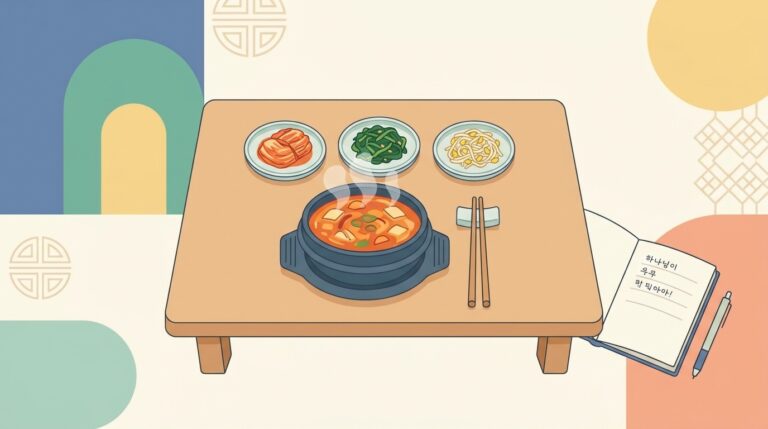
Master Korean Dining Etiquette: Who Eats First at a Korean Table?
Phase 1: Empathy & Storytelling
안녕하세요! 매일한글 에디터입니다. (Hello! I’m your Daily Hangul Editor!)
Picture this scene straight out of a K-drama: You are sitting at an authentic Korean restaurant with your Korean friend’s parents or your new coworkers. The table is bursting with sizzling samgyeopsal (pork belly), steaming bowls of doenjang-jjigae (soybean paste stew), and colorful side dishes. The aroma is heavenly, your stomach is growling loudly, and without thinking twice, you pick up your metal chopsticks and reach for the crispiest piece of meat.
Suddenly, the entire table goes quiet. A subtle chill runs through the air. You look up, and everyone is staring at their laps, waiting for the grandfather or the team leader to even pick up his spoon. You freeze mid-air with your chopsticks shaking—what just went wrong?
If you have ever felt confused or anxious about Korean table manners, take a deep breath. You are definitely not alone! This is one of the most common cultural stumbling blocks for foreign learners. In Korea, food isn’t just fuel; sharing a meal is an expression of social harmony, care, and respect. In this friendly guide based on feedback from over 1,000 beginner learners, you will master the exact words and body language needed to navigate dining with elders like a polished local.
Phase 2: Top 3 Essential Expressions
Here are the three golden phrases you need at any Korean dining table with seniors or elders.
1. 먼저 드세요 (Meonjeo deuseyo)
- Pronunciation: [Meon-jeo deu-se-yo] (Think of ‘Mun’ like ‘Monday’, ‘jeo’ like ‘jump’, ‘deu’ like ‘dirt’ without the ‘rt’, and ‘se-yo’ like ‘say-yo’.)
- Meaning: Literal: “Eat first.” / Real Nuance: “Please, after you / Please go ahead and eat first!”
- K-Culture Moment: In family dramas, when the eldest daughter-in-law sets down the fresh bowl of rice before her father-in-law and gently gestures with two hands.
- Editor’s Insight: This phrase shows that you are actively waiting for them out of respect, rather than simply being passive.
- Situation Spectrum:
- Casual (with close peers): 🚫 (Use ‘먼저 먹어’ instead)
- Semi-formal (colleagues/older friends): ✅
- Formal (in-laws/executives/grandparents): ✅
- 🤔 Think About It: In your culture, do people wait for the host or the oldest person to take the first bite, or is it normal to dig in as soon as food arrives?
2. 잘 먹겠습니다 (Jal meokgetseumnida)
- Pronunciation: [Jal meok-get-seum-ni-da] (Pronounce ‘Jal’ like ‘Jalapeno’ without ‘-peno’, ‘meok’ like ‘muck’, and ‘seumnida’ like ‘soom-nee-da’.)
- Meaning: Literal: “I will eat well.” / Real Nuance: “Thank you for the delicious meal / Let’s eat!”
- K-Culture Moment: Whenever K-pop idols sit down for a variety show feast or a meal cooked by their leader, they clap their hands together and cheer this out loud.
- Editor’s Insight: Saying this shows immense gratitude to the person who prepared or paid for the meal. Say it right before you pick up your spoon!
- Situation Spectrum:
- Casual: ⚠️ (Use ‘잘 먹을게’ with close same-age friends)
- Semi-formal: ✅
- Formal: ✅
- 🤔 Think About It: Why does Korean emphasize expressing gratitude before tasting whether the food is good or not?
3. 맛있게 드세요 (Mas-itge deuseyo)
- Pronunciation: [Ma-sit-ge deu-se-yo] (Think of ‘Ma’ like ‘Mom’, ‘sit’ like ‘seat’, ‘ge’ like ‘get’ without the ‘t’, and ‘deuseyo’.)
- Meaning: Literal: “Eat deliciously.” / Real Nuance: “Bon appétit / Enjoy your meal!”
- K-Culture Moment: The restaurant owner serving a hot stone bowl of bibimbap with a warm smile.
- Editor’s Insight: You say this to the people dining with you, especially if you are serving them or starting to eat together.
- Situation Spectrum:
- Casual: 🚫 (Use ‘맛있게 먹어’)
- Semi-formal: ✅
- Formal: ✅
- 🤔 Think About It: How is saying “Eat deliciously” different from English “Enjoy your meal”?
Phase 3: Textbook Korean vs. Real Korean
Let’s compare robotic textbook lines with what real Koreans say at the dinner table.
Situation 1: Telling an elder to start their meal
- 📖 Textbook Korean: 진지를 드십시오. (Jinji-reul deusipsio.)
- 🗣️ Real Korean: 먼저 드세요! (Meonjeo deuseyo!) or 식사하세요! (Siksahaseyo!)
- 💡 Why is it different? ‘진지를 드십시오’ is hyper-archaic and sounds like you are acting in a historical Joseon dynasty drama. In real modern life, a polite ‘먼저 드세요’ is warm, respectful, and natural.
Situation 2: Saying thanks before eating
- 📖 Textbook Korean: 감사히 먹겠습니다. (Gamsahi meokgetseumnida.)
- 🗣️ Real Korean: 잘 먹겠습니다! (Jal meokgetseumnida!)
- 💡 Why is it different? While ‘감사히 먹겠습니다’ is grammatically correct and very formal, ‘잘 먹겠습니다’ is the universal, natural rhythm spoken across all Korean dining tables.
Phase 4: K-Culture Deep Dive & Non-Verbal Manners
4-1. 눈치 (Nunchi) & Table Gestures
Korean dining etiquette is 50% language and 50% non-verbal radar (Nunchi). Keep these three rules in mind:
1. The Spoon Rule: Keep your hands in your lap until the oldest person at the table lifts their spoon and takes the first bite or sip of soup.
2. The Two-Hand Rule: When passing water, side dishes, or napkins to an elder, always use both hands (or support your right forearm with your left hand).
3. The Drinking Angle: When drinking alcohol or water in front of an elder, turn your torso slightly to the side and shield your cup with your free hand.
4-2. Cultural Code: The Warmth of Sharing
In Western dining, everyone usually orders their own plate. In Korea, most meals feature communal stews and shared banchan (side dishes). Waiting for elders isn’t about rigid oppression; it stems from the Confucian concept of Hyo (filial piety) and showing gratitude to the generation that worked hard to provide the feast.
Phase 5: Real-World Roleplay Scenario
Setting: You are at a traditional Korean barbecue restaurant in Mapo, Seoul, having dinner with your Korean coworker Minjun and the respected Team Leader Park (50s).
- Turn 1 (Minjun): 🎭 Placing sizzling galbi on the grill rack
고기 다 익었어요! (Gogi da ikeosseoyo! – The meat is ready!) - Turn 2 (You): 🎭 Looking toward Team Leader Park politely with your hands on your lap
부장님, 먼저 드세요. (Bujangnim, meonjeo deuseyo. – Team leader, please eat first.) - Turn 3 (Team Leader Park): 🎭 Smiling warmly and lifting his chopsticks
고마워요! 다들 배고팠지? (Gomawoyo! Dadeul baegopatji? – Thank you! Everyone was hungry, right?) - Turn 4 (Team Leader Park): 🎭 Taking the first bite of barbecue
자, 맛있게 먹어요! (Ja, mas-itge meogeoyo! – Alright, enjoy your food everyone!) - Turn 5 (You & Minjun): 🎭 Slightly bowing heads together
잘 먹겠습니다! (Jal meokgetseumnida! – Thank you for the meal!) - Turn 6 (You): 🎭 Handing the water bottle using both hands
부장님, 물 여기 있습니다. (Bujangnim, mul yeogi itseumnida. – Team leader, here is some water.) - Turn 7 (Team Leader Park): 🎭 Patting you on the shoulder happily
오, 한국 예절을 아주 잘 아네! (O, hanguk yejeoreul aju jal ane! – Oh, you know Korean etiquette very well!) - Turn 8 (You): 🎭 Smiling modestly
감사합니다! (Gamsahamnida! – Thank you!)
🔀 Interactive Choice Point
The server brings the steaming hot Kimchi stew and places a single ladle in the bowl.
What do you do?
- Option A: Grab the ladle right away and scoop a huge bowl for yourself since you love Kimchi stew.
- Option B: Scoop a fresh bowl of stew with both hands and place it in front of Team Leader Park first, saying “부장님, 먼저 드세요.”
- Option C: Sit completely frozen without touching anything until someone serves you.
Feedback:
* Choice A (Bad): ❌ Oops! Taking the best part of the food before the senior can make you appear impatient and unaware of group dining dynamics.
* Choice B (Best): 🌟 Perfect! Serving the elder first earns you instant 100 bonus points in Korean social manners and shows great thoughtfulness.
* Choice C (Risk): ⚠️ While safe, staying frozen makes the atmosphere slightly awkward. Taking gentle initiative to serve elders shows confidence and warmth!두
Phase 6: 10-Second Emotion Shadowing Drill
Practice reading these lines aloud with the indicated emotion and pauses (/):
[😊 Warm and Respectful]
부장님, / 먼저 드세요! / 식사하세요!
(Bujangnim, / meonjeo deuseyo! / siksahaseyo!)-
[🙏 Bright and Grateful]
정말 / 잘 먹겠습니다! / 감사합니다!
(Jeongmal / jal meokgetseumnida! / gamsahamnida!) -
[😋 Cheerful and Friendly]
모두 / 맛있게 / 드세요!
(Modu / mas-itge / deuseyo!)
Phase 7: K-Culture Mini Dictionary
- 어른 (Eoreun): Adult / Elder / Senior. Refers to people older than you or senior in social hierarchy who deserve honorific speech.
- 숟가락 (Sutgarak): Spoon. In Korea, soup and rice are eaten with a spoon, while side dishes are eaten with chopsticks (Jeotgarak).
- 건배 (Geonbae): Cheers / Toast. When clinking glasses with seniors, touch your glass rim slightly below theirs.
- 예의 (Yeeui): Manners / Etiquette. The cornerstone of harmonious relationships in Korean daily life.
Phase 8: Traveler’s Survival Kit
Top 3 Survival Phrases for Restaurants
- 이거 어떻게 먹어요? (Igeo eotteoke meogeoyo?) – How do I eat this? (Pro Tip: Waitstaff love demonstrating the best sauce mix!)
- 물 좀 더 주세요. (Mul jom deo juseyo.) – Please give us some more water. (Pro Tip: Often water is self-service (셀프 / Sel-peu), look out for signs!)
- 잘 먹었습니다! (Jal meogeotseumnida!) – I ate well / Thank you for the meal. (Pro Tip: Shout this to the kitchen/cashier as you walk out to pay!)
Editor’s Travel Note
When exploring Seoul’s foodie neighborhoods like Euljiro or Seongsu, make sure to use Download Naver Map App for Korean Restaurant Navigation instead of Google Maps for accurate opening hours. Also, if you visit popular barbecue spots with queues, use restaurant reservation apps like CatchTable to secure your table effortlessly.
Phase 9: One Step Deeper (Reflection Essay)
To foreign eyes, waiting for an elder to pick up a spoon might look like rigid obedience. But in Korean culture, dining is fundamentally rooted in communal care (Jeong). When you let an elder eat first, you are acknowledging their life experience and contributions. In return, the elder almost always makes sure you are well-fed, often placing the best cut of meat right onto your rice bowl. It is a reciprocal dance of respect and nurturing warmth.
💬 Your Turn: What is the most important unwritten dining rule in your home country? Drop your story in the comments below!
Phase 10: FAQ & Common Mistakes
Q: What if an elder tells me “Go ahead and eat before it gets cold!”?
A: If they explicitly invite you to eat first with phrases like “먼저 먹어요! (Meonjeo meogeoyo!)”, you can bow your head slightly, say “감사합니다, 잘 먹겠습니다!” and comfortably take your first bite.
Q: Is it okay to stick my chopsticks upright in my bowl of white rice?
A: Absolutely not! Sticking chopsticks upright in a rice bowl resembles incense sticks burned at ancestral rites and funerals (Jesa). Always rest your chopsticks on the spoon rest or beside your bowl.
Q: Should I hold my rice bowl in my hand while eating like in Japan or China?
A: No. In Korea, lifting your rice bowl off the table was traditionally considered bad manners. Leave the bowl flat on the table and scoop rice with your spoon.
🚨 Common Mistakes Board
- Mistake 1: Grabbing your spoon before everyone is seated and the senior starts.
👉 Correct Action: Place your hands gently on your lap and wait for the elder’s first bite. - Mistake 2: Leaving the table while the elders are still eating.
👉 Correct Action: Try to pace your eating speed with others. If finished early, place your spoon on the table and wait politely. - Mistake 3: Clinking your glass higher than the elder’s glass during a toast.
👉 Correct Action: Lower your glass rim so it clinks beneath theirs as a mark of humility.
Phase 11: Action Missions
- 🥉 Bronze Mission (Solo Practice): Look into the mirror, pretend someone served a feast, bow slightly, and clearly say: “잘 먹겠습니다!”
- 🥈 Silver Mission (Social Share): Share your favorite Korean food on Instagram or TikTok and tag your caption with
#잘먹겠습니다and#DailyHangul. - 🥇 Gold Mission (Real Life Application): Next time you dine at a Korean restaurant or with Korean friends, wait for the table host and say “먼저 드세요!”
- 🎮 K-Culture Watcher Mission: Watch an episode of a family K-drama (like Reply 1988 or Doctor Cha) and spot the exact moment when the family members wait for the grandparents or parents before eating.
Phase 12: Interactive Quiz Challenge
Test your new dining superpower with these quick questions!
Q1 (Situation Judgment): You are having dinner with your Korean boss. The food arrives. What should you say right before taking your first bite after the boss starts eating?
a) 안녕히 가세요 (Annyeonghi gaseyo)
b) 잘 먹겠습니다 (Jal meokgetseumnida)
c) 얼마예요? (Eolmayeyo?)
Q2 (Fill-in-the-Blank): When you want to tell an older person “Please, eat first”, fill in the blank:
“____ 드세요! (______ deuseyo!)”
Q3 (True / False): In Korea, sticking your chopsticks vertically into your rice bowl is considered a sign of good luck and high energy.
(True / False)
👉 Click here to reveal the Answers & Explanations!
- Answer: b) 잘 먹겠습니다 — This is the standard, polite phrase to express gratitude before eating a meal.
- Answer: 먼저 (Meonjeo) — “먼저 드세요” translates to “Please eat first / After you.”
- Answer: False — Never stick your chopsticks upright in rice! It resembles funeral incense and brings bad associations.






