

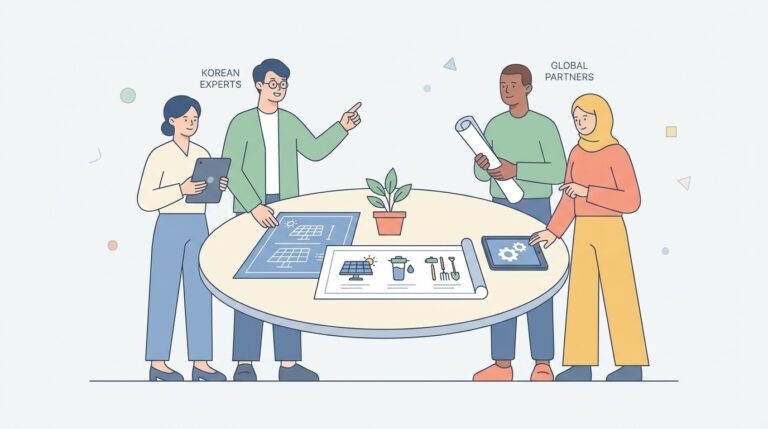
Master Level ODA Strategy: Discussing Appropriate Technology Localization in Korean
Phase 1: Empathy (Storytelling Immersion)
안녕하세요! 매일한글 에디터입니다. (Hello! This is your Daily Hangul Editor.)
Picture this: You are sitting in an international conference room in Pangyo Techno Valley or KOICA headquarters in Seongnam, participating in a high-stakes post-project evaluation. Your team deployed an innovative solar-powered water filtration device in a rural overseas community. Technically, it was brilliant. Culturally, however, it stalled because the maintenance cost exceeded the village’s micro-budget and local artisans were never trained on replacement parts. You want to articulate—in natural, nuanced, C2-level Korean—that success in international development cooperation (ODA) hinges not on unilateral tech transfer, but on building a self-sustaining local ecosystem through community-led governance.
Struggling to move past textbook phrases like “기술이 중요합니다” (Technology is important)? You are not alone. When advanced practitioners try to debate ODA frameworks, they often feel trapped in basic syntax that fails to convey their professional sophistication. This masterclass is designed specifically from field-tested feedback of international development specialists and diplomats. By mastering the high-register expressions in this guide, you will command roundtables, lead joint evaluations, and connect deeply with Korean development practitioners.
Phase 2: 3 Core Expressions In-Depth
1. 현지 주민 주도형 거버넌스를 안착시키다
- Pronunciation: [Hyeonji jumin judohyeong geobeoneonseureul anchaksikida] (Think: “Hyun-jee joo-min joo-do-hyung guh-buh-nun-seu-reul an-chak-see-kee-da”)
- Meaning: Direct: “To land a local resident-led governance.” | Real Nuance: “To firmly institutionalize participatory, community-driven governance on the ground.”
- K-Culture Moment: Frequently heard in policy debates and investigative documentaries like KBS Sisa Direct when examining long-term community empowerment initiatives.
- Editor’s Insight: ‘안착시키다’ (to settle down safely / take root firmly) is a top-tier verb in Korean policy and corporate strategy. It implies smooth, sustainable integration rather than a disruptive shock.
- Situation Spectrum: Casual 🚫 | Semi-formal ⚠️ | Formal ✅
- 🤔 Think About It: In your home language, do you say “empower locals” or “build governance”? How does the Korean focus on ‘안착’ (soft landing/rooting) highlight institutional harmony?
2. 기술의 수용성과 지속가능성을 담보하다
- Pronunciation: [Gisul-ui suyongseonggwa jisokganeungseong-eul dambohada] (Think: “Gee-sool-wee soo-yong-sung-gwa jee-soke-gah-neung-sung-eul dahm-bo-hah-da”)
- Meaning: Direct: “To mortgage/collateralize the technology’s receptivity and sustainability.” | Real Nuance: “To guarantee and safeguard the local adoption and long-term viability of the technology.”
- K-Culture Moment: Used by project leaders in K-dramas dealing with international negotiation and high-level corporate governance (e.g., Misaeng or Argon).
- Editor’s Insight: ‘담보하다’ (literally ‘to secure/guarantee via collateral’) elevates your assertion from a vague wish (“우리는 지속가능성을 원합니다”) to an airtight institutional guarantee.
- Situation Spectrum: Casual 🚫 | Semi-formal ⚠️ | Formal ✅
- 🤔 Think About It: Notice how Korean uses financial/legal metaphors (‘담보’) to stress non-negotiable accountability in development ethics.
3. 자생적 생태계 조성에 방점을 찍다
- Pronunciation: [Jasaengjeok saengtaegye joseong-e bangjeom-eul jjikda] (Think: “Jah-seng-jeok seng-te-gye jo-sung-eh bahng-jeom-eul jjeek-da”)
- Meaning: Direct: “To put an accent mark on creating a self-generating ecosystem.” | Real Nuance: “To place the primary strategic emphasis on fostering a self-reliant, sustainable local ecosystem.”
- K-Culture Moment: The go-to metaphor for Korean policy think tanks (KDI) and tech-incubator keynotes when emphasizing systemic independence over temporary aid.
- Editor’s Insight: ‘방점을 찍다’ (to put an accent mark / to punctuate) is an eloquent idiom meaning ‘to prioritize decisively’. Pair it with ‘자생적’ (self-generating/autonomous) for peak impact.
- Situation Spectrum: Casual 🚫 | Semi-formal ⚠️ | Formal ✅
- 🤔 Think About It: Why does Korean ODA discourse favor ecological metaphors (‘생태계 조성’) over mechanical ones like ‘building systems’?
Phase 3: Textbook Korean vs. Native C2 Korean
Situation 1: Highlighting that foreign tech must adapt to local culture
- 📖 Textbook Korean: 현지 문화를 고려해서 적정 기술을 바꿔야 합니다. (Hyeonji munhwareul goryeohaeseo jeokjeong gisureul bakkwoya hamnida. / We must change appropriate technology considering local culture.)
- 🗣️ Real Native C2 Korean: 기술의 일방적 이식을 지양하고, 현지 맥락에 부합하는 맞춤형 개량에 방점을 둬야 합니다. (Gisul-ui ilbangjeok isig-eul jiyanghago, hyeonji maengnag-e buhabhaneun matchumhyeong gaeryang-e bangjeom-eul dwoya hamnida.)
- 💡 Why the difference? C2 Korean avoids generic verbs like ‘바꾸다’ (to change) in favor of conceptual dichotomies such as ‘일방적 이식 지양’ (avoiding unilateral transplant) versus ‘맥락 부합 맞춤형 개량’ (context-aligned tailored refinement).
Situation 2: Emphasizing community self-reliance after donor exit
- 📖 Textbook Korean: 프로젝트가 끝나도 주민들이 스스로 고쳐 쓸 수 있어야 성공입니다. (Peurojekteuga kkeutnado jumindeuri seuseuro gochyeo sseul su isseoya seonggong-imnida. / It is a success if residents can fix and use it themselves after the project ends.)
- 🗣️ Real Native C2 Korean: 원조 공여국의 출구 전략 이후에도, 현지 자생력을 담보할 수 있는 유지보수 밸류체인이 확립되어야 진정한 결실을 맺습니다. (Wonjo gong-yeoguk-ui chulgu jeollyak ihu-edo, hyeonji jasaengnyeog-eul dambohal su inneun yujibosu baellyuchein-i hwaknipdoeeoya jinjeonghan gyeolsil-eul maetsumnida.)
- 💡 Why the difference? Strategic ODA parlance utilizes structural terms like ‘출구 전략’ (exit strategy) and ‘자생력 담보’ (guaranteeing self-reliance) to project institutional authority.
Phase 4: K-Culture Deep Dive & Non-Verbal Manners
4-1. 눈치 (Nunchi) & Diplomatic Body Language in ODA Roundtables
- In high-level Korean ODA committee settings, avoid immediate, aggressive refutations. Even if a proposed technology seems completely unviable for field conditions, start with ‘경청 제스처’ (active listening posture): lean slightly forward, nod gently, and deploy an acknowledging phrase like “말씀해주신 취지에 십분 공감합니다만…” (I fully empathize with your intention, however…).
- Two-handed document handling (두 손으로 자료 건네기) and keeping your notebook open with continuous note-taking conveys deep respect for the field partners’ observations.
4-2. Cultural Code Analysis: From Recipient to Donor
- Korea holds the historic distinction of transitioning from a war-torn ODA recipient nation to a full DAC (Development Assistance Committee) donor member within a single generation.
- Because of this heritage (exemplified by the historical Saemaul Undong and modern K-Cooperation programs), Korean ODA culture deeply values 상생 (Sangsaeng – Mutual Coexistence) and 주인의식 (Juin-uik – Ownership mentality). The most celebrated appropriate technology successes (such as the localized ‘G-Saver’ heat-accumulating stove in ger districts) succeeded precisely because they incorporated local materials and trained regional blacksmiths rather than importing turn-key machinery.
Phase 5: Real-world Roleplay Scenario
- Setting: A high-level project review session at the KOICA Headquarters briefing room.
- Character: Team Leader Park (박 팀장) – A seasoned ODA project director with 20 years of field experience in Southeast Asia and Central Asia.
Dialogue:
1. 박 팀장: 이번 라오스 농촌 식수 개선 사업에서 제안된 태양광 정수 설비는 기술적 스펙은 훌륭합니다만, 사후 관리가 염려되는군요. (Ibeon Raoseu nongchon siksu gaeseon saeob-eseo jeandeon taeyang-gwang jeongsu seolbineun gisuljeok seupegeun hollyunghamnidaman, sahu gwanriga yeomnyeodoeneungunyo.)
🎭 [차분하게 안경을 고쳐 쓰며 서류를 검토한다]
(The solar purification facility proposed for this Lao rural drinking water project has excellent specs, but I’m worried about follow-up management.)
- Learner (You): 팀장님 말씀대로 최첨단 설비가 능사는 아닙니다. 현지 부품 수급이 어려우면 즉각 무용지물이 되니까요. (Timjangnim malsseumdaero choecheomdan seolbiga neungsaneun animnida. Hyeonji bupum sugeub-i eoryeoumyeon jeukgak muyongjimuri doenikkayo.)
🎭 [자료의 현지 공급망 분석 차트를 짚으며]
(As you said, Team Leader, state-of-the-art facilities are not a panacea. If local parts procurement is difficult, it immediately becomes obsolete.) -
박 팀장: 맞습니다. 지난 아프리카 사업 때도 핵심 필터의 국산화에 실패해서 결국 가동이 중단된 뼈아픈 전례가 있었지요. (Masseumnida. Jinan Apeurika saeop ttaedo haeksim pilteoui guksan-hwa-e silpaehaeseo gyeolguk gadong-i jungdandoen ppyeoapeun jeonryega isseotjiyo.)
🎭 [안타까운 표정으로 고개를 끄덕인다]
(Exactly. In our previous Africa project, we had the painful precedent of operations halting because we failed to localize the key filter production.) -
Learner (You): 그래서 이번에는 설계 초기 단계부터 현지 직업훈련원과 연계하여 수리 인프라를 구축하고자 합니다. (Geuraeseo ibeon-eneun seolgye chogi dangyebuteo hyeonji jigeophullyeonwon-gwa yeongyehayeo suri impeurareul guchukhagoja hamnida.)
🎭 [확신에 찬 눈빛으로 제안서를 펼친다]
(That is why, starting from the initial design phase, we plan to connect with local vocational training institutes to establish repair infrastructure.) -
박 팀장: 현지 인력 양성을 통한 자생력 확보라… 구체적인 주민 참여 기전도 마련되어 있습니까? (Hyeonji inryeok yangseong-eul tonghan jasaengnyeok hwakbora… Guchejeogin jumin cham-yeo gijeondo maryeondoeeo isseumnikka?)
🎭 [흥미로운 듯 상체를 기울이며 묻는다]
(Securing self-reliance through local workforce development… Do we also have a specific mechanism for community participation in place?) -
Learner (You): 네, 마을 자치위원회가 운영비를 자체 징수하는 주민 주도형 거버넌스를 모델링했습니다. (Ne, maeul jachiwiwonhoega un-yeongbireul jache jingsuhaneun jumin judohyeong geobeoneonseureul modellinghaetseumnida.)
🎭 [신뢰감 있는 미소를 지으며 거버넌스 도표를 제시한다]
(Yes, we modeled a resident-led governance structure where the village autonomous council collects operating fees independently.) -
박 팀장: 훌륭합니다. 단순한 원조 수혜를 넘어 주인의식을 고취시키는 훌륭한 접근법이군요. (Hullyunghamnida. Dansunhan wonjo suhyereul neomeo juin-uisig-eul gochwisikineun hullyunghan jeopgeunbeob-igunyo.)
🎭 [만족스러운 표정으로 결재 서류에 서명한다]
(Splendid. That is an outstanding approach that transcends simple aid receipt and inspires true ownership.) -
Learner (You): 기술의 현지화와 사회적 수용성을 동시에 담보할 수 있도록 끝까지 면밀히 모니터링하겠습니다. (Gisul-ui hyeonji-hwawa sahoejeok suyongseong-eul dongsie dambohal su itdorok kkeutkkaji myeonmilhi moniteoringhagetseumnida.)
🎭 [공손히 고개를 숙이며 각오를 밝힌다]
(I will closely monitor the project to the end to ensure both technology localization and social receptivity.)
🔀 Interactive Branch Point: If Team Leader Park asks: “What if the local government demands high-tech automated machinery instead of appropriate tech?”
- Option A: “그분들은 현장을 몰라서 그럽니다. 우리가 정한 적정 기술로 밀어붙여야 합니다.” (They don’t know the field. We must push through with the appropriate technology we chose.)
- Option B: “고위 관계자의 기술적 효용성 기대치와 현지 실정을 절충할 수 있도록, 단계별 기술 고도화 로드맵을 제시하여 설득하는 것이 바람직합니다.” (It is advisable to persuade them by presenting a phased tech advancement roadmap that reconciles leadership’s efficiency expectations with field realities.)
- Option C: “상대국 정부의 요구이니 모든 예산을 투입해 최첨단 스마트 시스템으로 전면 교체하시죠.” (Since it’s the partner government’s demand, let’s invest all budget to replace everything with cutting-edge smart systems.)
Feedback & Analysis:
* Option A [Bad]: Too confrontational and paternalistic. In international diplomacy and ODA, dismissing partner stakeholders as ‘현장을 모른다’ (ignorant of the field) violates partnership principles.
* Option B [Best]: Displays exemplary C2 strategic communication—acknowledges stakeholder aspirations while mitigating operational risk via a ‘단계별 기술 고도화 로드맵’ (phased tech upgrading roadmap).
* Option C [Risk]: A recipe for catastrophic project failure; donor budget depletion without maintenance sustainability leads to abandoned equipment.
Phase 6: 10-Second Emotion Shadowing Drill
- Practice these three high-stakes sentences. Emphasize pauses at
/and match the emotional badge!
[🔥 확신에 찬 전문가의 어조로 / Confident & Professional]
단순한 기기 보급을 넘어 / 현지 맞춤형 유지보수 생태계를 구축하는 것이 / 사업 성패의 분수령입니다.
(Dansunhan gigi bogeub-eul neomeo / hyeonji matchumhyeong yujibosu saengtaegyereul guchukhaneun geos-i / saeop seongpae-ui bunsuryeong-imnida.)
(Beyond mere equipment distribution, establishing a localized maintenance ecosystem is the true watershed of project success.)-
[🤝 포용력 있고 균형 잡힌 어조로 / Diplomatic & Balanced]
수혜국의 문화적 맥락을 도외시한 기술은 / 아무리 혁신적이라도 / 현장에 착근될 수 없습니다.
(Suhyegug-ui munhwajeok maengnag-eul doeoesihan gisureun / amuri hyeoksinjeog-irado / hyeonjang-e chakgeundoel su eopseumnida.)
(Technology that neglects the recipient country’s cultural context, no matter how innovative, can never take root in the field.) -
[💡 전략적 제안의 명쾌한 어조로 / Decisive & Strategic]
초기 파일럿 사업의 성과를 토대로 / 주민 주도형 운영 모델의 자생력을 담보해야 합니다.
(Chogi pailleot saeob-ui seongkwareul todaero / jumin judohyeong un-yeong moder-ui jasaengnyeog-eul dambohaeya hamnida.)
(Based on the outcomes of the initial pilot project, we must guarantee the self-reliance of the community-led operational model.)
Phase 7: K-Culture Mini Dictionary
- 적정 기술 (Jeokjeong Gisul) | Appropriate Technology
Technology tailored to the environmental, cultural, and economic conditions of developing communities, prioritizing low-cost local maintenance over high-tech complexity. - 역량 강화 (Yeongnyang Ganghwa) | Capacity Building / Empowerment
A ubiquitous keyword in Korean development cooperation denoting educational and structural programs that empower local residents and institutions to take charge. - 상생 협력 (Sangsaeng Hyeomnyeok) | Mutual Coexistence & Cooperation
The core philosophical framework of modern Korean ODA, moving away from paternalistic charity toward equal, win-win global partnerships. - 착근성 (Chakgeunseong) | Embeddedness / Rootedness
A high-level sociological and policy term referring to how firmly a new system, behavior, or technology takes root and becomes organic within a local society.
Phase 8: Field Practitioner & Traveler Survival Kit
Top 3 Field survival Expressions:
- “현지 조달 가능한 자재를 우선적으로 검토해 주십시오.”
(Hyeonji jodal ganeunghan jajae-reul useonjeog-euro geomtohae jusipsio.)
Pro Tip: Use this during procurement planning to request prioritizing locally sourced parts. - “이 기술의 유지관리 매뉴얼을 현지어로 번역 및 표준화해야 합니다.”
(I gisur-ui yujigwanri maenyueor-eul hyeonjieoro beon-yeok mit pyojunhwahaeya hamnida.)
Pro Tip: Essential when ensuring that technical blueprints are translated into vernacular languages. - “사업 종료 후 모니터링 주기는 어떻게 설정되어 있습니까?”
(Saeop jongryo hu moniteoring jugineun eotteoke seoljeongdoeeo isseumnikka?)
Pro Tip: High-level governance inquiry regarding post-completion sustainability evaluations.
Editor’s Travel & Research Note:
For international development scholars and practitioners visiting Korea, explore policy resources directly at the KOICA ODA 정보 포털 웹사이트 방문하기 or navigate to project seminars in Pangyo using 네이버 지도 앱 다운로드. When traveling between government complexes in Sejong City and Seoul, the KTX reservation via Korail App is indispensable.
Phase 9: “A Step Deeper” (Humanities Reflection)
Korea’s modern ODA philosophy is profoundly influenced by its traditional communal labor-sharing practices: 품앗이 (Pum-asi – reciprocal labor exchange) and 두레 (Dure – communal collective farming). In historical Korean agrarian life, aid was never conceptualized as a unilateral handout from the wealthy to the destitute; rather, it was an ongoing cycle of mutual indebtedness and collective solidarity. Understanding this cultural DNA explains why Korean development agencies today obsess over “주민 자조(Self-Help)” and “협동조합(Cooperatives)” in appropriate technology projects. Technology is merely a vessel; the soul of Korean development cooperation lies in reigniting collective efficacy.
💬 Your Turn: How does your home culture view international aid? Is it seen primarily as technical assistance, humanitarian charity, or reciprocal partnership? Share your thoughts below in advanced Korean!
Phase 10: FAQ & Common Pitfalls
Q: Can I use ‘적정 기술’ (Appropriate Technology) when talking about domestic green tech in Korea?
A: While ‘적정 기술’ originally gained prominence in developing-world ODA contexts, in Korea today it is also used for low-cost, decentralized community innovations (such as energy-saving stoves in rural communities or urban regeneration projects). However, for commercial tech, use ‘친환경 로우테크’ (eco-friendly low-tech) or ‘생활 밀착형 기술’ (lifestyle-embedded technology).
Q: What is the difference between ‘원조’ (Wonjo) and ‘개발협력’ (Gaebal-hyeomnyeok)?
A: ‘원조’ (Aid/Assistance) carries a subtle unilateral overtone of a donor giving to a recipient. In professional, diplomatic, and academic discourse, Korean practitioners overwhelmingly prefer ‘국제개발협력’ (International Development Cooperation) as it embodies mutual respect and bilateral partnership.
Q: How do I express ‘capacity building’ naturally in Korean meeting minutes?
A: While ‘캐파 빌딩’ is occasionally used as professional jargon, the refined C2 institutional standard is always ‘현지 역량 강화’ (Localization Capacity Building) or ‘인력 양성’ (Human Resource Development).
🚨 Common Mistakes Warning Board:
- Mistake: Saying “우리가 기술을 가르쳐 줘야 합니다” (We must teach them technology – sounds patronizing).
Correct Action: “기술 이전 및 역량 강화 프로그램을 운영해야 합니다.” (We should run technology transfer and capacity building programs.) - Mistake: Translating ‘Self-reliance’ as “혼자 하기” (Doing it alone).
Correct Action: “현지 자생력 제고” or “자립적 운영 기반 확립”. - Mistake: Using “싸구려 기술” for low-cost tech.
Correct Action: “비용 효율적인 적정 기술” (Cost-effective appropriate technology).
Phase 11: Action Mission & Engagement
- 🥉 Bronze Mission (Solo Practice): Read the Phase 6 Shadowing Drill aloud 3 times, focusing on natural pauses at slashes (
/). - 🥈 Silver Mission (Social Output): Write a 2-sentence summary of an appropriate technology project in your country using the phrase
~에 방점을 찍다and post it in the comments below. - 🥇 Gold Mission (Real-world Execution): In your next Korean seminar or meeting, replace “지속가능해야 해요” with “사업의 지속가능성과 현지 수용성을 담보해야 합니다”.
- 🎮 K-Culture Mission: Watch a documentary on KOICA’s YouTube channel or Arirang TV and spot the terms
상생,역량 강화, and사후 관리in action!
Phase 12: Interactive Quiz Challenge
Question 1: Situation Judgment
You are presenting an evaluation report at an ODA conference. Which sentence most professionally conveys that the technology was redesigned to fit the local village’s electricity constraints?
* (A) 현지 전력 사정이 나빠서 대충 싼 기계로 바꿨습니다.
* (B) 현지의 열악한 전력 인프라를 감안하여, 저전력 구동형 맞춤형 기술로 개량하였습니다.
* (C) 전기가 안 들어오니까 기계를 쓰지 말자고 합의했습니다.
Question 2: Fill in the Blank
원조 사업의 진정한 성패는 외부 지원이 중단된 후에도 현지 주민들이 스스로 운영할 수 있는 (________) 거버넌스의 확립에 달려 있습니다.
* (A) 일방적
* (B) 주민 주도형
* (C) 단기적
Question 3: True / False Cultural Check
- True or False: In modern Korean international development cooperation, the term ‘원조’ (unilateral aid) is preferred over ‘개발협력’ (development cooperation) in official policy documents.
🔍 Click to Reveal Quiz Answers & Deep Explanations!
- Q1 Answer: (B)
Explanation: (B) uses sophisticated policy register: ‘열악한 인프라 감안’ (considering poor infrastructure) and ‘저전력 구동형 맞춤형 기술로 개량’ (reformed into low-power-driven tailored technology). (A) and (C) use colloquial and dismissive vocabulary. - Q2 Answer: (B) 주민 주도형
Explanation: ‘주민 주도형’ (Resident/community-led) perfectly collocates with ‘거버넌스 확립’ (establishing governance) and ‘자생력’ in ODA contexts. - Q3 Answer: False
Explanation: Official policy discourse and DAC standards heavily emphasize ‘국제개발협력’ (Development Cooperation) to stress reciprocal partnership and mutual respect over unilateral ‘원조’.







