

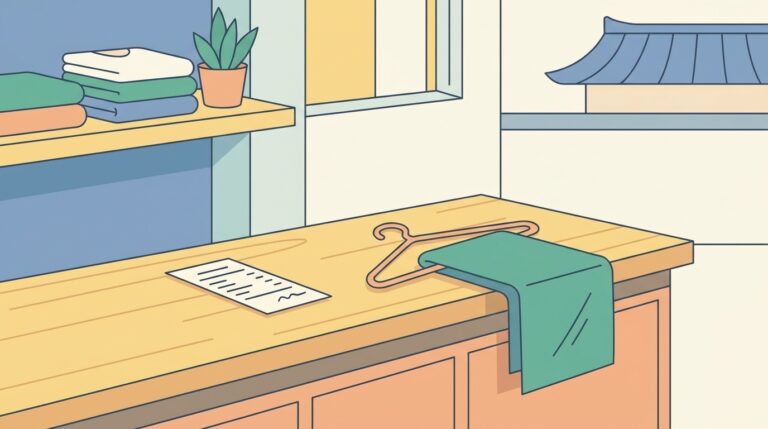
Phase 1: 공감 (Immersive Story Opening)
안녕하세요! 매일한글 (Daily Hangul) editor here! Imagine this: you just landed in Seoul, got caught in a sudden rain shower right after eating delicious Korean BBQ, and your favorite winter coat smells like smoky pork belly. You spot a cozy, traditional Korean dry cleaner (세탁소, Setakso) down a charming alleyway in Mapo. The kind owner (사장님, Sajangnim) smiles warmly, inspects your coat, and writes your name on a tag. You hand over your payment, but suddenly panic sets in: How do I prove this is my coat when I come back? What if they lose it? How do I ask for a receipt in Korean without freezing up?
If you have ever felt your heart beat faster at the payment counter in Korea, you are not alone! Many of our beginner learners tell us that handling everyday errands—like dropping off clothes or buying train tickets—feels ten times harder when it comes to the final step: asking for a proof of transaction. Master this one simple phrase today, and you will walk out of any Korean shop, cafe, or neighborhood laundry with complete peace of mind. Let’s make you sound like a savvy local!
Phase 2: 핵심 표현 3선 심층 분석 (Top 3 Key Expressions)
1. 영수증 주세요 (Yeongsujeung juseyo)
- Pronunciation: Yeong-su-jeung ju-se-yo (Sounds like “Young-soo-jung joo-say-yo”)
- Meaning: Literal: “Receipt, please give me.” / Natural: “Can I have a receipt, please?”
- K-Culture Moment: In K-Dramas like Hospital Playlist, busy characters grab takeout iced Americanos or drop off their white doctor gowns and quickly say this at the counter before rushing out.
- Editor’s Insight: 주세요 (Juseyo) is the magic wand of Korean. Put any noun before 주세요, and you instantly have a polite, natural request!
- Situation Spectrum:
- Casual (Friends): 🚫 (Too formal)
- Semi-formal (Cafes, Cleaners, Taxi): ✅ (Perfect!)
- Formal (High-end Business): ⚠️ (Use 영수증 부탁드립니다 instead)
- 🤔 Think About It: In English, we often frame requests as questions (“Could I get a receipt?”). In Korean, polite requests are often direct statements ending in ~주세요. How does this change the way you interact with store owners?
2. 얼마예요? (Eolmayeyo?)
- Pronunciation: Eol-ma-ye-yo (Sounds like “Uhl-mah-yay-yo”)
- Meaning: Literal: “How much is it?” / Natural: “How much do I owe you?”
- K-Culture Moment: When shopping in traditional markets like Mangwon Market or dropping heavy blankets at the local cleaners, customers point and cheerfully ask this.
- Editor’s Insight: Pair this with pointing your phone or card: 이거 얼마예요? (Igeo eolmayeyo? – How much is this?).
- Situation Spectrum:
- Casual: ⚠️ (Use 얼마야? with close friends)
- Semi-formal: ✅ (Everyday shopping standard)
- Formal: ⚠️
- 🤔 Think About It: Notice how short and punchy everyday Korean questions are compared to English politeness markers!
3. 언제 찾으러 와요? (Eonje chajeureo wayo?)
- Pronunciation: Eon-je cha-jeu-reo wa-yo (Sounds like “Uhn-jay chah-jeu-ruh wah-yo”)
- Meaning: Literal: “When to pick up come?” / Natural: “When should I come to pick it up?”
- K-Culture Moment: The classic phrase exchanged right before leaving laundry, shoe repair shops (구두수선), or photo print studios.
- Editor’s Insight: 찾다 (Chatda) means ‘to find’ or ‘to collect/claim’. Combining it with ~러 와요 creates the natural phrase for pickup timing.
- Situation Spectrum:
- Casual: 🚫
- Semi-formal: ✅ (Best for dry cleaners & tailor shops)
- Formal: ⚠️
- 🤔 Think About It: In Korean culture, clear scheduling builds mutual trust between small business owners and regular neighbors.
Phase 3: 교과서 한국어 vs 진짜 한국어 (Textbook vs. Real Korean)
Situation 1: Asking for a Receipt
- 📖 교과서 한국어 (Textbook): 영수증을 저에게 주십시오. (Yeongsujeung-eul jeo-ege jusipsio. – “Please bestow the receipt upon me.”)
- 🗣️ 진짜 한국어 (Real-Life): 영수증 주세요! (Yeongsujeung juseyo!) or 영수증 하나 주세요~ (Yeongsujeung hana juseyo~)
- 💡 왜 다를까?: Nobody uses ultra-formal imperative endings (~십시오) in a neighborhood shop. A bright 주세요 with a rising-falling melodic tone is friendly, warm, and natural.
Situation 2: Stating You Don’t Need a Receipt
- 📖 교과서 한국어 (Textbook): 영수증은 필요하지 않습니다. (Yeongsujeung-eun piryohaji anseumnida.)
- 🗣️ 진짜 한국어 (Real-Life): 영수증은 버려주세요! (Yeongsujeung-eun beoryeojuseyo! – “Please throw away the receipt!”) or 영수증 괜찮아요! (Yeongsujeung gwaenchanayo! – “Receipt is fine / No need!”)
- 💡 왜 다를까?: In modern Korea, credit card transactions send instant app notifications, so locals frequently tell cashiers to simply discard the paper receipt (버려주세요).
Phase 4: K-Culture 딥다이브 & 비언어적 매너 (Cultural Deep-Dive & Manners)
4-1. 눈치 (Nunchi) & Body Gestures at the Counter
When handing over cash, a credit card, or receiving your physical receipt/garment tag:
* Two-Hand Rule (두 손): Always support your right wrist or forearm lightly with your left hand, or hold your card with both hands. It instantly signals respect without saying a long sentence!
* Slight Head Bow (목례): A gentle 15-degree head nod while saying “감사합니다” (Gamsahamnida) leaves a glowing impression on neighborhood shopkeepers.
4-2. Cultural Insight: The Neighborhood 세탁소 (Setakso)
Unlike massive corporate laundromats, traditional Korean 세탁소 are beloved community hubs run by veteran tailors and master pressers. In slice-of-life K-Dramas like When the Camellia Blooms or Reply 1988, the dry cleaner is where neighbors gossip, share warm sweet potatoes, and mend cherished clothes. When you ask for a receipt or pickup tag (보관증), it’s not just paperwork—it’s an exchange of trust.
Phase 5: 실전 롤플레이 시나리오 (Real-Life Roleplay)
Setting: 행복세탁소 (Happiness Dry Cleaners) near Hongdae. An elderly, friendly owner wearing measuring tape around his neck inspects your wool jacket.
- Turn 1 (사장님 / Owner): 어서 오세요! 뭐 맡기시게요? (Eoseo oseyo! Mwo matgisigeyo?) 🎭 [Smiles warmly and takes the jacket]
- Turn 2 (You): 안녕하세요! 이거 드라이클리닝 해주세요. (Annyeonghaseyo! Igeo deuraikeullining haejuseyo.) 🎭 [Points to the coat collar]
- Turn 3 (사장님 / Owner): 네, 얼룩이 좀 있네요. 깨끗하게 해줄게요. (Ne, eollugi jom inneyo. Kkaekkeuthage haejulgeyo.) 🎭 [Checks buttons and pockets]
- Turn 4 (You): 얼마예요? (Eolmayeyo?) 🎭 [Prepares credit card with both hands]
- Turn 5 (사장님 / Owner): 오천 원이에요. (Ocheon-won-ieyo. – It’s 5,000 won.) 🎭 [Taps the card terminal]
- Turn 6 (You): 여기 카드요. 그리고 영수증 주세요! (Yeogi kadeuyo. Geurigo yeongsujeung juseyo!) 🎭 [Hands card with slight bow]
- Turn 7 (사장님 / Owner): 네, 여기 영수증이랑 카드요. 내일 저녁에 와요! (Ne, yeogi yeongsujeung-irang kadeuyo. Naeil jeonyeoge wayo!) 🎭 [Hands back receipt with pickup date circled]
- Turn 8 (You): 네! 내일 올게요. 감사합니다! (Ne! Naeil olgeyo. Gamsahamnida!) 🎭 [Gently bows and leaves happily]
🔀 Interactive Choice Point
The owner hands you the receipt and asks: “영수증 버려드려요?” (Shall I toss the receipt for you?). What do you say?
* Choice A: “네, 버려주세요!” (Ne, beoryeojuseyo!)
* 👉 Feedback [Best if you don’t need paper]: Super natural! Perfect if you track expenses digitally.
* Choice B: “아니요, 영수증 주세요!” (Aniyo, yeongsujeung juseyo!)
* 👉 Feedback [Best for claiming clothes]: Great choice! The receipt often doubles as your claim ticket with pickup notes.
* Choice C: “영수증 없어요.” (Yeongsujeung eopseoyo.)
* 👉 Feedback [Risk / Awkward]: This means “I don’t have a receipt,” which confuses the owner who is holding it.
Phase 6: 10초 감정 섀도잉 드릴 (10-Second Emotional Shadowing Drill)
Practice matching the rhythm and emotional cues. (Slash / indicates a micro-pause):
- [😊 Bright & Friendly]
- 영수증 / 주세요! (Yeongsujeung / juseyo!)
- Receipt / please give me!
- [🤔 Curious & Polite]
- 이거 / 얼마예요? (Igeo / eolmayeyo?)
- This / how much is it?
- [🤝 Reliable & Cheerful]
- 내일 / 찾으러 올게요! (Naeil / chajeureo olgeyo!)
- Tomorrow / I will come to pick it up!
Phase 7: K-Culture 미니 사전 (Mini Dictionary)
- 세탁소 (Se-tak-so) | Dry Cleaners / Laundry Shop | The neighborhood essential spot for dry cleaning, stain removal, and clothing repairs.
- 영수증 (Yeong-su-jeung) | Receipt | The physical or electronic proof of payment.
- 보관증 (Bo-gwan-jeung) | Claim Slip / Storage Ticket | A slip given by dry cleaners or shoe repair shops to reclaim your item.
- 현금영수증 (Hyeon-geum-yeong-su-jeung) | Cash Receipt | A tax-deductible receipt issued when paying in cash using your Korean phone number.
Phase 8: 여행자를 위한 생존 키트 (Traveler’s Survival Kit)
Survival TOP 3 Phrases
- 카드 돼요? (Kadeu dwaeyo?) – “Do you accept cards?” (Pro Tip: Small traditional dry cleaners may prefer cash or local bank transfer 계좌이체).
- 얼룩 지워주세요 (Eolluk jiwojuseyo) – “Please remove this stain.” (Pro Tip: Point directly at the coffee or soup splash).
- 수선도 돼요? (Suseondo dwaeyo?) – “Do you also do alterations/hemming?”
Editor’s Travel Note
When navigating Korean neighborhoods, standard Google Maps often lacks detailed small-shop data. Download the Naver Map application to search for nearby “세탁소” (Setakso) or “코인세탁소” (Coin Laundromats) with accurate opening hours and customer reviews!
Phase 9: 한 발 더 깊이 (Cultural Thought & Essay)
In South Korea’s high-trust society, asking for a receipt (영수증) is rarely about doubting the shopkeeper’s honesty. Instead, it is an expression of orderly social etiquette and clear closure of a shared contract. Neighborhood shopkeepers take pride in their craft, and returning with your receipt shows respect for their organizational system.
💬 Your Turn: In your home country, do people still keep paper receipts for laundry and repairs, or is everything 100% automated? Share your experience in the comments below!
Phase 10: FAQ & 오해 방지 (FAQ Schema)
Q: What if the dry cleaner doesn’t give a paper receipt?
A: Many small dry cleaners write a pickup slip (보관증) or write your name directly on a tag attached to the garment hanger. If you paid by card, you can still ask “영수증 주세요” for the card slip.
Q: Can I use “영수증 주세요” at convenience stores and cafes too?
A: Absolutely! 영수증 주세요 is universal across all retail and food businesses in Korea.
Q: How do I say “No receipt needed” quickly?
A: Just say “영수증 버려주세요” (Please throw it away) or “괜찮아요” (I’m okay/No thanks) with a small smile.
🚨 흔한 실수 (Common Mistakes TOP 3)
- ❌ Mistake 1: Saying 영수증 줘 (Yeongsujeung jwo) to an older shopkeeper.
- ✅ Correction: Always keep the polite ending: 영수증 주세요 (Yeongsujeung juseyo).
- ❌ Mistake 2: Confusing 영수증 (Receipt) with 메뉴판 (Menu).
- ✅ Correction: Practice saying 영수증 (Yeong-su-jeung) while holding your wallet.
- ❌ Mistake 3: Snatching the receipt with one hand.
- ✅ Correction: Receive items using both hands or with a slight head bow.
Phase 11: 액션 미션 & 참여 유도 (Action Missions)
- 🥉 Bronze Mission: Say “영수증 주세요!” 5 times out loud in front of a mirror with a bright smile.
- 🥈 Silver Mission: Next time you order at a Korean cafe or restaurant, say “영수증 주세요” and take a photo of your receipt!
- 🥇 Gold Mission: Visit a local dry cleaner or store in Korea, complete your transaction entirely in Korean, and collect your item without English!
- 🎮 K-Culture Mission: Watch an episode of a slice-of-life K-drama and spot whether characters take their receipt or say 버려주세요!
Phase 12: 인터랙티브 퀴즈 챌린지 (Interactive Quiz Challenge)
Q1. You just paid for dry cleaning and want your proof of payment. What do you say?
- A) 메뉴판 주세요 (Menyupan juseyo)
- B) 영수증 주세요 (Yeongsujeung juseyo)
- C) 물 주세요 (Mul juseyo)
👉 Click to view Answer & Explanation
Answer: B
Explanation: 영수증 (Yeongsujeung) means receipt. 메뉴판 is a menu, and 물 is water.
Q2. Fill in the blank:
“이거 ________?” (How much is this?)
* A) 어디예요 (eodiyeyo)
* B) 누구예요 (nuguyeyo)
* C) 얼마예요 (eolmayeyo)
👉 Click to view Answer & Explanation
Answer: C
Explanation: 얼마예요? (Eolmayeyo?) asks “How much is it?”. 어디예요 means “Where is it?” and 누구예요 means “Who is it?”.
Q3. [True or False] It is completely fine to use one hand without eye contact when taking receipts from elders in Korea.
👉 Click to view Answer & Explanation
Answer: False
Explanation: Using two hands or supporting your wrist along with a polite nod shows good manners and warmth (Nunchi & etiquette).







