

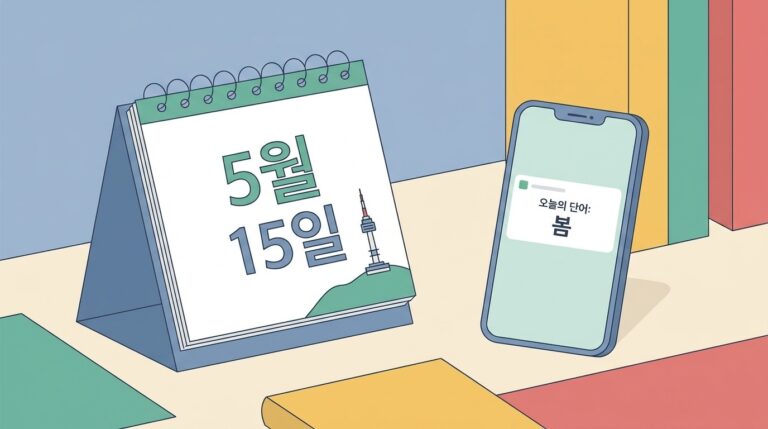
Never Miss a K-Pop Drop or Flight: How to Ask and Understand Today’s Date in Korean
Phase 1: Empathy (Story-Immersive Opening)
안녕하세요! I’m your Daily Hangul editor, and today we’re tackling one of the most deceptively tricky moments in daily Korean life: dates!
Picture this: You just landed in Seoul, still riding high on jet lag, and you rush into an Olive Young or your favorite idol’s pop-up store in Hongdae. There is a huge sign promising a limited-edition photocard gift or a 50% seasonal discount. Below it, in bold Korean font, reads: “이벤트 기간: 10월 24일까지” (Event Period: Until October 24th). You glance at your phone lock screen, but the time zone has scrambled your brain. You turn to the smiling staff member at the counter to confirm whether today is the actual deadline. You want to ask a simple question: “What date is it today?”
Suddenly, your mind freezes. Is date naljja? Or do you say myeot wol myeot il? Do you use Sino-Korean numbers or Native Korean numbers? You end up pointing at the calendar widget on your screen, giggling nervously.
Don’t worry—almost every single Korean learner at the A2 level hits this exact stumbling block. Korean dates follow a very systematic Sino-Korean number logic, but because natural spoken Korean blends syllables together, hearing and asking for dates in real life can feel like listening to fast-forwarded audio. Today’s guide is built straight from real student field experiences. By the end of this lesson, you’ll ask for and decipher dates in Korean smoothly, confidently, and without panic.
Phase 2: Top 3 Core Expressions Deep-Dive
1. 오늘 며칠이에요? (Oneul myeochirieyo?)
- Pronunciation: [O-neul myo-chi-ree-eh-yo] (Sounds like “Oh-neul” + “Myo-chilly-eh-yo”)
- Meaning: Literal: “Today how many days is it?” | Actual Nuance: “What’s the date today?”
- K-Culture Moment: The classic K-Drama office scene where a stressed protagonist filling out paperwork looks over the cubicle wall and asks their coworker for the date before stamping a document.
- Editor’s Insight: Notice that Korean does not write “몇 일”. It merges phonetically into “며칠”. This is the single most common, versatile, and natural phrase for asking today’s day of the month.
- Situation Spectrum: Casual: ⚠️ (Use ‘오늘 며칠이야?’) | Semi-formal: ✅ | Formal: ⚠️ (Use ‘오늘이 며칠입니까?’)
- 🤔 Think About It: In English, we ask “What is the date?” (noun). In Korean, we literally ask “How many-eth day is it?” focusing directly on counting the progression of the month!
2. 오늘 몇 월 며칠이에요? (Oneul myeot wol myeochirieyo?)
- Pronunciation: [O-neul myod-wol myo-chi-ree-eh-yo] (Pronounce ‘몇 월’ as ‘myod-wol’ due to syllable-final sound assimilation)
- Meaning: Literal: “Today, what month and what date is it?” | Actual Nuance: “What month and day is it today?”
- K-Culture Moment: Reality variety shows (like Running Man) where the cast checks the shoot date during the opening greeting.
- Editor’s Insight: Use this when you are completely disoriented (e.g., during international travel or after a long exam period) and need both the month and the day stated clearly.
- Situation Spectrum: Casual: ⚠️ | Semi-formal: ✅ | Formal: ✅
- 🤔 Think About It: Korean always organizes time from biggest to smallest: Year (년) -> Month (월) -> Day (일). How does your native language order dates?
3. 오늘 날짜가 어떻게 돼요? (Oneul naljjaga eotteoke dwaeyo?)
- Pronunciation: [O-neul nal-jja-ga eo-tteo-ke dwae-yo] (The double ‘jj’ is a crisp, tense ‘j’ sound)
- Meaning: Literal: “How does today’s date become?” | Actual Nuance: “Could you tell me what today’s date is, please?”
- K-Culture Moment: Checking in at a boutique hotel in Busan or opening a bank account where courteous, polished phrasing is expected.
- Editor’s Insight: Asking with “어떻게 돼요?” (How does it become?) is the ultimate polite formula in Korean whenever asking for information (like age, phone number, or date) without sounding blunt.
- Situation Spectrum: Casual: 🚫 | Semi-formal: ✅ | Formal: ✅
- 🤔 Think About It: Why does Korean polite speech avoid direct ‘What is…’ questions and prefer indirect ‘How does it become?’ formulas? It softens the social pressure on the listener!
Phase 3: Textbook Korean vs. Real Native Korean
Situation 1: Asking a friend what today’s date is
- 📖 Textbook Korean: 오늘 날짜는 몇 월 며칠입니까? (Oneul naljjaneun myeot wol myeochimnikka?)
- 🗣️ Real Native Korean: 오늘 며칠이더라? (Oneul myeochirideora?) or 오늘 며칠이야? (Oneul myeochiriya?)
- 💡 Why is it different? Textbook phrasing sounds like a military officer conducting an audit. Native speakers talking to friends or thinking aloud drop formal particles and use retrospective endings like “-더라?” (“What was it again?”).
Situation 2: Confirming the end date of an event or reservation
- 📖 Textbook Korean: 이 행사는 어느 날짜에 끝납니까? (I haengsaneun eoneu naljja-e kkeutnamnikka?)
- 🗣️ Real Native Korean: 이거 며칠까지예요? (Igeo myeochilkkajiyeyo?)
- 💡 Why is it different? Real-life Korean prefers concise phrases attached to particles like “~까지” (until). Instead of asking “On which date does it conclude?”, simply ask “Until what date is this?”
Phase 4: K-Culture Deep-Dive & Non-Verbal Manners
4-1. Nunchi & Polite Gestures
When asking for the date while filling out a form at a customer service desk, bank, or cafe, pair your question with a soft head nod (목례 – mokrye). If you are pointing to a specific line on a document, use an open palm facing upward rather than pointing a single index finger. Pointing fingers at papers held by elders or staff can feel slightly aggressive in Korean etiquette.
4-2. The Korean Calendar Rhythm (년-월-일 & D-Day Culture)
Korean culture is deeply milestone-oriented. Everything runs on dates: 100-day anniversaries (백일), couples’ celebrations, K-Pop comeback countdowns (D-Day), and precise flash sales. You will always see dates written in the logical order of Year – Month – Day (e.g., 2026년 3월 15일 or 26.03.15). If someone asks you today’s date, they expect: [Month]월 [Day]일. All dates use Sino-Korean numbers (일, 이, 삼, 사, 오, 육, 칠, 팔, 구, 십).
Watch out for June and October! June is not Yuk-wol, but 유월 (Yuwol), and October is not Sip-wol, but 시월 (Siwol) to make pronunciation smoother!
Phase 5: Real-Life Roleplay Scenario
Setting: At a vibrant K-Pop merchandise pop-up store in Seongsu-dong. You are filling out an entry slip for a lucky draw event with the staff member, Minho (민호).
- Minho (민호): 안녕하세요! 응모권 작성해 주시면 추첨 진행해 드려요. (Annyeonghaseyo! Eungmogwon jakseonghae jusimyeon chucheom jinhaenghae deuryeoyo. / Hello! If you fill out this entry ticket, we will enter you into the lucky draw.)
🎭 Hands you a pen and paper slip with a bright smile - Learner (나): 네, 감사합니다! 어… 저기요, 오늘 며칠이에요? (Ne, gamsahamnida! Eo… jeogiyo, oneul myeochirieyo? / Yes, thank you! Uh… excuse me, what’s the date today?)
🎭 Holds pen hovering over the date line, looking up politely - Minho (민호): 오늘은 5월 18일이에요! (Oneureun owol sibparirieyo! / Today is May 18th!)
🎭 Points gently to the date display board with two hands - Learner (나): 아, 5월 18일이요. 이거 언제 발표해요? (A, owol sibpaririyo. Igeo eonje balpyohaeyo? / Ah, May 18th. When do you announce the winners?)
🎭 Quickly jots down 5월 18일 on the slip - Minho (민호): 이번 주 일요일, 5월 24일에 인스타그램으로 발표됩니다! (Ibeon ju iryoil, owol isibsair-e inseutageuraemeuro balpyodoemnida! / It will be announced this Sunday, May 24th, on our Instagram!)
🎭 Hands you your receipt stub - Learner (나): 알겠습니다. 응모권 여기 있어요. (Algesseumnida. Eungmogwon yeogi isseoyo. / Got it. Here is the entry ticket.)
🎭 Hands the paper back using both hands - Minho (민호): 접수 완료되셨습니다. 좋은 결과 있으시길 바랄게요! (Jeopsu wanryodwoesyeosseumnida. Joeun gyeolgwa isseusigil baralkeyo! / Submission complete. Wishing you the best of luck!)
🎭 Bows politely - Learner (나): 감사합니다! 좋은 하루 보내세요. (Gamsahamnida! Joeun haru bonaeseyo. / Thank you! Have a great day.)
🎭 Waves gently and steps aside
🔀 Interactive Choice Point
You want to ask if the store’s exclusive poster giveaway is still active today. What do you say?
- Option A: “이거 오늘까지예요?” (Igeo oneul-kkajiyeyo? / Is this until today?)
- Option B: “오늘 날짜 몇 번이에요?” (Oneul naljja myeot beonieyo? / What number is today’s date?)
- Option C: “오늘 며칠 날짜예요 끝나요?” (Oneul myeochil naljjayeyo kkeutnayo? / What date is today it ends?)
Feedback:
* Option A [BEST]: Natural, precise, and polite! “~까지예요?” is the exact phrase Koreans use to check promotional validity.
* Option B [BAD]: Grammatically incorrect. “몇 번” asks for an item/order number (e.g., Bus #3), not calendar dates.
* Option C [RISK]: Clunky and confusing. Combining “며칠” and “날짜” in one sentence sounds unnatural to native ears.
Phase 6: 10-Second Emotion Shadowing Drill
Practice saying these aloud with rhythm pauses (/) and dynamic feelings:
[😊 Curiously & Politely]
저기요, / 오늘 / 며칠이에요?
(Jeogiyo, / oneul / myeochirieyo?)-
[🤔 Puzzled & Thinking Aloud]
오늘이… / 10월 / 며칠이더라?
(Oneuri… / siwol / myeochirideora?) -
[✨ Confident & Clear]
오늘은 / 3월 14일 / 화이트데이예요!
(Oneureun / samwol sipsair / Hwaiteude-iyeyo!)
Phase 7: K-Culture Mini Dictionary
- 며칠 (Myeochil) | What date / A few days | Used to ask the day of the month or refer to an unspecified handful of days (e.g., 며칠 전에 – a few days ago).
- 디데이 (D-de-i / D-Day) | Target countdown date | Widely used in Korea for exams, travels, anniversaries, and K-Pop drops (e.g., D-3 = 3 days left).
- 마감일 (Magam-il) | Deadline / Due date | Essential vocabulary for ticket bookings, pop-up store registrations, and paperwork.
- 당일 (Dang-il) | The same day / Today | Frequently seen on delivery apps and event notices (e.g., 당일 예약 – same-day reservation).
Phase 8: Traveler’s Survival Kit
Top 3 Survival Phrases
- 오늘 며칠이에요? (Oneul myeochirieyo?) — What’s the date today? | Pro Tip: Your go-to sentence for tickets, reservations, and paper forms.
- 몇 월 며칠까지예요? (Myeot wol myeochilkkajiyeyo?) — Until what month and day is it? | Pro Tip: Use this when checking museum exhibitions or sale periods.
- 오늘 날짜로 예약했어요. (Oneul naljjaro yeyakhaesseoyo.) — I made a reservation under today’s date. | Pro Tip: Say this at restaurant receptions and hotel lobbies.
Editor’s Travel Note
When traveling across Korea, keep the Naver Map App Download handy on your phone screen. Naver Map displays the operating hours and business holiday schedules (휴무일) formatted strictly in Korean month-day syntax. Also, convenience store deals (like 1+1 or 2+1 promotions) reset on the 1st of every month, so checking today’s date saves your wallet!
Phase 9: A Step Deeper (Reflection Question)
In many Western cultures, asking for the date is purely utilitarian. In Korean society, however, sharing and confirming dates often triggers shared collective context: “Oh, today is already mid-November, winter is coming!” or “Today is Pepero Day!” Time awareness is relational and collective.
💬 Your Turn: Does your country celebrate monthly unofficial holidays or strict countdowns like Korea does? Drop your favorite date or anniversary in the comments below in Korean format (e.g., O월 O일)!
Phase 10: FAQ & Common Pitfalls
Q: Why do we write ‘며칠’ instead of ‘몇 일’?
A: Even though “몇” means “how many” and “일” means “day”, historical sound shifts caused the standard Korean orthography to fix the spelling as “며칠” reflecting its true spoken pronunciation [며칠]. Writing “몇일” is considered a spelling error even on official exams!
Q: How do I pronounce June (6월) and October (10월)?
A: Never say Yuk-wol or Sip-wol! For smoother phonetic flow, the final consonants drop. June is 유월 (Yuwol) and October is 시월 (Siwol).
Q: Which number system do I use for Korean dates?
A: Always use Sino-Korean numbers (일, 이, 삼, 사, 오, 육…) for years, months, and days. Native Korean numbers (하나, 둘, 셋…) are only used when counting hours (시) or counting the total number of days as a duration (하루, 이틀, 사흘).
🚨 Common Mistakes Warning Board
- Mistake: Writing or typing “몇 일이에요?” ➔ Correct Action: Always write “며칠이에요?”.
- Mistake: Saying “십월” for October ➔ Correct Action: Say “시월 (Siwol)”.
- Mistake: Mixing up Year-Month-Day order on paper forms ➔ Correct Action: Always write Year (년) ➔ Month (월) ➔ Day (일).
Phase 11: Action Missions
- 🥉 Bronze Mission (Solo Practice): Look at today’s calendar and say today’s date out loud 3 times in Korean: “오늘은 [Month]월 [Day]일이에요.”
- 🥈 Silver Mission (Social Share): Post a story of your study notes or your bias’s birthday with the caption: “오늘 며칠이에요?” and tag your Korean study buddy.
- 🥇 Gold Mission (Real-World Use): Walk into a local Korean cafe, mart, or community chat and ask: “저기요, 오늘 며칠이에요?” without checking your smartwatch first!
- 🎮 K-Culture Mission: Find a K-Drama scene where characters sign a contract or celebrate an anniversary, and listen for how they pronounce the month and day.
Phase 12: Interactive Quiz Challenge
1. Situation Judgment Quiz: You are at a train station ticket counter and need to check what date it is today. Which phrase is the most natural?
* A) 오늘 몇 번이에요?
* B) 오늘 며칠이에요?
* C) 오늘 몇 년이에요?
2. Fill-in-the-Blank: October 5th in Korean is: [ ______ ] 5일.
* A) 십월
* B) 시월
* C) 열월
3. True or False: In Korean, dates are written in Day-Month-Year order just like in British English.
* (True / False)
👉 Click here to reveal the answers and explanations!
- Answer: B (오늘 며칠이에요?) — A asks for a number ID, and C asks what year it is!
- Answer: B (시월) — October drops the batchim ‘ㅂ’ to become ‘시월’.
- Answer: False — Korean dates strictly follow the biggest-to-smallest hierarchy: Year (년) ➔ Month (월) ➔ Day (일).







