

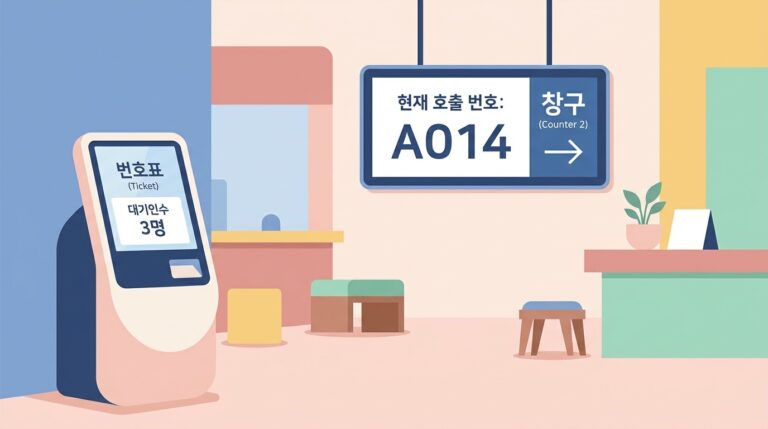
Phase 1: Empathy (Story Opening)
안녕하세요! 매일한글 에디터입니다. (Hello! This is your Daily Hangul editor.)
Have you ever walked into a gleaming Korean bank branch in Seoul, heard the distinct ding-dong! chime echoing through the air, and immediately froze? You see touchscreens labeled with confusing financial categories, bank tellers working with blazing speed, and a digital board flashing numbers faster than a K-Pop dance routine. If your first instinct was to back slowly out the glass doors, take a deep breath—you are definitely not alone!
Visiting a bank in South Korea can feel like stepping onto a high-stakes K-drama set, especially when you just need to update your address, open a basic checking account, or exchange travel money. Many of our B1 learners share that taking a queue number ticket (번호표) is surprisingly the most nerve-wracking moment because picking the wrong service button can mean waiting 40 minutes at the wrong counter!
In this lesson, we will demystify the Korean bank queue system step by step. Drawing from real experiences of foreign residents and native etiquette tips, this practical guide gives you the exact phrases, cultural nunchi (눈치), and confidence to navigate any Korean bank branch like a true local.
Phase 2: Core Expressions Deep Dive
1. 번호표 어디서 뽑아요? (Beonhopyo eodiseo ppobayo?)
- Pronunciation: [Bun-ho-pyo uh-dee-suh ppo-ba-yo?] (Rhymes with “fun-hope-yo, a-disco-pobayo”)
- Meaning: Literal: “Where do I pull a number ticket?” | Natural: “Where can I get a waiting number ticket?”
- K-Culture Moment: Think of those slice-of-life K-dramas where the protagonist walks into a bustling bank on a Friday afternoon and looks around bewildered before a friendly security guard points toward the kiosk.
- Editor’s Insight: The verb 뽑다 (ppopda) literally means “to pluck” or “to pull out,” stemming from the physical action of pulling paper tickets from dispensers. You will use this same verb for claw machine games (인형뽑기) and lottery tickets!
- Situation Spectrum: Casual: 🚫 | Semi-formal: ✅ | Formal: ✅ (번호표는 어디서 뽑습니까?)
- 🤔 Think About It: In many Western banks, you queue in a single physical line. Why do you think Korea adopted high-tech ticket dispensing kiosks so early across all public sectors?
2. 제 차례인가요? (Je charyeingayo?)
- Pronunciation: [Jeh cha-ryeh-in-ga-yo?] (Sounds like “Jey char-yeh-in-gah-yo”)
- Meaning: Literal: “Is it my turn?” | Natural: “Is it my turn now?”
- K-Culture Moment: When a chime rings, your number appears on screen, but another customer steps up to the counter by mistake. You politely approach with your ticket to confirm your turn.
- Editor’s Insight: 차례 (charye) means “turn” or “order.” Pairing it with ~인가요? softens the inquiry into a polite, non-confrontational question, perfect for clarifying queue misunderstandings.
- Situation Spectrum: Casual: ⚠️ (내 차례야?) | Semi-formal: ✅ | Formal: ✅ (제 차례입니까?)
- 🤔 Think About It: How does asking a polite question rather than asserting “I was first” reflect Korean values of maintaining social harmony (inhwa) in public spaces?
3. 일반 예금 업무 보러 왔어요 (Ilban yegeum eommu boreo wasseoyo)
- Pronunciation: [Eel-bahn yeh-geum um-moo bo-ruh wah-ssuh-yo]
- Meaning: Literal: “I came to see general deposit work.” | Natural: “I’m here for standard banking/deposit services.”
- K-Culture Moment: The security guard (청원경찰) at the front door greets you warmly and asks what brings you in today to help press the right kiosk button for you.
- Editor’s Insight: In Korea, banks divide counters into “일반 예금/입출금” (General deposits/withdrawals), “개인 대출” (Personal loans), and “기업/외환” (Corporate/Foreign Exchange). Specifying your goal saves everyone time.
- Situation Spectrum: Casual: 🚫 | Semi-formal: ✅ | Formal: ✅
- 🤔 Think About It: Korean utilizes the verb 보다 (to see/look) for carrying out tasks or errands (업무를 보다 / 볼일을 보다). What does viewing an errand as “seeing something through” reveal about language mindset?
Phase 3: Textbook Korean vs. Real Korean
Situation 1: Letting the teller know you will sit and wait
- 📖 Textbook Korean: “저는 저 의자에서 제 순서를 기다리겠습니다.” (Jeoneun jeo uija-eseo je sunseoreul gidarigesseumnida.) – Very robotic and overly formal.
- 🗣️ Real Korean: “저기 앉아서 기다릴게요!” (Jeogi anjaseo gidarilgeyo!)
- 💡 Why is it different?: Native speakers prefer light, conversational commitment endings (~ㄹ게요) instead of stiff textbook announcements when letting staff know they will take a seat nearby.
Situation 2: Asking which counter called your number
- 📖 Textbook Korean: “어느 창구로 가야 하는지 알려주십시오.” (Eoneu changguro gaya haneunji allyeojusipsio.)
- 🗣️ Real Korean: “몇 번 창구로 가면 돼요?” (Myeot beon changguro gamyeon dwaeyo?)
- 💡 Why is it different?: In fast-paced bank environments, Koreans ask directly with “몇 번 창구” (Which counter number) + “~면 돼요?” (Is it okay if I…?), which is polite, efficient, and natural.
Phase 4: K-Culture Deep Dive & Non-Verbal Manners
4-1. Nunchi (눈치) & Gestures at Korean Banks
- The Bank Guard Helper: As soon as you enter, you will often meet a security guard (청원경찰) standing near the kiosk. Do not be alarmed—their primary job is customer hospitality and guiding you to the right button!
- The Two-Handed Ticket Display: When your number is called, hold your ticket visibly with both hands as you walk toward the counter. It signals to the teller that you are the rightful number holder.
- Quick Eye Contact and Slight Bow: A 15-degree nod when sitting down builds instant rapport with your teller before exchanging any documents.
4-2. Cultural Insight: The Digital “Ppalli-Ppalli” Banking Culture
Korean banking is world-renowned for its hyper-efficient Ppalli-Ppalli (빠리빨리, fast-paced) culture. Digital display boards blink in sync with crisp voice announcements (“띵동~ 104번 고객님, 3번 창구로 오시기 바랍니다”). Because counters operate on tight efficiency, having your Alien Registration Card (ARC) or passport ready in hand while you wait is considered supreme bank etiquette.
Phase 5: Real-Life Roleplay Scenario
Setting: A bustling branch of Hana Bank near Gangnam Station.
Characters:
* Alex (알렉스): An exchange student needing to activate online banking.
* Security Guard / Guide (안내 직원): A helpful bank staff member assisting customers at the entrance kiosk.
- Turn 1 (Staff): 어서 오세요! 어떤 업무 보러 오셨어요?
(Eoseo oseyo! Eotteon eommu boreo osyeosseoyo?)
“Welcome! What kind of service do you need today?”
🎭 [Smiling warmly while gesturing toward the touch kiosk] -
Turn 2 (Alex): 안녕하세요! 인터넷 뱅킹 신청하러 왔어요.
(Annyeonghaseyo! Inteonet baengking sincheonghareo wasseoyo.)
“Hello! I came to apply for internet banking.”
🎭 [Politely bowing slightly with two hands placed in front] -
Turn 3 (Staff): 아, 그러시면 ‘예금/신규’ 버튼 누르시고 번호표 받으시면 됩니다.
(A, geureosimyeon ‘yegeum/sin-gyu’ beoteon nureusigo beonhopyo badeusimyeon doemnida.)
“Ah, in that case, press the ‘Deposit/New Account’ button and take your waiting ticket.”
🎭 [Tapping the screen to highlight the button for Alex] -
Turn 4 (Alex): 감사합니다! 대기 인원이 좀 많네요?
(Gamsahamnida! Daegi inwoni jom mannayo?)
“Thank you! Looks like there are quite a few people waiting?”
🎭 [Taking the printed ticket and checking the number] -
Turn 5 (Staff): 네, 점심시간이라 앞에 5명 대기 중이에요. 저쪽 소파에 앉아서 기다려 주세요.
(Ne, jeomsimsigan-ira ape daseot-myeong daegi jung-ieyo. Jeojjok sopae anjaseo gidaryeo juseyo.)
“Yes, because it’s lunch hour, there are 5 people ahead of you. Please sit on that sofa and wait.”
🎭 [Pointing toward the comfortable waiting lounge area] -
Turn 6 (Alex): 네, 알겠습니다. 혹시 신분증 미리 꺼내 둘까요?
(Ne, algesseumnida. Hoksi sinbunjeung miri kkeonae dulkkayo?)
“Okay, understood. Should I take out my ID in advance?”
🎭 [Holding backpack strap, checking preparation] -
Turn 7 (Staff): 네! 외국인등록증 미리 준비해 주시면 훨씬 빠르게 처리됩니다.
(Ne! Oegugindeungrokjeung miri junbihae jusimyeon hwolssin ppareuge cheoridoemnida.)
“Yes! If you have your Alien Registration Card ready, it will be processed much faster.”
🎭 [Giving an encouraging nod and thumbs-up] -
Turn 8 (Alex): 친절하게 안내해 주셔서 감사합니다!
(Chinjeolhage annaehae jusyeoseo gamsahamnida!)
“Thank you so much for your kind guidance!”
🎭 [Moving politely to the waiting area with ticket and ARC ready]
🔀 Interactive Choice Point
Your ticket number is 142, but the chime rings 143 because number 142 was momentarily skipped while you tied your shoelace. What should you say to the floor staff?
- Option A: “저기요! 142번 제 번호인데 방금 지나갔어요. 어떻게 해요?” (Jeogiyo! 142-beon je beonho-inde banggeum jinagasseoyo. Eotteoke haeyo?)
Feedback: Best Choice! Clear, polite, and directly explains that your number was just passed. The staff will immediately guide you to the next available teller. - Option B: “왜 내 번호 건너뛰어요?” (Wae nae beonho geonneottwieoyo?)
Feedback: Bad Choice. Uses 반말 (informal speech) and sounds confrontational/aggressive. This will create immediate awkwardness. - Option C: Say nothing, throw your ticket away, and press the machine to pull a brand-new ticket from the end of the line.
Feedback: Risk. You will waste another 30 minutes waiting when bank tellers can easily accommodate just-missed numbers if you ask politely!
Phase 6: 10-Second Emotion Shadowing Drill
Practice matching the rhythm and tone markers below:
[😊 친절하고 정중하게 / Friendly & Polite]
저기요, / 번호표는 / 어디서 뽑으면 돼요?
(Jeogiyo, / beonhopyoneun / eodiseo ppob-eumyeon dwaeyo?)-
[🤔 살짝 확인하듯이 / Inquiring & Attentive]
딩동 소리 났는데, / 지금 / 제 차례 맞나요?
(Dingdong sori nanneunde, / jigeum / je charye mannayo?) -
[😌 안도하며 밝게 / Relieved & Cheerful]
신분증 여기 있어요! / 안내해 주셔서 / 정말 감사합니다.
(Sinbunjeung yeogi isseoyo! / Annaehae jusyeoseo / jeongmal gamsahamnida.)
Phase 7: K-Culture Mini Dictionary
- 번호표 (Beon-ho-pyo) | Waiting Queue Ticket
Usage: The slip printed by the entrance kiosk displaying your assigned number, counter category, and current queue length. - 창구 (Chang-gu) | Service Counter / Teller Window
Usage: Refers to individual bank teller booths (e.g., 1번 창구 = Counter #1). - 대기 인원 (Dae-gi In-won) | Number of People in Queue
Usage: Listed on your ticket as “대기고객: 4명”, telling you exactly how many people are ahead of you. - 신분증 (Sin-bun-jeung) | Identification Card
Usage: Encompasses Alien Registration Cards (외국인등록증), Passports (여권), or Korean Driver’s Licenses (운전면허증).
Phase 8: Survival Kit for Travelers
Top 3 Survival Expressions
- “환전하러 왔어요.” (Hwanjeonhareo wasseoyo.)
Meaning: “I’m here to exchange currency.”
Pro Tip: Banks near tourist hubs (Myeongdong, Hongdae) have dedicated 외환 (Foreign Exchange) counters. - “제 번호 지나갔나요?” (Je beonho jinagannayo?)
Meaning: “Did my number already pass?”
Pro Tip: Use this within 2 minutes of missing your chime to be slotted into the very next turn. - “얼마나 기다려야 해요?” (Eolmana gidaryeoya haeyo?)
Meaning: “About how long is the wait?”
Pro Tip: Useful when you have an appointment and need to decide whether to stay or return later.
Editor’s Travel Note
- Finding quiet branches: Avoid visiting Korean banks between 11:30 AM and 1:30 PM (lunch rush hour for office workers). For the fastest service, check wait times or find less crowded branches using the Naver Map bank search navigation guide.
- Operating Hours: Most physical Korean bank branches close doors at 4:00 PM (16:00), so always aim to arrive before 3:30 PM!
Phase 9: Think Deeper (“한 발 더 깊이”)
South Korean banking combines ultra-modern digital automation with deeply rooted communal courtesy. While machines calculate your queue down to the second, the human interaction at the counter is defined by thoroughness and mutual respect. Tellers will bow before handing back your card and explain complex terms with endless patience if you show effort in Korean. It is a striking cultural intersection where high-speed efficiency (Ppalli-Ppalli) meets heartfelt hospitality (Jeong).
💬 Your Turn: Have you ever visited a bank or public office in South Korea? What surprised you the most about the waiting process? Share your story in the comments below!
Phase 10: FAQ & Common Mistakes
Q: What should I do if I press the wrong category on the kiosk ticket machine?
A: Don’t worry! Simply show your printed ticket to the roaming security guide or teller and say: “버튼을 잘못 눌렀어요. 예금 업무는 어디로 가요?” (I pressed the wrong button. Where do I go for deposit services?). They will happily reprint or reassign you.
Q: Can I use my passport instead of an Alien Registration Card (ARC)?
A: For simple currency exchange or international money transfers, a passport is usually fine. However, for opening new checking accounts or registering mobile banking, Korean financial laws strictly require a valid physical Alien Registration Card (외국인등록증).
Q: What does it mean when the teller screen flashes “업무 마감”?
A: It means that specific counter is temporarily closed for paperwork or staff shift. Look up at the central digital display board to see which other counter numbers are actively calling tickets.
🚨 Common Mistakes Alert Board
- Mistake: Standing directly behind someone at the counter while waiting.
Correct Action: Always remain seated in the waiting lounge chairs behind the privacy line until your chime rings. - Mistake: Wearing large headphones and missing your audio chime call.
Correct Action: Keep one ear open! Korean tellers announce numbers both through digital audio chimes and voice microphones. - Mistake: Forgetting to bring physical documents (relying on smartphone photos).
Correct Action: Korean banks strictly require physical original ID cards and stamped contracts—digital photos on your phone are not accepted.
Phase 11: Action Missions
- 🥉 Bronze Mission (Solo Practice): Stand in front of your mirror and practice saying: “인터넷 뱅킹 신청하러 왔어요. 번호표 어디서 뽑아요?” three times without pausing.
- 🥈 Silver Mission (Social Share): Write down the 4 bank counter vocabulary terms (예금, 대출, 외환, 카드) on a sticky note, take a picture, and share it on Instagram tagging
@DailyHangul! - 🥇 Gold Mission (Real Life Action): The next time you visit a Korean bank, post office, or immigration center, initiate the conversation with the greeting staff in full Korean.
- 🎮 K-Culture Mission: Watch an episode of a workplace K-drama (like Misaeng or Start-Up) and spot whether characters use physical queue tickets or digital apps for official errands!
Phase 12: Interactive Quiz Challenge
Question 1: Situation Judgment
You walk into a bank and hear “띵동! 205번 고객님, 4번 창구로 오세요.” Your ticket shows number 205. Where should you walk?
A) To Counter #2
B) To Counter #4
C) Back to the ticket machine
🔍 Click to Reveal Answer & Explanation
Correct Answer: B) To Counter #4
Explanation: “4번 창구” translates directly to Counter Number 4. “205번 고객님” refers to Customer #205 (you!).
Question 2: Fill in the Blank
Complete the sentence to ask the guard politely:
“실례지만, 번호표 어디서 ________?” (Excuse me, where do I pull a waiting ticket?)
🔍 Click to Reveal Answer & Explanation
Correct Answer: 뽑아요? (ppobayo?) / 뽑으면 돼요? (ppob-eumyeon dwaeyo?)
Explanation: The verb 뽑다 (to pull/extract) conjugated in polite present tense is 뽑아요, or in permission form 뽑으면 돼요.
Question 3: True or False Cultural Quiz
In South Korea, it is polite to stand right next to the bank teller counter so they notice you before your number ticket is called. (True / False)
🔍 Click to Reveal Answer & Explanation
Correct Answer: False!
Explanation: Standing near the counter intrudes on the current customer’s financial privacy. Always wait comfortably in the designated seating area until your number is broadcast on the screen.







