

How to Say ‘Fill It Up’ at a Korean Gas Station Like a Local
Phase 1: Empathy (Story-Immersive Opening)
안녕하세요! I am your Daily Hangul editor and your personal Korean culture navigator! Imagine this scene straight out of a heart-racing K-Drama road trip: you just rented a sleek car to drive down the scenic coastal roads of Jeju Island or cruise through the neon-lit highways of Gangwon-do. The sun is setting, your playlist is playing favorite OST tracks, and suddenly—beep, beep—the low fuel light flashes on your dashboard.
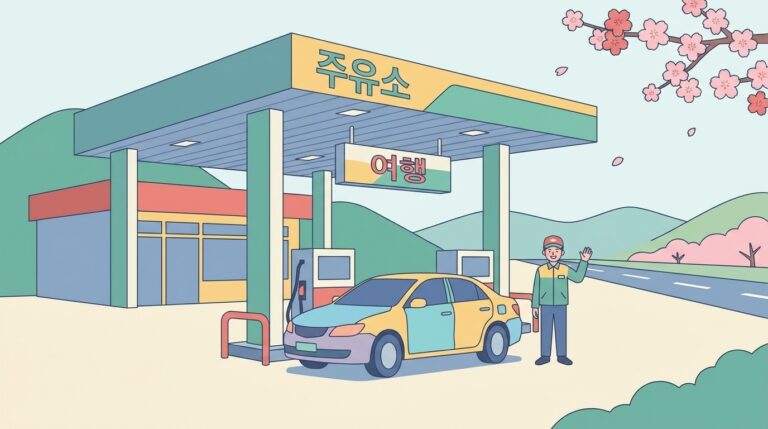
You pull into a bright Korean gas station (주유소). A friendly attendant wearing a safety vest and a welcoming smile trots over to your driver’s window and greets you with polite enthusiasm. You roll down the window, freeze, and your mind goes completely blank. You want to say “Fill ‘er up with regular gas, please!” but you don’t know the Korean words for fuel type, amount, or payment etiquette.
Don’t panic! You are definitely not alone. Many international travelers and expats find visiting Korean gas stations intimidating because of fast interactions and specific local phrasing. But here is the good news: mastering just one or two natural phrases will turn you into an effortless, confident driver in Korea. Let’s make sure you never get stranded on a Korean highway!
Phase 2: Core Expressions Deep Dive
1. 가득 채워 주세요 (Gadeuk chaewojuseyo)
- Pronunciation: [Gah-deuk chae-woh-joo-seh-yo] (Sounds like “Gah-deuk” as in ‘got deck’, followed by the polite ‘please fill for me’)
- Meaning: Literal: “Please fill it to the brim.” | Actual Nuance: “Fill it all the way up, please!”
- K-Culture Moment: Seen in road trip variety shows like 2 Days & 1 Night when cast members stop at rural rest areas before long drives.
- Editor’s Insight:
가득means full or overflowing. It is the absolute gold standard expression used at full-service stations across Korea.- Situation Spectrum: Casual: ⚠️ (Use with friends) | Semi-formal: ✅ (Perfect for attendants) | Formal: ✅
- 🤔 Think About It: In English, we often say “Fill it up.” Notice how Korean explicitly adds the polite request suffix
-주세요(-juseyo, please do for me) to maintain warm politeness towards service workers.2. 휘발유 가득이요 (Hwibalyu gadeugiyo)
- Pronunciation: [Hwee-bahl-yoo gah-deu-gee-yo] (Hwi-bal-yu sounds like ‘Hwee-bahl-yoo’)
- Meaning: Literal: “Gasoline/petrol full, please.” | Actual Nuance: “Regular gasoline, fill it up!”
- K-Culture Moment: When cool characters roll down their tinted car window, hand over a company credit card without looking, and effortlessly drop this snappy phrase.
- Editor’s Insight: Combining fuel type (
휘발유= gasoline /경유= diesel) with가득이요is the fastest, clearest shortcut that attendants love hearing.- Situation Spectrum: Casual: ⚠️ | Semi-formal: ✅ (Super natural & concise) | Formal: 🚫
- 🤔 Think About It: Koreans love efficiency (
빨리빨리culture). Combining fuel type and amount in one quick noun phrase saves time for everyone involved.3. 5만 원어치 넣어 주세요 (O-man-won-eochi neoeo juseyo)
- Pronunciation: [Oh-mahn-wuhn-uh-chee nuh-uh joo-seh-yo]
- Meaning: Literal: “Please put in 50,000 won’s worth.” | Actual Nuance: “Give me 50,000 won worth of fuel, please.”
- K-Culture Moment: Daily life scenes in slice-of-life K-Dramas where drivers budget their commute costs on the way to work.
- Editor’s Insight: If you don’t need a full tank, using
[Amount] + 어치(-eochi, worth) is the foolproof formula for getting exactly the amount of fuel you want.- Situation Spectrum: Casual: ⚠️ | Semi-formal: ✅ | Formal: ✅
- 🤔 Think About It: How do you specify fixed-rate fueling in your home country? In Korea, stating monetary units like 30,000 won or 50,000 won is far more common than requesting specific liters.
Phase 3: Textbook Korean vs. Real Korean
Situation 1: Asking for a full tank
- 📖 Textbook Korean: 기름을 가득 채워 주시겠습니까? (Gireumeul gadeuk chaewojusigesseumnikka? / Would you be willing to fill up the oil?)
- 🗣️ Real Korean: 가득 채워 주세요! (Gadeuk chaewojuseyo! / Fill it up, please!)
- 💡 Why is it different? Textbook Korean over-complicates grammar with formal question endings. Real drivers use clear, polite imperative requests for fast transactions.
Situation 2: Specifying gasoline type
- 📖 Textbook Korean: 휘발유를 자동차에 넣어 주십시오. (Hwibalyureul jadongchae neoeo jusipsio. / Please inject gasoline into the automobile.)
- 🗣️ Real Korean: 휘발유 5만 원어치요! (Hwibalyu omanwoneochiyo! / 50,000 won of regular gas, please!)
- 💡 Why is it different? Attendants need key nouns immediately to select the right pump nozzle and set the meter without delay.
Phase 4: K-Culture Deep Dive & Non-Verbal Manners
4-1. 눈치 (Nunchi) & Polite Gestures
- The Two-Hand Card Pass: When handing over your credit card or cash through the window, hand it over with both hands or support your right wrist with your left hand. It shows respect to the attendant.
- The Quick Window Nod: When you pull up, make eye contact, smile, and give a slight head nod before speaking. This breaks any awkward tension instantly.
- Fuel Cap Release Button: Know where your fuel door lever (
주유구 레버) is located before pulling up! Finding it quickly shows great Nunchi.
4-2. Cultural Insight: Full-Service vs. 셀프 (Self) Stations
In Korea, you will see two main types of gas stations: 일반 주유소 (Full-Service) and 셀프 주유소 (Self-Service). While self-service is growing popular in big cities, full-service stations are still everywhere on highways and suburbs. In full-service stations, staff will often clean your windshield or hand you free box tissues or bottled water as a complimentary service (서비스)!
Phase 5: Real-Life Roleplay Scenario
Setting: A sunny afternoon at a bustling GS Caltex station outside Seoul.
Characters:
* You: A traveler enjoying a weekend road trip.
* Mr. Park (Gas Station Attendant): An energetic, veteran pump attendant wearing a bright cap.
- Turn 1 (Mr. Park): 어서 오세요! 얼마치 넣어 드릴까요?
(Eoseo oseyo! Eolmachi neoeo deurilkkayo?)
“Welcome! How much fuel can I put in for you?”
🎭 Smiles warmly while holding the nozzle ready. -
Turn 2 (You): 안녕하세요! 휘발유 가득 채워 주세요.
(Annyeonghaseyo! Hwibalyu gadeuk chaewojuseyo.)
“Hello! Regular gasoline, fill it up please.”
🎭 Rolls down window completely and speaks with a friendly smile. -
Turn 3 (Mr. Park): 네, 휘발유 가득이요! 주유구 열어 주세요.
(Ne, hwibalyu gadeugiyo! Juyugu yeoreo juseyo.)
“Sure, gasoline full tank! Please open the fuel door.”
🎭 Points gently toward your car's fuel door. -
Turn 4 (You): 네, 열었습니다!
(Ne, yeoreosseumnida!)
“Yes, it is open!”
🎭 Pulls the fuel door lever beside the driver's seat. -
Turn 5 (Mr. Park): 결제는 카드로 하시겠어요?
(Gyeoljeneun kadeuro hasigesseoyo?)
“Will you be paying by card?”
🎭 Pulls out the wireless card reader device. -
Turn 6 (You): 네, 카드로 할게요. 여기 있어요.
(Ne, kadeuro halgeyo. Yeogi isseoyo.)
“Yes, I will pay with card. Here you go.”
🎭 Hands card over using both hands. -
Turn 7 (Mr. Park): 네, 주유 완료되었습니다. 영수증 필요하세요?
(Ne, juyu wanryodeoieosseumnida. Yeongsujeung piryohaseyo?)
“All done fueling. Do you need the receipt?”
🎭 Hands back your card along with a complimentary wet wipe pack. -
Turn 8 (You): 영수증은 괜찮아요. 감사합니다!
(Yeongsujeungeun gwaenchanayo. Gamsahamnida!)
“Receipt is okay without (no thanks). Thank you!”
🎭 Gives a warm polite head bow.
🔀 Interactive Branching Choice
When the attendant asks what fuel you want, what do you say?
* Option A: “기름 주세요!” (Gireum juseyo! / Give me oil!)
* Feedback (Risk): Too vague! They won’t know if you need gasoline (휘발유) or diesel (경유).
* Option B: “휘발유 가득 채워 주세요.” (Hwibalyu gadeuk chaewojuseyo.)
* Feedback (Best): Perfect! Clear fuel type, exact amount, and polite tone. Attendants will understand instantly.
* Option C: “가득.” (Gadeuk. / Full.)
* Feedback (Bad): Too blunt and informal (반말). Always attach -주세요 or -이요 to stay polite.
Phase 6: 10-Second Emotion Shadowing Drill
Repeat these out loud, matching the rhythm and emotional cues marked by / pauses!
[😊 Cheerful & Clear]안녕하세요! / 휘발유 / 가득 채워 주세요!
(Annyeonghaseyo! / Hwibalyu / gadeuk chaewojuseyo!)[💳 Polite & Cooperative]네! / 카드로 / 결제할게요.
(Ne! / Kadeuro / gyeoljehalgeyo.)[👋 Grateful & Refreshing]감사합니다! / 수고하세요!
(Gamsahamnida! / Sugohaseyo!)
Phase 7: K-Culture Mini Dictionary
- 주유소 (Juyuso) | Gas Station
- Essential spot on any Korean road trip, known for clean restrooms and complimentary car washes (세차).
- 휘발유 (Hwibalyu) | Gasoline / Petrol
- Yellow nozzle in Korea. Used for standard sedans and compact rental cars.
- 경유 (Gyeong-yu) | Diesel
- Blue or black nozzle in Korea. Used for many large SUVs, vans, and commercial trucks.
- 세차 (Secha) | Car Wash
- Often discounted after getting a full tank of gas at major chain stations like SK, GS, or S-Oil.
Phase 8: Traveler’s Survival Kit
TOP 3 Survival Phrases
- 경유 가득 채워 주세요. (Gyeong-yu gadeuk chaewojuseyo.)
- Pro Tip: If your rental SUV runs on diesel, make sure to say
경유instead of휘발유!
- Pro Tip: If your rental SUV runs on diesel, make sure to say
- 영수증 버려 주세요. (Yeongsujeung beoryeo juseyo.)
- Meaning: “Please throw away the receipt for me.” (Handy if you don’t need paper waste).
- 화장실 어디에 있어요? (Hwajangsil eodie isseoyo?)
- Meaning: “Where is the restroom?” (Korean gas station restrooms are free and usually very clean!).
Editor’s Travel Note
- Navigation Essential: Google Maps has limited driving features in Korea. Make sure to download and use the official Naver Map Navigation App on iOS/Android or KakaoMap for real-time gas station price comparisons while driving.
- Self-Service Tip: At “셀프” (Self) stations, screen menus usually have an English language button (marked as
English).
Phase 9: Step Deeper (Thought Question)
In Korea, customer service encounters are built around mutual efficiency and respect. Even short service interactions like fueling your car carry subtle linguistic markers of care. The verb 채우다 (to fill) combined with -주세요 (do for me) transforms a commercial order into a collaborative, pleasant interaction.
💬 Your Turn: How does ordering fuel in Korea compare to your home country? Do you prefer self-service pumps or the charm of friendly full-service stations? Share your stories in the comments below!
Phase 10: FAQ & Common Mistakes
Q: What is the difference between 휘발유 (Hwibalyu) and 경유 (Gyeong-yu)?
A: 휘발유 is unleaded regular gasoline (petrol), while 경유 is diesel fuel. Always double-check your rental car’s fuel door sticker before speaking to avoid engine damage!
Q: Can I pay with foreign international credit cards at Korean gas stations?
A: Yes! Standard Visa and Mastercard are accepted at virtually all attended and self-service pumps across Korea.
Q: What should I say if I just want 30,000 won worth of fuel?
A: Say “3만 원어치 넣어 주세요” (Sam-man-won-eochi neoeo juseyo).
🚨 Common Mistakes Alert
- Saying just “가스” (Gas): In Korea,
가스(LPG gas) refers to specialized taxis and commercial vehicles. For normal cars, say휘발유. - Forgetting the polite ending: Dropping
-요(-yo) sounds demanding. Always finish with채워 주세요. - Confusing Diesel with Gas: Never just say “기름” (fuel/oil) if you drive a diesel car. Always specify
경유clearly.
Phase 11: Action Missions
- 🥉 Bronze Mission: Practice saying
휘발유 가득 채워 주세요!3 times in front of the mirror with a friendly smile. - 🥈 Silver Mission: Save this guide and write down
휘발유vs경유in your travel notes app. - 🥇 Gold Mission: Next time you rent a car in Jeju or mainland Korea, use this exact sentence at a full-service pump without switching to English!
🎮 K-Culture Mission: Watch an episode of a Korean road variety show (like House on Wheels) and spot when they pull into a 주유소!
Phase 12: Interactive Quiz Challenge
1. You want a full tank of regular gasoline. Which sentence is the most natural and polite?
* A) 기름 줘 (Gireum jwo)
* B) 휘발유 가득 채워 주세요 (Hwibalyu gadeuk chaewojuseyo)
* C) 자동차 물 주세요 (Jadongcha mul juseyo)
2. Fill in the blank:
30,000 won worth: “3만 원____ 넣어 주세요.”
3. True or False:
경유 (Gyeong-yu) means regular unleaded gasoline. (T/F)
👉 Click here to check the Answers & Explanations!
- Answer: B –
휘발유 가득 채워 주세요is clear, accurate, and perfectly polite. - Answer: 어치 (eochi) –
어치is the counter attached to currency amounts meaning ‘worth of’. - Answer: False –
경유is Diesel!휘발유is gasoline.







