

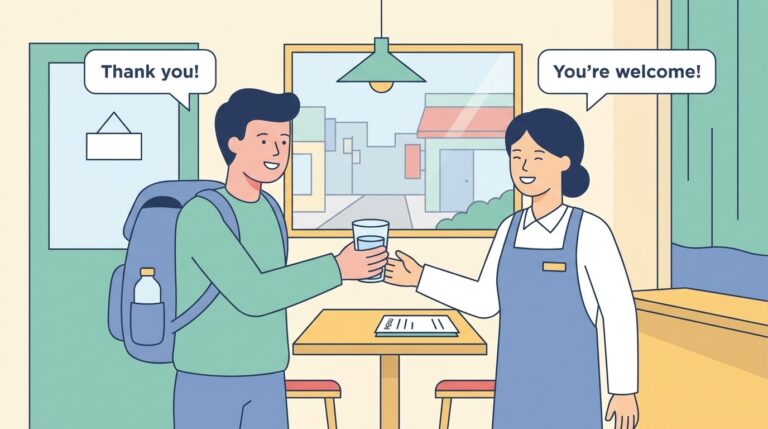
How to Ask for Water in a Korean Restaurant Without Panicking
Phase 1: Welcome to the Spice Survival Guide!
안녕하세요! (Annyeonghaseyo!) Daily Hangul editor and your personal Korean culture bestie here!
Picture this: You are sitting in a buzzing K-BBQ joint in Hongdae or a cozy Tteokbokki stall in Myeongdong. The food smells heavenly, sizzling meat fills the air, and you take a brave bite of that bright red spicy stew. Suddenly—fire! Your tongue is burning, your eyes water, and your glass is completely bone-dry. You desperately scan the room. The servers are rushing past with trays of sizzling pork belly. You want to ask for water, but your mind goes blank. Do you shout? Do you just wave your arms? Will it sound rude if you say the wrong word?
Take a deep breath—you are definitely not alone! This is the single most common panic moment our beginner learners share with us after their first dinner in Seoul. Asking for water is your ultimate restaurant survival skill. In this guide, tailored specifically for beginner (A1) learners and built from real classroom feedback, I’ll teach you how to ask for water like a total local—smoothly, politely, and with zero awkwardness. Let’s dive in!
Phase 2: 3 Core Expressions You Must Know
1. 물 주세요 (Mul ju-se-yo)
- Pronunciation: Mul ju-se-yo (Sounds like: “Mool” + “Jew-say-yo”)
- Meaning: “Water, please.”
- K-Culture Moment: The iconic line in almost every K-Drama comedy scene where a character chokes on spicy ramyun and taps the table frantically!
- Editor’s Insight: Mul (물) means ‘water’, and juseyo (주세요) is the magic phrase meaning ‘please give me’. This is the gold standard for beginners—polite, clear, and universally understood everywhere from street stalls to five-star hotel cafes.
- Situation Spectrum: Casual ✅ | Semi-formal ✅ | Formal ✅
- 🤔 Think About It: In English, we often ask questions like “Could I please get some water?” but in Korean, a direct polite request (주세요) is natural and respectful. How does your language express simple daily requests?
2. 저기요, 물 좀 더 주세요 (Jeogiyo, mul jom deo juseyo)
- Pronunciation: Jeo-gi-yo, mul jom deo ju-se-yo (Sounds like: “Chaw-gee-yo, mool johm duh jew-say-yo”)
- Meaning: Literal: “Over there, please give a little more water.” -> Real nuance: “Excuse me, could we get some more water, please?”
- K-Culture Moment: At a busy late-night pocha (street pub) when your table has run out of chilled bottled water during round two of spicy chicken feet.
- Editor’s Insight: Jeogiyo is the polite “Excuse me” to grab a server’s attention. Adding jom (좀 – a little) softens the tone instantly, making you sound extremely courteous and natural!
- Situation Spectrum: Casual ✅ | Semi-formal ✅ | Formal ⚠️
- 🤔 Think About It: Why do you think Koreans add words that mean “a little bit” (jom) when asking for something? Does your culture use softening words to avoid sounding demanding?
3. 물은 셀프예요? (Mureun selpeu-yeyo?)
- Pronunciation: Mu-reun sel-peu-ye-yo? (Sounds like: “Moo-reun sell-poo-yeh-yo?”)
- Meaning: “Is water self-service?”
- K-Culture Moment: Walking into a neighborhood gimbap shop or tteokbokki diner and spotting a metal water dispenser near the corner.
- Editor’s Insight: Many casual Korean eateries keep costs low by making water self-service. If you don’t see a water bottle brought to your table, look around for a sign that says ‘물은 셀프’ (Water is Self). Asking this question shows you understand how Korean diners work!
- Situation Spectrum: Casual ✅ | Semi-formal ✅ | Formal 🚫
- 🤔 Think About It: “Self” (셀프) is Konglish (Korean-style English). Isn’t it fascinating how loanwords adapt into daily conversational culture?
Phase 3: Textbook Korean vs. Real Street Korean
Situation 1: Getting a server’s attention for water
- 📖 Textbook Korean: 실례합니다, 물을 주시겠습니까? (Sillyehamnida, mureul jusigesseumnikka? – Excuse me, would you bestow water upon me?)
- 🗣️ Real Street Korean: 저기요~ 물 좀 주세요! (Jeogiyo~ mul jom juseyo! – Excuse me~ water please!)
- 💡 Why is it different? The textbook phrase sounds like you are speaking at an imperial banquet in a historical drama! Real Koreans keep it swift, warm, and simple using Jeogiyo + Mul juseyo.
Situation 2: Asking for a cold water refill
- 📖 Textbook Korean: 시원한 물을 다시 채워 주실 수 있나요? (Siwonhan mureul dasi chaewo jusil su innayo? – Can you refill the cold water?)
- 🗣️ Real Street Korean: 여기 시원한 물 좀 더 주세요! (Yeogi siwonhan mul jom deo juseyo! – Over here, more cold water please!)
- 💡 Why is it different? Korean restaurant service is famously speedy (Ppalli-ppalli culture). Short and precise expressions help the staff get you what you need in seconds.
Phase 4: K-Culture Deep Dive & Non-Verbal Manners
4-1. Nunchi & Body Language: The Art of the Call
- The Gentle Hand Raise: In Korea, shouting loudly across the room isn’t necessary. Gently raise your hand to chest or shoulder height, make brief eye contact, and say “Jeogiyo~“.
- The Magic Table Bell (Ding-Dong!): Look closely at the side of your table or on the napkin box. See that little circular button? That’s the 호출벨 (Hochul-bell / Call Bell)! If there is a bell, don’t yell—just press it once. A server will come straight to your table.
- Two-Hand Pouring Etiquette: When the server places the water bottle down or pours water for you, holding your cup or touching your forearm with your other hand is a subtle sign of deep Korean respect.
4-2. Cultural Insight: The Land of Free Water & Side Dishes
In many European countries or American fine dining, water often comes with a charge (still vs. sparkling). In Korea, 물 (water) and 반찬 (side dishes) are virtually 100% free and unlimited! It reflects Korea’s traditional Jeong (warm affection and hospitality) where sharing food and drink freely is basic kindness.
Phase 5: Real-Life Roleplay Scenario
Setting: A popular Bunsik (snack bar) near Ewha Womans University. You are sweating from eating spicy Tteokbokki.
Characters: You (Hungry Traveler) & Auntie Owner (Imo-nim).
- Turn 1 (You): 🎭 (Wiping forehead, looking for water bottle) 저기요! (Jeogiyo!) — Excuse me!
- Turn 2 (Imo-nim): 🎭 (Smiles warmly with an apron on) 네, 주문하시겠어요? (Ne, jumunhasigesseoyo?) — Yes, would you like to order?
- Turn 3 (You): 🎭 (Points at glass) 물 좀 주세요. (Mul jom juseyo.) — Water, please.
- Turn 4 (Imo-nim): 🎭 (Points toward the metallic dispenser in the corner) 아, 물은 셀프예요! 저기 정수기 있어요. (A, mureun selpeuyeyo! Jeogi jeongsugi isseoyo.) — Ah, water is self-service! The water purifier is over there.
- Turn 5 (You): 🎭 (Realizes with a nod) 아, 물은 셀프예요? 감사합니다! (A, mureun selpeuyeyo? Gamsahamnida!) — Ah, water is self-service? Thank you!
- Turn 6 (Imo-nim): 🎭 (Chuckles) 네, 컵은 그 옆에 소독기 안에 있어요~ (Ne, keobeun geu yeope sodokgi ane isseoyo~) — Yes, the cups are inside the sterilizer next to it~
- Turn 7 (You): 🎭 (Gets up, gets water, returns to table relieved) 시원하다! (Siwonhada!) — So refreshing!
- Turn 8 (Imo-nim): 🎭 (Hands extra sweet radish) 떡볶이 많이 맵죠? 천천히 드세요! (Tteokbokki mani maepjyo? Cheoncheonhi deuseyo!) — Tteokbokki is very spicy, right? Enjoy slowly!
🔀 Interactive Choice Point
You finish your spicy meal and your cup is empty again. You want another cup of water. What do you do?
- Option A: Stand up quietly and walk over to the water dispenser to fill your cup yourself.
- Option B: Wave your credit card and yell “Excuse me, waiter! Water!”
- Option C: Snap your fingers repeatedly at the counter staff.
🔍 Click here to check the feedback on your choice!
- If you chose A [BEST]: Perfect score! You remembered that this diner is self-service. You saved the owner a trip and acted like a true local pro.
- If you chose B [RISK]: While they might understand you are a tourist, calling in English and waving a card can cause confusion since water is free and self-service here.
- If you chose C [BAD]: Snapping fingers is considered very impolite in Korea. Always use the call bell or say Jeogiyo!
Phase 6: 10-Second Emotion Shadowing Drill
Read these aloud, pausing at the / marks, matching the emotional cues!
[🙋♂️ Polite & Confident]
저기요! / 물 좀 / 주세요!
(Jeogiyo! / Mul jom / juseyo!)-
[🥵 Spicy & Desperate]
너무 매워요… / 물 어디 있어요?
(Neomu maewoyo… / Mul eodi isseoyo?) -
[💡 Curious & Friendly]
혹시 / 물은 / 셀프예요?
(Hoksi / mureun / selpeu-yeyo?)
Phase 7: K-Culture Mini Dictionary
- 물 (Mul) | Water | The essential noun you need every single day. Cold water is siwonhan mul (시원한 물), hot water is tteugeoun mul (뜨거운 물).
- 저기요 (Jeogiyo) | Excuse me | Literally “Over there”. The most natural, polite way to call staff in restaurants, shops, or cafes.
- 셀프 (Sel-peu) | Self-service | Seen everywhere in fast-casual food spots: Mul-eun Selpeu (Water is self-service), Banchan-eun Selpeu (Side dishes are self-service).
- 이모님 (Imo-nim) | Auntie / Female diner staff | A warm, endearing title used for middle-aged female restaurant owners and servers that instantly melts hearts.
Phase 8: Survival Kit for Travelers
🚨 TOP 3 Quick-Fire Survival Expressions
- 물 주세요! (Mul juseyo!) — Water, please!
💡 Pro Tip: Say this with both hands ready to receive the bottle for instant bonus polite points! - 얼음물 있어요? (Eoreum-mul isseoyo?) — Do you have ice water?
💡 Pro Tip: Super handy during scorching Korean summer trips. - 물 셀프예요? (Mul selpeuyeyo?) — Is water self-serve?
💡 Pro Tip: Look for the stainless-steel tall machine before asking!
🧭 Editor’s Travel Note
- Navigation in Korea: Google Maps often lags for walking routes in South Korea due to local mapping regulations. Be sure to check the Naver Map app download guide before your trip for real-time restaurant reviews and bus stops.
- Table Drawers: Can’t find chopsticks, spoons, or napkins on your table? Check the side of the table! 90% of modern Korean restaurants have a hidden pull-out drawer right under the tabletop.
Phase 9: A Step Deeper (Think & Reflect)
In many Western cultures, dining is transactional and individualistic—every extra item, from bottled tap water to extra bread rolls, is itemized on the bill. In Korean dining culture, however, water and banchan represent unconditional community hospitality (인심 – Insim). Giving clean water freely is considered the most basic duty of welcoming a guest under one’s roof.
💬 Your Turn: Does your country charge for drinking water in restaurants, or is it offered freely? How do you feel about Korea’s “water is self-service” culture? Share your thoughts in the comments below!
Phase 10: FAQ & Common Mistakes
Q: Can I call the server “Ajumma” (아줌마)?
A: While Ajumma means middle-aged woman, it can sound blunt or slightly disrespectful nowadays. Instead, use 저기요 (Jeogiyo – Excuse me) or politely call them 이모님 (Imo-nim – Auntie) or 사장님 (Sajangnim – Boss/Owner).
Q: Is tap water in Korea safe to drink directly from the sink?
A: Tap water in Korea is strictly treated and clean, but most locals and restaurants prefer drinking filtered water from a dedicated dispenser (정수기 – Jeongsugi) or bottled water.
Q: What if I need hot water for tea or medicine?
A: You can say: “따뜻한 물 좀 주세요” (Ttatteutan mul jom juseyo – Please give me some warm water). Most dispensers also have a red lever for hot water.
🚨 Common Mistakes Warning Board
- Mistake: Shouting “Hey!” or whistling to get water.
👉 Correct Action: Press the table bell or say Jeogiyo softly with a raised hand. - Mistake: Waiting forever for water at a noodle joint when there is a big sign saying “물은 셀프”.
👉 Correct Action: Grab a cup from the UV sterilizer box and fill it from the dispenser yourself. - Mistake: Forgetting to say Gamsahamnida (Thank you) when handed water.
👉 Correct Action: A small head nod with Gamsahamnida completes the perfect exchange.
Phase 11: Action Missions
- 🥉 Bronze Mission (Solo Practice): Stand in front of your mirror, raise one hand politely, and say “저기요, 물 좀 주세요!” with a bright smile 5 times.
- 🥈 Silver Mission (Social Challenge): Next time you watch a K-Drama eating scene, listen closely and see if you can catch them saying Jeogiyo or Juseyo! Write down the scene in the comments.
- 🥇 Gold Mission (Real Life Action): Visit your local Korean restaurant or grocery food court this weekend and order your water entirely in Korean without switching to English!
Phase 12: Interactive Quiz Challenge
1. Situational Judgment
You are sitting at a Korean BBQ restaurant and your throat is on fire. You see a small button with a bell icon on the edge of your table. What is the most natural action?
* A) Wave both arms and scream “Water!”
* B) Press the button once and wait for the staff to come.
* C) Walk into the kitchen to find a pitcher.
👉 Click to reveal the answer & explanation
Answer: B
Explanation: That button is the Hochul-bell! Pressing it alerts the server’s smartwatch or table screen, so they will visit your table promptly.
2. Fill in the Blank
Complete the polite request for water:
“저기요, ____ 좀 주세요!” (Excuse me, please give me water!)
👉 Click to reveal the answer & explanation
Answer: 물 (Mul)
Explanation: Mul means water. Combined with jom juseyo, it creates the natural sentence “Water please!”
3. True or False Cultural Quiz
Statement: In Korea, if a sign says “물은 셀프”, the waiter will bring bottled water to your table if you wait patiently.
* [ ] True
* [ ] False
👉 Click to reveal the answer & explanation
Answer: False
Explanation: “물은 셀프” means water is self-service! You should get up, take a cup from the dispenser area, and pour it yourself.







