

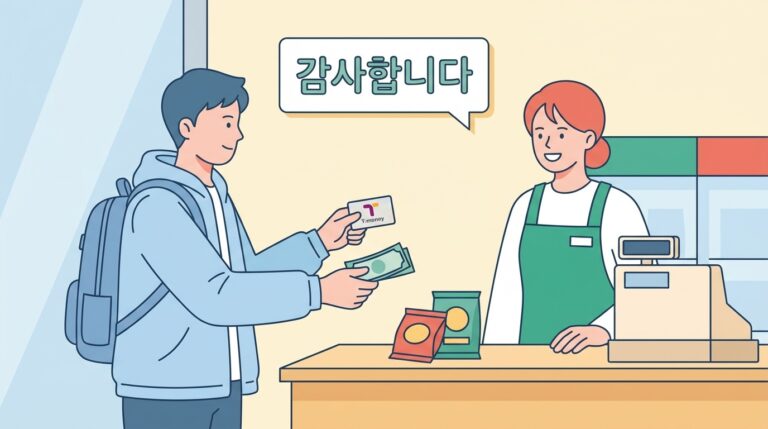
Master Korean Convenience Stores: How to Top Up Your Transit Card Like a Local
Phase 1: Empathy (Real-Life Convenience Store Moment)
안녕하세요! (Hello!) I am your Daily Hangul editor and your 10-year Korean cultural navigator.
Picture this classic Seoul moment: You are rushing down the stairs at Hongdae Station during the morning rush hour. You tap your T-money card against the turnstile scanner, but instead of a cheerful chime, an alarming robotic voice announces: “잔액이 부족합니다 (Insufficient balance).” The red barrier slams shut, commuters queue up behind you, and you realize you have zero funds left on your transit card.
You spot a GS25 or CU convenience store right across the street. You sprint inside with a crisp 10,000 KRW bill in your pocket, but as you approach the counter, your mind goes blank: How do I say ‘top-up’ without sounding like a textbook robot? Can I pay with my overseas credit card? Where do I place my card?
Take a deep breath! Topping up a transit card is one of the very first real-world milestones every traveler and expat faces in Korea. In this guide, tailored for B1 intermediate learners, we will move past clunky textbook phrases and equip you with natural, native-level expressions that make your convenience store visits fast, polite, and completely stress-free.
Phase 2: Core Expressions Deep Dive
1. 교통카드 충전해 주세요
- Pronunciation: Gyotong-kadeu chungjeon-hae juseyo (Sounds like: Gyo-tong kah-deu choong-jeon hae joo-seh-yo)
- Meaning: “Please top up / recharge my transit card.”
- K-Culture Moment: You will hear this in almost every K-drama slice-of-life scene where a student or young professional pops into a convenience store on their way to work or school.
- Editor’s Insight: The word
충전(chungjeon) literally means “recharge” or “replenish” (the same word used for charging phone batteries). When paired with-해 주세요(please do for me), it forms the quintessential polite request.- Situation Spectrum:
- Casual (with close friends): 🚫
충전해 줘(Chungjeon-hae jwo – Do not use with store clerks!)- Semi-formal (Standard for store clerks): ✅
교통카드 충전해 주세요- Formal / Business: ⚠️
교통카드 충전을 부탁드립니다(Too stiff for convenience stores)- 🤔 Think About It: In English, you might say “Can I put ten dollars on this?” In Korean, stating the specific action noun (
충전) followed by the polite imperative (-해 주세요) is much more natural than asking about capability (“Can I…?”).2. 만 원 충전해 주세요
- Pronunciation: Man-won chungjeon-hae juseyo (Sounds like: Mahn-won choong-jeon hae joo-seh-yo)
- Meaning: “Please charge 10,000 won.”
- K-Culture Moment: A customer hands over a single green note (10,000 KRW bill) and places their T-money card on the reader pad at the checkout counter.
- Editor’s Insight: In Korean service interactions, efficiency is key (Ppalli-ppalli culture). Combining the exact amount with the request (
[Amount] + 충전해 주세요) cuts down transaction time to under five seconds.- Situation Spectrum:
- Casual: 🚫
만 원 충전- Semi-formal: ✅
만 원 충전해 주세요(or simply만 원 충전이요)- Formal: ⚠️
만 원 충전하여 주십시오- 🤔 Think About It: Notice how Korean skips the word “with” (euro) here. Instead of saying “Please charge with 10,000 won,” simply placing the amount in front of
충전makes you sound like a true resident.3. 현금으로만 되나요?
- Pronunciation: Hyeongeum-euro-man doenayo? (Sounds like: Hyun-geum-eu-ro-mahn dweh-nah-yo?)
- Meaning: “Is it only possible with cash?” / “Do you only take cash for this?”
- K-Culture Moment: A confused foreign traveler tries tapping their Visa/Mastercard credit card to reload a physical T-money card, and the clerk politely explains the cash-only regulation.
- Editor’s Insight: The particle
-만(only) combined with-으로(by means of) and되나요?(is it workable?) softens the question while getting straight to the point.- Situation Spectrum:
- Casual: 🚫
현금만 돼?- Semi-formal: ✅
현금으로만 되나요?/현금만 가능해요?- Formal: ✅
현금 결제만 가능합니까?- 🤔 Think About It: Korea is nearly 100% cashless for dining and shopping, yet transit card reloads at convenience stores are one of the few strictly cash-only operations. Why do you think transit systems maintain this boundary?
Phase 3: Textbook Korean vs. Real Korean
Situation 1: Asking the clerk to top up 10,000 won
- 📖 Textbook Korean:
제 교통카드에 10,000원을 충전해 주시겠습니까?(Je gyotong-kadeu-e man-won-eul chungjeon-hae jusigesseumnikka?) - 🗣️ Real Korean:
교통카드 만 원 충전해 주세요.(Gyotong-kadeu man-won chungjeon-hae juseyo.) or simply만 원 충전이요~(Man-won chungjeon-iyo~) - 💡 Why is it different?: Textbook phrases overload honorific potential endings (
-주시겠습니까). In real Korean daily life, using polite-요ending with a cheerful upward intonation is both polite and practical.
Situation 2: Asking if you can pay with a credit card for the recharge
- 📖 Textbook Korean:
신용카드로 충전 금액을 결제할 수 있습니까?(Sinyong-kadeu-ro chungjeon geumaek-eul gyeolje-hal su isseumnikka?) - 🗣️ Real Korean:
카드 충전은 현금만 되죠?(Kadeu chungjeon-eun hyeongeum-man doejo?) - 💡 Why is it different?: Rather than asking a formal hypothetical question, locals use the tag-question ending
-죠?(right?), acknowledging that they already anticipate the cash policy while politely double-checking.
Phase 4: K-Culture Deep Dive & Non-Verbal Manners
4-1. 눈치 (Nunchi) & Counter Etiquette
- The Two-Hand Rule (두 손 건네기): Always hand over your cash and transit card using both hands or with your right hand supported lightly by your left hand at the wrist/forearm. It conveys respect without saying a word.
- The T-Money Cradle (단말기 위치): Do not just toss your card onto the counter. Look for the small rectangular sensor (often lit in blue or green with the T-money/Loca Mobility logo) next to the POS register and place your card directly on it.
- The Exit Bow: When the transaction is done, take your card, give a small head nod (약간의 목례), and say
감사합니다(Gamsahamnida).
4-2. Cultural Code: Why is Transit Card Top-Up Cash-Only in a Cashless Society?
Korea is renowned for being one of the most cashless societies in the world—you can buy a 500-won piece of gum with a card or mobile pay anywhere. However, physical prepaid transit cards (T-money, Cashbee) act like electronic cash reserves under financial regulations. To prevent credit card laundering and cash-advancing loopholes, convenience store terminals are strictly programmed to accept cash only for transit card top-ups. Always keep a 10,000 KRW or 50,000 KRW bill in your phone case or wallet!
Phase 5: Real-World Roleplay Scenario
Setting: GS25 near Gangnam Station during the evening rush. The store is bustling, and the register beeps rhythmically.
Characters:
* 민지 (Minji): Friendly but speedy convenience store clerk (20s).
* Alex: B1 Korean learner getting ready to take the subway.
- Turn 1 (Minji):
어서오세요! GS25입니다.(Eoseo-oseyo! GS25-imnida.)- 🎭 Bows slightly and scans the counter.
- “Welcome! GS25.”
- Turn 2 (Alex):
안녕하세요! 저 교통카드 충전 좀 하려고 하는데요.(Annyeonghaseyo! Jeo gyotong-kadeu chungjeon jom haryeogo haneundeyo.)- 🎭 Steps forward and places the transit card on the sensor pad.
- “Hello! I’d like to top up my transit card.”
- Turn 3 (Minji):
네, 얼마 충전해 드릴까요?(Ne, eolma chungjeon-hae deurilkkayo?)- 🎭 Looks up and preps the POS screen keypad.
- “Sure, how much would you like to charge?”
- Turn 4 (Alex):
이만 원 충전해 주세요.(I-man won chungjeon-hae juseyo.)- 🎭 Holds out two 10,000 KRW bills with both hands.
- “Please charge 20,000 won.”
- Turn 5 (Minji):
네, 카드 올려놓아 주시고요. 현금 이만 원 받았습니다.(Ne, kadeu ollyeonoha jusigoyo. Hyeongeum i-man won badatseumnida.)- 🎭 Presses the top-up button on screen while taking the cash.
- “Yes, please leave the card on the reader. Received 20,000 won cash.”
- Turn 6 (Minji):
충전 완료되셨습니다. 영수증 필요하세요?(Chungjeon wanryo-doesyeotseumnida. Yeongsujeung piryohaseyo?)- 🎭 Points at the card reader with an open palm.
- “Top-up is complete. Do you need a receipt?”
- Turn 7 (Alex):
아니요, 괜찮아요. 감사합니다!(Aniyo, gwaenchanhayo. Gamsahamnida!)- 🎭 Takes card and gives a warm head nod.
- “No, that’s okay. Thank you!”
- Turn 8 (Minji):
감사합니다. 좋은 하루 보내세요~(Gamsahamnida. Joeun haru bonaeseyo~)- 🎭 Smiles and turns to the next customer.
- “Thank you. Have a great day~”
🔀 Interactive Decision Point
At Turn 4, if you realized you only have a credit card and no cash, what should you say?
- Option A:
신용카드로 충전해 주세요!(Sinyong-kadeu-ro chungjeon-hae juseyo!)- ⚠️ Feedback (Risk): The clerk will immediately tell you “카드는 안 돼요, 현금만 가능하세요” (Card doesn’t work, only cash). It creates a minor delay.
- Option B:
혹시 카드 결제도 돼요? 현금이 없어서요.(Hoksi kadeu gyeolje-do dwaeyo? Hyeongeum-i eopseoseoyo.)- ✅ Feedback (Best): Perfect! Polite, natural, explains your situation with
-어서요(reasoning), and invites the clerk to suggest an ATM nearby.
- ✅ Feedback (Best): Perfect! Polite, natural, explains your situation with
- Option C:
돈 없어요. 그냥 갈게요.(Don eopseoyo. Geunyang galgeyo.)- 🚫 Feedback (Bad): Too blunt and informal (Banmal). Sounds like “I have no money, I’m just leaving.”
Phase 6: 10-Second Emotional Shadowing Drill
Practice reading these lines aloud with the indicated pause (/) and emotional tone!
[😊 밝고 공손하게 / Cheerful & Polite]
안녕하세요! / 교통카드 / 만 원만 / 충전해 주세요~
(Annyeonghaseyo! / Gyotong-kadeu / man-won-man / chungjeon-hae juseyo~)-
[🤔 조심스럽게 확인하며 / Curious & Gentle Inquiry]
저기요, / 혹시 / 교통카드 충전은 / 현금으로만 / 되나요?
(Jeogiyo, / hoksi / gyotong-kadeu chungjeon-eun / hyeongeum-euro-man / doenayo?) -
[👋 산뜻하게 마무리 / Crisp & Grateful]
영수증은 / 버려주세요. / 감사합니다!
(Yeongsujeung-eun / beoryeo-juseyo. / Gamsahamnida!)
Phase 7: K-Culture Mini Dictionary
- 티머니 (T-money / Ti-meoni): The most widely used rechargeable smart transit card in South Korea, usable on subways, buses, taxis, and select vending machines.
- 현금 결제 (Cash Payment / Hyeongeum Gyeolje): The act of paying with paper bills and coins. Essential term when dealing with transit top-ups.
- 잔액 (Balance / Janaek): The remaining monetary amount stored on your transit card or bank account.
- 영수증 (Receipt / Yeongsujeung): Proof of purchase. Convenience store clerks almost always ask:
영수증 드릴까요?(Shall I give you a receipt?).
Phase 8: Survival Kit for Travelers
Top 3 Survival Phrases
얼마 남았어요?(Eolma nam-asseoyo?) — “How much balance is left on this?”- Pro Tip: Hand your card to the clerk if you are unsure how much money is currently on it.
영수증은 버려주세요.(Yeongsujeung-eun beoryeo-juseyo.) — “Please throw away the receipt for me.”- Pro Tip: Say this quickly if you don’t want paper clutter in your pockets.
근처에 ATM기 있어요?(Geuncheo-e ATM-gi isseoyo?) — “Is there an ATM nearby?”- Pro Tip: Use this when you find out you need cash to recharge your card.
Editor’s Travel Note
- App Navigation: For seamless route planning in Korea, Google Maps has limited transit walking detail. Be sure to check the Naver Map Application Guide or download the KakaoMap Navigation App for real-time subway departure alerts.
- ATM Cash Strategy: Convenience store ATMs often have a higher withdrawal fee (approx. 1,000~3,000 KRW). If possible, withdraw 30,000~50,000 KRW at major subway station bank ATMs to keep in your pocket specifically for transit top-ups.
Phase 9: Step Deeper (Cultural Reflection)
In South Korea, convenience stores (Pyeon-ui-jeom) are not merely shops; they function as indispensable neighborhood infrastructure. From acting as safe havens at night to selling government trash bags, shipping parcel delivery, and recharging transit cards, these 24/7 hubs embody Korea’s collective value of extreme convenience (Pyeonli-seong) and social safety.
💬 Your Turn: In your home country, how do you top up public transit cards? Can you do it in retail stores with cash, or is everything strictly mobile and digital? Share your experience in the comments below!
Phase 10: FAQ & Common Mistakes
Q: Can I buy a new T-money card and recharge it at the same time in a convenience store?
A: Yes! You can purchase the physical card (which usually costs 3,000 to 5,000 KRW) using a credit card or cash, but the recharge amount itself must be paid in cash.
Q: What should I do if the clerk asks “얼마 충전해 드릴까요?” and I don’t know Korean numbers yet?
A: Simply hand over the exact cash bill you want to put onto the card. For instance, hand the card and a 10,000 KRW bill and say: 이거 다 충전해 주세요 (Igeo da chungjeon-hae juseyo – “Please charge all of this”).
Q: Can I get a refund for remaining transit card balances at convenience stores?
A: Yes! If your remaining balance is under 20,000 KRW, most convenience stores can process an instant cash refund on the spot for a small 500 KRW processing fee. Just say: 환불해 주세요 (Hwanbul-hae juseyo).
🚨 Common Mistakes TOP 3
- Mistake: Handing over a credit card to top up your T-money card.
- Correct Action: Always have cash bills ready before approaching the cashier counter.
- Mistake: Pulling the card away too fast before the machine finishes beeping.
- Correct Action: Keep your card firmly on the sensor pad until the clerk says
충전 완료되셨습니다(Top-up completed).
- Correct Action: Keep your card firmly on the sensor pad until the clerk says
- Mistake: Using informal language like
충전해 줘(Chungjeon-hae jwo) because the clerk looks young.- Correct Action: Always stick to polite honorifics (
충전해 주세요or충전 부탁드립니다).
- Correct Action: Always stick to polite honorifics (
Phase 11: Action Missions
- 🥉 Bronze Mission (Solo Practice): Stand in front of a mirror and practice saying
교통카드 만 원 충전해 주세요three times with a smile and two-handed gesture in under 5 seconds. - 🥈 Silver Mission (Social Check): Leave a comment below translating this sentence into Korean: “Please check the balance on my card!”
- 🥇 Gold Mission (Real Life Action): On your next trip to Korea (or at a Korean transit kiosk), walk into a convenience store, place your card on the reader, and complete the top-up entirely in Korean without switching to English!
- 🎮 K-Culture Mission: Watch an episode of a Korean variety show (like Running Man or Workman) and spot how cast members interact with convenience store part-timers.
Phase 12: Interactive Quiz Challenge
1. Situation Judgment Quiz
You want to charge 30,000 KRW onto your T-money card. Which sentence is the most natural and polite?
* A) 교통카드 3만 원 충전해.
* B) 교통카드 삼만 원 충전해 주세요.
* C) 삼만 원을 교통카드 안에 넣으세요.
2. Fill in the Blank
A: 얼마 충전해 드릴까요?
B: 교통카드 ________ 충전해 주세요. (10,000 won)
3. True or False Cultural Quiz
Statement: You can easily top up your physical T-money card at any convenience store using an international credit card.
* (True / False)
👉 Click here to check answers & explanations!
- Answer: B (
교통카드 삼만 원 충전해 주세요.)- Explanation: Choice A is informal (반말) which is rude to store clerks. Choice C is an awkward literal translation of “put inside.”
- Answer: 만 원 (Man-won)
- Explanation: 10,000 in Sino-Korean numbers is
만(Man).
- Explanation: 10,000 in Sino-Korean numbers is
- Answer: False
- Explanation: Transit card reloads at convenience stores are legally cash-only operations in South Korea.
- Explanation: Transit card reloads at convenience stores are legally cash-only operations in South Korea.







