

Glamping & Caravan in Korea: Easy A2 Korean Phrases for Beginners
Phase 1: Empathy & Storytelling
안녕하세요! Welcome back to Daily Hangul! I’m your Korean culture buddy and language navigator.
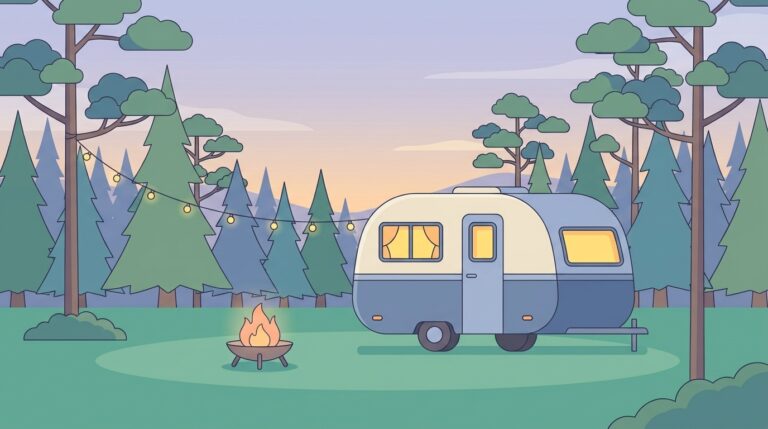
Picture this: You finally booked a cozy vintage caravan in Gapyeong after watching your favorite K-drama characters roast marshmallows over a fire pit. You step into the camping ground, the pine scent fills the crisp evening air, fairy lights are glowing, and you can smell sizzling pork belly (samgyeopsal). But suddenly, panic hits! How do you ask the campsite manager (sajangnim) for extra charcoal? How do you turn on the floor heating (ondol) inside the caravan before it freezes at night?
Many of our beginner students tell us: “I knew basic textbook Korean, but when I stood in front of the campsite host, my mind went totally blank!” Don’t worry at all. Today, we have tailored this beginner-friendly (A2) survival guide specifically for renting and enjoying a Korean caravan. By the end of this post, you’ll be able to check in, request BBQ tools, and stay warm all night like a true local camper!
Phase 2: Top 3 Key Expressions Deep Dive
1. 바베큐 숯불 준비해 주세요 (Babe-kyu sut-bul jun-bi-hae ju-se-yo)
- Pronunciation: [Ba-be-kyu soot-bool joon-bee-hae joo-seh-yo] (Sounds like “soot” from a fireplace + “bull”)
- Meaning: Literal: “Please prepare barbecue charcoal fire.” | Real Nuance: “We’d like to start our BBQ now, please set up the grill!”
- K-Culture Moment: Seen in almost every Korean healing reality show (like In the SOOP or Three Meals a Day) when evening falls and members gather around the outdoor grill.
- Editor’s Insight: In Korea, caravan sites provide the charcoal and grill grate for a small fee (usually 20,000~30,000 KRW). You don’t light it yourself; simply say this phrase and the host will ignite it for you.
- Situation Spectrum: Casual: ⚠️ (Only with close friends: 숯불 피워줘) / Semi-formal: ✅ (To campsite host: 바베큐 숯불 준비해 주세요) / Formal: ✅ (바베큐 숯불 준비 부탁드립니다)
- 🤔 Think About It: In English, you might say “Can we get the grill going?” In Korean, specifying 숯불 (charcoal fire) immediately informs the staff to bring burning briquettes safely.
2. 보일러 어떻게 켜요? (Bo-il-leo eo-tteo-ke kyeo-yo?)
- Pronunciation: [Boh-eel-luh uh-ttuh-keh kyuh-yoh?] (Sounds like English “boiler” + “uh-ttuh-keh” for how)
- Meaning: Literal: “How do I turn on the boiler?” | Real Nuance: “How do I work the heating / hot water system in this caravan?”
- K-Culture Moment: In K-dramas, when city characters go to the countryside in winter and frantically look for the wall controller before shivering under the blanket.
- Editor’s Insight: “보일러” controls both floor heating (ondol) and hot shower water. Even inside modern caravans, Korean heating relies on hot-water circulating floor pads. If it’s cold, ask this right away!
- Situation Spectrum: Casual: ⚠️ (보일러 어떻게 켜?) / Semi-formal: ✅ (보일러 어떻게 켜요?) / Formal: ✅ (보일러 작동법 알려주시겠어요?)
- 🤔 Think About It: While Western campers think of “turning on the AC/heater vent,” Koreans ask about the “boiler” because warmth starts from the floor.
3. 쓰레기 분리수거 어디에 해요? (Sseu-re-gi bun-ri-su-geo eo-di-e hae-yo?)
- Pronunciation: [Sseu-reh-gee boon-lee-soo-guh uh-dee-eh hae-yoh?]
- Meaning: Literal: “Where do I do waste sorting?” | Real Nuance: “Where is the recycling and trash disposal station?”
- K-Culture Moment: The polite morning scene after a camping party, where everyone cleans up beer cans, plastic bottles, and food containers before check-out.
- Editor’s Insight: Korea takes recycling very seriously! Leaving trash behind inside a caravan can incur penalty fees. Asking this shows you are a considerate and respectful traveler.
- Situation Spectrum: Casual: ⚠️ / Semi-formal: ✅ (쓰레기 분리수거 어디에 해요?) / Formal: ✅ (분리수거장이 어디인가요?)
- 🤔 Think About It: Korea categorizes trash into Food Waste (eumsikmul), Recyclables (jaehwalyong), and General Waste (ilban sseuregi). A great eco-friendly habit!
Phase 3: Textbook Korean vs. Real-Life Korean
Situation 1: Asking if you can check in early or enter the caravan
- 📖 Textbook Korean: 지금 카라반에 입실할 수 있습니까? (Jigeum karabane ipsilhal su itsseumnikka? – “May I enter the caravan lodging now?”)
- 🗣️ Real-Life Korean: 지금 들어가도 돼요? (Jigeum deureogado dwaeyo? – “Can we head inside now?”)
- 💡 Why the difference? At campsites, hosts are warm and informal. Using overly rigid Sino-Korean words like “입실(check-in)” sounds like a hotel business meeting. “들어가도 돼요?” is natural and friendly.
Situation 2: Asking for an extra blanket on a chilly night
- 📖 Textbook Korean: 저에게 추가 담요 한 장을 주시겠습니까? (Jeoege chuga damyo han jangeul jusigesseumnikka?)
- 🗣️ Real-Life Korean: 사장님, 이불 하나만 더 주세요! (Sajangnim, ibul hana-man deo juseyo! – “Boss, could we get one more blanket, please?”)
- 💡 Why the difference? Calling the host 사장님 (Sajangnim – boss/owner) creates instant warmth, and replacing “담요 (blanket/throw)” with “이불 (bedding quilt)” gets you the coziest comforter.
Phase 4: K-Culture Deep Dive & Non-Verbal Manners
4-1. Nunchi & Gestures: Camping Etiquette (매너타임)
- Manner Time (매너타임): Around 10:00 PM or 11:00 PM, all Korean campgrounds enforce “Manner Time.” Turn off loud speakers, lower your speaking volume, and dim bright outdoor lamps.
- Two-Hand Tongs Delivery: When the manager hands you grilling tongs, charcoal tongs, or keycards, always receive them with both hands or with your left hand lightly supporting your right wrist. It shows respect and gratitude.
4-2. Cultural Insight: The Holy Trinity of Caravan Food
Korean camping isn’t complete without the “Buldak + Samgyeopsal + Roasted Sweet Potato (gun-goguma)” combo! At night, campers wrap sweet potatoes in tin foil and place them directly under the glowing charcoal ash. When you check out the grill, don’t extinguish the fire completely until you roast your potatoes!
Phase 5: Real-Life Roleplay Scenario
Setting: 6:30 PM at a scenic riverside caravan glamping site in Chuncheon. You are meeting Min-ho, the cheerful campsite manager.
- Min-ho: 안녕하세요! 3호 카라반 예약하신 분 맞으시죠? (Hello! Are you the guest who reserved Caravan #3?)
🎭 Hands over the caravan key with a bright smile - Learner: 네, 맞아요! 지금 들어가도 돼요? (Yes, that’s right! Can we go inside now?)
🎭 Takes key with both hands - Min-ho: 네, 카라반 문 열어두었습니다. 짐 먼저 푸세요. (Yes, I left the door unlocked. Feel free to unpack first.)
- Learner: 감사합니다. 저, 보일러 어떻게 켜요? (Thank you. Um, how do I turn on the heating?)
🎭 Points toward the wall control panel inside - Min-ho: 벽에 스위치 누르고 ‘난방’ 버튼 누르시면 돼요. 온수도 잘 나옵니다! (Just press the switch on the wall and tap ‘난방 (Heating)’. Hot water works great too!)
- Learner: 알겠습니다! 사장님, 7시에 바베큐 숯불 준비해 주세요. (Understood! Boss, please prepare the BBQ charcoal fire at 7 o’clock.)
🎭 Makes a grilling gesture and smiles - Min-ho: 네! 7시에 숯불 피워 드릴게요. 고기 맛있게 구워드세요! (Got it! I will light the charcoal at 7:00. Enjoy your BBQ!)
- Learner: 네! 쓰레기 분리수거 어디에 해요? (Thanks! Where do we do the trash recycling?)
- Min-ho: 저기 관리실 옆에 분리수거함 있어요! (There are recycling bins right next to the main office over there!)
🔀 Interactive Choice Point
At 7:00 PM, Min-ho brings the hot charcoal grill, but you also want to make a cozy campfire (불멍 – fire pit). What do you say?
- Option A: “불멍 장작도 추가할 수 있어요?” (Can we add firewood for a campfire too?)
- 🌟 Feedback (Best!): Perfect! “장작 (firewood)” and “불멍 (staring at campfire)” will instantly show the host that you know Korean camping culture!
- Option B: “불 줘요.” (Give fire.)
- 🚫 Feedback (Bad): Too blunt and lacks politeness. It sounds like demanding a cigarette lighter in an informal way.
- Option C: “캠프파이어 하고 싶습니다.” (I wish to do a campfire.)
- ⚠️ Feedback (Risk): Understandable, but sounds a bit like an elementary school field trip announcement. Option A is much more natural.
Phase 6: 10-Second Emotional Shadowing Drill
Practice these lines out loud with the right intonations:
[😊 Cheerful & Inquiring]
“사장님, / 바베큐 숯불 / 언제 돼요?”
(Sajangnim, / ba-be-kyu soot-bool / eon-je dwae-yo? – Boss, when will the BBQ charcoal be ready?)-
[🥶 Shivering & Needy]
“카라반 안이 / 조금 추운데, / 보일러 어떻게 켜요?”
(Karaban an-i / jo-geum choon-de, / bo-il-leo eo-tteo-ke kyeo-yo? – It’s a bit cold inside the caravan, how do I turn on the heat?) -
[🤝 Polite & Responsible]
“쓰레기 분리수거는 / 어디에 버리면 될까요?”
(Sseu-re-gi boon-ree-soo-geo-neun / eo-di-e beo-ri-myeon doel-kka-yo? – Where should we dispose of the sorted trash?)
Phase 7: K-Culture Mini Dictionary
- 불멍 (Bul-meong) | Campfire Spacing Out | A beloved modern Korean trend of quietly zoning out and relaxing while watching flames in a fire pit.
- 매너타임 (Mae-neo-ta-im) | Campsite Quiet Hours | Designated quiet time (usually 10 PM to 7 AM) where loud music, shouting, and high brightness are prohibited.
- 장작 (Jang-jak) | Firewood Logs | Wood bundled and sold at caravan reception desks for solo campfires and marshmallow roasting.
- 일산화탄소 경보기 (Il-san-hwa-tan-so Gyeong-bo-gi) | Carbon Monoxide Detector | Crucial safety device inside caravans and tents. Never cover or turn this off!
Phase 8: Traveler’s Survival Kit
Top 3 Survival Phrases
- 수건 더 받을 수 있을까요? (Su-geon deo ba-deul su isseulkkayo?) — “Could we get more towels?”
- Pro Tip: Caravans often provide small face towels. If you need larger bath towels, ask early in the afternoon.
- 뜨거운 물 나와요? (Tteu-geo-un mul na-wa-yo?) — “Does hot water come out?”
- Pro Tip: Small caravans have electric water tanks (30-50L). If one person takes a long shower, the next person should wait 20 minutes for it to reheat!
- 와이파이 비밀번호가 뭐예요? (Wa-i-pa-i bi-mil-beon-ho-ga mwo-ye-yo?) — “What is the Wi-Fi password?”
Editor’s Travel Note
- App Guide: Search for “캠핑/글램핑” directly on the [Naver Map Navigation App] to find nearby 24-hour convenience stores or butcher shops (jeong-yuk-jeom) before reaching mountain campsites.
- Cash vs Card: While almost all sites accept cards, having 10,000 ~ 20,000 KRW in cash or a local bank transfer app is handy for purchasing extra firewood or late-night instant ramen from unmanned camp kiosks.
Phase 9: A Step Deeper (Reflection)
Korean caravan culture reflects the unique concept of ‘Chayong’ (borrowing nature) blended with ultra-modern convenience. Koreans love leaving the high-density cityscape to breathe mountain air, yet they expect high-speed heated floors and spotless grills inside their vehicles. This creates a warm community where campers frequently share extra kimchi, grilled sausages, or sweet potatoes with neighboring caravan guests.
💬 Your Turn: Have you ever stayed in a campervan or glamping spot in your home country? What is one item you must have when camping? Share in the comments below!
Phase 10: FAQ & Common Mistakes
Q: Can we cook inside the caravan kitchen?
A: Light cooking (like boiling ramen or heating food in a microwave) is permitted, but grilling greasy meats like pork belly (samgyeopsal) or frying fish indoors is strictly prohibited due to odor and fire safety. Always use the outdoor deck grill!
Q: What should I do if the electricity cuts off in the caravan?
A: Caravans have individual circuit breakers. If you use a hairdryer and electric kettle at the same time, it might trip. Simply tell the manager: “두꺼비집(차단기) 내려갔어요! (Dukkeobijip naeryeogatseoyo – The circuit breaker tripped!)”.
Q: Is drinking alcohol allowed outside during Manner Time?
A: Quiet drinking and whispering by the fire pit is totally fine! Just ensure there is no singing, shouting, or loud Bluetooth speaker playback after 10:00 PM.
🚨 Common Mistakes Alert
- Throwing food waste into the general trash bag: Correct Action: Keep vegetable peels and leftovers in the designated yellow or separate compost bucket.
- Throwing wood logs directly on the charcoal grill table: Correct Action: Charcoal (sut) is for cooking meat; firewood (jangjak) is exclusively for the separate fire pit (hwaro-dae).
- Leaving the caravan door wide open with interior lights on: Correct Action: Mountain insects love light! Always keep the mesh screen (bangchung-mang) zipped.
Phase 11: Action Mission & Engagement
- 🥉 Bronze Mission: Stand in front of your mirror and practice saying: “사장님, 바베큐 숯불 준비해 주세요!” with a bright voice 3 times.
- 🥈 Silver Mission: Post an Instagram story or tweet with the word #불멍 (Bul-meong) tagging your favorite camping photo.
- 🥇 Gold Mission: On your next trip to Korea, book a caravan site in Gapyeong or Jeju and successfully request charcoal and check-in solely in Korean!
- 🎮 K-Culture Mission: Watch an episode of the variety show Camping Club or House on Wheels and spot how celebrities use “보일러” and “숯불”!
Phase 12: Interactive Quiz Challenge
1. Situation Quiz: You arrived at the caravan site, unpacked your bags, and want to grill meat at 7 PM. What should you say to the manager?
* A) 불 꺼주세요 (Bul kkeo-ju-se-yo)
* B) 7시에 바베큐 숯불 준비해 주세요 (Il-gop-si-e ba-be-kyu sut-bul jun-bi-hae ju-se-yo)
* C) 라면 끓여주세요 (Ra-myeon kkeul-yeo-ju-se-yo)
2. Fill in the Blank:
“밤 10시 이후 조용히 해야 하는 시간을 __________(이)라고 불러요.”
(The quiet hours after 10 PM at Korean campsites are called ________.)
3. True or False:
In a Korean caravan, you can grill fresh pork belly right on the indoor kitchen counter. ( True / False )
👉 Click here to reveal Answers & Explanations!
- Answer: B | Explanation: B asks the host to prepare the charcoal fire at 7 PM. A means ‘Please turn off the fire,’ and C means ‘Please cook ramen for me.’
- Answer: 매너타임 (Manner Time) | Explanation: Campsites enforce 매너타임 usually from 10 PM or 11 PM to prevent noise complaints.
- Answer: False | Explanation: Greasy meats and fish must be grilled at the outdoor terrace grill to maintain indoor hygiene and avoid fire alarms!







