

Handling a Copyright Infringement Notice in Korea: The C2 Legal Korean Masterclass
Phase 1: Empathy (Story-Driven Opening)
안녕하세요! 매일한글 에디터입니다.
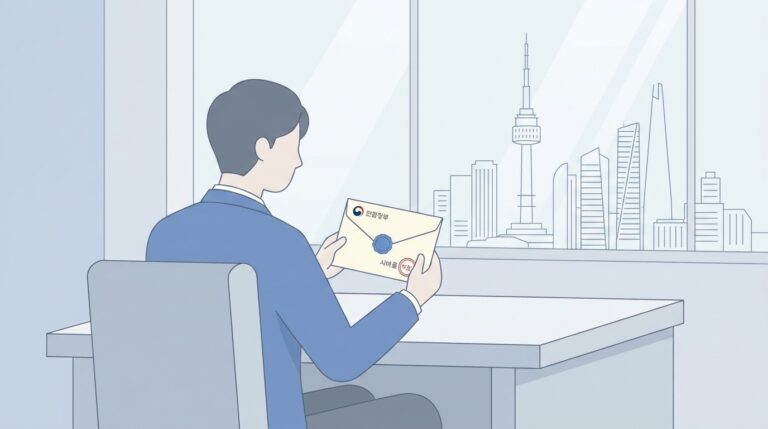
Imagine this: You are managing a creative agency or running a popular YouTube channel here in Seoul. You come home to your officetel after a long shoot, only to find a red slip from the Korean Post Office indicating a registered mail delivery (Naeyong-jeungmyeong, 내용증명). When you open it, the bold header hits you like a cold splash of water: 저작권 침해에 따른 경고 및 손해배상 청구 통지서 (Notice of Copyright Infringement and Claim for Damages) from a prominent law firm in Seocho-dong.
Your heart drops. In K-Dramas like Extraordinary Attorney Woo or Vincenzo, you’ve seen intense boardroom settlements, but facing one in real life inside Korea’s fast-paced digital IP ecosystem feels terrifying. Did using a 3-second sample of background music or an editorial screenshot just put you on the hook for millions of won?
Take a deep breath. Receiving a warning notice in Korea is often a standardized procedural opening move rather than an immediate court summons. With the right advanced (C2) legal register and strategic poise, you can assert your rights, prevent predatory settlement demands, and resolve the matter with composure. This masterclass is crafted from real case consultations and curated legal communications to give you the exact linguistic toolkit you need to navigate Korean IP law like a seasoned legal counselor.
Phase 2: Core Expressions Deep Dive (C2 Legal Mastery)
1. 내용증명을 정식으로 수령하였으며, 현재 법률 대리인과 함께 사실관계를 면밀히 검토 중에 있습니다.
- Pronunciation: Naeyong-jeungmyeong-eul jeongsik-euro suryeong-hayeosseumeo, hyeonjae beomnyul daeriin-gwa hamkke sasir-gwangye-reul myeonmilhi geomto jung-e itseumnida. (Sounds like: Nay-yong-jung-myung-eul jung-sheek-eu-roh soo-ryung…)
- Meaning: Literal: “I have formally received the certified notice and am currently reviewing the factual relations closely with legal counsel.” | Nuance: A calculated, unflappable response signaling that you will not be intimidated into an instant panic payout.
- K-Culture Moment: The classic opening rebuttal delivered by cool-headed in-house attorneys in legal dramas when facing aggressive corporate competitors.
- Editor’s Insight: In Korean legal etiquette, acknowledging receipt without admitting liability (사실관계 인정) is crucial. This sentence establishes formal parity between both parties.
- Situation Spectrum: Casual: 🚫 | Semi-formal: ⚠️ | Formal: ✅
- 🤔 Think About It: Notice how Korean formal dispute language relies on Sino-Korean nominal clauses (사실관계, 면밀히 검토). How does maintaining emotional detachment through syntax protect your negotiating position compared to your native language?
2. 해당 건은 저작권법상 정당한 범위 내의 공정이용(Fair Use) 및 인용에 해당함을 소명하고자 합니다.
- Pronunciation: Haedang geon-eun jeojakkwon-beopsang jeongdanghan beomwi nae-ui gongjeong-iyong mit in-yong-e haedang-hameul somyeong-hagoja hamnida. (Sounds like: Hae-dahng gun-eun juh-jahk-kwon-bup-sahng…)
- Meaning: Literal: “I wish to clarify/substantiate that the matter in question falls under fair use and legitimate citation within the lawful scope of the Copyright Act.” | Nuance: Substantive legal defense demonstrating complete familiarity with Article 28 and Article 35-5 of the Korean Copyright Act.
- K-Culture Moment: Used during intellectual disputes when content creators defend review videos or journalistic parodies against overzealous entertainment agencies.
- Editor’s Insight: 소명하다 (疏明) means to provide evidentiary explanation to dispel suspicion. It is a precise administrative and procedural term that commands immediate respect from legal teams.
- Situation Spectrum: Casual: 🚫 | Semi-formal: ⚠️ | Formal: ✅
- 🤔 Think About It: Why is asserting specific legal doctrines like 공정이용 (Fair Use) more effective in Korea than merely stating “I didn’t mean to copy it”?
3. 불필요한 법적 분쟁을 방지하고 상호 원만한 합의점을 도출하기 위해 실무 협의를 제안합니다.
- Pronunciation: Bul-piryohan beopjeok bunjaeng-eul bangji-hago sangho wonmanhan hab-uijeom-eul dochul-hagi wihae silmu hyeob-ui-reul jean-hamnida. (Sounds like: Bool-pee-ryo-hahn bup-juk boon-jaeng…)
- Meaning: Literal: “To prevent unnecessary legal disputes and derive a mutually amicable agreement point, I propose a working-level consultation.” | Nuance: A proactive offer to settle terms without litigation, setting a constructive boundary against extortionate demands.
- K-Culture Moment: The diplomatic compromise phase in commercial negotiations before formal filings take place.
- Editor’s Insight: In Korean civic and business dispute culture, demonstrating an open attitude toward 원만한 합의 (amicable settlement) reflects good faith (신의성실의 원칙), which judges look upon favorably if disputes escalate.
- Situation Spectrum: Casual: 🚫 | Semi-formal: ⚠️ | Formal: ✅
- 🤔 Think About It: How does Korean business culture balance uncompromising legal assertiveness with the relational art of leaving a bridge open for negotiation?
Phase 3: Textbook Korean vs. Real Native Korean
Situation 1: Responding to an allegation without prematurely admitting guilt
- 📖 교과서 한국어 (Textbook): 제가 잘못했는지 확인해 볼게요. 돈을 내야 하나요? (Let me check if I did something wrong. Do I have to pay?)
- 🗣️ 진짜 한국어 (Authentic Legal C2): 통지서의 주장 내용을 파악하였으며, 침해 여부에 대한 법적 타당성을 확인 후 공식 회신을 드리겠습니다. (I have noted the claims in the notice; a formal reply will follow upon verifying the legal validity regarding infringement.)
- 💡 왜 다를까?: Textbook phrasing inadvertently admits fault or signals financial vulnerability. Real legal communication separates acknowledging the claim from validating the infringement.
Situation 2: Challenging inflated settlement fees (합의금 헌팅)
- 📖 교과서 한국어 (Textbook): 청구 금액이 너무 비싸서 못 냅니다. 깎아주세요. (The claimed amount is too expensive. Please give me a discount.)
- 🗣️ 진짜 한국어 (Authentic Legal C2): 제시하신 손해배상 산정 근거가 통상적인 시장 라이선스 요율에 비추어 과다하므로 재산정이 필요하다고 판단됩니다. (The basis for damages presented appears excessive in light of standard market licensing rates, warranting recalculation.)
- 💡 왜 다를까?: Emotional bargaining weakens your stance. Advanced Korean challenges the methodology of damages calculation (손해배상 산정 근거).
Phase 4: K-Culture Deep Dive & Non-Verbal Manners
4-1. Nunchi (눈치) & Demeanor under Legal Pressure
- Written Formality over Quick Phone Calls: In Korea, phone confrontations often escalate emotions. Keep initial communications in written form (email or reply certified letter, 답변서). If on the phone, maintain a steady baritone, speak slowly, and use ending forms in -ㅂ니다/습니다.
- Physical Certified Mail Etiquette: When sending a formal reply, using the post office’s official 내용증명 service with three identical copies shows you understand Korean civil procedure.
4-2. Cultural Code: The Landscape of IP Settlements in Korea
Korea possesses one of the world’s most sophisticated digital copyright monitoring systems (often utilizing specialized automated crawler software run by boutique law firms). This has given rise to the phenomenon of 합의금 헌터 (settlement hunters) who target small creators and businesses with boilerplate cease-and-desist notices demanding 2,000,000 to 5,000,000 KRW for minor accidental font or thumbnail usage. Understanding this systemic background frees you from blind panic: it is a structured negotiation game.
Phase 5: Live Roleplay Scenario (C2 Level)
Setting: A formal conference call between Michael (Representative of a foreign digital agency in Hongdae) and Attorney Park (Legal counsel representing a Korean photography licensing firm).
- Turn 1 (Attorney Park): 🎭 정중하지만 사무적인 어조로 서류를 넘기며
“저희 법률사무소에서 발송한 저작권 침해 관련 내용증명은 검토해 보셨습니까? 기한 내 합의금 지급이 없을 시 형사고소로 전환될 예정입니다.”
(Have you reviewed the certified notice regarding copyright infringement sent by our law firm? If settlement is not paid by the deadline, we will proceed with criminal charges.) - Turn 2 (Michael): 🎭 침착하고 또박또박한 어조로 응대하며
“네, 변호사님. 발송해 주신 문건은 면밀히 검토하였습니다. 다만 본 건 게시물은 상업적 목적이 배제된 공정이용 범주에 해당한다고 판단하고 있습니다.”
(Yes, Counselor. We have thoroughly reviewed your document. However, we deem the post in question to fall under fair use without commercial intent.) - Turn 3 (Attorney Park): 🎭 약간의 압박을 가하며 반문하듯
“원작자의 명시적 허락 없이 전송된 이상, 무단 복제 및 전송권 침해에 해당한다는 대법원 판례가 명백히 존재합니다.”
(Since it was transmitted without explicit permission from the author, Supreme Court precedent clearly establishes this as unauthorized reproduction and transmission infringement.) - Turn 4 (Michael): 🎭 흔들림 없이 판례의 맥락을 짚으며
“말씀하신 취지는 이해하나, 당사는 보도 및 비평의 목적상 불가피하게 인용한 것이며 출처를 명확히 명기하였습니다.”
(I understand your point; however, our citation was inevitable for the purpose of reporting and critique, and the source was explicitly credited.) - Turn 5 (Attorney Park): 🎭 합의 가능성을 열어두며 톤을 누그러뜨리며
“그렇다 하더라도 원작자 측의 손해가 일부 발생했으므로, 원만한 종결을 위해 합의금 조정을 논의할 여지는 있습니다.”
(Even so, as the copyright holder suffered some loss, there is room to discuss adjusting the settlement sum for an amicable conclusion.) - Turn 6 (Michael): 🎭 합리적 데이터 중심의 태도로 전환하며
“당사 역시 소송 장기화는 원치 않습니다. 통상적인 디지털 이미지 1회 사용 라이선스 비용을 기준으로 합리적인 조정안을 서면 제시해 주시면 검토하겠습니다.”
(We also do not wish for prolonged litigation. If you provide a written adjustment proposal based on standard single-use digital license rates, we will review it.) - Turn 7 (Attorney Park): 🎭 동의하며 메모를 남기며
“알겠습니다. 합리적인 선에서 손해배상 산정 내역을 정리하여 명일 중으로 재송부해 드리겠습니다.”
(Understood. We will summarize the damages calculation at a reasonable level and resend it by tomorrow.) - Turn 8 (Michael): 🎭 정중하게 통화를 마무리하며
“네, 신속한 협의에 감사드립니다. 서면 수령 후 회신드리겠습니다.”
(Thank you for the prompt consultation. We will reply upon receipt of the document.)
🔀 Interactive Decision Point
If the attorney aggressively demands an instant oral wire-transfer agreement during the call, what should you say?
* Choice A (Risk): “지금 당장 계좌번호 주시면 절반 금액만 바로 송금하겠습니다.” (Send me the account now and I’ll wire half immediately.)
* Choice B (Best): “구체적인 합의 조건 및 권리 포기 조항이 명시된 서면 합의서 초안을 확인한 후 집행하겠습니다.” (I will execute payment after reviewing the draft written agreement stipulating specific terms and waiver of claims.)
* Choice C (Bad): “고소할 테면 마음대로 해보세요. 법정에서 뵙겠습니다.” (Sue me if you want. See you in court.)
- Feedback: Choice B is the C2 Master path. Never transfer money without a signed 합의서 (Settlement Agreement) containing a 처벌불원/민형사상 부제소 합의 (agreement not to file civil/criminal claims). Choice A waives legal leverage; Choice C triggers unnecessary criminal complaint escalation.
Phase 6: 10-Second Emotional Shadowing Drill
- Drill 1:
[침착하고 단호하게]
본 건에 대한 / 침해 고의성이 없었음을 / 명백히 밝히며, / 법적 절차에 앞서 / 원만한 소통을 희망합니다. - Drill 2:
[신중하고 정중하게]
요청하신 손해배상액의 / 구체적인 산출 근거를 / 서면으로 / 송부해 주시기 바랍니다.
Phase 7: K-Culture Mini Dictionary (Core Legal Terms)
- 내용증명 (Naeyong-jeungmyeong) | Certified Notice of Content | A registered postal verification by Korea Post documenting the exact text, sender, and delivery date. Used as preliminary evidence in civil disputes.
- 합의금 헌터 (Hab-uigeum Heonteo) | Settlement Hunter | Entities that aggressively scan the web for minor font/image infringements to coerce disproportionately large settlement payouts under threat of criminal suits.
- 소명자료 (Somyeong-jaryo) | Substantiating Evidence / Explanatory Materials | Official screenshots, purchase receipts, or fair-use records submitted to clear accusations.
- 부제소 합의 (Bujeso Hab-ui) | Covenant Not to Sue / Agreement of Non-Litigation | A vital settlement clause guaranteeing that neither party will raise future civil or criminal claims regarding the dispute.
Phase 8: Foreigner Survival Kit for Legal Disputes
- Survival Phrase 1: 저작권위원회 무료 상담을 통해 사실관계를 먼저 확인하겠습니다. (I will first verify the facts via free counseling at the Korea Copyright Commission.)
- Survival Phrase 2: 본 통지서에 명시된 주장에 동의하지 않으며, 서면 답변서로 갈음하겠습니다. (I do not agree with the claims in this notice; I will substitute my response with a written answer.)
- Survival Phrase 3: 한국저작권위원회의 분쟁조정 제도를 신청하고자 합니다. (I would like to apply for the dispute mediation system of the Korea Copyright Commission.)
- Editor’s Travel & Expat Note: Bookmark the Korea Copyright Commission Dispute Mediation Portal and utilize the Korea Legal Aid Corporation Consultation Booking. Foreign residents in Korea can receive free legal interpretation and consulting.
Phase 9: A Step Deeper (한 발 더 깊이)
In Anglo-American legal traditions, adversarial legal letters often immediately precede hard courtroom litigation. In contrast, Korean legal dispute culture frequently utilizes the criminal complaint process (형사 고소) alongside 내용증명 as strategic pressure to catalyze 합의 (mediation and private settlement). Understanding this relational dynamic allows you to view legal notices not as apocalyptic crises, but as highly formal invitations to structured negotiation under Korean administrative norms.
💬 Your Turn: Have you ever encountered unexpected copyright or licensing notices while creating content or working in Korea? Share your story or questions in the comments below!
Phase 10: FAQ & Common Mistakes
Q: Does receiving a 내용증명 mean I am already being sued in court?
A: No. A 내용증명 is simply post-office verification that a message was delivered. It does not carry court execution power by itself, but serves as formal documentation of intent.
Q: Can I be criminally punished for accidentally using a commercial font on a blog banner?
A: In principle, Korean courts have ruled that using a non-licensed font file (the program file .ttf) might involve copyright issues, but displaying the resulting rendered image often does not constitute criminal copyright infringement of the typeface design itself. Seek specialized counsel before paying settlement hunters.
Q: What is the official low-cost way to resolve copyright disputes without hiring an expensive lawyer?
A: You can file for official dispute mediation (분쟁조정) through the Korea Copyright Commission (한국저작권위원회), which offers neutral, legally binding mediation at a minimal fee.
🚨 Common Mistakes Alert (외국인 학습자의 흔한 실수 TOP 3)
- Ignoring the Letter Completely: Failing to reply can result in the claimant filing a formal police complaint (경찰 고소장 접수). Always acknowledge receipt in writing.
- Immediate Emotional Apology: Sending messages saying “정말 죄송합니다, 제가 몰랐습니다” can be legally submitted as an admission of copyright infringement (고의성 인정 증거).
- Paying Settlement without a Written Agreement: Transferring funds without a signed agreement (합의서) leaves you vulnerable to secondary claims by other copyright co-holders.
Phase 11: Action Missions
- 🥉 Bronze Mission (Solo Drill): Recite the 3 core legal expressions smoothly into your voice memo app using the shadowing pause marks.
- 🥈 Silver Mission (Social Check): Identify one digital media asset you frequently use (music, image, font) and research its Korean copyright classification status.
- 🥇 Gold Mission (Real-life Readiness): Draft a 3-sentence C2 formal response letter (답변서) assuming you received a bogus font notice.
- 🎮 K-Culture Mission: Watch an episode of a Korean legal drama (Extraordinary Attorney Woo, Law School, or Suits Korea) and spot the moment a character mentions 내용증명 or 합의서.
Phase 12: Interactive Quiz Challenge
📝 Question 1: Situational Judgment – When receiving a certified notice demanding 3 million won within 3 days, what is the best initial action?
Correct Answer: Verify the legitimacy of the copyright claim and send a formal written holding reply (검토 중 회신) while consulting the Korea Copyright Commission.
Explanation: Never panic-pay. Acknowledge receipt formally without admitting fault, and seek verified legal mediation.
📝 Question 2: Fill in the Blank – 저작권법상 보도, 비평, 교육 등을 위해 정당한 범위 내에서 이용하는 것을 [공정 _____]이라고 합니다.
Correct Answer: 이용 (공정이용 / Fair Use)
Explanation: 공정이용 (Fair Use, Article 35-5 of the Korean Copyright Act) allows lawful utilization of works under balanced conditions.
📝 Question 3: True or False – Once you wire settlement money (합의금), all legal disputes automatically terminate without any additional written paperwork.
Correct Answer: False (X)
Explanation: You must obtain a formal 합의서 containing a 부제소 합의 (covenant not to sue) and explicit withdrawal of any pending criminal complaints (고소 취하서).







