

Master Korean Slang: What Does ‘갑분싸 (Gapbunssa)’ Really Mean?
Phase 1: 공감 (Story-driven Opening)
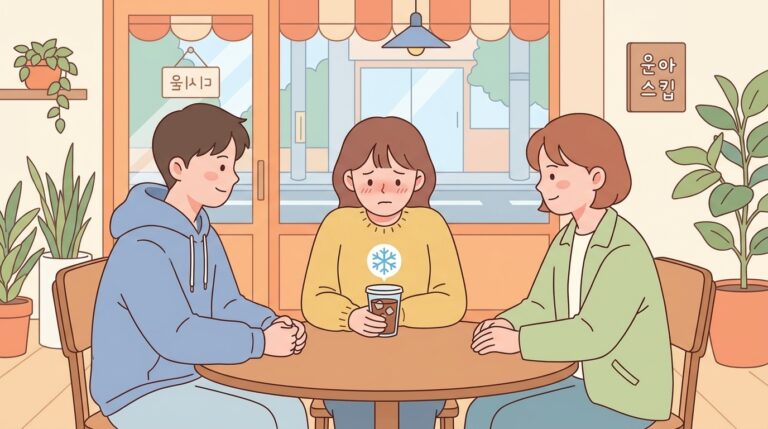
안녕하세요! 매일한글 에디터입니다. (Hello! I’m your Daily Hangul editor.) Have you ever been hanging out with Korean friends, laughing over delicious tteokbokki, when suddenly someone tells a joke that lands with a total thud? The room instantly turns icy cold, chopsticks freeze mid-air, and everyone avoids eye contact. In English, you might call this an “awkward silence” or a “vibe killer.” But in modern Korean, there is one ultimate slang word that everyone immediately whispers: 갑분싸 (Gap-bun-ssa).
Many beginner learners memorize textbook words like 조용하다 (to be quiet), but when real-life drama strikes in a Seoul cafe, textbooks leave you unprepared. Learning trendy abbreviations like 갑분싸 helps you instantly connect with native speakers and understand Korean variety shows (like Running Man or Knowing Bros). This guide is built directly from real student experiences to give you the confidence to navigate any social awkwardness like a local.
Phase 2: 핵심 표현 3선 심층 분석 (Top 3 Essential Expressions)
1. 갑분싸 (Gap-bun-ssa)
- Pronunciation: [Gap-bun-ssa] (Sounds like “Gop-boon-sah” with a sharp pop at the end)
- Meaning: Literal: Short for 갑자기 분위기 싸해짐 (Suddenly the atmosphere turns cold) | Real Nuance: “Buzzkill”, “Awkward silence”, or “Mood killer moment”.
- K-Culture Moment: On Korean variety shows, when an idol makes an unfunny dad joke, the screen suddenly freezes with cartoon wind and ice graphics, accompanied by the giant caption: 갑분싸.
- Editor’s Insight: It describes both the state of awkward silence and the action of ruining the party mood.
- Situation Spectrum: Casual ✅ | Semi-formal ⚠️ | Formal 🚫
- 🤔 Think About It: Why do Koreans place so much emphasis on group mood (bunwigi) compared to individual expression in your culture?
2. 분위기 메이커 (Bun-wi-gi Me-i-keo)
- Pronunciation: [Bun-wi-gi Me-i-keo] (Bun-wee-gee May-ee-ker)
- Meaning: Literal: Atmosphere maker | Real Nuance: “Life of the party” or the mood-booster.
- K-Culture Moment: In K-Dramas, the energetic best friend who brings people together and prevents awkward dates is always praised as the ultimate 분위기 메이커.
- Editor’s Insight: If you accidentally cause a 갑분싸, the 분위기 메이커 is the hero who steps up to save the day!
- Situation Spectrum: Casual ✅ | Semi-formal ✅ | Formal ⚠️
- 🤔 Think About It: Is there a specific person in your friend group whose designated role is keeping the energy high?
3. 썰렁하다 (Sseol-leong-ha-da)
- Pronunciation: [Sseol-leong-ha-da] (Sir-lung-ha-da with a tight ‘ss’ sound)
- Meaning: Literal: The weather/room is chilly | Real Nuance: “That joke fell flat” or “It’s so awkward it feels freezing.”
- K-Culture Moment: When a Korean comedian drops a weak punchline, other cast members will button up their coats and shiver, saying “아, 썰렁해! (Ah, it’s freezing!)”.
- Editor’s Insight: Pair this with 갑분싸 for dynamic conversation: “joke -> 썰렁하다 -> 갑분싸 outcome”.
- Situation Spectrum: Casual ✅ | Semi-formal ✅ | Formal 🚫
- 🤔 Think About It: How does your native language use temperature metaphors to describe social interactions?
Phase 3: 교과서 한국어 vs 진짜 한국어 (Textbook vs Real Korean)
Scenario 1: Describing a sudden awkward silence
* 📖 교과서 한국어 (Textbook): 갑자기 조용해졌어요. (Gap-ja-gi jo-yong-hae-jyeo-sseo-yo. / It suddenly became quiet.)
* 🗣️ 진짜 한국어 (Real-life Slang): 완전 갑분싸네요! (Wan-jeon gap-bun-ssa-ne-yo! / Totally ruined the mood!)
* 💡 왜 다를까? Textbook Korean is purely descriptive and flat, while 갑분싸 instantly captures the collective tension, emotion, and playful self-awareness of the room.
Scenario 2: Reacting to a bad joke
* 📖 교과서 한국어 (Textbook): 그 이야기는 재미없어요. (Geu i-ya-gi-neun jae-mi-eop-seo-yo. / That story is not funny.)
* 🗣️ 진짜 한국어 (Real-life Slang): 아, 썰렁해요… (Ah, sseol-leong-hae-yo… / Brr, that joke was chillingly bad…)
* 💡 왜 다를까? Saying “you are not funny” directly can sound confrontational in Korean culture; using temperature metaphors (썰렁하다) softens the critique playfully.
Phase 4: K-Culture 딥다이브 & 비언어적 매너 (Nunchi & Culture)
4-1. 눈치 (Nunchi) & Gestures
When 갑분싸 happens, body language speaks louder than words:
* Pupil Freeze: Native speakers often freeze their eyes wide open, glancing sideways at their neighbor to check their reaction (Nunchi mode activated).
* The Awkward Chuckle: A quiet, dry “하.하.하…” (Ha. Ha. Ha…) with two fingers touching the back of the neck or scratching the head.
* Saving the Mood: Wave your hand slightly and smile to break the tension without directly pointing fingers.
4-2. Cultural Code: The Power of ‘분위기 (Atmosphere)’ in Korean Society
In Korea, group harmony is paramount. A single joke isn’t evaluated purely on its logic, but on how well it maintains the group’s collective energy (분위기). Understanding 갑분싸 is not just about learning slang; it is your gateway to mastering Korean social intuition (눈치, Nunchi).
Phase 5: 실전 롤플레이 시나리오 (Interactive Roleplay)
Setting: A cozy chicken & beer (Chimaek) restaurant in Hongdae with Korean classmates Jiho and Minji.
- Jiho: 민지야, 어제 소개팅 어땠어? (Min-ji-ya, eo-je so-gae-ting eo-ttaess-eo? / Minji, how was your blind date yesterday?)
🎭 Smiling excitedly - Minji: 어… 그냥 그랬어. 사실 좀 별로였어. (Eo… geu-nyang geu-raess-eo. Sa-sil jom byeol-lo-yeoss-eo. / Uh… it was just okay. Actually, kind of bad.)
🎭 Looking down uncomfortably - You (Learner): [Your reaction here!]
- Jiho: 앗… 그렇구나… (At… geu-reoh-gun-a… / Oh… I see…)
🎭 Awkwardly sipping his drink - Minji: 분위기가 너무 조용해졌네… (Bun-wi-gi-ga neo-mu jo-yong-hae-jyeon-ne… / The mood got so quiet…)
- You: 갑분싸 만들어서 미안! (Gap-bun-ssa man-deul-eo-seo mi-an! / Sorry for killing the vibe!)
- Jiho: 아니야! 치킨 나왔다, 치킨 먹자! (A-ni-ya! Chi-kin na-wat-da, chi-kin meok-ja! / No worries! Chicken is here, let’s eat!)
🎭 Clapping hands to reset the energy - Minji: 좋아! 짠 하자! (Joh-a! Jjan ha-ja! / Good! Let’s clink glasses!)
🎭 Cheering up
🔀 인터랙티브 분기점 (Choose Your Response)
When the silence hits after Minji’s answer, what should you say?
- Option A: “완전 갑분싸네요! 치킨이나 먹어요!” (Wan-jeon gap-bun-ssa-ne-yo! Chi-kin-i-na meok-eo-yo! / Totally ruined the mood! Let’s just eat chicken!)
- 👉 Feedback [Best]: Excellent! Acknowledging the awkwardness with self-aware humor immediately diffuses the tension.
- Option B: “왜요? 그 남자가 못생겼어요?” (Wae-yo? Geu nam-ja-ga mot-saeng-gyeoss-eo-yo? / Why? Was the guy ugly?)
- 👉 Feedback [Bad]: Too intrusive and creates an even worse 갑분싸!
- Option C: (Keep silent for 1 minute while looking at your smartphone)
- 👉 Feedback [Risk]: Increases social distance and leaves the atmosphere frozen.
Phase 6: 10초 감정 섀도잉 드릴 (10-Second Emotion Shadowing Drill)
Practice reading these lines with real emotional pitch. Follow the / pauses:
[😅 뻘쭘하고 민망하게 / Embarrassed and sheepish]- 아… / 갑자기 / 분위기 / 갑분싸 됐네…
- (Ah… / gap-ja-gi / bun-wi-gi / gap-bun-ssa dwaen-ne…)
[🎉 밝고 유쾌하게 분위기 반전 / Brightly restoring the mood]- 괜찮아! / 내가 / 분위기 메이커 / 할게!
- (Gwaen-chan-a! / Nae-ga / bun-wi-gi me-i-keo / hal-ge!)
[🥶 장난스럽게 추워하며 / Playfully shivering]- 으 / 너무 썰렁해! / 에어컨 껐어?
- (Eu / neo-mu sseol-leong-hae! / E-eo-keon kkeoss-eo?)
Phase 7: K-Culture 미니 사전 (Mini Dictionary)
- 갑분싸 (Gap-bun-ssa): Sudden awkward silence or mood-killer moment.
- 분위기 (Bun-wi-gi): Atmosphere, vibe, or mood of a place/group.
- 눈치 (Nunchi): The art of sensing other people’s feelings and environmental vibes.
- 썰렁하다 (Sseol-leong-ha-da): Chilly; metaphorically used for unfunny jokes that freeze the room.
Phase 8: 여행자를 위한 생존 키트 (Traveler Survival Kit)
Top 3 Survival Expressions
- 분위기 좋아요! (Bun-wi-gi joh-a-yo! / The vibe here is great!) — Pro tip: Use this when entering a trendy cafe in Seongsu-dong.
- 장난이에요! (Jang-nan-i-e-yo! / Just kidding!) — Pro tip: Use this quickly if your joke causes a brief silence.
- 괜찮아요! (Gwaen-chan-a-yo! / It’s all good!) — Pro tip: The universal magic phrase to smooth over any minor hiccup.
Editor’s Travel Note
When exploring hot spots in Seoul, finding places with great vibes (분위기 맛집) is easy if you use local tools. Check restaurant reviews on the official 네이버 지도 앱 다운로드 page instead of relying solely on international apps, as locals leave real-time vibe ratings there.
Phase 9: “한 발 더 깊이” (Cultural Insight Essay)
In Western communication, an unexpected lull in conversation is often just seen as a gap in speech. In Korean communal culture, however, every gathering creates a shared energetic field called 분위기. A sudden silence is felt viscerally by everyone in the room. This makes terms like 갑분싸 humorous coping mechanisms: by naming the awkwardness aloud, everyone laughs, resets the tension, and restores harmony together.
💬 Your Turn: How does your culture handle sudden awkward silences in group conversations? Share your funniest story in the comments below!
Phase 10: FAQ & 오해 방지 (FAQ & Common Mistakes)
Q: Can I use ‘갑분싸’ with my Korean professor or boss?
A: No! 갑분싸 is strictly casual slang. Using it in formal settings will cause an actual 갑분싸. Use “분위기가 다소 무거워졌습니다 (The atmosphere has become a bit heavy)” in formal contexts instead.
Q: Is ‘갑분싸’ considered an insult?
A: It depends on the delivery. Between friends, it’s playful teasing. However, screaming it aggressively at someone can hurt their feelings.
Q: What is the opposite of ‘갑분싸’?
A: Koreans often use 갑분핫 (Gap-bun-hat) (Suddenly the mood becomes hot/hyped) or refer to a 분위기 메이커 (Mood maker).
🚨 흔한 실수 (Common Mistakes)
- Mistake 1: Using it with elders or business partners. ➔ Correct Action: Keep it strictly for friends and peers.
- Mistake 2: Mispronouncing ‘싸 (ssa)’ as soft ‘사 (sa)’. ➔ Correct Action: Pronounce the double consonant with sharp tension.
- Mistake 3: Using it when someone shares genuine sad news. ➔ Correct Action: Only use it for funny awkwardness, never during true grief or serious trouble.
Phase 11: 액션 미션 & 참여 유도 (Action Missions)
- 🥉 Bronze Mission: Practice saying 갑분싸 aloud 5 times with a dramatic gasp.
- 🥈 Silver Mission: Leave a comment below using 갑분싸 in a sentence!
- 🥇 Gold Mission: Spot the word 갑분싸 in a Korean YouTube variety show or K-Drama and comment the timestamp!
- 🎮 K-Culture Mission: Watch an episode of Running Man and count how many times caption ice effects appear when someone tells an unfunny joke.
Phase 12: 인터랙티브 퀴즈 챌린지 (Interactive Quiz)
Q1. What is the full form of the abbreviation ‘갑분싸’?
* A) 갑자기 분식집 싸움
* B) 갑자기 분위기 싸해짐
* C) 갑자기 분홍색 싸인펜
Q2. When is it appropriate to use ‘갑분싸’?
* A) During a formal job interview at Samsung.
* B) When hanging out with close friends and a bad joke causes silence.
* C) When paying for items at a convenience store.
Q3. [True / False] ‘썰렁하다’ only refers to cold weather and cannot be used for bad jokes.
👉 Click here to check the Answers & Explanations!
- Q1 Answer: B) 갑자기 분위기 싸해짐 (Suddenly the atmosphere turns cold).
- Q2 Answer: B) It is casual slang for friends, not formal business contexts.
- Q3 Answer: False! Koreans routinely say “썰렁해요” when a joke falls flat and freezes the room’s mood.







